7663 risultati
rif. 332256John Murray 1883. Crown 8vo pp. viii 487 32 advts; green cl bds paneled in blind spine lettered in gilt; edges sl deckled; VG light to moderate scuffing & soiling to bds; moderate to heavy bruising to spine & board edges & extrems with moderate chipping heavy to spine extrem at head lg open tear; moderate tanning foxing & soiling to pg edges; moderate tanning soiling & foxing to eps prelims & terminals; bookplate to front pastedown; heavy cracking to front hinge partially detatched from text block; moderate cracking to central gutters; light cracking to rear hinge; light foxing & moderate soiling throughout. Imprint dated 1878; publisher's advt. to rear dated 1883. John Murray 1883 unknown
2012rif. SKU1749962Academic Press 2012-11-20. hardcover. New. 8x1x11. New Book Ships with Tracking Academic Press hardcover

2012rif. New-May2-2017--17865Academic Press 2012-11-20. Hardcover. New. 0x0x0. New US Edition Textbook Ships with Emailed Tracking from USA Academic Press hardcover
2009rif. x-0521302080Cambridge University Press 2009. Hardcover. New. 1st edition. 808 pages. 9.06x6.38x1.73 inches. Cambridge University Press hardcover
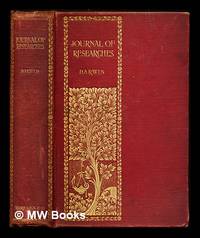
1845rif. 311707London: Ward Lock & Co 1845. 2nd edition. Hardcover. Previous owner's signature. Very good copy in the original gilt-blocked cloth. Title within ornamental borders. Frontispiece accompanied with a guard sheet. Spine bands and panel edges somewhat dulled and rubbed as with age. Remains quite well-preserved overall. Date is suggested. Physical description: 492p. illustrated. Notes: Includes publishers ads in the end. Includes index. Subjects: Beagle Ship: Natural history -- South America.Natural history -- Oceania. Natural History. Genre: Illustrated. London: Ward, Lock & Co hardcover
rif. 32038202-nnew. unknown
rif. 32038202like new. unknown
1875rif. mon0003756855New York: D. Appleton & Co. 1875. Hardcover. Good. . cover shows heavy wear and soilnig. pages tanned and clean. New York: D. Appleton & Co. hardcover
1985rif. 2311250012Cambridge University Press 1985. Hardcover. Good. 12 volume set. Partial set includes vols: 2 4-12 14-15. Bound in publisher's black cloth with green spine labels and gilt lettering. Hardcover. Good binding and cover. Light library stamps and markings. Contents: volume 2. 1837-1843; volume 4. 1847-1850; volume 5. 1851-1855; volume 6. 1856-1857; volume 7. 1858-1859. Supplement to the correspondence 1821-1857; volume 8. 1860; volume 9. 1861; volume 10. 1862; volume 11. 1863; volume 12. 1864; volume 14. 1866volume 15. 1867. This is an oversized or heavy book which requires additional postage for international delivery outside the US. Cambridge University Press hardcover
2016rif. 1-1107180570Cambridge Univ Pr 2016. Hardcover. New. 912 pages. 9.25x6.50x2.25 inches. Cambridge Univ Pr hardcover
2022rif. x-1009233564Cambridge Univ Pr 2022. Hardcover. New. 1022 pages. 9.41x6.50x2.52 inches. Cambridge Univ Pr hardcover
rif. 41458Med författarens tillåtelse öfversatt från tionde originalupplagan af G. Lindström. Landskrona : J. L. Törnqvists 1872. Octavo contemporary gilt-lettered qurter-calf over pebbled cloth edges rubbed and worn hinges slightly cracked pp. vii; 452; 18 advertisements ii text illustrations internally clean a very good copy. The first Swedish edition of Charles Darwin's Journal of researches into the natural history and geology of the countries visited during the voyage of H.M.S. Beagle round the world under the command of Capt. Fitz Roy translated from the ""tenth edition"" or 10th thousandth of 1860 see Freeman 20. Freeman 259 hardcover
rif. 41945London : John Murray 1890. Second edition revised and augmented. Twenty-seventh thousand. Octavo gilt-lettered green cloth very slightly marked light foxing to patterned endpapers pp. xvi; 693; blank 78 text illustrations a few leaves very slightly crumpled a fine copy. The second edition thirteenth issue of Darwin's important work on natural selection. As Freeman notes: the word 'evolution' occurs for the first time in any of Darwin's works on Page 2 of the first volume of the first edition before its appearance in the sixth edition of the 'Origin' in the following year. This edition includes the Supplemental Note on Sexual Selection in Relation to Monkeys Reprinted from Nature November 2 1876 p. 18. This first appeared in the 12th Thousand of 1877. Freeman 970. Â hardcover
2016rif. BN100274Darmstadt : Theiss Verlag 2016. 2016. Die Fahrt der Beagle : Darwins illustrierte Reise um die Welt. Die Fahrt der Beagle : Darwins illustrierte Reise um die Welt. Darmstadt : Theiss Verlag unknown
1875rif. 75850Torino: U.t.e. 1875. Cm. 26 pp. 509 3. Solida legatura coeva in mezza pergamena dorso liscio con fregi e titoli impressi. Esemplare particolarmente genuino e ben conservato. Seconda edizione italiana ma prima integrale non comune. U.t.e. unknown
186516 cm, brossura edtoriale con titolo e testo incorniciato, p. (I) 70. Antiporta inciso, illustrato da A. Colombo con una "Testa di Gorilla". De Filippi fu un grande sostenitore dell'evoluzionismo e con questa pubblicazione diffuse in italia le teorie darwiniane teorizzando e supportando scentificamente la discendenza dell'uomo dalle scimmie e scontrandosi con le teorie creazioniste. Dalla rprima pagina: " La infinitamente bella e grande varietà di forme di piante e di animali che popolano ora la superficie della terra, non è apparsa tutta insieme d’un sol getto, ma è stata preceduta da una successione di altre forme diverse, di altri mondi di viventi, che hanno lasciate, a documento della loro passata esistenza, spoglie più o meno complete negli strati della corteccia terrestre." Raro esemplare, conserva le copertine originali, dorso con piccolo rinforzo cartaceo, pagine in barbe ottimamente conservate.
1990rif. DADAX0521255910Cambridge University Press 1990-06-29. Illustrated. hardcover. New. 6.75x2.00x9.75. Buy with confidence. Excellent Customer Service & Return policy. Cambridge University Press hardcover
18978vo., with a portrait frontispiece (original tissue guard present) and 6 illustrations in the text, neat signature on half-title; original dark green, rhea hunt blocked in gilt on upper board, gilt back, patterned endpapers, joints lightly rubbed corners very lightly bruised, lower hinge starting (but binding entirely sound), a little age-worn else a very good, clean copy. With 32p publisher's catalogue (dated January 1898 and partially unopened) bound in at end. Quite apart from its scientific value, Darwin's first published work (1839) is an important travel work in its own right. This is essentially a re-issue of Murray's 1890 edition (Freeman 28) with the postscript incorporated in the text, but preserving the gilt 'rhea' hunt on upper board and gilt '3/6' on backstrip first seen in the 1889 edition (Freeman 21). In addition Captain Fitzroy's name is reset as 'Fitz Roy' on title. Freeman (Darwin), 49.
1915rif. 112663NY.: D. Appleton & Company 1915. Hardcover. Very Good/No Jacket. 8vo - over 7¾" - 9¾" Tall. Sixth edition Two volumes set. Specialy published by D. Appleton for the Brunswick subscription CO. Olive green color pebbled-cloth boards.Text unmarked. Charles Darwin's On the Origin of Species is a work of scientific literature which is considered to be the foundation of evolutionary biology. Its full title was On the Origin of Species by Means of Natural Selection or the Preservation of Favoured Races in the Struggle for Life. For the sixth edition of 1872 the short title was changed to The Origin of Species. Darwin's book introduced the scientific theory that populations evolve over the course of generations through a process of natural selection. It presented a body of evidence that the diversity of life arose by common descent through a branching pattern of evolution. Darwin included evidence that he had gathered on the Beagle expedition in the 1830s and his subsequent findings from research correspondence and experimentation. D. Appleton & Company hardcover
1930rif. 3794Brown grained cloth with gilt lettering on the spine. Embossed ship on front cover. On the Origin of Species or more completely On the Origin of Species by Means of Natural Selection or the Preservation of Favoured Races in the Struggle for Life published on 24 November 1859 is a work of scientific literature by Charles Darwin that is considered to be the foundation of evolutionary biology. Darwin's book introduced the scientific theory that populations evolve over the course of generations through a process of natural selection. The book presented a body of evidence that the diversity of life arose by common descent through a branching pattern of evolution. Darwin included evidence that he had collected on the Beagle expedition in the 1830s and his subsequent findings from research correspondence and experimentation. Various evolutionary ideas had already been proposed to explain new findings in biology. There was growing support for such ideas among dissident anatomists and the general public but during the first half of the 19th century the English scientific establishment was closely tied to the Church of England while science was part of natural theology. Ideas about the transmutation of species were controversial as they conflicted with the beliefs that species were unchanging parts of a designed hierarchy and that humans were unique unrelated to other animals. The political and theological implications were intensely debated but transmutation was not accepted by the scientific mainstream. The book was written for non-specialist readers and attracted widespread interest upon its publication. Darwin was already highly regarded as a scientist so his findings were taken seriously and the evidence he presented generated scientific philosophical and religious discussion. The debate over the book contributed to the campaign by T. H. Huxley and his fellow members of the X Club to secularise science by promoting scientific naturalism. Within two decades there was widespread scientific agreement that evolution with a branching pattern of common descent had occurred but scientists were slow to give natural selection the significance that Darwin thought appropriate. During "the eclipse of Darwinism" from the 1880s to the 1930s various other mechanisms of evolution were given more credit. With the development of the modern evolutionary synthesis in the 1930s and 1940s Darwin's concept of evolutionary adaptation through natural selection became central to modern evolutionary theory and it has now become the unifying concept of the life sciences. Charles Robert Darwin FRS FRGS FLS FZS 12 February 1809 – 19 April 1882 was an English naturalist geologist and biologist best known for his contributions to the science of evolution. His proposition that all species of life have descended from common ancestors is now widely accepted and considered a fundamental concept in science. In a joint publication with Alfred Russel Wallace he introduced his scientific theory that this branching pattern of evolution resulted from a process that he called natural selection in which the struggle for existence has a similar effect to the artificial selection involved in selective breeding. Darwin has been described as one of the most influential figures in human history and he was honoured by burial in Westminster Abbey. Darwin published his theory of evolution with compelling evidence in his 1859 book On the Origin of Species. By the 1870s the scientific community and a majority of the educated public had accepted evolution as a fact. However many favoured competing explanations which gave only a minor role to natural selection and it was not until the emergence of the modern evolutionary synthesis from the 1930s to the 1950s that a broad consensus developed in which natural selection was the basic mechanism of evolution. Darwin's scientific discovery is the unifying theory of the life sciences explaining the diversity of life. Darwin's early interest in nature led him to neglect his medical education at the University of Edinburgh; instead he helped to investigate marine invertebrates. Studies at the University of Cambridge Christ's College encouraged his passion for natural science. His five-year voyage on HMS Beagle established him as an eminent geologist whose observations and theories supported Charles Lyell's conception of gradual geological change and publication of his journal of the voyage made him famous as a popular author. Puzzled by the geographical distribution of wildlife and fossils he collected on the voyage Darwin began detailed investigations and in 1838 conceived his theory of natural selection. Although he discussed his ideas with several naturalists he needed time for extensive research and his geological work had priority. He was writing up his theory in 1858 when Alfred Russel Wallace sent him an essay that described the same idea prompting immediate joint publication of both of their theories. Darwin's work established evolutionary descent with modification as the dominant scientific explanation of diversification in nature. In 1871 he examined human evolution and sexual selection in The Descent of Man and Selection in Relation to Sex followed by The Expression of the Emotions in Man and Animals 1872. His research on plants was published in a series of books and in his final book The Formation of Vegetable Mould through the Actions of Worms 1881 he examined earthworms and their effect on soil Odhams Press, London. hardcover
1997rif. x-0762301309Jai 1997. Hardcover. New. 210 pages. 9.25x6.50x0.75 inches. Jai hardcover
2021rif. x-3030699390Humana Pr Inc 2021. Hardcover. New. 178 pages. 9.25x6.10x0.50 inches. Humana Pr Inc hardcover
1860rif. 32971New York: D. Appleton and Company 1860. 1st Edition Clamshell Collector's Case. 1st Edition Clamshell Collector's Case. Custom Clamshell Case. No Binding. First Edition Clamshell Case for Darwin's scientific breakthrough discoveries: ON THE ORIGIN OF SPECIES. Superb Custom Fitted Modern Collector's Clamshell Bookcase Not A Book HAND-CRAFTED by our conservation team each box is Gilt-stamped at the spine. The case is finished in black Nuba® with a 'sculpted' DNA design and gold sides. Every TBCL case can be finished in a selection of fine leathers & cloths or Nuba® or a combination of both. Nuba® is a fine supple & durable covering with a neutral ph that has the feel of velvety soft Italian Nubuck leather. This clamshell is perfectly sized to accommodate your first edition. A Terrific Collector's Custom Case for an important Book. TBCL Web Site photo/link available for OVER 100 generally in-stock titles. Custom Craft available upon request. "Book definitely NOT included" When you place your order: Please confirm the actual size of your first edition as sizes may vary with age. The text can be altered to add "signed" or other special requests.Sized to fit: 8" x 5.4" x 1.5". D. Appleton and Company unknown
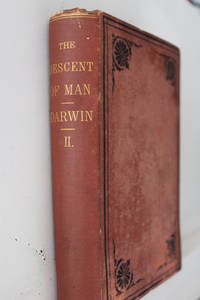
1871rif. 11131D. Appleton and Company 549 & 551 Broadway New York 1871. First American Edition 1871. Volume II only. Very Good Bound in the publisher's original brown cloth featuring a distinct black stamped circular/geometric design in the corners. Spine features bright un-faded gilt lettering and rules. 436 numbered pages beginning with 387 pages ending in concluding remarks followed by 388–436 comprehensive index. Rear advertisements feature a detailed catalog of scientific works including Herbert Spencer First Principles Social Statics Principles of Biology Sir John Lubbock Origin of Civilisation and Huxley. Binding is tight square and structurally sound. Hinges are firm with no split webbing. The bright gilt on the spine remains highly legible and attractive. Text block is clean and free of foxing or writing. The exterior brown cloth shows minor uniform surface rubbing to the faces of the boards and typical light shelfwear to the spine ends but otherwise presents as a remarkably clean crisp copy of this foundational scientific work. An excellent orphan volume for a collector looking to complete a set or secure a premium early American printing. D. Appleton and Company hardcover
1998rif. 1143330The Easton Press 1998. Hard cover. Near fine/No jacket. Collectors edition. Leather bound with gilded edges. Includes Vol 1 & 2 only. Both Vols: Book is in excellent condition with no visible flaws apart from some light handling wear. Binding is tight and inside is clean and unmarked. The Easton Press unknown