DARWIN, Charles (1809-1882)Biblio.com

7.637 Ergebnisse
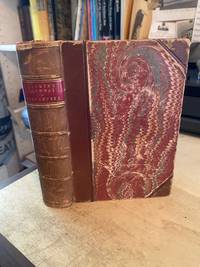
Best.-Nr. 42926/ by Charles Darwin ; with photographic and other illustrations. London : John Murray 1872. First edition second impression. Octavo modern binding of quarter crushed morocco over marbled papered boards vellum tips to corners spine in compartments with two contrasting Morocco title labels lettered and ruled in gilt contemporary owner's name to title page pp. vi 374 4 advertisements dated November 1872 with photographic heliotype plates and wood-engraved illustrations in the text; occasional spots of foxing a few quirked unopened the contents are clean a very good copy of the first edition. Freeman 1142. hardcover
Best.-Nr. 49890by means of natural selection or the preservation of favoured races in the struggle for life. London : John Murray 1891. Sixth edition with additions and corrections forty-first thousand. Octavo original publisher's gilt-lettered green cloth edges slightly rubbed small stain to lower board small nicks to head and foot of spine original patterned endpapers foxed neat owner's name dated 1946 small snag to head of half-title pp xxi blank 432 1 - publisher's catalogue folding lithographed plate some foxing to preliminaries and a couple of leaves but a very good crisp copy uncommonly so. A very good copy of the sixth edition of one of the most important texts in the history of science. The first edition a great rarity is described in Freeman as "". the most important biological work ever written.""; Dibner "". the most important single work in science.""; Printing & the Mind of Man "". revolutionized our methods of thinking and our outlook on the natural order of things. The recognition that constant change is the order of the universe had been finally established and a vast step forward in the uniformity of nature had been taken."" Â hardcover
Best.-Nr. 49891by means of natural selection or the preservation of favoured races in the struggle for life. London : John Murray 1892. Sixth edition with additions and corrections forty-third thousand. Octavo original publisher's gilt-lettered green cloth corners a little rubbed slightly bruised at head and foot of spine small stain to lower board original endpapers lightly foxed pp xxi blank 432 folding lithographed plate. A very good copy. A very good copy of the sixth edition of one of the most important texts in the history of science. The first edition of 1859 a great rarity is described in Freeman as "". the most important biological work ever written.""; Dibner "". the most important single work in science.""; Printing & the Mind of Man "". revolutionized our methods of thinking and our outlook on the natural order of things. The recognition that constant change is the order of the universe had been finally established and a vast step forward in the uniformity of nature had been taken."" The sixth edition extensively rewritten by Darwin and published in 1872 removed the word 'On' from the title 'On the origin of species' and includes rebuttal of Roman Catholic biologist St. George Mivart's theological arguments in his 1871 text On the Genesis of Species. The sixth edition is significant for including the use of the word 'evolution' for the first time in furtherance of Darwin's argument for natural selection. It is the last edition published in Darwin's lifetime and includes extensive revisions and rewriting by the author. The sixth edition went through numerous printings and includes all Darwin's revisions since On the origin of species was first released in 1859. It is considered the definitive text for what many consider to be the most significant scientific book ever published. Freeman 439 hardcover
1845Best.-Nr. 59290John Murray London 1845. Second Edition. Hardcover Half Leather. Good Condition. Size: 12mo - between 6¾ - 7¾" tall. viii 520pp. Front hinge cracking. Minor wear to spine with slight loss to top. Slight foxing front/rear pages but body of book mostly clean and unfoxed. Previous owner's book-plate laid in. Covers worn. Corners bumped. Illustrated. Quantity Available: 1. Shipped Weight: Under 1 kilogram. Category: Natural History & Resources; 19th century; Geography & Maps. Pictures of this item not already displayed here available upon request. Inventory No: 59290. . John Murray hardcover
1860Best.-Nr. 7701London: John Murray 1860. 8vo pp. xv i 519 1 32 ads. Original green cloth by Edmonds & Remnants boards blocked in blind spine blocked in gilt brown endpapers. A little minor spotting contents leaves toned. Extremities bumped spine darkened and torn at head boards a little marked and endpapers rubbed. Newspaper clipping tipped to front flyleaf. An early issue of the definitive edition of Darwin’s first published book containing his final additions to the text. Originally published in 1839 the extensively revised second edition followed in 1845 and was reprinted several times all in a small-format Colonial and Home Library series. For this edition the stereotypes of the text are printed on larger paper and Darwin adds a new postscript; the whole is then bound to match the early editions of the Origin of Species so giving ‘the whole book a much better appearance’ Freeman. In this copy the ads at the rear are dated January 1863 - in the earliest copies they were December 1861 and Freeman notes they can be as late as September 1868. The next printing was 1870. Freeman F20. John Murray hardcover
1878Best.-Nr. 14399London; John Murray Albemarle Street 1878. 1878. Second Edition. Octavo pp. viii 487 32 of publisher's catalogue to end 1 diagram and 109 tables within text. Publisher's original green cloth blind-stamped frame to boards titled in gilt to spine. Top edge and fore-edges of select pages untrimmed. Elegant bookplate of All Nations Bible College London to front paste-down. Underlining to first page. Corners slightly rubbed top edge a little dusty. A very good copy. The result of an offshoot of Darwin's work on natural selection and evolution. The author performed experiments which demonstrated that plants which self-fertilized were weaker than those which cross-fertilized. Freeman 298. London; John Murray, Albemarle Street, 1878. hardcover
1877Best.-Nr. AQ28345London: John Murray 1877. xvi 300 32pp. With a terminal publisher's advertisement catalogue. Original publisher's green cloth stamped in gilt and blind. Recased with new endpapers. Housed in modern green morocco-backed clamshell case. Extremities rubbed and a trifle marked. Scattered spotting. The second edition revised and significantly enlarged from the first of 1862 of Darwin's first detailed demonstration of his theory of evolution through natural selection analysing how complex ecological relationships resulted in the coevolution of orchids and insects. Freeman 801. Second edition revised. 8vo. John Murray hardcover
Best.-Nr. alb98d3e2221b64a7a8The Convolutee of Eight Books: Seven Books in the JZL series, The Lives of Great Men: F. Pavlenkos Biographical Library: Newton: C. Darwin: Em Kant: Auguste Comte: A. Schopenhauer: Adam Smith: D. S. Mill In Russian /Konvolyut vosmi knig: semi knig serii «ZhZL, Zhizn zamechatelnykh lyudey: Biograficheskaya biblioteka F. Pavlenkova»: Nyuton: Ch. Darvin: Em. Kant: Ogyust Kont: A. Shopengauer: Adam Smit: D.S. Mill With the appendix of the book: Lewis J. G. Emmanuel Immanuel Kant. His Life and Historical Meaning 1892-1897. The Convolutee of Eight Books: 1) Philip M. Newton. His Life and Scientific Activities: A Biographical Essay. With Newtons portrait engraved in Leipzig by Gedan. St. Petersburg: Typography and Chromolythography by A. Transchel, 1892. 80 p. We have thousands of titles and often several copies of each title may be available. Please feel free to contact us for a detailed description of the copies available. SKUalb98d3e2221b64a7a8.
Best.-Nr. 7655P., Reinwald, 1875, un volume in 8 relié en pleine toile verte éditeur, (2-faux-titre et titre), 8pp., 552pp., quelques figures dans le texte,,20pp.(catalogue de l'éditeur)
1882Best.-Nr. 94485Paris, C. Reinwald, 1882, in-8, [2]-XXVI-599 pp, 20 pp. de cat. éd, Percaline verte de l'éditeur, Première édition française, traduite de l'anglais annotée et augmentée d'une préface par le Dr. Edouard Heckel, directeur du Muséum d'histoire naturel de Marseille en 1879. Nombreuses figures sur bois dans le texte. Ce livre a été conçu par Darwin comme une extension de son ouvrage sur les plantes grimpantes, visant à montrer que les mêmes stratégies de croissance se retrouvaient ailleurs dans le règne végétal. La première édition est parue le 6 novembre 1880. Charles Darwin, qui faisait l'analogie entre les règnes végétal et animal, a consacré aux plantes plusieurs grandes monographies. L'observation du végétal lui a permis de déduire des phénomènes de changement et donc de développer la théorie transformiste. Légers frottements. Quelques rousseurs sur les premiers et derniers feuillets. Couverture rigide
1871Best.-Nr. 023041New York: D. Appleton and Co 1871. Octavo. . 5th edition with additions and corrections. Half-title 447pp. 8pp. publisher's ads. Darwin's work introduced the scientific theory that populations evolve over the course of generations through a process of natural selection. Bound in publisher's brown pebble grained embossed cloth spine lettering faded yellow endpapers marginal faint damp stain to lower corners not affecting text wear to spine ends. Previous owner's name E. K. Boyle dated 1871 who was a prominent lawyer of Belfast Maine. A very good copy. D. Appleton and Co unknown
1872Best.-Nr. 60122London and New York, Macmillan and Co., 1872. Royal8vo. In publisher's original red embossed cloth. In ""Nature. A Weekly Illustrated Journal of Science"", Vol. 6, May-October 1872. Stamp to title-page and p. 1 and ex-libris pasted on to pasted down front end-paper. Binding with wear and light soiling, spine loose and missing part of cloth to upper part.. Internally fine and clean. Darwin's paper (co-author): 211-216" P. 279. [Entire volume: XII, 548 pp].
1874Best.-Nr. 60115London and New York, Macmillan and Co., 1874. Royal8vo. In a bit later full green cloth. In ""Nature. A Weekly Illustrated Journal of Science"", Vol. 10, May 1874 - October 1874. Stamp to title-page and ex-libris pasted on to pasted down front end-paper. Stamps to front free end paper. Traces from book block having been bended. Darwin's paper: Pp. 24-25. [Entire volume: XI, (1), 534 pp].
1872Best.-Nr. 53225Torino, Tipografico-Editrice Torinese, (1872). Large8vo. In publisher's original full green cloth. Embossed title with gilt lettering to spine and front board. Corners of binding bumped and lower part of back hindge with a small tear. An overall very fine and clean copy. (2), 464 pp.
1921Best.-Nr. 53616Madrid, Calpe, (1921 & 1922) 8vo. Bound in one half calf binding with four raised bands. Spine with wear, otherwise a fine copy. X, (6), 361, VIII, 359, (3) pp. + 1 folded map.
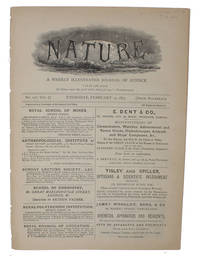
1873Best.-Nr. 60132London, 1873. Small folio. Extracted, with traces from the sewn cords, in the original printed wrappers. In ""Nature"", No. 172, Vol. 7, February 13. Entire issue offered. Issue split in two, otherwise fine and clean. Housed in a portfolio with white paper title-label to front board. Darwin's notice: P. 281 [Entire issue: Pp. (1), lx, 277-296].
1872Best.-Nr. 52355Stockholm, Albert Bonniers, 1872. 8vo. 2 volumes in one (as issued) contemporary half calf binding with gilt lettering to spine. A fine and clean copy. (Frontiespiece), (1), 314, (2) pp."" (4), XV, (1), 294, (6), 39 pp.
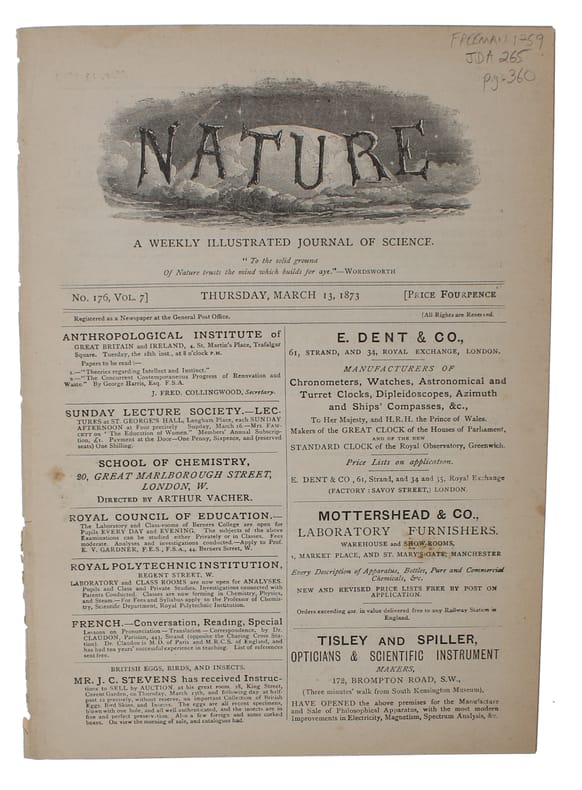
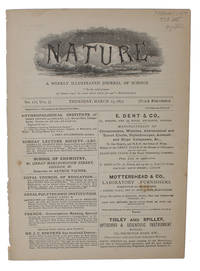
1873Best.-Nr. 60131London, 1873. Small folio. Extracted, with traces from the sewn cords, in the original printed wrappers. In ""Nature"", No. 176, Vol. 7, March 13. Entire issue offered. Issue split in two, otherwise fine and clean. Housed in a portfolio with white paper title-label to front board. Darwin's notice: P. 360. [Entire issue: Pp. (1), lxxxvi-xcii, 357-376].
1874Best.-Nr. 60115London and New York Macmillan and Co. 1874. Royal8vo. In a bit later full green cloth. In "Nature. A Weekly Illustrated Journal of Science" Vol. 10 May 1874 - October 1874. Stamp to title-page and ex-libris pasted on to pasted down front end-paper. Stamps to front free end paper. Traces from book block having been bended. Darwin's paper: Pp. 24-25. Entire volume: XI 1 534 pp. First appearance of Darwin's paper on Primrose flowers. Primrose flowers and the flowers of related members of the Primulaceae are often removed from their stalks and scattered on the ground by green finches apparently consuming the ovaries and nectaries - here first described by Darwin. Freeman 1771 hardcover
1872Best.-Nr. 60122London and New York Macmillan and Co. 1872. Royal8vo. In publisher's original red embossed cloth. In "Nature. A Weekly Illustrated Journal of Science" Vol. 6 May-October 1872. Stamp to title-page and p. 1 and ex-libris pasted on to pasted down front end-paper. Binding with wear and light soiling spine loose and missing part of cloth to upper part. Internally fine and clean. Darwin's paper co-author: 211-216; P. 279. Entire volume: XII 548 pp. First publication of these two short notices by Darwin. Freeman 1937 & 1756. hardcover
1921Best.-Nr. 53616Madrid Calpe 1921 & 1922 8vo. Bound in one half calf binding with four raised bands. Spine with wear otherwise a fine copy. X 6 361 VIII 359 3 pp. 1 folded map. First complete Spanish translation of Darwin's "Journal of Researches": "La única que completa e intacta se ofrece en castellano" From the introduction to the present work. The work now now known as Voyage of the Beagle was Darwin's first published book. As Darwin later recalled in his autobiography 'The voyage of the Beagle has been by far the most important event in my life and has determined my whole career'. "On its first appearance in its own right also in 1839 it was called Journal of researches into the geology and natural history etc. The second edition of 1845 transposes 'geology' and 'natural history' to read Journal of researches into the natural history and geology etc. and the spine title is Naturalist's voyage. The final definitive text of 1860 has the same wording on the title page but the spine readsNaturalist's voyage round the world and the fourteenth thousand of 1879 places A naturalist's voyage on the title page. The voyage of the Beagle first appears as a title in the Harmsworth Library edition of 1905. It is a bad title: she was only a floating home for Darwin on which in spite of good companionship he was cramped and miserably sea-sick; whilst the book is almost entirely about his expeditions on land." Freeman.Freeman 252.Blanco & Llorca: 5 Blanco & Llorca: Bibliogrfía crítica illustrada de las obras de Darwin en españa 1857-2005. hardcover
1872Best.-Nr. 53225Torino Tipografico-Editrice Torinese 1872. Large8vo. In publisher's original full green cloth. Embossed title with gilt lettering to spine and front board. Corners of binding bumped and lower part of back hindge with a small tear. An overall very fine and clean copy. 2 464 pp. First Italian translation of Darwin's Journal of researches now known as Voyage of the Beagle being his first published book. As Darwin later recalled in his autobiography 'The voyage of the Beagle has been by far the most important event in my life and has determined my whole career'. "On its first appearance in its own right also in 1839 it was called Journal of researches into the geology and natural history etc. The second edition of 1845 transposes 'geology' and 'natural history' to read Journal of researches into the natural history and geology etc. and the spine title is Naturalist's voyage. The final definitive text of 1860 has the same wording on the title page but the spine readsNaturalist's voyage round the world and the fourteenth thousand of 1879 places A naturalist's voyage on the title page. The voyage of the Beagle first appears as a title in the Harmsworth Library edition of 1905. It is a bad title: she was only a floating home for Darwin on which in spite of good companionship he was cramped and miserably sea-sick; whilst the book is almost entirely about his expeditions on land." FreemanThe first edition appeared in German in 1844 at the instigation of Baron von Humboldt and the second in Danish French German Italian Russian and Swedish in Darwin's lifetimeFreeman 211 hardcover
1873Best.-Nr. 60132London 1873. Small folio. Extracted with traces from the sewn cords in the original printed wrappers. In "Nature" No. 172 Vol. 7 February 13. Entire issue offered. Issue split in two otherwise fine and clean. Housed in a portfolio with white paper title-label to front board. Darwin's notice: P. 281 Entire issue: Pp. 1 lx 277-296. First appearance of Darwin's comment on Dr. Huggins' letter containing an account of three generations of dogs which exhibited fright when in the vicinity of a butcher or butcher's shop an observation which Darwin considered of the utmost importance: "The following letter seems to me so valuable and the accuracy of the statements vouched for by so high an authority that I have obtained permission from Dr. Huggins to send it for publication" From the present publication. Freeman 1757 unknown
1872Best.-Nr. 52355Stockholm Albert Bonniers 1872. 8vo. 2 volumes in one as issued contemporary half calf binding with gilt lettering to spine. A fine and clean copy. Frontiespiece 1 314 2 pp.; 4 XV 1 294 6 39 pp. The rare first Swedish translation of "The Descent of Man" translated by Rudolf Sunderström. Freeman's collation is incorrect as he also dated the first Swedish translation of "Origin of Species" wrongly.Withbound is Lawrence Heap Åberg's "Ett försök att uppvisa darwinismens öfverensstämmelse med en rationelt idealistisk verldsåskådning" 1874. Freeman 1136 unknown
1873Best.-Nr. 60131London 1873. Small folio. Extracted with traces from the sewn cords in the original printed wrappers. In "Nature" No. 176 Vol. 7 March 13. Entire issue offered. Issue split in two otherwise fine and clean. Housed in a portfolio with white paper title-label to front board. Darwin's notice: P. 360. Entire issue: Pp. 1 lxxxvi-xcii 357-376. First appearance of Darwin' comment on Aldred Wallace's suggestion that animals find their way home by recognising the odour of the places which they have passed. In the comment Darwin describes the following anecdote: "Many years ago I was on a mail-coach and as soon as we came to a public-house the coachman pulled up for the fraction of a second. He did so when we came to a second public-house and I then asked him the reason. He pointed to the off-hand wheeler and said that she had been long completely blind and she would stop at every place on the road at which she had before stopped. He had found by experience that less time was wasted by pulling up his team than by trying to drive her past the place for she was contented with a momentary stop. After this I watched her and it was evident that she knew exactly before the coachman began to pull up the other horses every public-house on the road for she had at some time stopped at all. I think there can be little doubt that this mare recognised all these houses by her sense of smell." From the present paper. Freeman 1759 unknown