DARWIN, CharlesBiblio.com

7637 risultati
rif. 97749London John Murray 1868. . First edition second issue; 2 vols 8vo; engravings throughout the text single leaf of publisher's ads at the end of each volume bookplates of Cyril Frampton contents faintly toned; original green cloth titles to spine gilt boards blocked in blind black coated endpapers recased with the joints hinges corners and spine ends repaired some spots and marks to the cloth very good condition; 411 & 486 pp. First edition second issue of the work in which the phrase 'survival of the fittest' appeared for the first time. The Variation of Animals and Plants Under Domestication was 'the only section of Darwin's big book on the origin of species which was printed in his lifetime and corresponds to the first two intended chapters' Freeman p. 122. 'With detailed facts and lengthy discussion the work includes what Darwin believed to be new ideas of pangenesis but the topics of sexual selection and human evolution were excluded from these already thick volumes. Despite their size the works sold briskly Desmond & Moore Darwin p.550. After running through the first issue in just a week Freeman John Murray produced a second issue with several variations between the two. In the first the imprint is printed on a single line on the spine while it is broken on to two lines in the second as here. Numerous errata also appear in the first issue most of which were corrected in the second. A second edition of 1875 bears even greater alterations to the text as well as being reduced in size to a crown octavo. Freeman 877. London, John Murray, 1868. hardcover
rif. 63615. A folio sheet of Whatman hand-made paper folded to four pages the announcement on the first two pages signed at the top margin of the first side by GEORGE V and on the verso by EDWARD P both signatures lithographed dated June 3 1918 the sheet now folded horizontally with a printed leaf from the Central Chancery at St. James's Palace and the posting envelope to Sir Horace Darwin K.B.E. The Orchard Cambridge PLUS a typed letter signed by DAVID LLOYD GEORGE from 10 Downing Street : Sir I have the honour to inform you that the King has been pleased to approve that you should receive the honour of Knight Commander of the Order of the British Empire in recognition of the valuable services you have rendered to the nation in connection with the war.' dated May 27 1918 with postal envelope. SIR HORACE DARWIN 1851-1928 born in Down House in 1851 the fifth son and ninth child of Charles Darwin and his wife Emma and the youngest of their seven children who survived to adulthood. He was educated at a private school in Woodbridge Suffolk and at Trinity College Cambridge where he graduated BA in 1874. He founded the Cambridge Scientific Instrument Company in 1885 and was Mayor of Cambridge between 1896 and 1897. He was elected a Fellow of the Royal Society in 1903 and was knighted in 1918. unknown
1998rif. 28815Westport Connecticut U.S.A.: Praeger Pub Text. New. 1998. Hardcover. 0275961281 . FREE UPGRADE to Courier/Priority Shipping Upon Request - IN STOCK AND IMMEDIATELY AVAILABLE FOR SHIPMENT - -- with a bonus offer-- . Praeger Pub Text hardcover
1846rif. 371065New York: Harper & Brothers 1846. First American edition. 2 vols. Small 8vo. Publisher's cloth spine chipped with loss wityh blindstamps on title-page from GTS. First American edition. 2 vols. Small 8vo. First American edition of Darwin's important first published book containing the observations and field work that form the basis for On the Origin of Species. "The five years of the voyage were the most important event in Darwin's intellectual life and in the history of biological science. Darwin sailed with no formal scientific training. He returned a hard-headed man of science knowing the importance of evidence almost convinced that species had not always been as they were since the creation but had undergone change. The experiences of his five years in the Beagle how he dealt with them and what they led to built up into a process of epoch-making importance in the history of thought" DSB. Darwin's Journal "his first published book is undoubtedly the most often read" Freeman 31. It is "one of the most interesting records of natural history exploration ever written and is one of the most important for it was on this voyage that Darwin prepared for his lifework ultimately leading to The Origin of Species" Hill I 104-5. First published in 1839 as "the third volume of The Narrative of the Voyages of H.M. Ships Adventure and Beagle edited by Captain Robert Fitzroy. Since then it has changed its name four times so that today it is universally referred to as The Voyage of the Beagle. On its first appearance in its own right also in 1839 it was called Journal of Researches into the Geology and Natural History etc. The second edition of 1845 transposes 'Geology' and 'Natural History'. and the spine title is Naturalist's Voyage" Freeman 32. This first American edition is based on that 1845 second London edition. Issued as Harper's New Miscellany Volumes X and XI. Freeman 16; Sabin 18647 Harper & Brothers unknown
1876rif. 6383London: John Murray 1876. First edition. Fine. Octavo 20 cm; viii 482 pages. Advertisements for other works of the author on the verso of the title 3-line errata slip tipped in prior to Chapter One. Original cloth. Owner's name in ink and old bookseller notations in pencil on front free endpaper. Else a fine copy in remarkably fresh condition. Reference: Freeman 1249. In his eye-opening re-appraisal of Darwin's botanical books Oliver Sachs wrote that Darwin's botanical studies were "engines of war great missles of evidence lobbed at the skeptics of his theory of natural seledtion" The River of Consciousness. Sachs observes that the botanical studies are "even more overwhelming" than the author's magnum opus The Origin of Species in its presentation of natural seledtion as the basic fact of evolution. John Murray hardcover
1868rif. 151873London: John Murray 1868. First edition first issue of Darwin's hypothesis of pangenesis in which he first uses the phrase "survival of the fittest" for the first time. First issue without publisher's advertisements errata with five items in six lines in the first volume on page vi and nine items in seven lines in the second volume on page viii. Octavo two volumes bound in full contemporary calf with titles and tooling to the spine double gilt ruling to the front and rear panels all edges marbled marbled endpapers illustrated with numerous in-text illustrations and a chart. In very good condition bookplates to the front pastedowns. Darwin's Variation Under Domestication “took up in detail that subject which had been confined to one chapter of the Origin. It contained Darwin’s hypothesis of pangenesis by means of which he tried to frame an explanation of hereditary resemblance inheritance of acquired characters atavism and regeneration. It was a brave attempt to account for a number of phenomena which were beyond the bounds of scientific knowledge in his day such as fertilization by the union of sperm with egg the mechanism of chromosomal inheritance and the development of the embryo by successive cell division. His hypothesis of pangenesis could not therefore give a permanently acceptable account of the multitude of phenomena it was designed to explain. It was however a point of departure for particulate theories of inheritance in the later 19th century” DSB. John Murray unknown
1846rif. 371065New York: Harper & Brothers 1846. First American edition. 2 vols. Small 8vo. Publisher's cloth spine chipped with loss wityh blindstamps on title-page from GTS. First American edition. 2 vols. Small 8vo. First American edition of Darwin's important first published book containing the observations and field work that form the basis for On the Origin of Species. "The five years of the voyage were the most important event in Darwin's intellectual life and in the history of biological science. Darwin sailed with no formal scientific training. He returned a hard-headed man of science knowing the importance of evidence almost convinced that species had not always been as they were since the creation but had undergone change. The experiences of his five years in the Beagle how he dealt with them and what they led to built up into a process of epoch-making importance in the history of thought" DSB. Darwin's Journal "his first published book is undoubtedly the most often read" Freeman 31. It is "one of the most interesting records of natural history exploration ever written and is one of the most important for it was on this voyage that Darwin prepared for his lifework ultimately leading to The Origin of Species" Hill I 104-5. First published in 1839 as "the third volume of The Narrative of the Voyages of H.M. Ships Adventure and Beagle edited by Captain Robert Fitzroy. Since then it has changed its name four times so that today it is universally referred to as The Voyage of the Beagle. On its first appearance in its own right also in 1839 it was called Journal of Researches into the Geology and Natural History etc. The second edition of 1845 transposes 'Geology' and 'Natural History'. and the spine title is Naturalist's Voyage" Freeman 32. This first American edition is based on that 1845 second London edition. Issued as Harper's New Miscellany Volumes X and XI. Freeman 16; Sabin 18647 Harper & Brothers unknown books
1876rif. 6383London: John Murray 1876. First edition. Fine. Octavo 20 cm; viii 482 pages. Advertisements for other works of the author on the verso of the title 3-line errata slip tipped in prior to Chapter One. Original cloth. Owner's name in ink and old bookseller notations in pencil on front free endpaper. Else a fine copy in remarkably fresh condition. Reference: Freeman 1249. In his eye-opening re-appraisal of Darwin's botanical books Oliver Sachs wrote that Darwin's botanical studies were "engines of war great missles of evidence lobbed at the skeptics of his theory of natural seledtion" The River of Consciousness. Sachs observes that the botanical studies are "even more overwhelming" than the author's magnum opus The Origin of Species in its presentation of natural seledtion as the basic fact of evolution. John Murray hardcover books
1832rif. 4893England 1832. Letter written in brown ink on a folded sheet the back leaf containing an address in manuscript with a black wax seal a dragon with a D. The stamp has been cut from the letter without affecting the text. Letter by Francis Darwin announcing the death of his mother. The letter has been addressed to Samuel Tertius Galton in Birmingham the stamp has been cut from the letter without affecting the text. There is a black wax seal a dragon with a D on the verso. The text of the letter reads: My dear Galton /It has pleased God to remove our dearest mother from this world of sin & sorrow. She appeared to be much as usual until 2 o'clock & whilst sitting in her chair by the fire complained of general uneasiness. Sophie & I assisted her to the bed & she expired at 1/4 before 3 oclock in the presence of Dr. Bent & ourselves. She had thought herself so much better lately that Mrs. Hadley & Millicent were both sent home yesterday & the day before. /I hope Violetta will not suffer from this severe shock to us all. You shall hear again in a day or two. /Believe me affectionately yours / Frans S. Darwin. Violetta Darwin was the eldest daughter of Erasmus Darwin from his second marriage to Elizabeth Chandos Pole which took place in 1781. Violetta was married to Samuel Tertius Galton and the mother of Francis Galton. It is therefore likely that the Francis of this letter was one of her four brothers. unknown
1832rif. 4893England 1832. Letter written in brown ink on a folded sheet the back leaf containing an address in manuscript with a black wax seal a dragon with a D. The stamp has been cut from the letter without affecting the text. Letter by Francis Darwin announcing the death of his mother. The letter has been addressed to Samuel Tertius Galton in Birmingham the stamp has been cut from the letter without affecting the text. There is a black wax seal a dragon with a D on the verso. The text of the letter reads: My dear Galton /It has pleased God to remove our dearest mother from this world of sin & sorrow. She appeared to be much as usual until 2 o'clock & whilst sitting in her chair by the fire complained of general uneasiness. Sophie & I assisted her to the bed & she expired at 1/4 before 3 oclock in the presence of Dr. Bent & ourselves. She had thought herself so much better lately that Mrs. Hadley & Millicent were both sent home yesterday & the day before. /I hope Violetta will not suffer from this severe shock to us all. You shall hear again in a day or two. /Believe me affectionately yours / Frans S. Darwin. Violetta Darwin was the eldest daughter of Erasmus Darwin from his second marriage to Elizabeth Chandos Pole which took place in 1781. Violetta was married to Samuel Tertius Galton and the mother of Francis Galton. It is therefore likely that the Francis of this letter was one of her four brothers. unknown books
1901rif. 52738London: Jarrold & Sons 1901. First printing. Near fine. First edition advance review copy of this scarce turn-of-the-century primer on Darwinism for "every day people." A popular introduction to evolution by means of natural selection for "the young person the person with little education the person who is not studious the masses in short." Influenced by renowned naturalist Alfred Russel Wallace with whom he became acquainted due to their mutual work in land nationalization projects Ogilvy turned his attention to the still widely misunderstood concept of evolution. Wallace who had already provided the introduction for Ogilvy's THE THIRD FACTOR OF PRODUCTION also reviewed the manuscript for this book. Certainly with his connection to Darwin as "a co-discoverer and friend" he was one of the best possible beta readers for such a text. Ogilvy stresses that this book was written to make the principles of Darwinism accessible to all by making the subject "simple clear and interesting" and avoiding "technicalities and dry structural details" - addressing what he felt was a general misunderstanding of Darwin's findings amongst the population he sought to reach. A contemporary review in the science journal NATURE confirms this referring to a "widespread . ignorance and misapprehension of Darwin's teaching among the general public." Another from THE EXPOSITORY TIMES praises the "blessed simplicity in Mr. Ogilvy's way of presenting the subject." Laid into this copy is a typed letter signed by the publisher sending it to a journal editor for review. OCLC locates only a handful of US holdings and only a few more elsewhere. A gorgeous copy. 7.25'' x 4.75''. Original green cloth with dark green stamped Art-Nouveau design lettered in red to front board and in gilt to spine. Pictorial endpapers. 160 pages. Single typed sheet dated 21 March 1901 and signed "Jarrold Sons" laid in. Boards with touch of wear to extremities. Faint offsetting to endpapers light foxing to edges. Crisp and tight. Jarrold & Sons unknown
1901rif. 52738London: Jarrold & Sons 1901. First printing. Near fine. First edition advance review copy of this scarce turn-of-the-century primer on Darwinism for "every day people." A popular introduction to evolution by means of natural selection for "the young person the person with little education the person who is not studious the masses in short." Influenced by renowned naturalist Alfred Russel Wallace with whom he became acquainted due to their mutual work in land nationalization projects Ogilvy turned his attention to the still widely misunderstood concept of evolution. Wallace who had already provided the introduction for Ogilvy's THE THIRD FACTOR OF PRODUCTION also reviewed the manuscript for this book. Certainly with his connection to Darwin as "a co-discoverer and friend" he was one of the best possible beta readers for such a text. Ogilvy stresses that this book was written to make the principles of Darwinism accessible to all by making the subject "simple clear and interesting" and avoiding "technicalities and dry structural details" - addressing what he felt was a general misunderstanding of Darwin's findings amongst the population he sought to reach. A contemporary review in the science journal NATURE confirms this referring to a "widespread . ignorance and misapprehension of Darwin's teaching among the general public." Another from THE EXPOSITORY TIMES praises the "blessed simplicity in Mr. Ogilvy's way of presenting the subject." Laid into this copy is a typed letter signed by the publisher sending it to a journal editor for review. OCLC locates only a handful of US holdings and only a few more elsewhere. A gorgeous copy. 7.25'' x 4.75''. Original green cloth with dark green stamped Art-Nouveau design lettered in red to front board and in gilt to spine. Pictorial endpapers. 160 pages. Single typed sheet dated 21 March 1901 and signed "Jarrold Sons" laid in. Boards with touch of wear to extremities. Faint offsetting to endpapers light foxing to edges. Crisp and tight. Jarrold & Sons unknown books
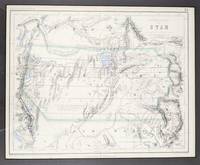
1857rif. 57211London and Edinburgh: John Murray; W. & A. K. Johnston 1857. A well-executed beautifully engraved map. Hand-colored. 16 x 13 inches 25 x 22 inches in mat and frame. Faint vertical center fold line else fine. Wheat 934. Not in Moffat. From the rare Atlas of the United States. 1857 by Rogers and Johnston. This is the only commercial atlas map of its time to show the Utah Territory on a single map and it is in its own right one of the rarest maps of the territory. In addition to county boundaries and information from Fremont's report the map provides a good deal of detail on springs Indians topographical features forts early roads and more. Portions of Nevada Colorado Arizona and New Mexico are included. The first separately printed map of Utah. This map was published at the time of the Utah War 1857-58 and depicts Brigham Young's original view of the large Deseret Territory. Fillmore City is shown as the capitol. The map includes a note from Fremont's report which states "The Great Basin is elevated above the sea between 4000 and 5000 ft. it is surrounded by lofty mountains and is believed to be filled with rivers and lakes which have no communication with the sea deserts and oases which have never been explored and savage tribes which no traveller has seen or described. John Murray; W. & A. K. Johnston unknown
1857rif. 57211London and Edinburgh: John Murray; W. & A. K. Johnston 1857. A well-executed beautifully engraved map. Hand-colored. 16 x 13 inches 25 x 22 inches in mat and frame. Faint vertical center fold line else fine. Wheat 934. Not in Moffat. From the rare Atlas of the United States. 1857 by Rogers and Johnston. This is the only commercial atlas map of its time to show the Utah Territory on a single map and it is in its own right one of the rarest maps of the territory. In addition to county boundaries and information from Fremont's report the map provides a good deal of detail on springs Indians topographical features forts early roads and more. Portions of Nevada Colorado Arizona and New Mexico are included. The first separately printed map of Utah. This map was published at the time of the Utah War 1857-58 and depicts Brigham Young's original view of the large Deseret Territory. Fillmore City is shown as the capitol. The map includes a note from Fremont's report which states "The Great Basin is elevated above the sea between 4000 and 5000 ft. it is surrounded by lofty mountains and is believed to be filled with rivers and lakes which have no communication with the sea deserts and oases which have never been explored and savage tribes which no traveller has seen or described. John Murray; W. & A. K. Johnston unknown books
1913rif. 3357Hameenlinna: Karisto 1913. First Finnish edition. In later half leather. Very nice conditon. First Finnish edition. In later half leather. XVI 621 1 pp. frontiespiece of Darwin. First Finnish translation of Darwin's Origin of Species. Karisto unknown
1914rif. 1914Prague: I. L. Kobra 1914. First edition. In publisher’s cloth binding. Previous owner’s bookplate on front pastedown. Corners slightly rubbed. Light foxing here and there. Overall in fine condition. First edition. In publisher’s cloth binding. 387 1 p. and 1 folding chart. First Czech edition of Darwin’s opus magnum On the Origin of Species 1859 the foundation of evolutionary biology. The translator František Klapálek 1863–1919 was a prominent entomologist founding member and the first chairman of the Czech Entomological Society. . I. L. Kobra unknown
1872rif. 189795London: John Murray 1872. Completing Darwin's evolutionary writings First edition first issue "written as a confutation of the idea that the facial muscles of expression in man were a special endowment" Freeman. The plates are among the earliest commercially reproduced photographs in a scientific book. While researching this work Darwin invited the photographer Oscar Rejlander to make comparative studies of laughter and crying obtained photographs of asylum inmates from the asylum director James Crichton-Browne and consulted the French physiologist Guillaume Duchenne on his electrical research on facial muscles. In the first issue "that" is spelled correctly on the first line of page 208. The plates are lettered with Roman numerals; another state is known in Arabic numerals without priority of issue. Freeman suggests that the Arabic numeral plates were printed first but notes that "the two states seem to occur at random in the two issues of the text and Darwin's own copy at Cambridge has the Roman" Freeman. Octavo. With 7 tissue-guarded heliotype plates of which 3 folding woodcut illustrations within text. With 4 pp. publisher's advertisements dated November 1872 at rear. Original dark green cloth spine lettered in gilt covers panelled in blind black coated endpapers. Label partially removed from front pastedown; pencil ownership signature of one "Dudley Crawford". Rubbing to cloth spine darkened ends and corners bumped and worn inner hinges split outer leaves foxed neat tape repair to upper margin of pp. 1-2 chip to lower outer corner of pp. 311-2: in very good condition. Freeman 1141; Garrison-Morton 4975; Norman 600. hardcover
1876rif. 153564London: John Murray 1876. First Edition; First Printing. Hardcover. Near Fine in green cloth. Neat owner name. John Murray hardcover
1908rif. 191094London: printed for the Linnean Society 1908. Marking fifty years of evolutionary theory First and only edition of this commemorative volume in the strikingly gilt-stamped original cloth. It celebrates the proposal of the theory of evolution described in the words of the Linnean Society's then president Dukinfield Henry Scott as "without doubt the greatest event in the history of our Society since its foundation" p. 1. The grand event marked the fiftieth anniversary of the presentation of Darwin and Wallace's papers on natural selection first read to the society in 1858 by Charles Lyell and Joseph Hooker. Both papers are here reprinted in full alongside the event programme the list of attendees of the celebratory dinner the general meeting minutes and summaries of the special lantern demonstrations delivered during the evening. Of particular interest is a detailed account of the objects exhibited in the library which comprised natural history specimens illustrating variation across species. The event took place at the Institution of Civil Engineers because the Society's rooms in Burlington House were not large enough to hold the number of scientists in attendance. Attendees also included members of the Darwin family representatives of scientific societies and several foreign ministers. Wallace was the first recipient of the Darwin-Wallace medal; six similarly influential evolutionary biologists - including Hooker Galton and Haeckel - received silver versions. It was also issued in wrappers. Octavo. Portrait frontispiece of Darwin 9 plates 7 of which portraits with corresponding facsimile signatures. Original cream cloth spine lettered in gilt medallic portraits of Darwin and Wallace stamped in gilt on front cover black endpapers top edge gilt. Cloth soiled spine darkened extremities rubbed gilt portraits bright cockling to endpapers foxing to contents and edges: a very good copy. Freeman 353. hardcover
1868rif. AQ29889London: John Murray 1868. In two volumes. viii 411 1 32; viii 486pp 2. Bound by Edmonds & Remnants ticket to REP of Vol. II in original publisher's green cloth lettered in gilt. Lightly rubbed and marked a little chipping to head and foot of spines. Hinges just starting occasional light spotting else a crisp set. A crisp copy of the first edition first issue with 12 errata across both volumes and the publisher's imprint featuring on a single line to the foot of each spine of English naturalist Charles Darwin's 1809-1882 ground-breaking study of variation within plants and animals caused by the modification of species by breeders and horticulturists. The variation of animals and plants under domestication is notable for containing the first appearance of the term 'survival of the fittest' as a substitute for Darwin's more anthropomorphic 'natural selection'; and the first expression of his theory of Pangenesis the inheritance of acquired characteristics. Freeman F877.1. First edition first issue. 8vo. John Murray hardcover
1839rif. 008349London: Henry Colburn 1839. Book. Good. Full-Leather. First Edition. 8vo - over 7¾ - 9¾" tall. The first two volumes of the four volume set. Volume I - Proceedings of the First Expedition. 1826-1830 under command of Captain P. Parker King. xxviii 2 l. 597pp; Vol. II. - Proceedings of the Second Expedition 1831-1836 under the command of Captain Robert Fitzroy. xiv 1 l. 694p addenda 41 plates including 2 frontispieces lacking the four loose folding maps 2 maps in each volume and the "Chart of a part of South America" in volume I. Volume II is lacking the title page but has the half-title page. Browning mostly front portions of both books and plates some old marginal damp stains both books in full tree calf bindings recased with new marbled endpapers using original spine strips lower half of Vol. II spine strip sympathetically replaced. Gilt monogram of General Assembly library on both volumes. Please enquire if you are interested in purchasing volumes separately. Henry Colburn Hardcover
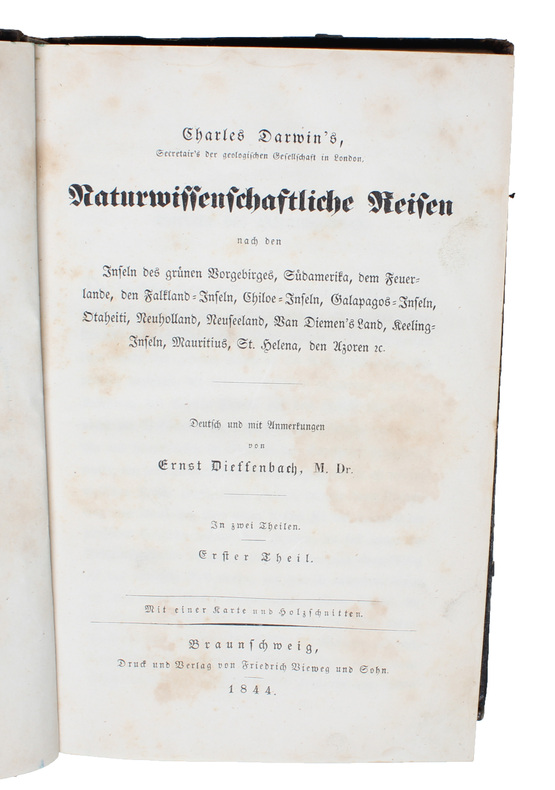
1844rif. 54590Brunswick, F. Vieweg und Sohn, 1844. 8vo. 2 volumes bound in one contemporary half calf binding with gilt lettering to spine. Previous owner's stamp to front free end-paper. Light brownspotting throughout, especially to first and last leaves. XVI, 319, VIII, 301, (3) pp. + 1 folded map.
1844rif. 54590Brunswick F. Vieweg und Sohn 1844. 8vo. 2 volumes bound in one contemporary half calf binding with gilt lettering to spine. Previous owner's stamp to front free end-paper. Light brownspotting throughout especially to first and last leaves. XVI 319 VIII 301 3 pp. 1 folded map. Rare first German translation of Darwin's Journal of researches now known as Voyage of the Beagle constituting the very first translation of any of Darwin's works into any language. As Darwin later recalled in his autobiography 'The voyage of the Beagle has been by far the most important event in my life and has determined my whole career'. "On its first appearance in its own right also in 1839 it was called Journal of researches into the geology and natural history etc. The second edition of 1845 transposes 'geology' and 'natural history' to read Journal of researches into the natural history and geology etc. and the spine title is Naturalist's voyage. The final definitive text of 1860 has the same wording on the title page but the spine readsNaturalist's voyage round the world and the fourteenth thousand of 1879 places A naturalist's voyage on the title page. The voyage of the Beagle first appears as a title in the Harmsworth Library edition of 1905. It is a bad title: she was only a floating home for Darwin on which in spite of good companionship he was cramped and miserably sea-sick; whilst the book is almost entirely about his expeditions on land." FreemanFreeman 176 unknown
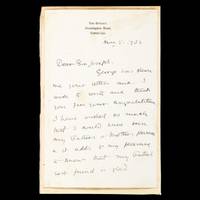
rif. 419752 pp. manuscript in ink written on the first two sides of an octavo-size bifolium of notepaper 180 x 115 mm with Horace Darwin's letterhead 'The Orchard Huntingdon Road Cambridge'; dated 5 May 1903 the letter is addressed 'Dear Sir Joseph' i.e. Sir Joseph Dalton Hooker and is signed in full at the foot of the second side 'Horace Darwin'; the writer thanks Hooker for his congratulations by inference on his becoming a Fellow of the Royal Society although this event is not referred to explicitly; mounted on a section cut from an album page; some toning from the old glue on the verso else clean and legible. An unpublished and hitherto unrecorded piece of private correspondence between Cambridge scientist Horace Darwin 1851-1928 - the son of Charles Darwin - and the eminent botanist Sir Joseph Dalton Hooker 1817-1911 - Charles Darwin's closest friend. Horace thanks Hooker for congratulating him on becoming a Fellow of the Royal Society an achievement which elicits fond memories of his father: for although he had passed away more than twenty years earlier we sense that Horace's emotional and deeply sincere words sum up accurately and concisely how much Charles Darwin meant to both men - as a proud and loving father as a loyal friend and as a brilliant intellect. 'Dear Sir Joseph George Horace's older brother has shown me your letter and I wish to write and thank you for your congratulations. I have wished so much that I could have seen my Father & Mother's pleasure & it adds to my pleasure to know that my Father's best friend is glad. My wife and I are sorry that you are so far from well but we hope you may be able to get to George's later & that we may see you then. Ever sincerely Horace Darwin'. Horace's obvious attachment to and respect for his father is to a large extent explained in this extract from The Darwin Correspondence Project: Darwin and Fatherhood University of Cambridge: 'The close relationships that developed with many of his adult children were highly prized by Darwin. So how exceptional was Darwin as a father In most respects the concerns and beliefs that Darwin expressed about fatherhood were ones that were very typical of men from similar backgrounds in the mid-Victorian period. He frequently discussed his own and other people’s children in letters to friends and relatives. He sought to ensure that his children would be successful when measured according to conventional norms of professional middle-class behaviour. The importance that Darwin attached to his paternal responsibilities and the enjoyment that he gained from his relationships with each of his sons and daughters were typical. However the characteristic that made Darwin unusual when compared to his neighbours and friends was the nature of his work. As a gentleman scientist who worked from home and was frequently not well enough to go to public events his life was centred on his home and family to an exceptional extent. His wife children and servants thus contributed to his research and writing and the practical and intellectual consequences of his scientific work were central to the relationships that he formed with his children.' Provenance: Autograph album compiled by Jane Emma Murphy Balcombe 1854–1924 ""The Briars"" Mornington Victoria Australia; à Beckett family Melbourne by descent. Â unknown
1922rif. 68590London: Mills & Boon 1922. First edition of this collection of Darwin's golf columns from The London Times. Octavo original cloth. Presentation copy inscribed by Bernard Darwin on the front free endpaper "To G.M. from the author with his best regards. Sept. 1922." It was customary for Darwin to sign "from the author" which denoted a personal affiliation with the recipient. Rare and desirable signed and inscribed. It has been said that Darwin's writings established the standards for golf reporting against which all others are measured" D&J. Murdoch 178; D&M 13880; D&J D4000. Mills & Boon hardcover