"DARWIN, CHARLES.Livre Rare Book
7.646 Ergebnisse
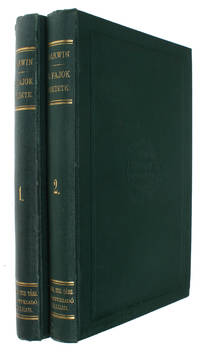
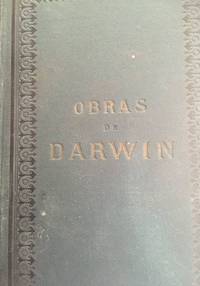
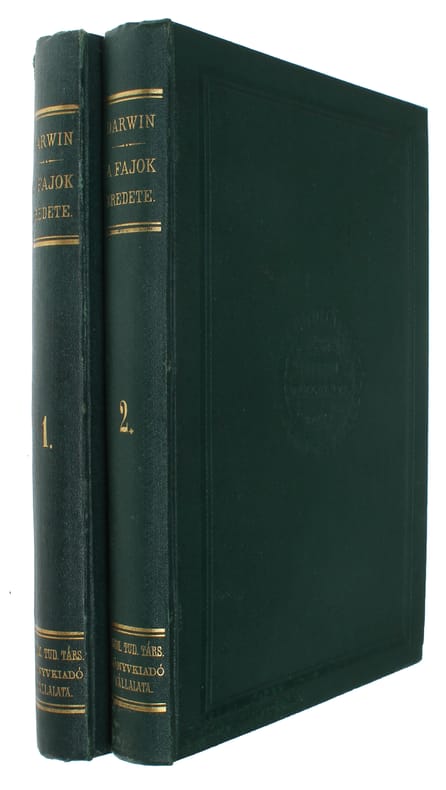
1874Best.-Nr. 60158Budapest, Kiadja a Természettudományi Társulat [Academy of Sciences], 1873 & 1874. 8vo. In two contemporary embossed full cloth bindings with gilt letter- and numbering to spine. Bindings with light wear, primarily affecting hindges. Previous owner's stamp to half title and title page in both volumes. Light occassional brownspotting, primarily affecting first and last leaves. An overall nice copy. XVI, (2), 303, (1)"" VII, (1), 361, (1) pp. + 1 leaf of Advertisement + 2 plates (A frontiespiece of Darwin and one listing the evolution of the different generations).
1874Best.-Nr. 60158Budapest Kiadja a Természettudományi Társulat Academy of Sciences 1873 & 1874. 8vo. In two contemporary embossed full cloth bindings with gilt letter- and numbering to spine. Bindings with light wear primarily affecting hindges. Previous owner's stamp to half title and title page in both volumes. Light occassional brownspotting primarily affecting first and last leaves. An overall nice copy. XVI 2 303 1; VII 1 361 1 pp. 1 leaf of Advertisement 2 plates A frontiespiece of Darwin and one listing the evolution of the different generations. The exceedingly rare first Hungarian translation of Darwin's "Origin of Species". Together with the Serbian and the Spanish the first Hungarian translation of the "Origin" is arguably the scarcest of all the translations of the work and very few copies of it are known. The Hungarian public was introduced to Darwinism early on when Ferenc Jánosi reviewed The Origin of Species in the Budapesti Szemle Budapest Review half a year after it first appeared in English. Darwin's principal works were first published in Hungarian translation by the Royal Hungarian Natural Science Society Királyi Magyar Természettudományi Társulat. Translator Dapsy László had been actively working to make Darwin and his idea known in Hungary. Through his articles he consistently presented Darwinism as a possible model for the type of progressive society that Hungary should attempt to achieve thus being one of the very earliest to apply Darwin's theories to human society and politics in general. "Dapsy's translation inspired by liberal ideals of progress increasingly became part of the conservative discourse of Hungarian politics reinterpreted and appropriated according to the nationalist agendas merging in Hungarian Society". Mund The Reception of Charles Darwin in Nineteenth-Century Hungarian Society.Prior to his translation in 1872 Dapsy wrote Darwin: "I am sorry to say that as yet here such tendencies are received with a good deal of aversion but I believe that by-and-by they will accept it and it would be a great advancement for our political life too". Dapsy to Darwin 12 June 1872. Darwin's response is not known. "It is characteristic of the enlightened spirit of the country in this period that Darwin received academic recognition earlier in Hungary than in England. Although Cambridge did not honor Darwin until 1879 he was elected an honorary member of The Hungarian Academy of Sciences in 1872 the same year on this occasion the renowned Hungarian zoologist Tivadar Margó visited him at Down.Historical circumstances played a major role in this quick appearance of Darwinism and its popularity in Hungary. The failure of the 1848-49 revolution and war of independence seemingly put an end to progressive political discourse signaling an ideological crisis among the intelligentsia. In this context the natural sciences with their 'eternal truths' promised a way out inasmuch as science's promised objectivity might well serve as a politically neutral expression of progressive values" Mund The Reception of Charles Darwin in Nineteenth-Century Hungarian Society.The present book was one of four scientific works published between 1872 and 1874 by the Hungarian Academy of Sciences the others being Bernhard von Cotta's Geologie der Gegenwart 1865 Huxley's Lectures on the Elements of Comparative Anatomy 1864 and Tyndall's Heat Considered as a Mode of Motion 1863. An advertisement for these books occurs on the final leaf of vol. II.During Darwin's lifetime 'Origin' was published in eleven different languages some of them in more than one edition: The first foreign translation was the German 1860 followed by a Dutch 1860 French 1862 French 1862 Italian 1864 Russian 1864 Swedish 1869 Danish 1872 Hungarian 1873 Spanish 1877 and Serbian 1878 the last three by far being the rarest. OCLC locates only three complete copies: Paris Mazarin Library University Library of Szeged and The Huntington Library CA. Staatsbibliothek zu Berlin only hold volume 1. Freeman 703. hardcover
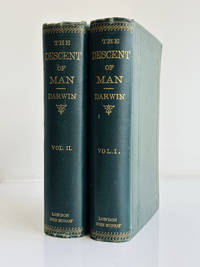
1871Best.-Nr. 12819First Edition First Issue. Extremely scarce. With "transmitted" the first word on p.297 in the first volume; in the second volume printer's note on verso of half-title errata on verso of title and the postscript leaf after p.viii. January ads in both volumes. The First Edition contains two parts: The Descent of Man itself and Selection in Relation to Sex. "The word 'evolution' in Volume 1 .2 occurs for the very first time in any of Darwin's worlds." Freeman 128-9. Often misunderstood Darwin never said that man was descended from apes let alone monkeys; that statement of his -- what he claimed and that highly important and still controversial statement today was that man's ancestors if alive today would have to be classified among the primates. One of the most significant books ever written SIGMUND FREUD Freeman 937; GarrisonMorton 170; Printing and the Mind of Man 169; Rieber 12. SCARCE AND HIGHLY COLLECTIBLE Both volumes endpapers highly foxed otherwise in surprisingly decent condition gilt titles clean and in volume two surprisingly bright. John Murray hardcover books
1881Best.-Nr. feb01441881. First Japanese Edition 3 books of The descent of man and selection in relation to sex by Charles Darwin. .人祖論. Used book For more details and availability please contact me Ichibe Yamanaka
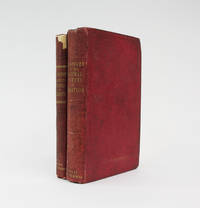
Best.-Nr. 18098London: John Churchill. 1844 and 1845. First edition first printing. First edition first printing. Two volumes. 8vo. Publisher's original red cloth with gilt titles to the spines. A very good set the bindings square and firm with minor nicks to the head of the spine of 'Vestiges' minor cracking to the inner hinges and chipping with loss to the spine ends of 'Explanations' the corners of both volumes a little bumped. The contents of 'Vestiges' with minor toning to page edges and the occasional minor mark to a couple of page margins are otherwise in excellent order clean throughout and without previous owners' inscriptions or stamps. The contents of 'Explanations' with a small contemporary bookseller's ticket to the front pastedown minor toning to the page edges the odd marginal mark a few faint pencil underlings a very minor water mark to the rear pastedown and free endpaper and a paper flaw to p.59 are otherwise in very good condition. All in all an attractive and appealing set in entirely original unsophisticated condition. Housed in a bespoke quarter morocco solander case. The first edition of the first full-length exposition of an evolutionary theory in English and the most important precursor to Darwin's 'On the Origin of Species'. "This outspoken statement of a belief in evolution published anonymously to protect Chambers' reputation as a publisher anticipated Darwin's Origin by 16 years Garrison and Morton p.218. Bringing "together a large variety of data from both geology and the life sciences to support the idea of the origin of species through a process of transmutation. It played a significant role in the history of mid-nineteenth century biology by making evolutionism a commonplace topic of discussion" becoming a sensational best-seller read widely by the intellectual and cultural elite thus easing the way for Darwin's own writings Norman. Notably the work also contains what is probably the first discussion of computing within the context of biology with Chambers demonstrating "that evolutionary change occurring over long periods of time could be seen as similar to the workings of Babbage's Difference Engine programmed from the beginning of its operation to produce in sequence several different series of numbers according to a succession of mathematical rules". Vestiges in fact served to significantly aid public understanding of Babbage's work with his ideas receiving "a much wider circulation through Chamber's text than through the two editions of the "Ninth Bridgewater Treatise" Hook et al. Origins of Cyberspace p.147. The October 1844 first edition of Vestiges consisted of 750 copies with a second edition of 1000 copies quickly following in December. The book was constantly revised with Chambers refining arguments addressing criticism and reacting to new scientific publications. Late in 1845 largely in response to Adam Sedgwick's review of the work in the Edinburgh Review Chamber's wrote "Explanations: A Sequel to Vestiges of the Natural History of Creation" consisting of 1500 copies and which was subsequently appended to later editions DSB III:192. The 11th edition of 1860 included a three page discussion of Darwin's recently published Origin a book which according to historian James A. Secord Vestiges outsold up until the early twentieth century. It was not until the 12th edition of 1884 in the preface written by his friend Alexander Ireland that Robert Chambers was revealed to have written Vestiges ending several decades of public speculation that had named everyone from Prince Albert to Darwin himself as the potential author. Secord James: Victorian Sensation The Extraordinary Publication Reception and Secret Authorship of Vestiges of the Natural History of Creation 2001. Further details and images for any of the items listed are available on request. All items are catalogued by humans. Lucius Books welcomes direct contact with our customers. London: John Churchill. 1844 and 1845 hardcover
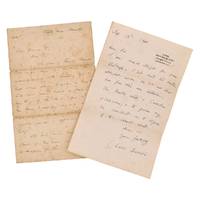
1881Best.-Nr. 611Autograph letter signed concerning carnivorous beetles. Down Beckenham Kent 13th September 1881 8vo 205 x 131mm horizontal mailing folds 1pp. in fine condition signed "Charles Darwin"; with retained copy of Harmer's letter to Darwin Wick near Arundel 1881 8vo 205 x 130mm horizontal mailing folds weak at folds. A fine unpublished letter to John Harmer thanking him for his account of a beetle attacking a six-inch worm and for the beetle itself which Harmer had enclosed. Harmer had captured the beetle in Arundel Park in Sussex after witnessing the beetle attack the worm he writes "not having noticed any thing of the kind before I carried him home to satisfy myself whether such was his food or whether his appetite would be affected by captivity. He has since disposed of the fluids of two more which he cuts up in a very business like manner." Harmer fed it more worms then sent it to Darwin in case there was "an element of interest in the circumstance". Darwin's response reads "I am much obliged for your kindness. I had read that beetles attacked worms but did not know how far this was authentic. The beetle sent is Carabus Violaceus; & the genus may be considered as the tiger of the insect world." The posthumous revised edition of "The Formation of Vegetable Mould Through the Action of Worms" 1882 notes that "the larger species of Carabus and Staphylinus… attack… worms ferociously". This observation is absent from the first edition of 1881 so it seems Harmer's efforts were put to good use. Not in the Darwin Correspondence Project but Harmer's letter to Darwin is DCP-LETT-13332.
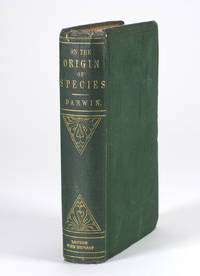
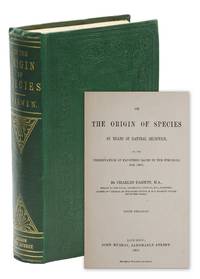
1860Best.-Nr. 001613London: John Murray 1860. 5 vi-ix 2 2-502pp 1 2-32pp. Original embossed cloth title author and publisher in gilt to spine chocolate coloured endpapers. Later recased on an Oxford hollow corners gently bumped couple of minor bumps to board edges minor rubbing to extremities. Internally some light foxing especially to first two sections an old repair to tiny tears to fore edge of half title and title former owner's name and address to front endpaper but generally fairly clean. With the folding lithographic chart by William West between pages 116 and 117; 32pp of adverts dated January 1860 to rear. Bookseller's label of Folthorp of Brighton to front pastedown and the binder's ticket of Edmonds & Remnants to lower pastedown. Now housed in a cloth drop back box with title and author in gilt to spine made by Temple Bookbinders. The fifth thousand or second edition second issue though not so-called on the title page one of three thousand copies with the misprint 'speceies' corrected and the whale-bear story diluted see Freeman page 78 binding variant 'a' with upright of L in London over right hand upright of H in John. Freeman 376. Second Edition. Hardback. Good/No Jacket. 8vo. John Murray Hardcover
1877Best.-Nr. feb027271877. First Spanish Edition - On the Origin of Species by Means of Natural Selection or the Preservation of Favoured Races in the Struggle for Life by Charles Darwin. El origen de las especies Used book For more details and availability please contact me Biblioteca Perojo hardcover
1879Best.-Nr. 32820659One page. Original folds. Very good condition. Nicely framed. Darwin discusses the hereditary transmission of behavior and a vivid example of the phenomenon from the opening chapter of The Expression of the Emotions in Man and Animals. In this letter Darwin thanks Fanny Kellogg for "communicating the curious case of an habitual gesture like that which I have described as inherited. I may add that since I wrote the action has been transmitted to another generation. Your case shall be sent to Mr. Galton who gave me the information." In The Expression of the Emotions in Man and Animals 1872 Darwin had discussed the heritability of habitual gestures. There he cited at length a remarkable case related to him by his cousin Francis Galton. Galton a distinguished scientist in his own right was keenly interested in the inheritance in humans and the two men often shared findings and theories. Darwin quoted Galton in The Expression of the Emotions on page 33: "A gentleman of considerable position was found by his wife to have the curious trick when he lay fast asleep on his back in bed of raising his right arm slowly in front of his face up to his forehead and then dropping it with a jerk so that the wrist fell heavily on the bridge of his nose. The trick did not occur every night but occasionally and was independent of any ascertained cause. Sometimes it was repeated incessantly for an hour or more. The gentleman's nose was prominent and its bridge often became sore from the blows which it received. At one time an awkward sore w as produced that was long in healing on account of the recurrence night after night of the blows which first caused it. His wife had to remove the button from the wrist of his night-gown as it made severe scratches and some means were attempted of tying his arm." Galton went on "Many years after his death his son married a lady who had never heard of the family incident. She however observed precisely the same peculiarity in her husband but his nose from not being particularly prominent has never as yet suffered from the blows. The trick does not occur when he is half-asleep as for example when dozing in his arm-chair but the moment he is fast asleep it is apt to begin …" Galton further noted that the behavior had been passed down to the son's daughter. Darwin's letter offered here reveals that he learned after the publication of Expression of Emotions that yet another generation has acquired the remarkable habitual behavior! This fascinating letter demonstrates the lengths to which Darwin went gathering data and telling examples for his writings. His published books reached a wide audience producing additional correspondence with yet more evidence for his theories. The letter is also noteworthy for being signed in full "Charles Darwin" instead of the more usual abbreviated "Ch. Darwin."
1860Best.-Nr. 200052New York: D. Appleton & Company 1860. First Edition; First Printing. Hardcover. First American edition first printing first issue with two quotes/reviews opposite the title page. Near fine condition. 432 pp. Bound in publisher's green pebbled cloth decorated in blind titles in gilt on the spine original coated brown endpapers folding chart intact. A Near Fine copy. Light rubbing to cloth at corners/tips. Light foxing and occasional offsetting to contents. Small tear at rear endpaper. Text is unaffected. No other interior marks bar owner's name in pencil remained for potential provenance. D. Appleton & Company hardcover
1881Best.-Nr. 60016Tokyo, Ichibe Yamanaka., Meiji 14. (1881). 8vo. 3 volumes, all in the contemporary (original?) yellow wrappers (Traditional Fukuro Toji binding/wrappers). Extremities with wear and with light soiling, promarily affecting vol. 1. Title in brush and ink to text-block foot. A few ex-ownership stamps. Folding plate with repair. A fine set. 46 ff" 70 ff. + 9 plates of which 1 is folded" 72 ff. ""Vol. I contains prefaces to 1st and 2d editions of Descent of man Nos 936 & 944"" vol. II contains chapter 1 and vol. III chapter 2. All published, intended to form 9 vols containing chapters 1-7 and 21."" (Darwin-Online).
1881Best.-Nr. 60016Tokyo Ichibe Yamanaka. Meiji 14. 1881. 8vo. 3 volumes all in the contemporary original yellow wrappers Traditional Fukuro Toji binding/wrappers. Extremities with wear and with light soiling promarily affecting vol. 1. Title in brush and ink to text-block foot. A few ex-ownership stamps. Folding plate with repair. A fine set. 46 ff; 70 ff. 9 plates of which 1 is folded; 72 ff. "Vol. I contains prefaces to 1st and 2d editions of Descent of man Nos 936 & 944; vol. II contains chapter 1 and vol. III chapter 2. All published intended to form 9 vols containing chapters 1-7 and 21." Darwin-Online. The exceedingly rare first translation of Darwin's Descent of Man and the first partial translation of Origin of Species constituting the very first translation of any of Darwin's work into Japanese and arguably being the most influential - albeit in a different way than could be expected - of all Darwin-translations. "The first translation of a book by Darwin was published in 1881: a translation of The Descent of Man titled as Jinsoron On the Ancestors of Man; Darwin 1881. The translator was a scholar of education Kozu Senzaburo . In spite of its title the book was actually a hybrid which included a mixture of chapters of the Descent namely chapters 1-7 and 21 together with other texts: the Historical Sketch that Darwin appended to the third edition of the Origin 1861 and some sections taken from Thomas Huxley's Evidence as to Man's Place in Nature Kaneko 2000. So this book can also be described as the first publication including a partial translation of a text from the Origin" Taizo Translating "natural selection" in Japanese: from "shizen tota" to "shizen sentaku" and backDarwin's theories had a profound influence on Japan and Japanese culture but in a slightly different way than in the West: Darwinism was marked as social and political principles primarily embraced by social thinkers philosophers and politicians to advocate the superiority of Japanese culture and society and military and not by biologist and zoologist. "It was as if Darwin's famous oceanic journey and the meticulous research into the animal and plant kingdoms that he spent his life undertaking had all been staged as an elaborate excuse for composing a theory whose true object was Victorian society and the fate of the world's modern nations." Golley Darwinism in Japan: The Birth of Ecology.The popularity of Darwin's works and theories became immensly popular in Japan: "Curiously there are more versions of "The Origin" in Japanese than in any other language. The earliest were literary with subsequent translations becoming more scientific as the Japanese developed a technical language for biology." Glick The Comparatice Reception of Darwinism P. XXIIDarwin's work had in Japan - as in the rest of the world - profound influence on the academic disciplines of zoology and biology however in Japan the most immediate influence was not on these subjects but on social thinkers: ". it exerted great influence on Japanese social thinkers and social activists. After learning of Darwin's theory Hiroyuki Kato the first president of Tokyo Imperial University published his New Theory of Human Rights and advocated social evolution theory social Darwinism emphasizing the inevitable struggle for existence in human society. He criticized the burgeoning Freedom and People's right movement. Conversely Siusui Kautoku a socialist and Japanese translator of the Communist Manifesto wrote articles on Darwinism such as "Darwin and Marx" 1904. In this and other articles he criticized kato's theory on Social Darwinism insisting that Darwinism does not contradict socialism. The well known anarchist Sakae Osugi published the third translation of On the Origin of Species in 1914 and later his translation of peter Kropotokin's Mutial Aid: A Factor of Evolution. Osugi spread the idea of mutual aid as the philosophical base of Anarcho-syndicalism." Tsuyoshi The Japanese Lysenkoism and its Historical Backgrounds p. 9 "Charles Darwin's theory of evolution was introduced to Japan in 1877 Morse 1936/1877 during Japan's push to gain military modernity through study of western sciences and technologies and the culture from which they had arisen. In the ensuing decades the theory of evolution was applied as a kind of social scientific tool i.e. social Spencerism or social Darwinism Sakura 1998:341; Unoura 1999. Sakura 1998 suggests that the theory of evolution did not have much biological application in Japan. Instead Japanese applied the idea of 'the survival of the fittest' which was a misreading of Darwin's natural selection theory to society and to individuals in the struggle for existence in Japan's new international circumstances see also Gluck 1985: 13 265.However at least by the second decade of the 1900s and by the time that Imanishi Kinji entered the Kyoto Imperial University the curricula in the natural and earth sciences were largely based on German language sources and later on English language texts. These exposed students to something very different from a social Darwinist approach in these sciences. New sources that allow us to follow" ASQUITH Sources for Imanishi Kinji's views of sociality and evolutionary outcomes p. 1."After 1895 the year of China's defeat in the Sino-Japanese War Spencer's slogan "the survival of the fittest" entered Chinese and Japanese writings as "the superior win the inferior lose." Concerned with evolutionary theory in terms of the survival of China rather than the origin of species Chinese intellectuals saw the issue as a complex problem involving the evolution of institutions ideas and attitudes. Indeed they concluded that the secret source of Western power and the rise of Japan was their mutual belief in modern science and the theory of evolutionary progress. According to Japanese scholars traditional Japanese culture was not congenial to Weastern science because the Japanese view of the relationship between the human world and the divine world was totally different from that of Western philosophers. Japanese philosophers envisioned a harmonious relationship between heaven and earth rather than conflict. Traditionally nature was something to be seen through the eyes of a poet rather than as the passive object of scientific investigations. The traditional Japanese vision of harmony in nature might have been uncongenial to a theory based on natural selection but Darwinism was eagerly adopted by Japanese thinkers who saw it as a scientific retionalization for Japan's intense efforts to become a modernized military and industial power. Whereas European and American scientists and theologians became embroiled in disputes about the evolutionary relationship between humans and other animals Japanese debates about the meaning of Darwinism primarily dealt with the national and international implications of natural selection and the struggle for survival. Late nineteenth-century Japanese commentators were likely to refer to Darwinism as an "eternal and unchangeable natural law" that justified militaristic nationalism directed by supposedly superior elites". Magner A History of the Life Sciences Revised and Expanded p. 349"Between 1877 and 1888 only four works on the subject of biological evolution were published in Japan. During these same eleven years by contrast at least twenty Japanese translations of Herbert Spencer's loosely "Darwinian" social theories made their appearance. The social sciences dominated the subject and when Darwin's original The Origin of Species Seibutsu shigen finally appeared in translation in 1896 it was published by a press specializing in economics. It is not surprising then that by the early 20th century when Darwin's work began to make an impact as a biological rather than a "social" theory the terms "evolution" shinka "the struggle for existence" seizon kyôsô and "survival of the fittest" tekisha seizon had been indelibly marked as social and political principles. It was as if Darwin's famous oceanic journey and the meticulous research into the animal and plant kingdoms that he spent his life undertaking had all been staged as an elaborate excuse for composing a theory whose true object was Victorian society and the fate of the world's modern nations." Golley Darwinism in Japan: The Birth of Ecology.Freeman 1099c unknown
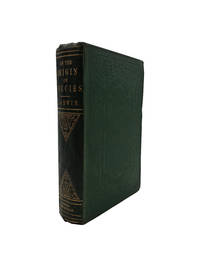
1860Best.-Nr. 42820886SECOND EDITION published on January 7 1860 less than two months after the first edition. Three thousand copies were printed. On the Origin of Species is "certainly the greatest biological book ever written" Freeman and "the most important single work in science" Dibner. Darwin's theory of the origin of species by means of natural selection arose out of his studies in the 1830s during and after the voyage of H.M.S. Beagle. From 1831 to 1836 Darwin sailed around the world on the Beagle. During this five-year voyage Darwin and the Beagle visited the Galapagos Islands Brazil Argentina Tierra del Fuego Chile Peru Tahiti Australia New Zealand and other islands and countries finally returning to England by sailing around the Cape of Good Hope. Darwin observed "It appears to me that nothing can be more improving to a young naturalist than a journey in distant countries." The voyage of the Beagle was "the most important event in Darwin's intellectual life and in the history of biological science. Darwin sailed with no formal scientific training. He returned a hard-headed man of science knowing the importance of evidence almost convinced that species had not always been as they were since creation but had undergone change. … The experiences of his five years … and what they led to built up into a process of epoch-making importance in the history of thought" DSB. Over the coming thirty years Darwin refined the ideas that had germinated aboard the Beagle and finally published them in On the Origin of Species. Darwin concluded his book "There is grandeur in this view of life with its several powers having been originally breathed into a few forms or into one; and that whilst this plan has gone cycling on according to the fixed law of gravity from so simple a beginning endless forms most beautiful and most wonderful have been and are being evolved." Darwin's ideas about evolution and natural selection are the underpinnings of modern biological science. Moreover they have given us a new way of viewing and talking about the world. "Darwin not only not only drew an entirely new picture of the workings of organic nature; he revolutionized our methods of thinking and our outlook on the order of natural things. The recognition that constant change is the order of the universe had finally been established" Printing and the Mind of Man 344b. Provenance: nineteenth-century bookplate and signature of William Pearce. Original green cloth. Light wear to spine ends. A fine copy with the fragile inner hinges intact. Freeman 376. John Murray hardcover
1860Best.-Nr. 179998London: John Murray 1860. With a gift inscription by the inventor of the fuel cell Second edition revised to include the author's response to criticisms of the first edition published the year before. This copy is inscribed on the title page by William Robert Grove the physicist and proponent of natural selection "Imogen from her loving Father WRG" and is intelligently annotated throughout. Grove 1811-1896 was the inventor of the first fuel cell a pioneer of energy conservation and the first person to demonstrate that molecules thermally dissociated into atoms. In his 1866 inaugural address he became the first president of the British Association for the Advancement of Science to publicly announce his support for the theory of evolution although "Darwin was displeased that the address did not discuss what was specific to his theory. In a letter that has not been found he voiced his criticisms to Grove who replied that he had wanted the address to be accessible to non-specialists" Darwin Correspondence Project. Grove instilled an interest in science in his family presenting this copy to his daughter Imogen Emily 1848-1886 and nurturing the interests of his grandson the astronomer Edmond Herbert Grove-Hills 1864-1922. This copy additionally has the partially erased ownership signature of a member of the Grove family presumably Imogen on the half-title. The Origin of Species is "the most important biological book ever written" Freeman. The changes to the second edition include the correction of the misprint "speceies" and the dilution of the "whale-bear" story which speculates that a bear scooping insects from the water may evolve into a whale-like creature. This hypothesis was seen as absurd and was seized upon by Darwin's critics to ridicule both the scientist and his evolutionary theory; Charles Lyell advised him to remove it entirely. "This story is not found again in any printing except in the American editions of 1860 until the end of copyright" Freeman p. 78. All copies of the second edition save for a handful dated 1859 are marked "fifth thousand" on the title page; the edition is not otherwise indicated as the second. This second issue the form in which the second edition is almost always seen was published on 7 January 1860 in a print run of 3000 copies. Octavo in 12s. Folding diagram facing p. 117. With 32 pp. of publisher's advertisements dated January 1860 at rear. Original green diagonal-wave-grain cloth spine lettered ruled and decorated in gilt covers blocked in blind Freeman's variant a light brown coated endpapers binder's ticket of Edmonds & Remnants on rear pastedown. With the ownership signature dated 1895 of Ada Mary Charles Montagu Douglas Scott 1855-1943 on title page. Cloth bright and clean spine slanted extremities and inner hinges reinforced damp stains to endpapers: a very good copy indeed. Freeman 376. "Darwin in letters 1866" Darwin Correspondence Project accessible online. hardcover
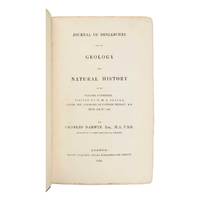
1839Best.-Nr. 612London Henry Colburn 1839 FIRST EDITION FIRST ISSUE publisher's cloth rebacked replacing original spine. 8vo uncut pp xiv i.e. xii 615 1 blank Addenda 609-629 two folding charts a little foxing to charts as usual with 16 pp inserted publisher's advertisements dated August 1839 8pp prospectus for other publications. First edition first issue an attractive copy of the first separate issue of Darwin's Journal his first formal publication and a classic of natural history travel narrative. It was perhaps the most important scientific voyage ever undertaken for it gave impetus and direction to all of Darwin's later research. 'The five years of the voyage were the most important event in Darwin's intellectual life and in the history of biological science. Darwin sailed with no formal scientific training. He returned a hard-headed man of science knowing the importance of evidence almost convinced that species had not always been as they were since the creation but had undergone change. He also developed doubts of the value of the Scriptures as a trustworthy guide to the history of the earth and of man with the result that he gradually became an agnostic. The experiences of his five years in the Beagle how he dealt with them and what they led to built up into a process of epoch-making importance in the history of thought' Gavin de Beer in DSB. The Journal of Researches was issued as part of the Voyage of the Beagle volumes and also as a separate book as above; this separate issue comprises sheets from the same print-run but with cancel half-title and title-page. Both were published and available in June 1839. Freeman 11 Henry Colburn hardcover
1871Best.-Nr. 20642London: John Murray 1871. John Murray London 1871. First edition first issues of both volumes with "transmitted" the first word on p. 297 in the first volume; in the second the printer's note on the verso of the half-title errata on title verso and the postscript leaf after p. viii. The first issue had a print-run of just 2500 copies. Both volumes in comparable excellent near fine condition. One small name within each F. Bond. Neat internal repair to each gutter of both volumes. Internally exceptionally clean and externally also remarkably fresh with only a little wear to the spine tips and edges and a little bubbling to the bottom of the rear panels. The binding is exceptionally tight. Not usually encountered in such beautiful condition. Charles Darwin expands on his theory of evolution focusing on human origins and the role of sexual selection. In this groundbreaking work Darwin argues that humans share a common ancestor with other animals particularly apes emphasising the continuity between humans and the rest of the natural world. He explores how natural selection and sexual selection have shaped human physical and behavioural traits including differences between sexes and races. Darwin also discusses the development of moral sense intellect and social behaviour suggesting that these too evolved gradually. The book was controversial challenging religious and scientific views of the time by placing humans firmly within the framework of evolutionary biology. 'The Descent of Man' not only deepened public understanding of human evolution but also laid the foundation for later studies in anthropology psychology and evolutionary theory making it a landmark in scientific literature and is claimed to be such by Sigmund Freud "One of the ten most significant books ever written". John Murray unknown
1860Best.-Nr. 140949121London: John Murray 1860. Second Edition. Very Good. Second edition second issue with "fifth thousand" listed on the title page. x 502 32 pp. Bound in publisher's emerald green cloth with decorative stamping in blind and gilt brown coated endpapers. Very Good with slight darkening and lean to spine and crimping at head and tail light bumping to corners and board edges and shallow indentation to rear board center. Hinges repaired two preliminary leaves beginning to detach overopened throughout; binding cracked but holding at p. 121. Occasional foxing to margins. Gift inscription dated 1860 to half-title page recipient's bookplate to front pastedown small binder ticket to rear pastedown. A remarkably good copy with crisp blindstamping and bright gilt. An immensely influential work considered to be the foundation of evolutionary biology in which Darwin postulates that species evolve over the course of generations through natural selection. This copy was gifted to the Reverend Archibald Weir by a grateful student "in remembrance of his preparing him in Classics for the preliminary examination at Apothecaries Hall. John Murray unknown
1838Best.-Nr. 69522London: Smith Elder and Co 1838. OWEN Richard. WATERHOUSE George R. The Zoology of the Voyage of the H.M.S. Beagle. Under the Command of Captain Fitzroy R.N. During the Years 1832 to 1836. Part I II. Mammalia. London: Smith Elder and Co. 1838. Full Description: DARWIN Charles. OWEN Richard. WATERHOUSE George R. The Zoology of the Voyage of the H.M.S. Beagle. Under the Command of Captain Fitzroy R.N. During the Years 1832 to 1836. Part I II. Mammalia. London: Smith Elder and Co. 1838-1840. First editions of Part I and Part II of Mammalia in two quarto volumes 12 1/8 x 9 1/2 inches; 307 x 241 mm. Part I. Owen Richard. Fossil Mammalia. 1838-1840. 2 iv iv 111 1 colophon pp. Complete with thirty-two lithographic plates by G. Scharf one of which is folding and two which are double paged. With the preface to the whole work and a geological introduction by Charles Darwin. Bound without the half-title but with the additional fly-title. Part II. Waterhouse George Robert. Mammailia. 1839. 4 xii 97 3 blank pp. Complete with thirty-two hand-colored lithographic plates and three numbered engraved plates. With the errata slip bound in before B1. Bound without the half-title but with the additional fly-title. This volume with a geographical introduction and notes by Darwin. Two volumes uniformly bound in half tan calf over contemporary marble boards. Spines each with red and green morocco spine labels lettered in gilt. Contemporary endpapers. All edges speckled red. Some repairs to inner hinges. Text is very clean. The final three plates in volume II with some foxing otherwise all plates are very clean. Overall a very good copy of these two volumes. These first two volumes out of the complete work in 5 volumes are the only two volumes to be published with introductions by Charles Darwin. In the first volume he writes a Geological Introduction and in the second volume he writes a Geographical Introduction. "Darwin contributed a geological introduction to Part I the Fossil Mammalia pp. 3-12 and a geographical introduction to Part II the Mammalia pp. i-iv." Freeman p 26. In 1832 Captain Robert Fitzroy of the Royal British Navy undertook a five-year circumnavigation of the earth. Fitzroy who was only twenty-seven at the time asked a young Charles Darwin to be the naturalist for the voyage. The five-year journey included passing the coastlines of South America and particularly the Galapagos Islands near Ecuador. Darwin collected numerous specimens and data from this now famous area and these became the basis for his theory of natural selection which was a key component in his masterful theory of evolution. "The lavish scientific record of Darwin's collecting endeavours during the five-year voyage of the Beagle originally issued in 19 numbers. The 166 plates 82 finely hand-colouredof the complete works were due to the tireless energy and flair which the relatively untrained ship's scientist put first into the collection of specimens and then into ensuring that the zoological specialists duly reported on them after his return. The cost of the plates was covered by a treasury grant of one thousand pounds but to complete the work for Smith and Elder who were publishers of large illustrated books and government publications Darwin had to persevere as steadily with his pen as with his gun and geological hammer turning himself into a considerable authority during the course of five years spent editing the work of others." Christies "He superintended the Zoology's text wrote introductions for the different parts and added notes from his various Beagle records about animal behaviour and habitats wherever appropriate while also supervising the printers proofreading the sheets arranging artists for the plates chivying the experts and keeping them all moving forward within a tight self-imposed budget" Janet Browne Charles Darwin: Voyaging 2003 p. 370. Freeman Darwin 9.1 & 9.2. Nissen IVB 384. Nissen ZBI 1391. Sabin 18649. HBS 69522. $25000. Smith, Elder and Co unknown
1839Best.-Nr. 189181London: Henry Colburn 1839. The Voyage of the Beagle First separate edition of this eyewitness account of one of the most influential expeditions in human history describing what Darwin judged "by far the most important event in my life" and recording the fieldwork that led to the Origin of Species Life and Letters I p. 61. These records are "famous as the genesis of Darwin's theory of evolutionary biology" Hill transforming his horizons from an intended career as a country parson and seeding a determination to establish himself as a gentleman scientist. The Journal known ever since as The Voyage of the Beagle is renowned among Darwin's books as "undoubtedly the most often read and standing second only to On the Origin of Species as the most often printed" p. 31. The Journal was first published early in 1839 as Volume III of the Narrative of the Surveying Voyages of His Majesty's Ships Adventure and Beagle. This separate edition was printed from the same sheets but with two preliminary leaves cancelled and one leaf discarded: the cancelled leaves now credit Darwin's election to the Royal Society which took place after the publication of the Narrative set. Octavo 235 x 145 mm. With 2 folding engraved maps woodcuts in the text. Contemporary brown paper-covered boards recently rebacked to style decorated and ruled in gilt and blind and with red morocco label vellum tips. Later 19th-century engraved monogram bookplate. Remnants of contemporary ink ownership inscription to front free endpaper. Light rubbing infrequent foxing to edges minor foxing and short closed tears to inner margins of both plates contents generally fresh and crisp: a very good copy indeed. Freeman 11. Francis Darwin ed. The Life and Letters of Charles Darwin 1887. hardcover
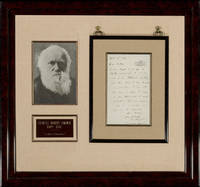
1866Best.-Nr. 1259011866. Signed. DARWIN Charles. Autograph letter signed. Down Beckenham Kent: Dec 17 1866. One leaf of black-edged mourning stationery measuring 4-1/2 by 7 inches penned on recto for one page; floated matted and framed with an early photographic card; entire piece measures 17 by 14 inches. $29500.Fine unpublished 1866 autograph letter written by Charles Darwin answering the questions of an anonymous correspondent concerning editions of his landmark work On the Origin of Species boldly signed by him with his full name ""Charles Darwin"" he often used ""C."" or ""Ch."" instead of his full given name. Beautifully framed with an early photographic card.The letter reads in full: ""Down Beckenham Kent Dec. 17th. Dear Sir Four editions of the Origin have appeared; that published last month is considerably added to & can be procured through any bookseller. I am glad to hear that you are interested in the subject. Dear sir yours faithfully Charles Darwin."" In November Darwin had copies of the substantially revised and augmented fourth edition of the Origin sent to Huxley and Wallace among others; their letters acknowledging receipt and praising the new edition are dated November 11 and November 19 respectively. The mourning stationery reflects the death of Darwin's sister Susan Elizabeth Darwin in October; another sister Emily Catherine Langton had died in January that year. See ""Darwin in letters 1866; Survival of the Fittest"" Darwin Correspondence Project online. Darwin Correspondence Project 5310F summary only. Very faint fold marks. Darwin's full signature bold and fine. Letters in which Darwin discusses his landmark work are particularly scarce and desirable. unknown
1860Best.-Nr. 55674London: John Murray 1860. Very good plus. Second edition of this epochal work - extensively and argumentatively annotated by a 19th-century reader who is both reasonably scientifically informed and morally shocked by its contents. The first printing of ORIGIN famously sold out in a single day in November 1859 leading publisher Murray to issue a second edition as soon as Darwin had made revisions in January 1860. The book was met with both considerable acclaim and criticism sparking heated debates across the country. It is possible that our annotator was among those who rushed out to obtain a copy of the second edition amidst this furor as aniline ink was commercially available by the 1860s. The comments range in length tone and depth of engagement suggesting an intense and frankly emotional reading experience for the annotator. Some annotations are insulting or flippant as when the annotator calls Darwin "cocksure" 477 or simply writes "stuff!" as in "rubbish" often used as a euphemism in place of cursing. Other annotations engage with the substance of the science asking "how can a genus descend from a species" 446 which does indeed contradict Linnaeus's traditional hierarchical taxonomy; and comparing Darwin unfavorably to Lyell whom "one has not to read over and over again in hopeless despair of finding meaning!" 282. ORIGIN OF SPECIES "dealt a body blow to traditional Western religious thought" Larsen 89 and some of the annotations are religiously inflected especially on the question of how Darwin's arguments were perceived to conflict with the belief in a divine Creator. The annotator argues "of course to talk of a Creator or God to sic odious to Mr D" 413 - a not unfounded comment as Darwin had actually revised this second edition to add the phrase "by the Creator" on the last page "in order to conciliate angry clerics" Kutschera. Indeed even Darwin's supporters were aware of the threatening religious implications: Thomas Henry Huxley claimed in an 1860 review that "Old ladies of both sexes consider it a decidedly dangerous book" quoted in Larson 83. These religious comments appear to underlie the fury of the annotator who expands them into a moral argument: "How arrogant how almost insolent for any man to write in this style as if he had been present throughout the ages and know the whole secret of animated nature" 356. The annotator injects morality into the science as when he complains about Darwin germinating seeds sourced from the droppings of birds: "I hope for the sake of his family he washed his hands. But these naturalists are dirty both in thought and conduct" 361. In a section on fertility in flowers the annotator argues "He must have had a very bawdy mind" 257 and wishes Darwin had never been born: "I wish to heavens either his male or female progenitor had been sterile" 256. The private nature of the marginalia here allows us an unfiltered glimpse at the raw response of a contemporary reader. At a later point someone appears to have attempted to erase many of them suggesting the effacer was themself angered or embarrassed or just annoyed by the commentary - yet the annotations remain important as both a distillation and reflection a broader wave of outrage that the book's publication spurred perhaps best summed up by the final marginal comment. Darwin's last line describes "endless forms most beautiful and wonderful have been and are being evolved." The annotator has underlined "and are being" and written "are they" A tremendously rich copy worthy of further research offering a detailed case study in the contemporary backlash to one of the most controversial books of all time. 8'' x 5''. Original green cloth stamped in blind gilt-stamped spine. Brown coated endpapers. Second issue as usual "fifth thousand". Publisher's catalogue at rear. 10 502 32 pages. Annotated by "E.H. Morels" throughout in pencil and aniline ink often very faded or effaced but largely legible more than 100 in all including an extensive note on the final page. Light wear and spotting to cloth with short nick to center of spine. Hinges firm. John Murray unknown
1839Best.-Nr. 189657London: Henry Colburn 1839. An outstanding account of natural history exploration First edition of the Voyage of the Beagle with the third volume Darwin's Journal of Researches being the first separate edition of his account. The popularity of Darwin's contribution to the series meant that his volume was reissued three months later as a standalone publication the version present in this set. The first issue of Darwin's Journal appeared in May 1839 as Volume III of the Narrative under the title Journal and Remarks Freeman 10. The second issue was published in August printed from the same sheets but with variant preliminaries Freeman 11. It "is undoubtedly the most often read and stands second only to On the Origin of Species as the most often printed" of Darwin's works Freeman p. 31. Volume I of the Narrative contains King's account of the expedition on the Adventure made between 1826 and 1830 surveying the coasts of Patagonia and Tierra del Fuego. In Volume II its appendix bound separately as issued FitzRoy describes the narrative of the Beagle's second voyage between 1831 and 1836 to South America the Galapagos Islands Tahiti New Zealand and Australia. 3 vols in 4 vols I-III and appendix to vol. II octavo 224 x 145 mm; 219 x 137 mm. With 47 engraved plates 9 folding engraved maps 3 bound in and 6 linen-backed and loose in front pockets diagrams and tables within text. Recent and late 19th-century vol. III half calf spines lettered and ruled in gilt spine labels marbled sides and edges buff endpapers. Contemporary ownership signature of one I. S. G. Smith on title page of vol. III partially obscured during binding process; 1950s unattributed inscription on first blank of vol. I; ownership signatures of one Thomas Leighton dated 1979 on vol. I II and appendix blanks; 20th-century bookplates of one Richard Campbell perhaps of the Campbells of Kildalloig and later Carmarthenshire. Wear to vol. III extremities spine of same a little darkened foxing to maps plates and occasionally to contents tear to half-title of vol. I closed tears to map folds repairs to folding map facing p. 463 vol. I and both maps in vol. III first of which creased and standing a little proud: overall in very good condition. Freeman 10 Narrative vols I & II & 11 Journal. Francis Darwin ed. The Life and Letters of Charles Darwin 1887. unknown
1839Best.-Nr. 1226633 vols. London: Henry Colburn 1839. 3 vols. in 4 vol. 2 having a separate appendix 8vo xxviii iv 1-559 556-597 pp. with 17 engraved plates and 3 folding maps; xiv 2 1-694 2 pp. with 25 engraved plates and 2 folding maps; viii 352 pp. with 6 engraved plates and 2 folding maps; iii-xiv 629 1 609-615 pp. with 2 folding maps. In total 9 folding maps all now bound in and 48 plates and charts. A very good copy with minimal wear and a few repaired tears to the folding maps rebound sympathetically and well in half speckled calf and marbled boards backstrips elaborately gilt with morocco labels and raised bands in two slipcases. § First edition first issue of the account of the most famous voyage in the history biological science. Volume III is the first issue of Darwin's Journal his first published book containing the observations and fieldwork that would form the basis for On The Origin of Species. "The five years of the voyage were the most important event in Darwin's intellectual life and in the history of biological science. Darwin sailed with no formal scientific training. He returned a hard-headed man of science knowing the importance of evidence almost convinced that species had not always been as they were since the creation but had undergone change. DSB III 566. Darwin's Journal "is one of the most interesting records of natural history exploration ever written and is one of the most important for it was on this voyage that Darwin prepared for his lifework ultimately leading to On The Origin of Species" Hill 104-5. Vol.1 contains Captain King's account of the first voyage which surveyed the coasts of Patagonia and Tierra del Fuego; Vol 2. with the appendix contains Captain Fitzroy's account of the second voyage of the Beagle which visited Brazil Argentina Tierra del Fuego Chile Peru the Galapagos Islands Tahiti New Zealand Australia among other islands and countries. A beautiful copy of these incomparably important books. Freeman 10. Hill 104-105. Norman 584. Henry Colburn hardcover books
1839Best.-Nr. 317725London: Henry Colburn 1839. First edition. xxviii 4 597; xiv 2 694 1; xiv 615; viii 352 pp. including half titles in three primary volumes plus forty-six plates including two frontispieces one plan and nine folding maps and charts. 4 vols. 8vo. Bound in period half dark green morocco and marbled boards spines gilt t.e.g. Repaired tear on half-title of vol. I maps backed with japanese tissue. Bound without publisher's ads at end of appendix volume which are often lacking. Fine. First edition. xxviii 4 597; xiv 2 694 1; xiv 615; viii 352 pp. including half titles in three primary volumes plus forty-six plates including two frontispieces one plan and nine folding maps and charts. 4 vols. 8vo. Darwin's First Book. The account of the Beagle's two voyages edited by Robert Fitzroy who served as commander of both voyages. Volume three of this work represents the first edition of Darwin's account of the voyage which provided the basis for his work on the origin of species found here in its second issue entitled JOURNAL OF RESEARCHES INTO THE GEOLOGY AND NATURAL HISTORY OF THE VARIOUS COUNTRIES VISITED BY H.M.S. BEAGLE. "The third volume contains Darwin's account of the voyage now famous as the genesis of his theory of evolutionary biology. The demand for Darwin's JOURNAL immediately exceeded that for the companion volumes of the NARRATIVE. Colburn therefore brought out a separate edition of it in the same year" - Hill. Freeman notes that Darwin's "first published book is undoubtedly the most often read and stands second only to ON THE ORIGIN OF SPECIES as the most often printed. It is an important travel book in its own right and its relation to the background of his evolutionary ideas has often been stressed." The first volume contains Captain King's account of the first coastal surveys of Patagonia and Terra del Fuego produced on the first expedition between 1826 and 1830. The other volumes comprise the account of the second voyage of the Beagle. Between 1831 and 1836 the ship visited Brazil Argentina Terra del Fuego Chile Peru the Galapagos Islands Tahiti New Zealand and Australia. The appendix to the second volume bound here as the fourth volume of this set includes a meteorological journal official instructions correspondence and notes. Four of the six plates in the appendix volume consist of sixteen separate illustrations of various cloud formations. A fine attractive set of a landmark of scientific exploration one of the most important Pacific voyages and Darwin's first substantial book publication. Hill 607; Freeman 10 pp. 31-39; Borba de Moraes p. 247; Sabin 37826 Henry Colburn unknown books
1870Best.-Nr. 266381870. Our first Darwin signed photograph in all these years Charles Darwin English naturalist whose scientific theory of evolution by natural selection became the foundation of modern biology and evolutionary studies. Darwin's explanation for the great unfolding of life through time - evolution by natural selection - transformed our understanding of the living world and focused attention on the cumulative inherited change in a population of organisms through time leading to the appearance of new forms: the process by which new species or populations of living things develop from preexisting forms through successive generations. Darwin revolutionized the understanding of the development of living things as Einstein revolutionized our understanding of the physical universe. An attractive Carte de Visite signed ""Ch. Darwin” circa late 1870s very good condition though with a few small adhesive tape marks. The photograph was taken by Elliott & Fry 56 Baker Street London and has their front and back stamps. For a century after its founding in 1863 the firm’s core business was taking and publishing photographs of the Victorian public and social artistic scientific and political luminaries. Among the notables known to have sat for a photograph by Elliott & Fry were Prime Minister William Gladstone Alfred Lord Tennyson W.S. Gilbert Rudyard Kipling Oliver Wendell Holmes Sr. Florence Nightingale and Charles Darwin. In all our years in the field we have seen just a handful of Darwin signed photographs and have never ourselves had one. This is indeed a rarity. But the provenance is just as fascinating as finding a signed Darwin photograph with provenance is perhaps unique. William Bateson was a British biologist who founded and named the science of genetics and whose experiments provided evidence basic to the modern understanding of heredity. He was a dedicated evolutionist and his early works on the mechanisms of biological evolution were strongly influenced by Charles Darwin though he believed that Darwin’s theory of evolution required a firmer base in heredity. Bateson also became the foremost champion of Gregor Mendel’s work on genetics. Darwin died in 1882 when Bateson was at college and though Bateson may have written Darwin such letter is unknown. Bateson and his wife did however correspond with Darwin’s family in later years as “Darwin Online” indicates. This CDV comes with an autograph letter signed from Darwin’s granddaughter Margaret Keynes dated January 23 1929 addressed to Sir George Buckston Browne proposing an alternative date for her and her husband Dr. Geoffrey Keynes to come for lunch expressing gladness that Browne wanted ""the Bateson letter and the other things"" and acknowledging that he attended the same school as Dr. Keynes. Browne had bought Darwin's old home so lunch there would have been a homecoming of sorts for Margaret. Finding the CDV and letter together we would conjecture that this CDV was the property - one of “the other things” - of Margaret that she mentioned in the letter that she was glad Browne wanted and had descended in the family to her along with the Bateson letter. Thus this CDV was apparently property of the Darwin family the most important provenance imaginable. <img class=""alignnone wp-image-25018 size-post-window"" src=""https://cdn.raabcollection.com/wp-content/uploads/20231204144051/Folder-site-11-1600x1327.jpg"" alt="""" width=""1600"" height=""1327"" /> unknown