7661 risultati
1847rif. 1641FIRST EDITION MAGNIFICENT SET OF THE INAUGURAL 24 VOLUMES PUBLISHED BY THE NEW PALAEONTOGRAPICAL SOCIETY OF LONDON—100 MONOGRAPHS 1000 PLATES 7000 PAGES INCLUDING SEMINAL WORKS OF CHARLES DARWIN AND RICHARD OWEN. 24 quarto volumes 8 x 11 inches later half leather gilt-lettered on spine with gilt panel lines over green textured cloth with gilt-rules green patterned endpapers each containing up to 7 monographs with lithographic or engraved plates many folding and some wood engravings in the text. The volumes appear to be unread with tight bindings that are as new and bright plates. Preliminary pages of each volume contain a perforated stamp of the Carnegie Library of Pittsburgh—there are no other ownership marks only rare light foxing. Very good. The Palaeontographical Society was established in 1847 and is the oldest society devoted to the study of paleontology worldwide. Its primary role is to promote the description and illustration of the British fossil flora and fauna via publication of an authoritative monograph series. The monographs were issued annually to members of the society. They cover a wide range of taxonomic groups from microfossils trilobites and ammonites through to Coal Measure plants mammals and reptiles and from all ages from Cambrian to Pleistocene. They form a benchmark for understanding the past life of the British Isles and many include the original descriptions of numerous key species. The first monograph Vol. 1 on the Crag Mollusca was published in March 1848 and the Society continues this work today. Notable authors in the series include Charles Darwin and Richard Owen both members of the Society. Darwin's interest in barnacles had first arisen in his student days in Edinburgh under the guidance of Robert Grant and increased during his detailed work in dissecting and classifying the specimens he had collected on the Beagle voyage. Darwin published his papers on fossil barnacles included in volumes 5 1851 and 8 1854 reflecting the 8 years that he devoted to the study of extinct and living barnacles establishing his credentials for formulating his theory of natural selection in The Origin of Species in 1859. In his analysis of reptilian British fossils Darwin's leading opponent Richard Owen identified unique characteristics of Megalosaurus vol. 9 Iguanodon and Hylaeosaurus vol. 10 that distinguished them from extant lizards and coined the term dinosaur "terrible lizard" in 1841. There are 22 monographs by Owen in the first 24 volumes including 16 on dinosaurs 4 on other reptiles and turtles and 2 on mammals including whales. British fossil hunter William Buckland found some fossils in 1819 and he eventually described them and named them in 1824. Like scientists before him Buckland thought the fossils belonged to an ancient larger version of a modern reptile. The first edition of a work which laid the foundation to vertebrate paleontology was Georges Cuvier's Recherches sur les ossements fossiles de quadrupèdes Researches on quadruped fossil bones published in France in 1812. In 1822 Cuvier's disciple and editor of the scientific publication Journal de physique Henri de Blainville introduced the term palaeontologie as the study of fossilized organisms—translated to the English paleontology. The word palaeontographical was coined by members of the Clay Club that established the new society whose goal was to describe and illustrate newly discovered fossils. The rapid progress in geology and paleontology during the 1830s and 1840s was aided by a growing international network of geologists and fossil specialists whose work was organized and reviewed by an increasing number of geological societies. Many of these geologists and paleontologists were now paid professionals working for universities museums and government geological surveys. The relatively high level of public support for the earth sciences was due to their cultural impact and their proven economic value in helping to exploit mineral resources such as coal. Another important factor was the development in the late 18th and early 19th centuries of museums with large natural history collections. The first 24 years of the Palaeontographical Society Monographs spans the middle of the 19th century and brackets publication of The Origin of Species in 1859. The intense activity in British paleontology at this time is reflected in the 110 monographs contained in these 24 volumes and provides a visual as well as a narrative context for the contributions of Darwin and Owen. The 27 contributing authors reveal the strong attraction of paleontology for physicians and the wide variety of species whose ancestors were pursued. These ranged from minute foraminifera to larger marine invertebrates including corals tunicates brachiopods mollusks echinoderms ammonites belemnites trilobites and eurypterids and vertebrates fish reptiles and mammals. Because photography did not become widely available until the end of the 19th century illustrations in the monographs were executed as lithographs or engravings. The most prominent London lithographers of the day were recruited to produce the dramatic plates. Many of these artists were themselves accomplished naturalists. These included Day & Son Lithographers to Queen Victoria; George Henry Ford a member of the British Museum; Michael & Nicholas Hanhart who developed a complex layering of tint stones; Charles Joseph Hullmandel author of The Art of Drawing on Stone; and the Sowerby family a British family of several generations of naturalists illustrators botanists and zoologists active from the late 18th century to the mid twentieth century. The three George Sowerbys produced major works on mollusks and their systematics including the many monographs by the Society as well as Darwin's barnacles. Notably the Sowerbys were responsible for also producing the copper plate engravings for these monographs including James De Carle Sowerby who founded the Royal Botanic Society and Gardens and was its secretary for 30 years. The Paleontographical Society Monographs are cited by Darwin in his reading notebooks. NOTE: Available upon request info@BiomedRarebooks.com A 22-page detailed description of the set containing large magnification images of selected plates list of individual monographs in each volume and list of authors subjects plates sorted by subject. Palaeontographical Society hardcover books
1868rif. 010633New York: Orange Judd and Company 1868. Book. Very Good. Cloth. First American Edition. 12mo - over 6¾ - 7¾" tall. First American Edition. Authorized Edition with a preface by Asa Gray. Illustrated. 494 pages plus 6 pages ads in rear in Volume I and 568 pages plus 8 pages ads in rear in Volume II. Dark brown end papers. Green cloth covered blind stamped boards with gilt lettering to the spines.About Very Good. Volume I has modest wear to tips and spine ends slight sun darkened spine minimal rubbing. Both hinges opened. Front paste down with two different prior owner book plates. Front free end paper prior owner name in ink. Pages 191 to 210 loose from binding. Volume II has small ink stain to front board wear to tips and spine ends front hinge open showing webbing but holding nicely prior owner book plate glue shadow at paste down the plate laid in. Internally clean and unmarked. The later owner of this book was the noted University of Cincinnati chemist and educator William B. Jensen. Priced to allow for hinge repair. . Orange Judd and Company Hardcover books
1912rif. 1691Adelphi W.C.: The Eugenics Education Society 1912. First edition. SCARCE PROCEEDINGS OF FIRST INTERNATIONAL EUGENICS CONGRESS PRESIDED BY LEONARD DARWIN. 15.5x24 cm hardcover publisher's green cloth binding gilt title to spine institutional library bookplate to front paste-down "withdrawn" handstamp to front free endpaper i-xix 490 pp. Rebacked preserving original spine cover corners worn front hinge cracked light foxing to first and last pages browning to page edges binding tight and pages clean and unmarked. Good in custom archival mylar cover. Papers in English French and Italian. CONTENTS: Variazione E Erededita Nell'uomo Variation and Heredity in Man G. SERGI; On the Increase of Stature in certain European Populations SOREN HANSEN; Le Cosidette Leggi Dell'Ereditarieta Nell'Uomo The So-called Laws of Heredity in Man V. GUIFFRIDA-RUGGERI; The Inheritance of Fecundity . RAYMOND PEARL; La PsicoLOGiA Ethnica e La Scienza Eugenistica Ethnic Psychology and the Science of Eugenics ENRICO MORSELLI; The Inheritance of Epilepsy DAVID F. WEEKS; L'influence de l'age des Parents sur les Caracteres Psycho-Physique DES ENFANTS The Influence of Parental Age on the Psycho-Physiological Characters of Children ANTONIO MARRO; Genetics and Eugenics R. C. PUNNETT; Rapport sur l'organisation Pratique de l'Action Eugenique Report on the Practical Organisation of Eugenic Action LOUIS QUERTON; Marriage Laws and Customs C. B. DAVENPORT; Eugenique Selection et Determinisme Des Tares Eugenics Selection and the Origin of Defects FREDERIC HOUSSAY; La Puericulture avant la Procreation General Considerations upon " Education before Procreation " ADOLPHE PINARD; Preliminary Report to the First International Eugenics Congress of the Committee of the Eugenics Section American Breeders' Association to Study and Report as to the Best Practical Means for Cutting off the Defective Germ-Plasm in the Human Population BLEEKER VAN WAGENEN; Eugenics and the New Social Consciousness SAMUEL G. SMITH; Practicable Eugenics in Education F. C. S. SCHILLER; Elite Fisio-Psichica e Elite Economica The Psycho-Physical Elite and the Economic Elite ACHILLE LORIA; La Cause de l'Inferiorite des Characteres Psycho-Physiologiques des Classes Inferieurs . The Cause of the Inferiority of Physical and Mental Characters in the Lower Social Classes ALFREDO NICEFORO; La Fertilite des Mariages suivant la Profession et la Situation Sociale The Fertility of Marriages according to Profession and Social Position LUCIEN MARCH; Eugenics and Militarism VERNON L. KELLOGG; Eugenics in Party Organization ROBERTO MICHELS; The Influence of Race on History W. C. D. and C. D. WHETHAM; Some Interrelations between Eugenics and Historical Research ADAMS WOODS; II Contributi Demografici ai Problemi dell' Eugenica The Contributions of Demography to Eugenics CORRADO GINI; Maternity Statistics of the State of Rhode Island State Census of 1905 FREDERICK L. HOFFMAN; Sur la Prophylaxie de la Syphilis Hereditaire et Son Action Eugenique On the Prophylaxis of Hereditary Syphilis and its Eugenic Effect Dr. HALLOPEAU; Alkohol und Eugenik The Effect of Alcohol on the Germ-Plasm Dr. ALFRED MOEN; Alcoolisme et Degenerescence. Statistiques du Bureau central d'Administration des Alienes de Paris et du Departement de la Seine de 1867 a I912 Alcoholism and Degeneracy. Statistics from the central office for the management of the insane of Paris and the Department of the Seine from 1867 to 1912 Drs. MAGNAN and FILLASSIER; Rassenhygiene und Arztliche Geburtshilfe Eugenics and Obstetrics AGNES BLUHM; The Place of Eugenics in the Medical Curriculum L E. JORDAN; The History of a Healthy Sane Family showing Longevity in Catalonia VALENTI Y VIVO; Heredity and Eugenics in Relation to Insanity F. W. MOTT; Quelques Considerations sur les Enfants Arrieres Some Remarks on Backward Children RAOUL DUPUY. LEONARD DARWIN 1850 – 1943 son of Charles Darwin and president of the Congress was an English politician economist and eugenicist. He was president of the Royal Geographical Society from 1908 to 1911 and chairman of the British Eugenics Society from 1911 to 1928 – succeeding his half-cousin once removed Francis Galton. Darwin played an important part in the life of the geneticist and statistician Ronald Fisher supporting him intellectually morally and sometimes financially. Cited by RC Engs in The Eugenics Movement 2005: "As the early-twentieth-century eugenics movement spread on both sides of the Atlantic the First International Eugenics Congress brought together eugenics leaders from the United States Britain Germany and other countries. The congress held at the University of London Jiily 24-30 1912 was hosted by the British Eugenics Education Society. Attendance included 324 individuals from around the world. The conference name tags bore the likeness of Francis Galton the father of eugenics. This major race improvement or eugenics conference was aimed at all organizations and individuals studying eugenics race hygiene and heredity. Britain's pivotal eugenics leader Leonard Darwin son of naturalist Charles Darwin served as chairman. Other British delegates included eugenics author C. W. Saleeby geneticist William Bateson 1861-1926 and Winston Churchill 1874-1965 then secretary of state for home affairs and later prime minister. Eugenics supporter and Statistician R. A. Fisher as a student served as a steward; statistician Karl Pearson did not attend. From the United States 'vice presidents' or those who helped organize the conferences included inventor Alexander Graham Bell eugenics leader Charles Davenport university presidents Charles Eliot and David Starr Jordan. Other notable American delegates were anthropologist Henry Fairfield Osbom; eugenics supporter Madison Grant; and geneticists William E. Castle Frederick A. Woods and Raymond Pearl. The conference sessions were divided into four categories the relationship of eugenics to 1 biological research 2 sociological and historical research 3 legislation and social customs and 4 the practical applications of eugenic principles. The papers and proceedings from the conference program were published by the Eugenics Society in two volumes. Vol. I. Problems in Eugenics: Papers Communicated to the First International Eugenics Congress 1912 contained 490 pages. Most of the papers presented at the conference were found in this volume offered here. Specific titles included "Eugenics and Militarism" "The Influence of Race on History" and "Backward Children." Vol. 2 Problems in Eugenics: Report of Proceedings contained 189 pages. Although it ineluded a few papers its primary focus was discussion following presentations. A planning committee was formed to plan the next congress in 1913. However due to World War I the committee did not meet until October 1919 in London where it agreed to hold a Second Intemational Congress of Eugenics in New York in 1921." The Eugenics Education Society hardcover books
1860rif. 1296Boston: Ticknor and Fields 1860. First edition. 1860 THE ATLANTIC MONTHLY JULY-DECEMBER 1860--CONTAINS 3 REVIEWS OF DARWIN'S ORIGIN OF SPECIES AND AN EDITORIAL PROMOTING LINCOLN'S CANDIDACY FOR PRESIDENT BOTH MEN WERE BORN FEBRUARY 12 1809. 9 1/2 inches tall hardcover 3/4 black leather binding spine with raised bands gilt ruled compartments and gilt title and initials of previous owner Fr. A. Bryan. Edges marbled marbled endpapers with armorial bookplate of Fr. A. Bryan to front paste-down iv 764 pp; joints starting binding tight light foxing to endpapers pages crisp and unmarked very good. Darwin first wrote to Asa Gray in 1855. A correspondence and intellectual comradeship quickly developed to the point where in July 1857 Darwin informed Gray of his as yet unpublished theory of natural selection thereby making Gray the third person after Joseph Hooker and Charles Lyell to know his secret. Part of this letter to Gray was later included in the presentation to the Linnean Society in July 1858 when Darwin first made his theory and Wallace's public. After the publication of The Origin of Species Gray became Darwin's foremost American defender against his Harvard colleague Louis Agassiz and other critics. Gray arranged for the publication of an American edition of the Origin of Species and wrote a positive review for the American Journal of Science. Then in the three issues-July pp 109-116 August pp 229-239 October pp 406-425 1860--of The Atlantic Monthly contained in this volume he wrote again anonymously in defense of Darwin the first two parts "Darwin on the Origin of Species" the third "Darwin and His Reviewers". Darwin was extremely pleased with Gray's Atlantic Monthly piece and eventually funded its publication-retitled and under Gray's name-by Ticknor and Fields the publisher of The Atlantic Monthly and had 250 copies sent to him for distribution by Trubner and Co. Because James Fields was a close friend of Louis Agassiz the pamphlet was never sold by Ticknor and Fields in the United States. "Thus although actually printed in America the pamphlet was in effect a British publication and received the impetus of Darwin's promotional efforts there" Dupree Asa Gray p. 299. Notably also contained in this volume is a report in the October issue pp 492-502 titled The Election in November: ""We believe that this election is a turning-point in our history . . . It is in a moral aversion to slavery as a great wrong that the chief strength of the Republican party lies. . . . We are persuaded that the election of Mr. Lincoln will do more than anything else to appease the excitement of the country. He has proved both his ability and his integrity; he has head experience enough in public affairs to make him a statesman and not enough to make him a politician. The encroachments of Slavery upon our national policy have been like those of a glacier in a Swiss valley. Inch by inch the huge dragon with his glittering scales and crests of ice coils itself onward an anachronism of summer the relic of a bygone world where such monsters swarmed. But it has its limit the kindlier forces of Nature work against it and the silent arrows of the sun are still as of old fatal to the frosty Python. Geology tells us that such enormous devastators once covered the face of the earth but the benignant sunlight of heaven touched them and they faded silently leaving no trace but here and there the scratches of their talons and the gnawed boulders scattered where they made their lair. We have entire faith in the benignant influence of Truth the sunlight of the moral world and believe that slavery like other worn-out systems will melt gradually before it. 'All the earth cries out upon Truth and the heaven blesseth it; ill works shake and tremble at it and with it is no unrighteous thing.'" Psalm 66 Isaiah 13 Hebrews 6. Abraham Lincoln and Charles Darwin were born on the same day February 12 1809. Both lost their mother at a young age and despite their differences in upbringing both men saw themselves as autodidacts. In his book Lincoln and Darwin 2010 James Lander argues that they also shared an interest in science and a skeptical approach to religion. Darwin closely followed the events of the American Civil War and wanted Lincoln and the Union to prevail. Lander explores similarities in the intellectual development concerns and impacts of Abraham Lincoln and Charles Darwin focusing in particular on the issue of slavery in the United States which both men influentially opposed. Lander's broader argument is that Lincoln and Darwin shared the same outlook on the central issues of race science and religion. He also looks at the relationship between science and race in the 19th century United States and the emergence and influence of scientific racism. Of particular interest in this volume of The Atlantic the article on the coming presidential election refers to geologic time and extinction of the dinosaurs as a metaphor for the hoped-for extinction of slavery. Also in this volume a review of Home Ballads and Poems by John Greenleaf Whittier concluding "We have had no more purely American poet thn Mr. Whittier none in whom the popular thought found such ready and vigorous expression." THE ATLANTIC was founded in 1857 in Boston as The Atlantic Monthly a literary and cultural magazine that published leading writers' commentary on education the abolition of slavery and other major political issues of that time. In 1860 three years into publication The Atlantic's then-editor James Russell Lowell endorsed Republican Abraham Lincoln for his first run for president and also endorsed the abolition of slavery. Ticknor and Fields hardcover books
rif. 1418345FLF Press. Softcover. Octavo. In Very Good condition. Spine indigo with orange and white lettering. Sealed in lightly torn plastic shrink wrap with orange sticker on front. Mild general shelf wear. Shelved in LGBT. 1418345. Shelved Dupont Bookstore. FLF Press unknown books
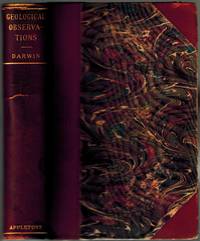
1896rif. 010618New York : D.Appleton and Company 1896. Book. Very Good. Half-Leather. 3rd Edition. 8vo - over 7¾ - 9¾" tall. Third Edition with Maps and Illustrations. xiii 648 pp. Contemporary half red leather over marbled boards gilt lettering and rules to the spine. Top edge gilt. Very Good. Spine has small chip to top of spine; closed tear to mid spine; and rubbing at the corners and edges. Intermittent toning around paste downs and end pages. First published in 1846 Darwin's Geological Observations made up the third part of his memoir of his voyage on the Beagle during the years 1832-1836. Contains two Parts; "Part One: Volcanic Islands and Part Two: South America". Maps and fold outs present and undamaged small stains to the final two fold-outs. Uncommon in collectible condition. . D.Appleton and Company Hardcover books
1987rif. TB33685Birmingham: Gryphon Editions Inc. 1987. Special Edition of Gryphon Editions. Fine in dark blue leather covered boards with bright gilt decorations and text stamped on the spine and front and rear boards with three raised bands on the spine marbled end papers gilt edges to the text block and a silk placement ribbon sewn in at the head of the spine. A small 8vo measuring 7 3/4 by 4 3/4 inches. 502 pages including an index. An elegant reprinting in facsimile of the first edition of 1859. Gryphon Editions, Inc. hardcover books
2003rif. 2349892London: The Folio Society 2003. 4th Printing. Hard Cover. Near Fine/Near Fine. 10x7x2. 2007 4th printing Ford-Smith Folio 76 #1156. Includes publisher's slipcase. Minor blemishes to slipcase embossed owner stamp on half-title page otherwise an excellent copy. 2003 Hard Cover. xxxiv 518 pp. Includes three sections of color and black-and-white reproductions of illustrations maps on endpapers new introduction by Richard Keynes. The Voyage of the Beagle is the title most commonly given to the book written by Charles Darwin and published in 1839 as his Journal and Remarks bringing him considerable fame and respect. This was the third volume of The Narrative of the Voyages of H.M. Ships Adventure and Beagle the other volumes of which were written or edited by the commanders of the ships. Journal and Remarks covers Darwin's part in the second survey expedition of the ship HMS Beagle. Due to the popularity of Darwin's account the publisher reissued it later in 1839 as Darwin's Journal of Researches and the revised second edition published in 1845 used this title. A republication of the book in 1905 introduced the title The Voyage of the "Beagle" by which it is now best known. Beagle sailed from Plymouth Sound on 27 December 1831 under the command of Captain Robert FitzRoy. While the expedition was originally planned to last two years it lasted almost five - Beagle did not return until 2 October 1836. Darwin spent most of this time exploring on land three years and three months on land; 18 months at sea. The book is a vivid travel memoir as well as a detailed scientific field journal covering biology geology and anthropology that demonstrates Darwin's keen powers of observation written at a time when Western Europeans were exploring and charting the whole world. Although Darwin revisited some areas during the expedition for clarity the chapters of the book are ordered by reference to places and locations rather than by date. Darwin's notes made during the voyage include comments hinting at his changing views on the fixity of species. On his return he wrote the book based on these notes at a time when he was first developing his theories of evolution through common descent and natural selection. The book includes some suggestions of his ideas particularly in the second edition of 1845. The Folio Society hardcover books
1997rif. S12976Knoxville:: University of Tennessee Press 1997. 1997. 8vo. xxi 184 pp. Frontis. index. Tan gilt-stamped cloth dust-jacket. Fine. SIGNED BY THE AUTHOR on the title. Tracing the growth of creationism in America as a political movement this book explains why the particularly American phenomenon of anti-evolution has succeeded as a popular belief. Conceptualizing the history of creationism as a strategic public relations campaign Edward Caudill examines why this movement has captured the imagination of the American public from the explosive Scopes trial of 1925 to today's heated battles over public school curricula. Caudill shows how creationists have appealed to cultural values such as individual rights and admiration of the rebel spirit thus spinning creationism as a viable even preferable alternative to evolution. / In particular Caudill argues that the current anti-evolution campaign follows a template created by Clarence Darrow and William Jennings Bryan the Scopes trial's primary combatants. Their celebrity status and dexterity with the press prefigured the Moral Majority's 1980s media blitz more recent staunchly creationist politicians such as Sarah Palin and Mike Huckabee and creationists' savvy use of the Internet and museums to publicize their cause. Drawing from trial transcripts media sources films and archival documents Intelligently Designed highlights the importance of historical myth in popular culture religion and politics and situates this nearly century-old debate in American cultural history. publisher. / Edward Caudill is a professor of journalism and electronic media at the University of Tennessee Knoxville. ISBN 10: 087049984X University of Tennessee Press, 1997. hardcover books
1868rif. 5018Two Volume Set; First Edition/Second Issue; A Very Good set. A remarkably well preserved set of this expanded work on the Origin of Species the only follow up work published in Darwin's lifetime; an important addition to the Theory of Evolution canon. The first issue sold out in a week prompting the 2nd issue printing which corrected a number of mistakes from the first issue. This set is in very good or better condition with 3/4 calf and marbled boards gilt spines with raised bands and marbled endpapers; rubbing and chipping to the spine ends and edges endpapers rubbed and a previous owner's stamp to the front free paper. Overall a highly collectible set of an important work. Not remaindered not ex-library; will ship carefully wrapped in a sturdy box. John Murray hardcover books
1881rif. S4145London:: Harrison and Sons 1881. 1881. 303 x 231 mm. 4to. Pages 491-535; 537-545 pp. 4 tables 3 lithographic plates; 2 figs. 2 tables. Dis-bound. George Howard Darwin was the fifth child of Charles Robert Darwin and Emma Wedgwood. George Darwin graduated from Trinity College Cambridge in 1868. In 1883 Darwin was elected Plumian professor of astronomy and experimental philosophy at Cambridge. Darwin delved deeply into the problems of the origin and evolution of the solar system making numerous investigations of the figures of equilibrium for rotating masses of fluid. A further application of Darwin's theory of tidal friction to the motion of the planets round the sun opened up the wider question of the genesis of the solar system. DNB 1912-1921 pp. 144-147; DSB III pp. 582-584. Harrison and Sons, 1881. unknown books
1981rif. S6746Ithaca and London:: Cornell University Press 1981. 1981. FIRST EDITION. 8vo. xv 834 pp. Blue cloth. Fine. Cornell University Press, (1981). hardcover books
1978rif. S8255Folkestone:: Dawson 1978. 1978. First edition. 8vo. 309 pp. Alphabetical dictionary of Darwin related information. Green cloth dust-jacket. FINE. Dawson, (1978). hardcover books
1960rif. S8254Norwalk:: Burndy Library 1960. 1960. 4to. 72 pp. Illus. folding facs. Printed wrappers; a bit soiled and rubbed but a very good copy. Burndy Library, 1960. unknown books
1979rif. LLV2259London:: Society for Nautical Research 1979. 1979. 8vo. 285-382 pp. Illus. Printed wrappers. Fine. Stansbury's contribution appears on pp. 355-357. Other articles in this issue include: "Admiral of the Fleet the Earl Mountbatten of Burma" obituary; "Roman Triremes and the Outriggerless Phoenician Trireme" Lucien Basch; "Seamen in Dutch Ports c. 1700-c.1914" J.B. Bruijn; "Shipowning in Boston Lincolnshire 1836-1848" Stephanie Jones; "Whalebacks" W.P. Dunphy. Society for Nautical Research, 1979. unknown books
1967rif. LLV2237Berkeley and Los Angeles:: University of California Press 1967. 1967. 8vo. xii 251 1 pp. 9 illus. on plates folding maps appendices index. Cloth dust-jacket; jacket rubbed. Very good. Darwin's letters 1831-1860 edited by Nora Barlow the granddaughter of Darwin. University of California Press, 1967. hardcover books
1872rif. 49393London: John Murray 1872. Very Good. London: John Murray 1872. First Edition mixed issue with issue points detailed below. Octavo; green cloth boards; brown endpapers; vi 374pp. 4pp. recent works dated November 1872. 7 heliotype plates 3 folding; numerous in-text illustrations. Light wear to boards with brief exposure and smudging; binding sound; previous owner's small ownership label to preliminaries; spotting to terminals tide marks to margins; still a Very Good copy. First issue points present: Final signatures are 2B2 and 2C3 with only 2B1 and 2C1 signed; "that" in first line of 208 spelled correctly and all first issue "Recent Works" points present per Freeman. Second Issue points present: Lacks blank preceding title page plates are numbered in Roman though Norman disputes this as a point and text block is 189mm. While working on Descent of Man Darwin became interested in emotional expression across species. In animals he believed expressions were a part of their purposeful action and not connected to emotion. Humans however were very emotional. He examines reactions and expressions in human subjects to different stimuli like "low spirits" of grief and anxiety and "high spirits" like love. Though for Darwin the most intriguing and peculiar reaction to emotion was blushing. So much so that he dedicates an entire chapter to it and comes to the conclusion "It appears that the mental powers of infants are not as yet sufficiently developed to allow of their blushing. Hence also it is that idiots rarely blush." Freeman 1141 & 1142 Norman 600; Garrison-Morton 4975. John Murray unknown books
1870rif. 266381870. Our first Darwin signed photograph in all these years Charles Darwin English naturalist whose scientific theory of evolution by natural selection became the foundation of modern biology and evolutionary studies. Darwin's explanation for the great unfolding of life through time - evolution by natural selection - transformed our understanding of the living world and focused attention on the cumulative inherited change in a population of organisms through time leading to the appearance of new forms: the process by which new species or populations of living things develop from preexisting forms through successive generations. Darwin revolutionized the understanding of the development of living things as Einstein revolutionized our understanding of the physical universe. An attractive Carte de Visite signed ""Ch. Darwin” circa late 1870s very good condition though with a few small adhesive tape marks. The photograph was taken by Elliott & Fry 56 Baker Street London and has their front and back stamps. For a century after its founding in 1863 the firm’s core business was taking and publishing photographs of the Victorian public and social artistic scientific and political luminaries. Among the notables known to have sat for a photograph by Elliott & Fry were Prime Minister William Gladstone Alfred Lord Tennyson W.S. Gilbert Rudyard Kipling Oliver Wendell Holmes Sr. Florence Nightingale and Charles Darwin. In all our years in the field we have seen just a handful of Darwin signed photographs and have never ourselves had one. This is indeed a rarity. But the provenance is just as fascinating as finding a signed Darwin photograph with provenance is perhaps unique. William Bateson was a British biologist who founded and named the science of genetics and whose experiments provided evidence basic to the modern understanding of heredity. He was a dedicated evolutionist and his early works on the mechanisms of biological evolution were strongly influenced by Charles Darwin though he believed that Darwin’s theory of evolution required a firmer base in heredity. Bateson also became the foremost champion of Gregor Mendel’s work on genetics. Darwin died in 1882 when Bateson was at college and though Bateson may have written Darwin such letter is unknown. Bateson and his wife did however correspond with Darwin’s family in later years as “Darwin Online” indicates. This CDV comes with an autograph letter signed from Darwin’s granddaughter Margaret Keynes dated January 23 1929 addressed to Sir George Buckston Browne proposing an alternative date for her and her husband Dr. Geoffrey Keynes to come for lunch expressing gladness that Browne wanted ""the Bateson letter and the other things"" and acknowledging that he attended the same school as Dr. Keynes. Browne had bought Darwin's old home so lunch there would have been a homecoming of sorts for Margaret. Finding the CDV and letter together we would conjecture that this CDV was the property - one of “the other things” - of Margaret that she mentioned in the letter that she was glad Browne wanted and had descended in the family to her along with the Bateson letter. Thus this CDV was apparently property of the Darwin family the most important provenance imaginable. <img class=""alignnone wp-image-25018 size-post-window"" src=""https://cdn.raabcollection.com/wp-content/uploads/20231204144051/Folder-site-11-1600x1327.jpg"" alt="""" width=""1600"" height=""1327"" /> unknown books
1871rif. 013873London: Published by the author printed by Spottiswoode & Co 1871. 1st Edition. Hardcover. Very Good. Nobleman author's vanity binding of his ant-Darwin treatise with complimentary ALS from Darwin's publisher John Murray PM Gladstone Napoleon III Times publisher John Walter and 37 others bound-in. 8vo custom contemporary binding likely commissioned by the Baron himself in polished grey full leather gilt ruled covers front hinge recently repaired 137 pages of text followed by 41 ALS bound-in and in the rear 6 pages one-sided of a pasted-in newspaper review of the book from an unidentified publication. The review observes that Sir Walsh "found it necessary in drawing a parallel between astronomy and geology to allude to Darwin and Buckle Lord Ornathwaite makes their theories the subject of severe criticism." The ALS's bound-in are from peers and public figures variously complimenting Sir Walsh on his work many agreeing with the intellectual aspersions that Sir Walsh heaps on Darwin. Gladstone admits to not being particularly familiar with Darwin's work but posits nevertheless that evolutionary theory tears away at the "fabric of belief". But it is John Murray Darwin's own publisher who is shameless in criticizing the most famous author he will have published: "Although I happen to publish the works both of Buckle & Darwin I do not hesitate to myself a sceptic in the theories of both & I hope one day to see these fallacies exploded & should not be sorry to aid in this result." Most of the letters are on baronial estate or residential letterhead and bound-in chronologically from the end of 1871 through July 1872. Published by the author, printed by Spottiswoode & Co hardcover books
1878rif. 26410London: John Murray 1878. Very Good. London: John Murray 1878. Sixth Edition Twentieth Thousand with additions and corrections. Octavo. 458 pp. with half title and folding plate facing page 91. Bound in contemporary quarter calf; five raised bands gilt decorating and black title label to spine; marbled edges and endpapers. Boards worn along edges with exposure corners bumped rubbing to joints and surface cracking to spine. Recent repair to joints; scraping with surface loss to endpapers; binding holding soundly. Bookplate of tea planter Henry Randolph Trafford to front pastedown. Ownership inscription to preliminaries; text block a bit stiff but pages unmarked and legible throughout. A Very Good later printing of the sixth edition which was originally published in 1872 and was the first to include the word "evolution" though all editions included "evolved" as the final word of text. John Murray unknown books
1921rif. 21107New York City: Max N Maisel 1921. First Yiddish language edition. Original publisher's blue cloth. Very good; some staining to the cloth of volume 1. Chipped dustjacket present for volume 2 only. Some moderate spotting throughout. 8vo I - 6 3 - 364 pp. frontispiece of Darwin; II - 8 9 - 368 pp.; III - 6 9 - 312 pp. Text illustrations throughout. Unsigned. This edition also contains volume 1 of J A Thomson's Essay on Darwinism Freeman #1138; OCLC locating only the APS copy. [Max N Maisel] hardcover books
1859rif. 1293943London: John Murray 1859. Third Edition. Hardcover. Octavo 429 pages with two fold outs and pages of advertisements. In Good plus condition. Rebacked in green cloth with gilt lettering to spine with original boards and preserved and parts of original spine laid on. Boards show wear along the edges; corners bumped and beginning to fray. Pages are age toned as is typical with some minor spotting mostly at the beginning and on the fold outs. Interior otherwise clean and free of marking. An ex-library copy with usual markings including a bookplate from the Royal Navy on front paste down and faded ink stamp on title page. Darwin's contribution present and corrected on page 268. The first edition of 1849 had a transposition error in Darwin's essay some later states included a corrected text in a rear pocket. The second edition was issued in 1851 with no offprint of Darwin's article. This is the third edition complete. Fold out maps are present with some slight tears to the rear map. Shelved in Case 10. 1293943. Shelved Dupont Bookstore. John Murray hardcover books
1989rif. 2308586Oxford: Oxford University Press 1989. Reprint. Hard Cover. Near Fine/Near Fine. 11x8x16. Browne Hablot Knight Phiz; Cattermole George; Seymour; Cruikshank George; Stone Marcus; Dalziel E.G.; Green Townley; Green Charles; Fraser F.A.; French H.; Mahoney J.; Pailthorpe F.W.; Landseer Edwin; Maclise Daniel; Leech John; Tenniel . Reprints. A couple tiny cosmetic blemishes otherwise an exceptional set. Bindings tight and square pages clean bright and unmarked. 1989 Hard Cover. Complete in twenty-one hardcover volumes. 8vo. 7 1/2 x 5. The complete works of Charles Dickens including original illustrations by Hablot Knight Browne Phiz and other artists and scholarly introductions by various contributors. Includes: The Pickwick Papers; David Copperfield; Bleak House; A Tale of Two Cities; Oliver Twist; Nicholas Nickleby; Dombey and Son; The Old Curiosity Shop; Martin Chuzzlewit; Our Mutual Friend; Christmas Stories; Sketches by Boz; Great Expectations; Little Dorrit; Barnaby Rudge; Christmas Books; Hard Times; The Mystery of Edwin Drood; American Notes and Pictures from Italy; Master Humphrey's Clock and A Child's History of England; The Uncommercial Traveller and Reprinted Pieces. Oxford University Press hardcover books
rif. 124278New York: Clarke Given and Hooper Publishers. Good. Hardcover. A Good edition with heavy edgewear to the boards and pages the spine starting to separate loose tanned pages and other general wear ; Darwin's book The Descent of Man and Selection in Relation to Sex is a brilliant examination of the evolution of the human species. He outlines the different stages of human evolution and the roles that sex and selection have played in shaping us. This book is essential reading for anyone interested in human evolution.; 8vo; 797 pages . Clarke, Given and Hooper, Publishers hardcover books
1998rif. 56205New York Oxford: Oxford University Press. Fine in Near Fine dust jacket. 1998. Third Edition. Hardcover. 0195112717 . A handsome Later Edition in unblemished condition in a Near Fine dust-jacket that has some adhesive residue on the cover ; This book by Charles Darwin is a compilation of his work on the expression of emotions in man and animals. Darwin discusses how expressions of emotions change through the different stages of life and how this affects social interactions. He also discusses the evolutionary origins of emotions and their impact on human behavior.; 8vo; 472 pages; Price . Oxford University Press hardcover books