Darwin, Charles RobertLivre Rare Book

7 675 résultats
réf. 5199779Short description: In Russian. Darwin, Charles Robert. On the expression of feelings in humans and animals. type. A. Porokhovshchikov. You are welcome to reach out to us for a detailed description of the copies currently available. Delivery of this book may take longer than usual including extended processing and pre-shipping time, no expedited shipping is available. Please advise us if you have a set date or a deadline to receive your order.SKU5199779
réf. alb98d3e2221b64a7a8The Convolutee of Eight Books: Seven Books in the JZL series, The Lives of Great Men: F. Pavlenkos Biographical Library: Newton: C. Darwin: Em Kant: Auguste Comte: A. Schopenhauer: Adam Smith: D. S. Mill In Russian /Konvolyut vosmi knig: semi knig serii «ZhZL, Zhizn zamechatelnykh lyudey: Biograficheskaya biblioteka F. Pavlenkova»: Nyuton: Ch. Darvin: Em. Kant: Ogyust Kont: A. Shopengauer: Adam Smit: D.S. Mill With the appendix of the book: Lewis J. G. Emmanuel Immanuel Kant. His Life and Historical Meaning 1892-1897. The Convolutee of Eight Books: 1) Philip M. Newton. His Life and Scientific Activities: A Biographical Essay. With Newtons portrait engraved in Leipzig by Gedan. St. Petersburg: Typography and Chromolythography by A. Transchel, 1892. 80 p. We have thousands of titles and often several copies of each title may be available. Please feel free to contact us for a detailed description of the copies available. SKUalb98d3e2221b64a7a8.
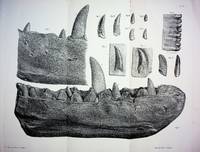
1847réf. 1641FIRST EDITION MAGNIFICENT SET OF THE INAUGURAL 24 VOLUMES PUBLISHED BY THE NEW PALAEONTOGRAPICAL SOCIETY OF LONDON—100 MONOGRAPHS 1000 PLATES 7000 PAGES INCLUDING SEMINAL WORKS OF CHARLES DARWIN AND RICHARD OWEN. 24 quarto volumes 8 x 11 inches later half leather gilt-lettered on spine with gilt panel lines over green textured cloth with gilt-rules green patterned endpapers each containing up to 7 monographs with lithographic or engraved plates many folding and some wood engravings in the text. The volumes appear to be unread with tight bindings that are as new and bright plates. Preliminary pages of each volume contain a perforated stamp of the Carnegie Library of Pittsburgh—there are no other ownership marks only rare light foxing. Very good. The Palaeontographical Society was established in 1847 and is the oldest society devoted to the study of paleontology worldwide. Its primary role is to promote the description and illustration of the British fossil flora and fauna via publication of an authoritative monograph series. The monographs were issued annually to members of the society. They cover a wide range of taxonomic groups from microfossils trilobites and ammonites through to Coal Measure plants mammals and reptiles and from all ages from Cambrian to Pleistocene. They form a benchmark for understanding the past life of the British Isles and many include the original descriptions of numerous key species. The first monograph Vol. 1 on the Crag Mollusca was published in March 1848 and the Society continues this work today. Notable authors in the series include Charles Darwin and Richard Owen both members of the Society. Darwin's interest in barnacles had first arisen in his student days in Edinburgh under the guidance of Robert Grant and increased during his detailed work in dissecting and classifying the specimens he had collected on the Beagle voyage. Darwin published his papers on fossil barnacles included in volumes 5 1851 and 8 1854 reflecting the 8 years that he devoted to the study of extinct and living barnacles establishing his credentials for formulating his theory of natural selection in The Origin of Species in 1859. In his analysis of reptilian British fossils Darwin's leading opponent Richard Owen identified unique characteristics of Megalosaurus vol. 9 Iguanodon and Hylaeosaurus vol. 10 that distinguished them from extant lizards and coined the term dinosaur "terrible lizard" in 1841. There are 22 monographs by Owen in the first 24 volumes including 16 on dinosaurs 4 on other reptiles and turtles and 2 on mammals including whales. British fossil hunter William Buckland found some fossils in 1819 and he eventually described them and named them in 1824. Like scientists before him Buckland thought the fossils belonged to an ancient larger version of a modern reptile. The first edition of a work which laid the foundation to vertebrate paleontology was Georges Cuvier's Recherches sur les ossements fossiles de quadrupèdes Researches on quadruped fossil bones published in France in 1812. In 1822 Cuvier's disciple and editor of the scientific publication Journal de physique Henri de Blainville introduced the term palaeontologie as the study of fossilized organisms—translated to the English paleontology. The word palaeontographical was coined by members of the Clay Club that established the new society whose goal was to describe and illustrate newly discovered fossils. The rapid progress in geology and paleontology during the 1830s and 1840s was aided by a growing international network of geologists and fossil specialists whose work was organized and reviewed by an increasing number of geological societies. Many of these geologists and paleontologists were now paid professionals working for universities museums and government geological surveys. The relatively high level of public support for the earth sciences was due to their cultural impact and their proven economic value in helping to exploit mineral resources such as coal. Another important factor was the development in the late 18th and early 19th centuries of museums with large natural history collections. The first 24 years of the Palaeontographical Society Monographs spans the middle of the 19th century and brackets publication of The Origin of Species in 1859. The intense activity in British paleontology at this time is reflected in the 110 monographs contained in these 24 volumes and provides a visual as well as a narrative context for the contributions of Darwin and Owen. The 27 contributing authors reveal the strong attraction of paleontology for physicians and the wide variety of species whose ancestors were pursued. These ranged from minute foraminifera to larger marine invertebrates including corals tunicates brachiopods mollusks echinoderms ammonites belemnites trilobites and eurypterids and vertebrates fish reptiles and mammals. Because photography did not become widely available until the end of the 19th century illustrations in the monographs were executed as lithographs or engravings. The most prominent London lithographers of the day were recruited to produce the dramatic plates. Many of these artists were themselves accomplished naturalists. These included Day & Son Lithographers to Queen Victoria; George Henry Ford a member of the British Museum; Michael & Nicholas Hanhart who developed a complex layering of tint stones; Charles Joseph Hullmandel author of The Art of Drawing on Stone; and the Sowerby family a British family of several generations of naturalists illustrators botanists and zoologists active from the late 18th century to the mid twentieth century. The three George Sowerbys produced major works on mollusks and their systematics including the many monographs by the Society as well as Darwin's barnacles. Notably the Sowerbys were responsible for also producing the copper plate engravings for these monographs including James De Carle Sowerby who founded the Royal Botanic Society and Gardens and was its secretary for 30 years. The Paleontographical Society Monographs are cited by Darwin in his reading notebooks. NOTE: Available upon request info@BiomedRarebooks.com A 22-page detailed description of the set containing large magnification images of selected plates list of individual monographs in each volume and list of authors subjects plates sorted by subject. Palaeontographical Society hardcover books
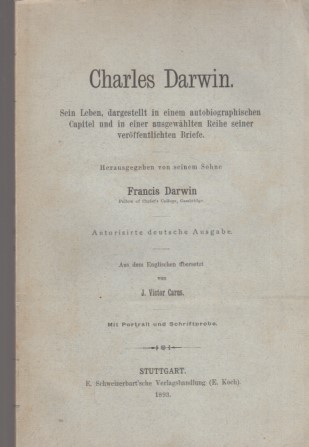
1893réf. 1212041Stuttgart; E. Schweizerbart'sche Verlagshandlung (E. Koch), 1893. IV; 385 Seiten; graph. Darst.; 23,5 cm; fadengeh. Orig.-Pappband.
1893Gutes Exemplar; Einband mit minimalen Läsuren; Seiten unaufgeschnitten; wenige Seiten mit Wasserspuren u. gering fleckig. - Charles Robert Darwin (* 12. Februar 1809 in Shrewsbury; † 19. April 1882 in Down House/Grafschaft Kent) war ein britischer Naturforscher. Er gilt wegen seiner wesentlichen Beiträge zur Evolutionstheorie als einer der bedeutendsten Naturwissenschaftler. Die Ende 1831 begonnene und fast fünf Jahre andauernde zweite Reise mit der HMS Beagle, die den jungen Darwin einmal um die Welt führte, war zugleich Schlüsselerlebnis und Grundlage für sein späteres Werk. Der breiten Öffentlichkeit wurde Darwin erstmals durch seinen 1839 herausgegebenen Reisebericht bekannt. Mit seiner Theorie über die Entstehung der Korallenriffe und weiteren geologischen Schriften erlangte er in wissenschaftlichen Kreisen die Anerkennung als Geologe. Seine Untersuchungen an den Rankenfußkrebsen (Cirripedia) verschafften ihm Mitte der 1850er Jahre zusätzlich einen Ruf als angesehener Zoologe und Taxonom. Bereits 1838 entwarf Darwin seine Theorie der Anpassung an den Lebensraum durch Variation und natürliche Selektion und erklärte so die phylogenetische Entwicklung aller Organismen und ihre Aufspaltung in verschiedene Arten. Über 20 Jahre lang trug er Belege für diese Theorie zusammen. … (wiki) // ... Man wird z. B. sehen, daß nach dem 8. Capitel eine Unterbrechung eintritt; die Erzählung geht von 1854 auf 1831 zurück, damit die sich auf die Entwicklungslehre beziehenden Capitel die Geschichte ununterbrochen darstellen. In gleicher Weise wird die botanische Thätigkeit, welche in dem späteren Theile seines Lebens so viel von meines Vaters Zeit in Anspruch nahm, besonders in dem 16. und 17. Capitel besprochen. Was das 4. Capitel betrifft, in welchem ich eine Schilderung der Arbeitsweise meines Vaters zu geben versucht habe, so sei mir zu erwähnen gestattet, daß ich während der letzten acht Jahre seines Lebens als sein Assistent thätig gewesen bin und ich daher Gelegenheit gehabt habe, etwas von seinen Gewohnheiten und Methoden kennen zu lernen. ... (Vorwort Francis Darwin) // INHALT : Die Darwins ----- Autobiographie ----- Religion ----- Erinnerungen ----- Leben in Cambridge - Die Anstellung am Beagle: 1828 ----- 1831 ----- Die Reise: 1831 ----- 1836 ----- London und Cambridge: 1836 ----- 1842 ----- Leben in Down: 1842 ----- 1854 ----- Das Grundlegen der ,Entstehung der Arten': 1831 ----- 1844 ----- Das Wachsthum der ,Entstehung der Arten': 1843 ----- 1858 ----- Das Schreiben der ,Entstehung der Arten', Juni 1858 b Kovbr 1859 ----- Die Herausgabe der ,Entstehung der Arten', Okt b Decbr 1859 ----- Die ,Entstehung der Arten' ----- Anzeigen und Kritiken ----- Annahmen und Angriffe: 1860 ----- Die Ausbreitung der Entwicklung: 1861 ----- 1871 ----- Miscellanea ----- Wiederaufnahme geologischer Arbeit ----- Die Vivisectionsfrage ----- Ehrenbezeugungen ----- Die Befruchtung der Blüthen ----- Kletterpflanzen ----- Bewegungsvermögen bei Pflanzen ----- Insectenfressende Pflanzen ----- Kew-Index der Pflanzennamen Schluß ----- Anhang : Das Begräbnis in der Westminster Abtei ----- Portraits.
1980réf. 77076Frankfurt am Main : Societäts-Verlag 1980. 871 S. : Ill. ; 22 cm Leinen 0
1896réf. 87310NY:: D. Appleton and Company. Very Good. 1896. Hardcover. B00CIZQL7Q . With illustrations. Authorized edition. Octavo half bound in burgundy leather with gilt lettering on the spine marbled boards top edge gilt. Age darkened along the spine moderate edge wear else very good. Some unopened pages. Binding is solid.; 592 pages . D. Appleton and Company, hardcover books
1991réf. 1419001Cambridge: Cambridge University Press 1991. Hardcover. Octavo Volume Seven only: xxxv 671 pages. In Good minus condition with a Good minus dust jacket. Spine is green with black and white print. Dust jacket has edge wear small vendor label on rear panel. Boards in black cloth.Text block has name in ink on front flyleaf marginal notation in ink. Illustrated: b&w frontispiece portrait and plates photographs. NOTE: Shelved in Netdesk Column F ND-F . 1419001. FP New Rockville Stock. Cambridge University Press hardcover books
1890réf. 12138London: Ward Lock and Co 1890. Later Edition. Hardcover. Good. Later Edition. Hardcover. Previously owned by Oliver Sacks. The original editions app.eared in 1842 1844 and 1846 respectively. Minerva Library No. 18. Presents all three parts of the first edition of Darwin's geological results of the Beagle voyage with a critical introduction to each work by Prof. John W. Judd. The voyage of the Beagle lasted from December 1831 to October 1836 and carreid Darwin around the wotld but especially to South America. Former owner name on ffep: Trevor H. Evans St. Johns Hospital. From the library of Dr. Oliver Sacks the renowned neurologist author and educator. He was in his life celebrated for his contributions to the understanding of the human brain and his ability to communicate complex scientific concepts to a broader audience. In doing so he highlighted the profound impact of neurological disorders on human identity and experience. His library is a reflection of this remarkable polymath's questing mind. Moderate shelf/edge wear discoloration to boards toning else tight and unmarred. Original textured green cloth boards with black and gilt borders and lettering patterned endpapers. 8vo.xx 549pp. illus. b/w illus. including 3 fold-out plates plus 6 page publisher's catalogue 40 text figures. Ward, Lock, and Co hardcover books
19714to [28 x 21 cm]; xvii, [iii], 362, [ii] pp, numerous illustrations from drwgs by Fritz Kredel including full-page printed in black and red, index, title page in red and black. original morocco-backed wood veneer boards, elaborate gilt design and title lettering on spine, fine and clean in original veneer covered slipcase with gilt decorated end (sight wear to edge). A picture of this book is available upon request by email. Freeman 1043. It was originally published in 1871 in 2 volumes, the word 'evolution' appearing for the first time in any of Darwin's works, and deals with the evolution of man. This edition is printed from the definitive 1877 edition. It is a companion volume to Origin of Species.
réf. 120387Paris, C. Reinwald et Cie. 1879, 235x150mm, reliure d'éditeur. reliure percaline avec auteur, titre et ornementations dorés au dos. Bel exemplaire.
1908réf. 26264Leipzig, Alfred kröner, (1908-09). Orig. printed wrappers. VI,154 pp.
1909réf. 26265Leipzig, Alfred Kröner, (1909). Orig. printed wrappers. VI,288 pp., textillustr.
1889réf. 50929Fagerstrand pr. Høvig, Bibliothek for de tusen hjem, (1889). 8vo. 3 vols in later printed full cloth. Bindings with light soiling and miscolouring to spines. All three volumes with ex-libris (Olga Siegfried Wagner). A fine set. (Frontispiece), 445, (1) pp. (Frontispiece), 456 pp." (Frontispiece), 488 pp.
1889réf. 53189Fagerstrand pr. Høvig, Bibliothek for de tusen hjem, (1889). 8vo. 3 vols in contemporary black half calf. Previous owner's name (Danish zoologist S. L. Tuxen) to top of Front free end-papers. A fine and clean set. (three Frontispieces), 445, (1) pp. 456 pp." 488 pp.
1889réf. 60362Fagerstrand pr. Høvig, Bibliothek for de tusen hjem, (1889). 8vo. 3 volumes all in publisher's original embossed cloth-bindings with gilt lettering to spines and front boards. Very light wear to extremities, corners bumped, an overall excellent set. 445, (1) pp. 456 pp." 488 pp. + 3 Frontispieces.
réf. 117808Paris, C. Reinwald 1887, 235x150mm, reliure percaline verte de l’éditeur. Coiffes légèrements frottées. Joints de liaison internes renforcés. Nom du possesseur sur le haut de la page de faux-titre. Intérieur propre, bel exemplaire.
réf. 121676Paris, Jean de Bonnot 1982, 215x140mm, XI - 464 + 471pages, reliure d'éditeur. Dos ornementations dorés,plats ornés à froid, tranche supérieure dorée. Exemplaire à l'état de neuf.
1874réf. 52245Kjøbenhavn, Gyldendal, 1874-75. 8vo. Bound in one contemporary half calf. Gilt spine with gilt lettering. Spine a little rubbed and upper compartment of spine with some loss of leather. (6),V,426"(2),401 pp., textillustrations. A few leaves with brownspots.
1874réf. 53165Kjøbenhavn, Gyldendal, 1874-75. 8vo. Bound in one contemporary half calf. Gilt spine, titlelabel with gilt lettering. Light edgewear and light wear to spineends. (6),V,426"(2),401 pp., textillustrations. Internally clean and fine.
1871réf. 56496Stockholm, L.J. Hiertas Förlagsexpedition, 1871. 8vo. Contemporary half calf with gilt lettering to spine and gilt ornamentation forming five compartments. Hindges with a few worm holes, back hindges mostly affected, but binding still tight and firmly attached to book block. Previous owner's stamp to pasted down front end-paper. Internally extraordinarily fine and clean. XI, (1), 420 pp. + plate with genealogical tree inserted between p. 96 and p. 97.
1963réf. 60530Adelaide, The Limited Editions Club, 1963. 4to. In half wallaby over paper covered boards, imitating wooden boards. Spine in black wallaby hide with gilt lettering and ornamentation with green inlaid label. XXXII, 470 pp. + 6 engraved coloured plates and 72 illustrations in text. The paper was also produced in Australia for this specific edition. No. 785 out of 1500 copies. Housed in a green slip-case. A fine and clean copy.
1913réf. LCI-5477London, John Murray 1913 1 in -8 fort volume Reliure pleine toile 1031
1892réf. LCI-21891892 London Murray, John 1892 1 In 12 Couverture percaline verte 432[pp] Cartonnage Editeur;
1887réf. 57522BB3 Bände. London, John Murray, 1887. Gross-8°. IX, 3 n.n. S., 539 (recte 395) S.; 2 Bl.,393 S.; IV, 418 S. Mit 3 Frontispiz, 1 Faksimile und Illustrationen im Text. Originalleinwandbände.