7 682 résultats
1967réf. LLV2237Berkeley and Los Angeles:: University of California Press 1967. 1967. 8vo. xii 251 1 pp. 9 illus. on plates folding maps appendices index. Cloth dust-jacket; jacket rubbed. Very good. Darwin's letters 1831-1860 edited by Nora Barlow the granddaughter of Darwin. University of California Press, 1967. hardcover books
1930pp. xvi, 1000. 8vo. 210mm. Original full cloth binding. Spine darkened. MOD LIB BX 1
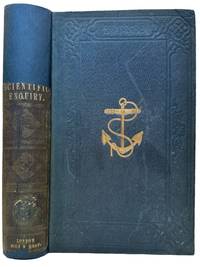
1849réf. SRW1705London:: John Murray . . . publisher to the admiralty 1849. 1849. 8vo. xi 1 488 pp. Large folding oceanographic map showing the Approximate Limits of the Great Currents and Drifts of the Ocean scattered figures 1 engraved plate Hydrographic delineation appendices; final leaf reinforced at gutter. Original full dark green embossed cloth with gilt anchor device on upper cover in blind on the back cover Freeman notes that “in some copies but not all the anchor on the top board is gilt” as is with this copy no pocket in rear bottom board as per this issue; spine replaced preserving a remnant of the original spine corners and joints reinforced. Bookplate of Charles F. Cox New York; embossed stamp of the Carnegie Institution Solar Observatory under George Ellery Hale being from his library donated to the Mount Wilson Observatory. Very good. Rare. FIRST EDITION second issue with pp.171-90 cancelled containing the corrected sheets including part of Darwin’s article. Freeman notes that most copies of the first issue including Darwin’s own were published with a separate 20-page cancellans inserted into a pocket inside the back cover. Freeman further states that some copies may have been issued without the cancellans as here. This collection of scientific articles on subjects relating to naval training was used as a textbook for cadets at the Royal Naval College. Darwin contributed the section on “Geology” which contained serious transpositions of the text which were cancelled and replaced with corrected sheets. / “Sir John Frederick William Herschel 1792-1871 – astronomer mathematician chemist - was one of the most important British scientists of the nineteenth century. Son of the famous astronomer William Herschel he was persuaded by his father to pursue the astronomical investigations William could no longer undertake; John’s subsequent career resulted in a knighthood and a lifetime of accolades. This 1849 publication was commissioned by the Admiralty to encourage and assist naval officers to undertake scientific research while abroad. The work provides instructions in making and recording observations in a wide range of disciplines - astronomy; magnetism; hydrography; tides; geography; geology; earthquakes; mineralogy; meteorology; atmospheric waves; zoology; botany; ethnology; medicine; statistics - written by experts in these fields including G.B. Airy Capt. Beechey Leut. Col. Sabine R. Mallet Sir H.T. de la Beche W. R. Birt Richard Owen W.J. Hamilton Rev. Dr. Whewell Charles Darwin Dr. Pritchard G.R. Porter Dr. Bryson Sir William Jackson Hooker and Herschel himself. It was hoped that the instructions could also be used by other travellers to advance scientific knowledge and the work remained in print for over fifty years.” PROVENANCE 3: 1 Charles Finney Cox 1846-1912 New York. He worked as an American railroad manager holding roles including Assistant Treasurer of the Canada Southern Railway Company Vice-President of the Richmond & Alleghany Railroad Company and President of the Carthage & Adirondack Railway Company. He became Treasurer and President of the New York Academy of Sciences. In 1896 Cox was appealing for financial assistance to fund a suitable building for the Scientific Alliance of New York including creating a 100000 volume library etc. Cox was an active member of scientific groups like the New York Microscopical Society and the Royal Microscopical Society. He assembled a notable collection of Darwiniana which was later acquired by the New York Botanical Garden in 1912 as a permanent memorial; 2 embossed stamp of the Carnegie Institution Solar Observatory under 3 George Ellery Hale 1868-1938 being from his library donated to the Mount Wilson Observatory. REFERENCES: Freeman 1977 326; Norman 1057. John Murray . . . publisher to the admiralty, 1849. hardcover books
1985réf. BL1509New York and London:: Garland 1985. 1985. Series: Garland Reference Library of the Humanities Vol. 369. 4to. 690 pp. Port. of Darwin index; small tick-mark in one margin otherwise clean. Red cloth gilt-stamped spine title. Burndy bookplate. Near fine. ISBN: 0824092244 First edition noting that a 46-page supplement with a reprinting the original was issued in 1994. Frederick Burkhardt was for many years the President Emeritus of the American Council of Learned Societies. His decades of work on The Correspondence of Charles Darwin constituted a signal example of dedication to a demanding and ambitious scholarly enterprise. He was an Honorary Fellow of Clare Hall Cambridge. Garland, 1985. hardcover books
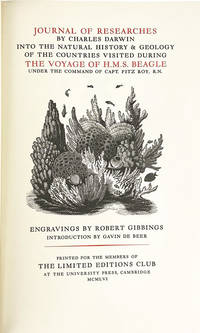
1956réf. 022366Cambridge: Limited Editions Club 1956. Hardcover. Fine in lightly worn glassine and an intact near Very Good slipcase. Robert Gibbings. Tall quarto 7-1/2" x 12" bound in full sailcloth stamped in brown with a native tapa design; 490 pages. Introduction by Sir Gavin de Beer. Illustrated with text wood engravings by Robert Gibbings. Copy #751 of 1500 SIGNED by the artist on the colophon page. Monthly Letter laid in. Limited Editions Club hardcover books
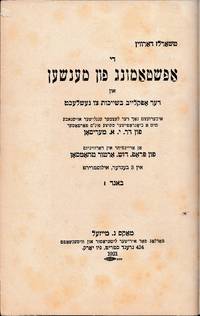
1921réf. 21107New York City: Max N Maisel 1921. First Yiddish language edition. Original publisher's blue cloth. Very good; some staining to the cloth of volume 1. Chipped dustjacket present for volume 2 only. Some moderate spotting throughout. 8vo I - 6 3 - 364 pp. frontispiece of Darwin; II - 8 9 - 368 pp.; III - 6 9 - 312 pp. Text illustrations throughout. Unsigned. This edition also contains volume 1 of J A Thomson's Essay on Darwinism Freeman #1138; OCLC locating only the APS copy. [Max N Maisel] hardcover books
1884réf. 40145BBStuttgart, Band 1-5: Schweizerbart (E. Schweizerbart'sche Verlagshandlung) / Band 6: Fines Mundi, 1884 - 1886 (Bde. 1-5) / 2017 (Bd. 6). Sechs Bände. Mischauflage (Bände 1,3,4 und 5: 2. Auflage, Band Bände 1-5: Mit goldener Titelprägung versehene Ganzleinenbände der Zeit / Band 6: Originaler Hardcoverband (Unveränderter Faksimilereprint der Ausgabe Schweizerbart, 1876.). Besitzer-Etikett (Ex Libris) auf vorderer Cover-Innenseite aller Bände. Textseiten der Original-Bände altersbedingt leicht gebräunt. Die Bände 4 und 5 durchgehend etwas stockfleckig. Keine Anstreichungen! Keine handschriftlichen Besitzervermerke! Bindunge (Charles Darwin - ).
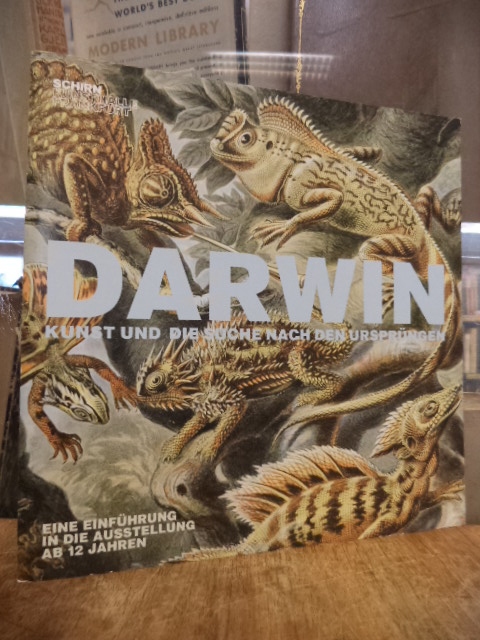
réf. 37865ABFfm., Schirn Kunsthalle / Rasch, 2017. quadr.8°, 35 S. mit Farb- und s/w-Abbildungen und Illustrationen, illustr. original Kartonage (geheftet), schönes, sauberes Exemplar, noch mit Beilagen zur Ausstellung.
1950réf. 194710New York: Henry Schuman 1950. First edition thus. Hardcover. 266 pages. Edited by Sir Francis Darwin. Features Charles Darwin's notes and letters depicting the growth of the "Origin of Species." Includes an introductory essay by George Gaylord Simpson. A near fine copy in cloth boards and in a near fine dust jacket with a tear to the top of the rear panel and some other minor wear. Henry Schuman unknown books
1860réf. 1296Boston: Ticknor and Fields 1860. First edition. 1860 THE ATLANTIC MONTHLY JULY-DECEMBER 1860--CONTAINS 3 REVIEWS OF DARWIN'S ORIGIN OF SPECIES AND AN EDITORIAL PROMOTING LINCOLN'S CANDIDACY FOR PRESIDENT BOTH MEN WERE BORN FEBRUARY 12 1809. 9 1/2 inches tall hardcover 3/4 black leather binding spine with raised bands gilt ruled compartments and gilt title and initials of previous owner Fr. A. Bryan. Edges marbled marbled endpapers with armorial bookplate of Fr. A. Bryan to front paste-down iv 764 pp; joints starting binding tight light foxing to endpapers pages crisp and unmarked very good. Darwin first wrote to Asa Gray in 1855. A correspondence and intellectual comradeship quickly developed to the point where in July 1857 Darwin informed Gray of his as yet unpublished theory of natural selection thereby making Gray the third person after Joseph Hooker and Charles Lyell to know his secret. Part of this letter to Gray was later included in the presentation to the Linnean Society in July 1858 when Darwin first made his theory and Wallace's public. After the publication of The Origin of Species Gray became Darwin's foremost American defender against his Harvard colleague Louis Agassiz and other critics. Gray arranged for the publication of an American edition of the Origin of Species and wrote a positive review for the American Journal of Science. Then in the three issues-July pp 109-116 August pp 229-239 October pp 406-425 1860--of The Atlantic Monthly contained in this volume he wrote again anonymously in defense of Darwin the first two parts "Darwin on the Origin of Species" the third "Darwin and His Reviewers". Darwin was extremely pleased with Gray's Atlantic Monthly piece and eventually funded its publication-retitled and under Gray's name-by Ticknor and Fields the publisher of The Atlantic Monthly and had 250 copies sent to him for distribution by Trubner and Co. Because James Fields was a close friend of Louis Agassiz the pamphlet was never sold by Ticknor and Fields in the United States. "Thus although actually printed in America the pamphlet was in effect a British publication and received the impetus of Darwin's promotional efforts there" Dupree Asa Gray p. 299. Notably also contained in this volume is a report in the October issue pp 492-502 titled The Election in November: ""We believe that this election is a turning-point in our history . . . It is in a moral aversion to slavery as a great wrong that the chief strength of the Republican party lies. . . . We are persuaded that the election of Mr. Lincoln will do more than anything else to appease the excitement of the country. He has proved both his ability and his integrity; he has head experience enough in public affairs to make him a statesman and not enough to make him a politician. The encroachments of Slavery upon our national policy have been like those of a glacier in a Swiss valley. Inch by inch the huge dragon with his glittering scales and crests of ice coils itself onward an anachronism of summer the relic of a bygone world where such monsters swarmed. But it has its limit the kindlier forces of Nature work against it and the silent arrows of the sun are still as of old fatal to the frosty Python. Geology tells us that such enormous devastators once covered the face of the earth but the benignant sunlight of heaven touched them and they faded silently leaving no trace but here and there the scratches of their talons and the gnawed boulders scattered where they made their lair. We have entire faith in the benignant influence of Truth the sunlight of the moral world and believe that slavery like other worn-out systems will melt gradually before it. 'All the earth cries out upon Truth and the heaven blesseth it; ill works shake and tremble at it and with it is no unrighteous thing.'" Psalm 66 Isaiah 13 Hebrews 6. Abraham Lincoln and Charles Darwin were born on the same day February 12 1809. Both lost their mother at a young age and despite their differences in upbringing both men saw themselves as autodidacts. In his book Lincoln and Darwin 2010 James Lander argues that they also shared an interest in science and a skeptical approach to religion. Darwin closely followed the events of the American Civil War and wanted Lincoln and the Union to prevail. Lander explores similarities in the intellectual development concerns and impacts of Abraham Lincoln and Charles Darwin focusing in particular on the issue of slavery in the United States which both men influentially opposed. Lander's broader argument is that Lincoln and Darwin shared the same outlook on the central issues of race science and religion. He also looks at the relationship between science and race in the 19th century United States and the emergence and influence of scientific racism. Of particular interest in this volume of The Atlantic the article on the coming presidential election refers to geologic time and extinction of the dinosaurs as a metaphor for the hoped-for extinction of slavery. Also in this volume a review of Home Ballads and Poems by John Greenleaf Whittier concluding "We have had no more purely American poet thn Mr. Whittier none in whom the popular thought found such ready and vigorous expression." THE ATLANTIC was founded in 1857 in Boston as The Atlantic Monthly a literary and cultural magazine that published leading writers' commentary on education the abolition of slavery and other major political issues of that time. In 1860 three years into publication The Atlantic's then-editor James Russell Lowell endorsed Republican Abraham Lincoln for his first run for president and also endorsed the abolition of slavery. Ticknor and Fields hardcover books
1963réf. 195274New York: The Heritage Press 1963. Hardcover. VG/VG light wear to board cloth edges spine ends & corners. slipcase tanned. green paper boards w/ gilt illustration quarter leatherette spine w/ gilt printing. 470 pgs w/ bw illustrations. green paper slipcase. Includes publisher's 'Sandglass' newsletter/introduction. Remains a nice bright and sharp copy; light handled and possibly unread. The Heritage Press hardcover books
1957réf. 195419New York: Heritage Press 1957. Hardcover. VG- Boards and Slipcase have light edgewear/scuffs/smudged; interior is clean; binding is solid. Gibbings Robert. Off-white cloth boards with brown lettering and illustration; brown slipcase; xvi 489 pp.; richly illustrated. When HMS Beagle sailed out of Devonport on 27 December 1831 Charles Darwin was twenty-two and setting off on the voyage of a lifetime. His journal here reprinted in a shortened form shows a naturalist making patient observations concerning geology natural history people places and events. Volcanoes in the Galapagos the Gossamer spider of Patagonia and the Australasian coral reefs - all are to be found in these extraordinary writings. The insights made here were to set in motion the intellectual currents that led to the theory of evolution and the most controversial book of the Victorian age: The Origin of Species. This volume reprints Charles Darwin's journal in a shortened form. In their introduction Janet Brown and Michael Neve provide a background to Darwin's thought and work and this edition also includes notes maps appendices and an essay on scientific geology and the Bible by Robert FitzRoy Darwin's friend and Captain of the Beagle. - Amazon synopsis. Heritage Press hardcover books
1880réf. 1104181880. London: John Murray 1880. 8vo x 592 32 ads dated May 1878 pp. Illustrated with 196 in-text woodcuts. Original green blind-stamped cloth backstrip titled in gilt brown coated endpapers hinges cracked a little wear to crown and foot of backstrip text block edges but not pages stained an unsophisticated copy. § § First edition first issue inscribed in Charles Darwin's hand "Elizabeth Darwin From her Father." Presentation copies from Darwin in his own hand are exceptionally rare most presentation copies were inscribed "from the author" by the publisher; a copy inscribed to a family member by Darwin himself is extraordinarily so. Elizabeth Darwin known as Bessy was Charles and Emma Darwin's youngest daughter and perhaps the most enigmatic of all their ten children. She is remembered as a quiet soul who lived in the family home until the death of her mother and then in a cottage on her own near her three brothers until her death in 1926. The book which Darwin has inscribed to her was written with the assistance of her brother Francis who had himself become an accomplished botanist. It is an extension of Darwin's earlier work on movement in climbing plants showing that the same mechanisms hold true for flowering plants in general. It was well reviewed and immediately sold 1500 copies. Darwin was an exceptionally affectionate father whose anxious feelings for his own children greatly spurred his study of inherited characteristics and of evolution. He and his wife Emma were first cousins a genetic liability that tormented him. This book written in partnership with one of his children and presented to another is a potent testament to the intertwining of scientific genius and fatherhood that so characterized Darwin and catalyzed his momentous career. Books inscribed by Darwin to his children are extremely rare on the market. The last such book at auction - a copy of The Descent of Man and Selection in Relation to Sex inscribed by Darwin to his daughter Henrietta who had edited the book - sold for £90000 at Sotheby's in 2015. unknown books
1892réf. 549489London: John Murray 1892. Hardcover. Very Good. Stated eleventh thousand. Octavo. 394pp. Illustrated with photogravure plates from photographs by Oscar Rejlander. Light edgewear tiny rubbed spot on the lower shoulder and small light stain on lower board both hinges neatly strengthened very good or better. A bright copy. John Murray hardcover books
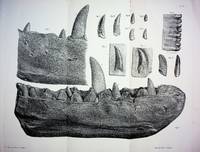
1847réf. 1641FIRST EDITION MAGNIFICENT SET OF THE INAUGURAL 24 VOLUMES PUBLISHED BY THE NEW PALAEONTOGRAPICAL SOCIETY OF LONDON—100 MONOGRAPHS 1000 PLATES 7000 PAGES INCLUDING SEMINAL WORKS OF CHARLES DARWIN AND RICHARD OWEN. 24 quarto volumes 8 x 11 inches later half leather gilt-lettered on spine with gilt panel lines over green textured cloth with gilt-rules green patterned endpapers each containing up to 7 monographs with lithographic or engraved plates many folding and some wood engravings in the text. The volumes appear to be unread with tight bindings that are as new and bright plates. Preliminary pages of each volume contain a perforated stamp of the Carnegie Library of Pittsburgh—there are no other ownership marks only rare light foxing. Very good. The Palaeontographical Society was established in 1847 and is the oldest society devoted to the study of paleontology worldwide. Its primary role is to promote the description and illustration of the British fossil flora and fauna via publication of an authoritative monograph series. The monographs were issued annually to members of the society. They cover a wide range of taxonomic groups from microfossils trilobites and ammonites through to Coal Measure plants mammals and reptiles and from all ages from Cambrian to Pleistocene. They form a benchmark for understanding the past life of the British Isles and many include the original descriptions of numerous key species. The first monograph Vol. 1 on the Crag Mollusca was published in March 1848 and the Society continues this work today. Notable authors in the series include Charles Darwin and Richard Owen both members of the Society. Darwin's interest in barnacles had first arisen in his student days in Edinburgh under the guidance of Robert Grant and increased during his detailed work in dissecting and classifying the specimens he had collected on the Beagle voyage. Darwin published his papers on fossil barnacles included in volumes 5 1851 and 8 1854 reflecting the 8 years that he devoted to the study of extinct and living barnacles establishing his credentials for formulating his theory of natural selection in The Origin of Species in 1859. In his analysis of reptilian British fossils Darwin's leading opponent Richard Owen identified unique characteristics of Megalosaurus vol. 9 Iguanodon and Hylaeosaurus vol. 10 that distinguished them from extant lizards and coined the term dinosaur "terrible lizard" in 1841. There are 22 monographs by Owen in the first 24 volumes including 16 on dinosaurs 4 on other reptiles and turtles and 2 on mammals including whales. British fossil hunter William Buckland found some fossils in 1819 and he eventually described them and named them in 1824. Like scientists before him Buckland thought the fossils belonged to an ancient larger version of a modern reptile. The first edition of a work which laid the foundation to vertebrate paleontology was Georges Cuvier's Recherches sur les ossements fossiles de quadrupèdes Researches on quadruped fossil bones published in France in 1812. In 1822 Cuvier's disciple and editor of the scientific publication Journal de physique Henri de Blainville introduced the term palaeontologie as the study of fossilized organisms—translated to the English paleontology. The word palaeontographical was coined by members of the Clay Club that established the new society whose goal was to describe and illustrate newly discovered fossils. The rapid progress in geology and paleontology during the 1830s and 1840s was aided by a growing international network of geologists and fossil specialists whose work was organized and reviewed by an increasing number of geological societies. Many of these geologists and paleontologists were now paid professionals working for universities museums and government geological surveys. The relatively high level of public support for the earth sciences was due to their cultural impact and their proven economic value in helping to exploit mineral resources such as coal. Another important factor was the development in the late 18th and early 19th centuries of museums with large natural history collections. The first 24 years of the Palaeontographical Society Monographs spans the middle of the 19th century and brackets publication of The Origin of Species in 1859. The intense activity in British paleontology at this time is reflected in the 110 monographs contained in these 24 volumes and provides a visual as well as a narrative context for the contributions of Darwin and Owen. The 27 contributing authors reveal the strong attraction of paleontology for physicians and the wide variety of species whose ancestors were pursued. These ranged from minute foraminifera to larger marine invertebrates including corals tunicates brachiopods mollusks echinoderms ammonites belemnites trilobites and eurypterids and vertebrates fish reptiles and mammals. Because photography did not become widely available until the end of the 19th century illustrations in the monographs were executed as lithographs or engravings. The most prominent London lithographers of the day were recruited to produce the dramatic plates. Many of these artists were themselves accomplished naturalists. These included Day & Son Lithographers to Queen Victoria; George Henry Ford a member of the British Museum; Michael & Nicholas Hanhart who developed a complex layering of tint stones; Charles Joseph Hullmandel author of The Art of Drawing on Stone; and the Sowerby family a British family of several generations of naturalists illustrators botanists and zoologists active from the late 18th century to the mid twentieth century. The three George Sowerbys produced major works on mollusks and their systematics including the many monographs by the Society as well as Darwin's barnacles. Notably the Sowerbys were responsible for also producing the copper plate engravings for these monographs including James De Carle Sowerby who founded the Royal Botanic Society and Gardens and was its secretary for 30 years. The Paleontographical Society Monographs are cited by Darwin in his reading notebooks. NOTE: Available upon request info@BiomedRarebooks.com A 22-page detailed description of the set containing large magnification images of selected plates list of individual monographs in each volume and list of authors subjects plates sorted by subject. Palaeontographical Society hardcover books
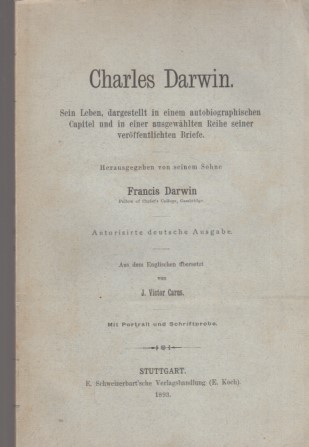
1893réf. 1212041Stuttgart; E. Schweizerbart'sche Verlagshandlung (E. Koch), 1893. IV; 385 Seiten; graph. Darst.; 23,5 cm; fadengeh. Orig.-Pappband.
1893Gutes Exemplar; Einband mit minimalen Läsuren; Seiten unaufgeschnitten; wenige Seiten mit Wasserspuren u. gering fleckig. - Charles Robert Darwin (* 12. Februar 1809 in Shrewsbury; † 19. April 1882 in Down House/Grafschaft Kent) war ein britischer Naturforscher. Er gilt wegen seiner wesentlichen Beiträge zur Evolutionstheorie als einer der bedeutendsten Naturwissenschaftler. Die Ende 1831 begonnene und fast fünf Jahre andauernde zweite Reise mit der HMS Beagle, die den jungen Darwin einmal um die Welt führte, war zugleich Schlüsselerlebnis und Grundlage für sein späteres Werk. Der breiten Öffentlichkeit wurde Darwin erstmals durch seinen 1839 herausgegebenen Reisebericht bekannt. Mit seiner Theorie über die Entstehung der Korallenriffe und weiteren geologischen Schriften erlangte er in wissenschaftlichen Kreisen die Anerkennung als Geologe. Seine Untersuchungen an den Rankenfußkrebsen (Cirripedia) verschafften ihm Mitte der 1850er Jahre zusätzlich einen Ruf als angesehener Zoologe und Taxonom. Bereits 1838 entwarf Darwin seine Theorie der Anpassung an den Lebensraum durch Variation und natürliche Selektion und erklärte so die phylogenetische Entwicklung aller Organismen und ihre Aufspaltung in verschiedene Arten. Über 20 Jahre lang trug er Belege für diese Theorie zusammen. … (wiki) // ... Man wird z. B. sehen, daß nach dem 8. Capitel eine Unterbrechung eintritt; die Erzählung geht von 1854 auf 1831 zurück, damit die sich auf die Entwicklungslehre beziehenden Capitel die Geschichte ununterbrochen darstellen. In gleicher Weise wird die botanische Thätigkeit, welche in dem späteren Theile seines Lebens so viel von meines Vaters Zeit in Anspruch nahm, besonders in dem 16. und 17. Capitel besprochen. Was das 4. Capitel betrifft, in welchem ich eine Schilderung der Arbeitsweise meines Vaters zu geben versucht habe, so sei mir zu erwähnen gestattet, daß ich während der letzten acht Jahre seines Lebens als sein Assistent thätig gewesen bin und ich daher Gelegenheit gehabt habe, etwas von seinen Gewohnheiten und Methoden kennen zu lernen. ... (Vorwort Francis Darwin) // INHALT : Die Darwins ----- Autobiographie ----- Religion ----- Erinnerungen ----- Leben in Cambridge - Die Anstellung am Beagle: 1828 ----- 1831 ----- Die Reise: 1831 ----- 1836 ----- London und Cambridge: 1836 ----- 1842 ----- Leben in Down: 1842 ----- 1854 ----- Das Grundlegen der ,Entstehung der Arten': 1831 ----- 1844 ----- Das Wachsthum der ,Entstehung der Arten': 1843 ----- 1858 ----- Das Schreiben der ,Entstehung der Arten', Juni 1858 b Kovbr 1859 ----- Die Herausgabe der ,Entstehung der Arten', Okt b Decbr 1859 ----- Die ,Entstehung der Arten' ----- Anzeigen und Kritiken ----- Annahmen und Angriffe: 1860 ----- Die Ausbreitung der Entwicklung: 1861 ----- 1871 ----- Miscellanea ----- Wiederaufnahme geologischer Arbeit ----- Die Vivisectionsfrage ----- Ehrenbezeugungen ----- Die Befruchtung der Blüthen ----- Kletterpflanzen ----- Bewegungsvermögen bei Pflanzen ----- Insectenfressende Pflanzen ----- Kew-Index der Pflanzennamen Schluß ----- Anhang : Das Begräbnis in der Westminster Abtei ----- Portraits.
1980réf. 77076Frankfurt am Main : Societäts-Verlag 1980. 871 S. : Ill. ; 22 cm Leinen 0
1896réf. 87310NY:: D. Appleton and Company. Very Good. 1896. Hardcover. B00CIZQL7Q . With illustrations. Authorized edition. Octavo half bound in burgundy leather with gilt lettering on the spine marbled boards top edge gilt. Age darkened along the spine moderate edge wear else very good. Some unopened pages. Binding is solid.; 592 pages . D. Appleton and Company, hardcover books
1991réf. 1419001Cambridge: Cambridge University Press 1991. Hardcover. Octavo Volume Seven only: xxxv 671 pages. In Good minus condition with a Good minus dust jacket. Spine is green with black and white print. Dust jacket has edge wear small vendor label on rear panel. Boards in black cloth.Text block has name in ink on front flyleaf marginal notation in ink. Illustrated: b&w frontispiece portrait and plates photographs. NOTE: Shelved in Netdesk Column F ND-F . 1419001. FP New Rockville Stock. Cambridge University Press hardcover books
1890réf. 12138London: Ward Lock and Co 1890. Later Edition. Hardcover. Good. Later Edition. Hardcover. Previously owned by Oliver Sacks. The original editions app.eared in 1842 1844 and 1846 respectively. Minerva Library No. 18. Presents all three parts of the first edition of Darwin's geological results of the Beagle voyage with a critical introduction to each work by Prof. John W. Judd. The voyage of the Beagle lasted from December 1831 to October 1836 and carreid Darwin around the wotld but especially to South America. Former owner name on ffep: Trevor H. Evans St. Johns Hospital. From the library of Dr. Oliver Sacks the renowned neurologist author and educator. He was in his life celebrated for his contributions to the understanding of the human brain and his ability to communicate complex scientific concepts to a broader audience. In doing so he highlighted the profound impact of neurological disorders on human identity and experience. His library is a reflection of this remarkable polymath's questing mind. Moderate shelf/edge wear discoloration to boards toning else tight and unmarred. Original textured green cloth boards with black and gilt borders and lettering patterned endpapers. 8vo.xx 549pp. illus. b/w illus. including 3 fold-out plates plus 6 page publisher's catalogue 40 text figures. Ward, Lock, and Co hardcover books
19714to [28 x 21 cm]; xvii, [iii], 362, [ii] pp, numerous illustrations from drwgs by Fritz Kredel including full-page printed in black and red, index, title page in red and black. original morocco-backed wood veneer boards, elaborate gilt design and title lettering on spine, fine and clean in original veneer covered slipcase with gilt decorated end (sight wear to edge). A picture of this book is available upon request by email. Freeman 1043. It was originally published in 1871 in 2 volumes, the word 'evolution' appearing for the first time in any of Darwin's works, and deals with the evolution of man. This edition is printed from the definitive 1877 edition. It is a companion volume to Origin of Species.
1899réf. 48069ABStuttgart, E. Schweizerbart'sche Verl. Handlg (E. Nägele) 1899. 2., durchges. Aufl. 8. X/568 S., m. Abb. Hlw., verg. Rü.-Tit. Minim. Einr. d. ober. u. unt. Kapit., leicht bestoss., Schn. gebräunt, minim. Fl. a. ober. Kante d. S. 221-224, innen minim. gebräunt, sonst sauber u. gut erhalten. Besitzerverm. a. Vors. 2
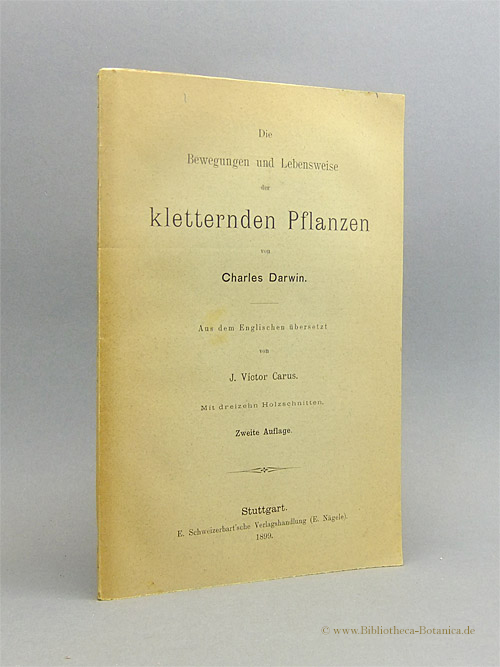
1899réf. 15833ABStuttgart, Schweizerbart, 1899. 23,5 cm. VIII, 160 S. mit 13 Holzschnitten. Originalkarton (Softcover). 2.Aufl. Rücken etwas gedunkelt. Sonst tadelloses Exemplar. Ch. Darwin's gesammelte Werke ; 9.
1979réf. 6650Cuildford: Genesis Publications in association with Australia & New Zealand Book Co. 1979. Limited to 500 copies signed by the author's grandson G.P. Darwin. Fine. 35 cm; 843 pages 5 unnumbered leaves of plates illustrations. In half polished black leather over green cloth with red leather roundel on upper board within a stamped gilt lozenge; facsimile autograph in gilt on lower board. Spine in six compartments with red leather title label and gilt ornaments. All edges brightly gilt. Protected in publisher's slipcase of green cloth with cream-colored paper label. Effectively as new. Facsimile of Darwin's handwritten journal of the crucial voyage of the Beagle with a preface by King Charles III Prince Charles at the time and an introduction by Richard Darwin Keynes. Genesis Publications in association with Australia & New Zealand Book Co. hardcover books