Charles, DarwinBiblio.com

7.682 Ergebnisse
Best.-Nr. 0526757264.Gpaperback. Good. Access codes and supplements are not guaranteed with used items. May be an ex-library book. paperback
2007Best.-Nr. x-1602061459Cosimo Inc 2007. Hardcover. New. 318 pages. 8.50x5.75x1.00 inches. Cosimo Inc hardcover
Best.-Nr. 1016378971.Ghardcover. Good. Access codes and supplements are not guaranteed with used items. May be an ex-library book. hardcover
Best.-Nr. 1016389698.Gpaperback. Good. Access codes and supplements are not guaranteed with used items. May be an ex-library book. paperback
Best.-Nr. 3337228542.Gpaperback. Good. Access codes and supplements are not guaranteed with used items. May be an ex-library book. paperback
1910Best.-Nr. 103002New York: P. F. Collier 1910. Hardcover. Very Good in boards. Soiling. Ink to front endpaper. Part of "Dr. Eliot's Five-Foot Shelf of Books."; 8vo 8" - 9" tall. P. F. Collier hardcover
1986Best.-Nr. KFZZQ100474Yomiuri Shimbun 1986. Soft Cover. Fine. KFZZQ100474 Yomiuri Shimbun paperback
1985Best.-Nr. DYTWW10146Yomiuri Shimbun Company 1985. Soft Cover. Fine. Number of books£º1 Yomiuri Shimbun Company paperback
Best.-Nr. A9781167733833New. unknown
Best.-Nr. ria9781020227707_inpHardcover. New. New Book; Fast Shipping from UK; Not signed; Not First Edition; Le livre qui a changé le monde! Charles Darwin propose une explication de l'évolution et de l'origine des espèces animales et végétales dans cet ouvrage classique de la biologie.This work has been selected by scholars as being culturall hardcover
Best.-Nr. B9781167733833New. unknown
Best.-Nr. ria9783382203825_inpPaperback. New. New Book; Fast Shipping from UK; Not signed; Not First Edition; Réimpression inchangée de l'édition originale de 1868. La maison d'édition Anatiposi publie des livres historiques en réimpression. En raison de leur âge ces livres peuvent présenter des pages manquantes ou une qualité moindre. Notre o paperback
Best.-Nr. ria9783382203832_inpHardcover. New. New Book; Fast Shipping from UK; Not signed; Not First Edition; Réimpression inchangée de l'édition originale de 1868. La maison d'édition Anatiposi publie des livres historiques en réimpression. En raison de leur âge ces livres peuvent présenter des pages manquantes ou une qualité moindre. Notre o hardcover
1846Best.-Nr. MS0029bvi279 pages with frontispiece folding map 5 folding plates one folding hand-colored lithographic geological cross-section by G.B. Sowerby Junior figures and index. Lacks the 32 pages of advertisements which is often the case. Octavo 9" x 5 1/2" bound in half leather over marbled boards with five raised spine bands and black label in gilt lettering. Freeman 273; Norman 857; Sabin 18646 First edition. Published in 1846 Geological Observations on South America is the third and final part of Charles Darwin's geological trilogy detailing the findings from his famous five-year voyage aboard the HMS Beagle under the command of Captain Robert FitzRoy. The trilogy consists of Part 1: The Structure and Distribution of Coral Reefs 1842; Part 2: Geological Observations on the Volcanic Islands 1844; and Part 3: Geological Observations on South America 1846 — dedicated entirely to the continental mainland where Darwin spent the majority of his land-based exploration. It was not until 1851 that an edition of all three geological works was first published. The third and last of Darwin's geological reports on the Beagle voyage. In it he described the pampas the plateaux and the Andes showing how they had been gradually pushed up in the way Lyell had surmised without the intervention of catastrophic events. The descriptions of secondary fossil shells from South America illustrated in Sowerby's plates are by Edward Forbes. Darwin argued that vast landforms—including the pampas plateaus and the Andes mountain chain—were formed by slow continuous upward pressure over immense periods strongly supporting Charles Lyell's uniformitarian geology rather than sudden catastrophic events. Seismic and Volcanic History: Detailed logs and analysis of South American earthquakes volcanic rock mineralogy lava granite and deformed metamorphic strata. Fossil Contributions: Features specialized descriptions of tertiary and secondary fossil shells contributed by paleontologists G. B. Sowerby and Edward Forbes. Included original engraved folding map and hand-colored geological cross-sections illustrating the terrain and strata of the continent. Condition; Rebound without publisher's 32p pages of advertisement. Folding map repaired but with some tears. hand-colored plate with tears at folds some bumping and rubbing at the corners boards lightly scuffed some light toning plate IV with some edge wear else very good of a scarce title. Stewart & Murray for Smith, Elder & Company hardcover
Best.-Nr. 46475026like new. unknown
Best.-Nr. ria9781021086877_inpHardcover. New. New Book; Fast Shipping from UK; Not signed; Not First Edition; In questo trattato Darwin esplora la teoria dell'origine dell'uomo e la scelta sessuale in relazione alla perpetuazione della specie. Un'opera fondamentale per la comprensione dell'evoluzione degli esseri umani.This work has been select hardcover
1862Best.-Nr. MS0012vi3651 pages with one folding plate and 33 woodcuts in text without the advertisements. Small octavo 7 1/2" 4 3/4" bound in full 19th-century calf spine gilt stamped spine in five compartments divided by double gilt fillets with Rugby School coat of arms to cover. Marbled end pages. Clark: 180-181; Freeman 800; Norman 595 First edition. Fertilisation of Orchids is a book by English naturalist Charles Darwin published on 15 May 1862 under the full explanatory title On the Various Contrivances by Which British and Foreign Orchids Are Fertilized by Insects and On the Good Effects of Intercrossing. Darwin's previous book On the Origin of Species had briefly mentioned evolutionary interactions between insects and the plants they fertilized and this new idea was explored in detail. Field studies and practical scientific investigations that were initially a recreation for Darwin—a relief from the drudgery of writing—developed into enjoyable and challenging experiments. Aided in his work by his family friends and a wide circle of correspondents across Britain and worldwide Darwin tapped into the contemporary vogue for growing exotic orchids. The book was his first detailed demonstration of the power of natural selection and explained how complex ecological relationships resulted in the coevolution of orchids and insects. The view has been expressed that the book led directly or indirectly to all modern work on coevolution and the evolution of extreme specialisation. It influenced botanists and revived interest in the neglected idea that insects played a part in pollinating flowers. It opened up the new study areas of pollination research and reproductive ecology directly related to Darwin's ideas on evolution and supported his view that natural selection led to a variety of forms through the important benefits achieved by cross-fertilization. Although the general public showed less interest and sales of the book were low it established Darwin as a leading botanist. Orchids was the first in a series of books on his innovative investigations into plants. Condition: Some scuffing to leather points rubbed. Provenance: H.M. Fitzgerald owner's name dated December 1869; Seddon H. Chadwick owner's name dated May 1943 to front end paper else very good. John Murray hardcover
2014Best.-Nr. x-1446029875Becker Press 2014. Paperback. New. 556 pages. 8.40x5.50x1.10 inches. Becker Press paperback
Best.-Nr. 6127756571Read Books UK . Papeback. New. pp. 558 Read Books (UK) unknown
1871Best.-Nr. MS0006z2 volumes. viii42316 publisher's advertisements pages dated January 1871 with figures. viii47516 publisher's advertisements pages dated January 1871 with figures and index. Small octavos 7 1/2" x 5 1/4" bound in original publisher's green cloth with gilt lettering to spine and blind stamped borders enclosing panel on boards. Untrimmed edges. Freeman 939 p. 128-132 First edition second state. The first issue of The Descent of Man had a print-run of just 2500 copies. It was published in February 1871 closely followed in March 1871 by the second issue printing of a further 2000 copies. The Descent of Man and Selection in Relation to Sex is a book by English naturalist Charles Darwin first published in 1871 which applies revolutionary theory to human evolution and details his theory of sexual selection a form of biological adaptation distinct from yet interconnected with natural selection. The book discusses many related issues including evolutionary psychology. evolutionary ethics evolutionary musicology differences between human races differences between sexes the dominant role of women in mate choice and the relevance of the evolutionary theory to society. In January 1871 Thomas Huxley's former disciple the anatomist St. George Mivart had published On the Genesis of Species as a critique of natural selection. Anonymously in a Quarterly Review article he claimed that the Descent of Man would unsettle "our half educated classes" and talked of people doing as they pleased breaking laws and customs. An infuriated Darwin guessed that Mivart was the author and thinking "I shall soon be viewed as the most despicable of men" looked for an ally. In September Huxley wrote a cutting review of Mivart's book and article which a relieved Darwin told him "How you do smash Mivart's theology. He may write his worst & he will never mortify me again". As 1872 began Mivart politely inflamed the argument again writing "wishing you very sincerely a happy new year" while wanting a disclaimer of the "fundamental intellectual errors" in the Descent of Man. This time Darwin ended the correspondence. Condition: Spine ends rubbed edge wear stained and soiling to covers volume one lacking back end paper inner hinges cracked in both volumes but holding. Volume two with dethatched front end paper corners bumped and rubbed Internal fingering and soiled else a fair set. John Murray hardcover
1873Best.-Nr. A2091vii37414 ad pages with figures drawings 7 plates some folding and index. Octavo 8" x 5 1/4 bound in original publisher's red cloth with gilt lettering to spine and ruled in black with design to cover. DSB Freeman 1143. cf Garrison & Morton 4975 First American edition. The Expression of the Emotions in Man and Animals is Charles Darwin's third major work of evolutionary theory following On The Origin of Species1859 and The Descent of Man 1871. Originally intended as a section of The Descent of Man it was published separately in 1872 and concerns the biological aspects of emotional life. In this book Darwin sets out some early concepts of behavioral genetics and explores the origins of such human characteristics as the lifting of the eyebrows in moments of surprise and the mental confusion which typically accompanies blushing. A German translation of The Expression appeared in 1872; Dutch and French translations followed in 1873 and 1874. A second edition of the book was published in 1890. Before Darwin human emotional life had posed problems to the traditional philosophical categories of mind and body. Darwin's biological approach links mental states to the neurological organization of movement and he allows cultural factors only an auxiliary role in the shaping of expression. Darwin's interest can be traced to his time as a medical student and the 1824 publication of Sir Charles Bell's Anatomy and Philosophy of Expression which argued for a spiritual dimension to the subject. Darwin sought out the opinions of some leading British psychiatrists notably James Crichton-Browne in the preparation of the book which forms his main contribution to psychology. Amongst the innovations with this book are Darwin's circulation of a questionnaire probably inspired by his cousin Francis Galton in his preparatory research; simple psychology experiments on emotional recognition with his friends and family; and borrowing from Duchenne de Boulogne a physician at the Salpêtrière the use of photographs in his presentation of scientific information. The Expression of the Emotions is an important landmark in the history of book illustration. Wikipedia Condition: Spine ends rubbed a few plates with some partial split at folds corners bumped and rubbed over opened at signature starting at the gathering on page 235 to 256 page 181 crudely opened else a about a very good copy. D Appleton and Company hardcover
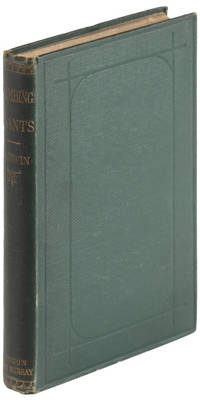
1875Best.-Nr. MS0026viii20832 ad pages with diagrams and index. Small octavo 7 3/4" x 5 1/4" bound in original publisher's blind-stamped green cloth lettered in gilt on spine. Second edition revised; First Edition in book form. The Movements and Habits of Climbing Plants is a landmark botanical book written by Charles Darwin first published in book form in 1875. Following his groundbreaking work on On the Origin of Species Darwin sought to provide further evidence for his theory of natural selection by demonstrating how weak-stemmed plants adapted mechanically to compete for light. Darwin meticulously studied over a hundred species and categorized climbing plants into five main classes based on their specialized organs and physiological habits. This volume is a revised reprint of Darwin's well-known treatise on the habits of climbing plants published in 1865 in the ninth volume of the "Journal of the Linnean Society" with such additions and corrections as the progress of knowledge since that time has rendered necessary. Although the subject had been investigated previously to that time by the German physiologists Palm and Von Mohl it was Mr. Darwin's publication describing many facts not previously recorded that first introduced the remarkable phenomena connected with it to the notice of the general public. The phrase Climbing Plant is used by Darwin as a generic term for all those which provided themselves with but weak stems that have no power of standing erect avail themselves of the assistance of neighboring plants for the purpose of raising their foliage and flowers to a considerable height from the ground. The plants included under this head are arranged in four divisions according to the part that is modified in order to subserve this purpose: 1 Twining Plants called in the first edition Spiral Twiners in which the stem is the climbing organ; 2 Leaf-climbers which climb by the aid of the petiole or some other portion of the leaf; 3 Tendril-bearers by far the most numerous class which are provided with tendrils specially contrived for this purpose; and 4 Hook and root-climbers which climb by the aid of hooks on aërial roots or merely scramble over other plants. In all these classes except the last the mechanical means by which the climbing is effected is a sensitiveness and power of revolution possessed by the extremity of the stem or tendril or by the petiole. Lieutenant-General James Francis Tennant CIE FRS 1829-1915 was a British soldier and astronomer. His mathematical skills landed him with the Great Trigonometric Survey where he was engaged in triangulation of the great longitudinal series until 1857 when he was diverted to garrison duties during the Indian Mutiny. In 1859 when he rejoined the survey he was given the directorship of the Madras Observatory where his interest in astronomy started. He was noted for being an observer for the Royal Astronomical Society for the solar eclipse of 17 August 1868 across the Indian peninsula and that of 11 December 1871 across southern India and later the transit of Venus of 1874. It was during these observations that photographic equipment was used extensively for the first time Tennant was a practiced expert in photography and his skill aided the observations of the eclipses in particular that of the solar corona. Condition: Bookplate of Francis J. Tennant to front paste-down. Minor wear to corners boards and spine hinges starting light toning spine darkened else very good. John Murray hardcover
2019Best.-Nr. BIBLB0040950082019. Leather Bound. New. Size: 14.60 x 22.86 cms This book is available in 5 different Leather color without any extra cost. Explore More Options by Clicking on 'More Images' and Notify Us of Your Choice via Email within 24 hours of placing the order. Presenting an Exquisite Leather-Bound Edition expertly crafted by the prestigious organization Rare Biblio with Original Natural Leather that gracefully adorns the spine and corners. The allure continues with Golden Leaf Printing that adds a touch of elegance while Hand Embossing on the rounded spine lends an artistic flair. This masterpiece has been meticulously reprinted in 2019 utilizing the invaluable guidance of the original edition published many years ago in 1897. The contents of this book are presented in classic black and white. Its durability is ensured through a meticulous sewing binding technique enhancing its longevity. Imprinted on top-tier quality paper. A team of professionals has expertly processed each page delicately preserving its content without alteration. Due to the vintage nature of these books every page has been manually restored for legibility. However in certain instances occasional blurriness missing segments or faint black spots might persist. We sincerely hope for your understanding of the challenges we faced with these books. Recognizing their significance for readers seeking insight into our historical treasure we've diligently restored and reissued them. Our intention is to offer this valuable resource once again. We eagerly await your feedback hoping that you'll find it appealing and will generously share your thoughts and recommendations. Lang: - English Vol:- Volume 2 Pages:- 162 If it is a multi-volume set then it is only a single volume. Product Disclaimer: Kindly be informed that owing to the inherent nature of leather as a natural material minor discolorations or textural variations may be perceptible. Explore the FOLIO EDITION 12x19 Inches: Available Upon Request. hardcover
Best.-Nr. ria9783663002772_inpPaperback. New. New Book; Fast Shipping from UK; Not signed; Not First Edition; Wenn jemand es unternimmt über einen Gegenstand zu schreiben mit dem er sich bisher beruflich noch nicht beschäftigt hat so sollte er eigentlich damit beginnen sehr viel zu les en und sich über das Gelesene sorgfältige Notizen zu ma paperback
1953Best.-Nr. GB000P1AYU0I4N00Doubleday & Company 1953. Hardcover. Very Good. May have limited writing in cover pages. Pages are unmarked. ~ ThriftBooks: Read More Spend Less.Dust jacket quality is not guaranteed. Doubleday & Company hardcover