Charles Robert DarwinBiblio.com

7663 risultati
2014rif. x-1446029875Becker Press 2014. Paperback. New. 556 pages. 8.40x5.50x1.10 inches. Becker Press paperback
rif. 6127756571Read Books UK . Papeback. New. pp. 558 Read Books (UK) unknown
1871rif. MS0006z2 volumes. viii42316 publisher's advertisements pages dated January 1871 with figures. viii47516 publisher's advertisements pages dated January 1871 with figures and index. Small octavos 7 1/2" x 5 1/4" bound in original publisher's green cloth with gilt lettering to spine and blind stamped borders enclosing panel on boards. Untrimmed edges. Freeman 939 p. 128-132 First edition second state. The first issue of The Descent of Man had a print-run of just 2500 copies. It was published in February 1871 closely followed in March 1871 by the second issue printing of a further 2000 copies. The Descent of Man and Selection in Relation to Sex is a book by English naturalist Charles Darwin first published in 1871 which applies revolutionary theory to human evolution and details his theory of sexual selection a form of biological adaptation distinct from yet interconnected with natural selection. The book discusses many related issues including evolutionary psychology. evolutionary ethics evolutionary musicology differences between human races differences between sexes the dominant role of women in mate choice and the relevance of the evolutionary theory to society. In January 1871 Thomas Huxley's former disciple the anatomist St. George Mivart had published On the Genesis of Species as a critique of natural selection. Anonymously in a Quarterly Review article he claimed that the Descent of Man would unsettle "our half educated classes" and talked of people doing as they pleased breaking laws and customs. An infuriated Darwin guessed that Mivart was the author and thinking "I shall soon be viewed as the most despicable of men" looked for an ally. In September Huxley wrote a cutting review of Mivart's book and article which a relieved Darwin told him "How you do smash Mivart's theology. He may write his worst & he will never mortify me again". As 1872 began Mivart politely inflamed the argument again writing "wishing you very sincerely a happy new year" while wanting a disclaimer of the "fundamental intellectual errors" in the Descent of Man. This time Darwin ended the correspondence. Condition: Spine ends rubbed edge wear stained and soiling to covers volume one lacking back end paper inner hinges cracked in both volumes but holding. Volume two with dethatched front end paper corners bumped and rubbed Internal fingering and soiled else a fair set. John Murray hardcover
rif. G0226136558I5N00University of Chicago Press 1965. Hardcover. Acceptable. Readable copy. Pages may have considerable notes/highlighting. ~ ThriftBooks: Read More Spend Less.Dust jacket quality is not guaranteed. University of Chicago Press hardcover
1873rif. A2091vii37414 ad pages with figures drawings 7 plates some folding and index. Octavo 8" x 5 1/4 bound in original publisher's red cloth with gilt lettering to spine and ruled in black with design to cover. DSB Freeman 1143. cf Garrison & Morton 4975 First American edition. The Expression of the Emotions in Man and Animals is Charles Darwin's third major work of evolutionary theory following On The Origin of Species1859 and The Descent of Man 1871. Originally intended as a section of The Descent of Man it was published separately in 1872 and concerns the biological aspects of emotional life. In this book Darwin sets out some early concepts of behavioral genetics and explores the origins of such human characteristics as the lifting of the eyebrows in moments of surprise and the mental confusion which typically accompanies blushing. A German translation of The Expression appeared in 1872; Dutch and French translations followed in 1873 and 1874. A second edition of the book was published in 1890. Before Darwin human emotional life had posed problems to the traditional philosophical categories of mind and body. Darwin's biological approach links mental states to the neurological organization of movement and he allows cultural factors only an auxiliary role in the shaping of expression. Darwin's interest can be traced to his time as a medical student and the 1824 publication of Sir Charles Bell's Anatomy and Philosophy of Expression which argued for a spiritual dimension to the subject. Darwin sought out the opinions of some leading British psychiatrists notably James Crichton-Browne in the preparation of the book which forms his main contribution to psychology. Amongst the innovations with this book are Darwin's circulation of a questionnaire probably inspired by his cousin Francis Galton in his preparatory research; simple psychology experiments on emotional recognition with his friends and family; and borrowing from Duchenne de Boulogne a physician at the Salpêtrière the use of photographs in his presentation of scientific information. The Expression of the Emotions is an important landmark in the history of book illustration. Wikipedia Condition: Spine ends rubbed a few plates with some partial split at folds corners bumped and rubbed over opened at signature starting at the gathering on page 235 to 256 page 181 crudely opened else a about a very good copy. D Appleton and Company hardcover
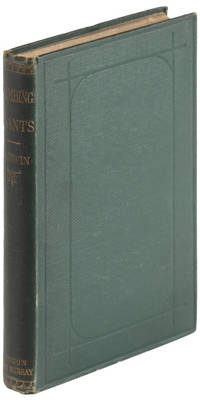
1875rif. MS0026viii20832 ad pages with diagrams and index. Small octavo 7 3/4" x 5 1/4" bound in original publisher's blind-stamped green cloth lettered in gilt on spine. Second edition revised; First Edition in book form. The Movements and Habits of Climbing Plants is a landmark botanical book written by Charles Darwin first published in book form in 1875. Following his groundbreaking work on On the Origin of Species Darwin sought to provide further evidence for his theory of natural selection by demonstrating how weak-stemmed plants adapted mechanically to compete for light. Darwin meticulously studied over a hundred species and categorized climbing plants into five main classes based on their specialized organs and physiological habits. This volume is a revised reprint of Darwin's well-known treatise on the habits of climbing plants published in 1865 in the ninth volume of the "Journal of the Linnean Society" with such additions and corrections as the progress of knowledge since that time has rendered necessary. Although the subject had been investigated previously to that time by the German physiologists Palm and Von Mohl it was Mr. Darwin's publication describing many facts not previously recorded that first introduced the remarkable phenomena connected with it to the notice of the general public. The phrase Climbing Plant is used by Darwin as a generic term for all those which provided themselves with but weak stems that have no power of standing erect avail themselves of the assistance of neighboring plants for the purpose of raising their foliage and flowers to a considerable height from the ground. The plants included under this head are arranged in four divisions according to the part that is modified in order to subserve this purpose: 1 Twining Plants called in the first edition Spiral Twiners in which the stem is the climbing organ; 2 Leaf-climbers which climb by the aid of the petiole or some other portion of the leaf; 3 Tendril-bearers by far the most numerous class which are provided with tendrils specially contrived for this purpose; and 4 Hook and root-climbers which climb by the aid of hooks on aërial roots or merely scramble over other plants. In all these classes except the last the mechanical means by which the climbing is effected is a sensitiveness and power of revolution possessed by the extremity of the stem or tendril or by the petiole. Lieutenant-General James Francis Tennant CIE FRS 1829-1915 was a British soldier and astronomer. His mathematical skills landed him with the Great Trigonometric Survey where he was engaged in triangulation of the great longitudinal series until 1857 when he was diverted to garrison duties during the Indian Mutiny. In 1859 when he rejoined the survey he was given the directorship of the Madras Observatory where his interest in astronomy started. He was noted for being an observer for the Royal Astronomical Society for the solar eclipse of 17 August 1868 across the Indian peninsula and that of 11 December 1871 across southern India and later the transit of Venus of 1874. It was during these observations that photographic equipment was used extensively for the first time Tennant was a practiced expert in photography and his skill aided the observations of the eclipses in particular that of the solar corona. Condition: Bookplate of Francis J. Tennant to front paste-down. Minor wear to corners boards and spine hinges starting light toning spine darkened else very good. John Murray hardcover
2019rif. BIBLB0040950082019. Leather Bound. New. Size: 14.60 x 22.86 cms This book is available in 5 different Leather color without any extra cost. Explore More Options by Clicking on 'More Images' and Notify Us of Your Choice via Email within 24 hours of placing the order. Presenting an Exquisite Leather-Bound Edition expertly crafted by the prestigious organization Rare Biblio with Original Natural Leather that gracefully adorns the spine and corners. The allure continues with Golden Leaf Printing that adds a touch of elegance while Hand Embossing on the rounded spine lends an artistic flair. This masterpiece has been meticulously reprinted in 2019 utilizing the invaluable guidance of the original edition published many years ago in 1897. The contents of this book are presented in classic black and white. Its durability is ensured through a meticulous sewing binding technique enhancing its longevity. Imprinted on top-tier quality paper. A team of professionals has expertly processed each page delicately preserving its content without alteration. Due to the vintage nature of these books every page has been manually restored for legibility. However in certain instances occasional blurriness missing segments or faint black spots might persist. We sincerely hope for your understanding of the challenges we faced with these books. Recognizing their significance for readers seeking insight into our historical treasure we've diligently restored and reissued them. Our intention is to offer this valuable resource once again. We eagerly await your feedback hoping that you'll find it appealing and will generously share your thoughts and recommendations. Lang: - English Vol:- Volume 2 Pages:- 162 If it is a multi-volume set then it is only a single volume. Product Disclaimer: Kindly be informed that owing to the inherent nature of leather as a natural material minor discolorations or textural variations may be perceptible. Explore the FOLIO EDITION 12x19 Inches: Available Upon Request. hardcover
rif. ria9783663002772_inpPaperback. New. New Book; Fast Shipping from UK; Not signed; Not First Edition; Wenn jemand es unternimmt über einen Gegenstand zu schreiben mit dem er sich bisher beruflich noch nicht beschäftigt hat so sollte er eigentlich damit beginnen sehr viel zu les en und sich über das Gelesene sorgfältige Notizen zu ma paperback
1953rif. GB000P1AYU0I4N00Doubleday & Company 1953. Hardcover. Very Good. May have limited writing in cover pages. Pages are unmarked. ~ ThriftBooks: Read More Spend Less.Dust jacket quality is not guaranteed. Doubleday & Company hardcover
1952rif. 384197Dolphin Books 1952. FIRST THUS. Paperback. Very Good/No Jacket. First Edition Thus First Printing. Not price-clipped. Published by Dolphin Books 1952. Octavo. Paperback. Book is very good with light spotting to the page ends and light shelf wear. A lovely copy of this novel by Charles Galton Darwin. 100% positive feedback. 30 day money back guarantee. NEXT DAY SHIPPING! Excellent customer service. Please email with any questions. All books packed carefully and ship with free delivery confirmation/tracking. All books come with free bookmarks. Ships from Sag Harbor New York. Dolphin Books paperback
rif. ria9780837168760_inpHardcover. New. New Book; Fast Shipping from UK; Not signed; Not First Edition; N/A hardcover
1952rif. feb027041953. First Edition The Next Million Years by Charles G. Darwin Used book For more details and availability please contact me Rupert Hart-Davis hardcover
1987rif. 68853New York: Oxford University Press USA 1987. Hardcover. Very Good- in a Very Good dust jacket. Spine is bowed. Minor toning to pastedowns.; Oxford Illustrated Dickens; 7.52 X 5.07 X 1.71 inches; 826 pages. Oxford University Press, USA hardcover
1909rif. 295380Cambridge at the University Press 1909. Hard Cover. Very Good binding. An attractive First Edition of this fore-runner of one of the most important books of the 19th century.~~Two essays written in 1842 and 1844 in which Darwin’s theory of natural selection is first considered; the 1842 essay was published earlier that year but this is the first appearance in print of the 1844 essay and thus the first appearance of the two essays together. Of note is that “the sketch of 1844 bears on the whole a striking resemblance to the origin of species . even some of the sentences are identical.” DNB Vol. V 1917 p. 526 Darwin himself provides evidence of the high estimate he had formed of the sketch: “A letter exists addressed to his wife in which he made provision in case of his death for the publication of the manuscript . stating that he believes his conclusions to be ‘a considerable step in science’” ibid.~~Large Octavo; in the publisher’s green buckram binding with spine lettered in gilt and beveled edges; xxix 1. 263 pages including the Index; top edge gilt with other edges rough-cut; there is a small and neatly penned name on the front endpaper; with photogravure portrait frontispiece protected with a tissue guard and a facsimile; the spine is just a bit darkened; a previous owner’s signature on the front pastedown. ~~~ DNB Vol V 1917 p. 527. Very Good binding. Cambridge at the University Press unknown books
1982Charles Darwin, Gian Arturo Ferrari, a cura di Charles Darwin. L'espressione delle emozioni nell'uomo e negli animali. Taccuino M e N. Profilo di un bambino. , Boringhieri 1982 - TS.4 italian, Opera con copertina rigida e sovraccoperta. TS.4.
2002rif. 17975Berlin : Argon 2002. 399 S. : 32 S. Bildtl ; 25 cm, mit Schutzumschlag Pp., gebundene Ausgabe, Hardcover/Pappeinband, Buch als Mängelexemplar gekennzeichnet, sonst guter Zustand
1890rif. 29360Leipzig., Theodor Thomas Verlag 1890. 8°, Original - Leinen. VIII, 392 S. Titelblatt gestempelt, gebundene Ausgabe, Halbleder, Rückenleder berieben, sonst gut
1870rif. 266381870. Our first Darwin signed photograph in all these years Charles Darwin English naturalist whose scientific theory of evolution by natural selection became the foundation of modern biology and evolutionary studies. Darwin's explanation for the great unfolding of life through time - evolution by natural selection - transformed our understanding of the living world and focused attention on the cumulative inherited change in a population of organisms through time leading to the appearance of new forms: the process by which new species or populations of living things develop from preexisting forms through successive generations. Darwin revolutionized the understanding of the development of living things as Einstein revolutionized our understanding of the physical universe. An attractive Carte de Visite signed ""Ch. Darwin” circa late 1870s very good condition though with a few small adhesive tape marks. The photograph was taken by Elliott & Fry 56 Baker Street London and has their front and back stamps. For a century after its founding in 1863 the firm’s core business was taking and publishing photographs of the Victorian public and social artistic scientific and political luminaries. Among the notables known to have sat for a photograph by Elliott & Fry were Prime Minister William Gladstone Alfred Lord Tennyson W.S. Gilbert Rudyard Kipling Oliver Wendell Holmes Sr. Florence Nightingale and Charles Darwin. In all our years in the field we have seen just a handful of Darwin signed photographs and have never ourselves had one. This is indeed a rarity. But the provenance is just as fascinating as finding a signed Darwin photograph with provenance is perhaps unique. William Bateson was a British biologist who founded and named the science of genetics and whose experiments provided evidence basic to the modern understanding of heredity. He was a dedicated evolutionist and his early works on the mechanisms of biological evolution were strongly influenced by Charles Darwin though he believed that Darwin’s theory of evolution required a firmer base in heredity. Bateson also became the foremost champion of Gregor Mendel’s work on genetics. Darwin died in 1882 when Bateson was at college and though Bateson may have written Darwin such letter is unknown. Bateson and his wife did however correspond with Darwin’s family in later years as “Darwin Online” indicates. This CDV comes with an autograph letter signed from Darwin’s granddaughter Margaret Keynes dated January 23 1929 addressed to Sir George Buckston Browne proposing an alternative date for her and her husband Dr. Geoffrey Keynes to come for lunch expressing gladness that Browne wanted ""the Bateson letter and the other things"" and acknowledging that he attended the same school as Dr. Keynes. Browne had bought Darwin's old home so lunch there would have been a homecoming of sorts for Margaret. Finding the CDV and letter together we would conjecture that this CDV was the property - one of “the other things” - of Margaret that she mentioned in the letter that she was glad Browne wanted and had descended in the family to her along with the Bateson letter. Thus this CDV was apparently property of the Darwin family the most important provenance imaginable. <img class=""alignnone wp-image-25018 size-post-window"" src=""https://cdn.raabcollection.com/wp-content/uploads/20231204144051/Folder-site-11-1600x1327.jpg"" alt="""" width=""1600"" height=""1327"" /> unknown books
1872rif. 49393London: John Murray 1872. Very Good. London: John Murray 1872. First Edition mixed issue with issue points detailed below. Octavo; green cloth boards; brown endpapers; vi 374pp. 4pp. recent works dated November 1872. 7 heliotype plates 3 folding; numerous in-text illustrations. Light wear to boards with brief exposure and smudging; binding sound; previous owner's small ownership label to preliminaries; spotting to terminals tide marks to margins; still a Very Good copy. First issue points present: Final signatures are 2B2 and 2C3 with only 2B1 and 2C1 signed; "that" in first line of 208 spelled correctly and all first issue "Recent Works" points present per Freeman. Second Issue points present: Lacks blank preceding title page plates are numbered in Roman though Norman disputes this as a point and text block is 189mm. While working on Descent of Man Darwin became interested in emotional expression across species. In animals he believed expressions were a part of their purposeful action and not connected to emotion. Humans however were very emotional. He examines reactions and expressions in human subjects to different stimuli like "low spirits" of grief and anxiety and "high spirits" like love. Though for Darwin the most intriguing and peculiar reaction to emotion was blushing. So much so that he dedicates an entire chapter to it and comes to the conclusion "It appears that the mental powers of infants are not as yet sufficiently developed to allow of their blushing. Hence also it is that idiots rarely blush." Freeman 1141 & 1142 Norman 600; Garrison-Morton 4975. John Murray unknown books
1974Charles Darwin Introduzione all'evoluzionismo. , Newton Compton Italiana 1974, Piatti e dorso con fioriture e lievi segni di usura dati dal tempo. Tagli con gore. Interno ingiallito ma in buono stato. Buono (Good) . 302
rif. B21814-ND. Appleton and Company. Collectible - Acceptable. 1868 Appleton early US edition brown cloth edgewear wear to corners and spine heel about 1 3/4 inch of backstrip at spine head is missing tears to backstrip at sides front hinge cracked owner stamp to front pastedown pencil notes to page opposite half-title owner name in pencil to title page foxing and pencil underlining to some pages pencil arrows in some margins o/w clean hinge cracked in a couple of places but binding still sound diagram opposite p108 is in very good condition no dust jacket photo on Amazon shows frontis of Darwin - our copy does not have a frontis not sure if it ever did. D. Appleton and Company hardcover books
2008Brossura commerciale in cartonato flessibile lucido, copertina in buono stato, illustrata in entrambi i piatti, con alette integre, ben tenuta, con segni da manipolazione. Stato interno perfettamente conservato, carte molto ben tenute, velate da tonalità brunita, tagli puliti e leggermente bruniti. Taglio di piede macchiata da pulviscolo. Edizione italiana a cura di Telmo Pievani. Prefazione di Niles Eldredge. Traduzione di Isabella C. Blum. Numero pagine 373. USATO
1871rif. 006663London: John Murray 1871. First edition first printing. Quarter leather. This is the first edition first impression of Charles Darwins The Descent of Man and Selection in Relation to Sex his first book to apply the term evolution - in a striking contemporary fine binding. The binding features quarter calf over marbled paper-covered boards with blind tooled transitions between the boards and calf corners and spine. The spine features raised gilt-decorated bands framed by double gilt rules a black title panel and gilt devices adorning undecorated compartments. The boards endpapers and page edges are all marbled in a matching nonpareil combed pattern creating a compelling aesthetic consistency. First impression of the first edition is confirmed by issue points; in Volume I transmitted is the first word on p.297; Volume II has errata on the title page verso seventeen errata for Volume I and eight for Volume II and a tipped-in Postscript at unpaginated pp. ix-x referring to errors which were reset for the second issue. The sixteen pages of advertisements for Murrays standard works are not present removed when the book was rebound as were the half-title leaves. Condition is very good overall. Despite overall toning the calfs original red mostly settling to brown and scuffing the exceptional contemporary bindings are square clean tight and original with no sign of repair restoration or hinge failure. The first impression contents are bright with light spotting primarily confined to the first and final leaves. The sole previous ownership mark is the same name and date of January 1878 inked on the upper right corner of each blank leaf recto preceding the title page. Given that the subject blank leaves were added when the book was finely bound it follows that the binding was commissioned during or before January 1878. On the Origin of Species 1859 fomented a reorientation that would eventually supplant dogmatic creationist hierarchy with rationalistic naturalist biology. But in Origin Darwin had said little about how his ideas applied to human beings. In The Descent of Man and Selection in Relation to Sex Darwin argued that all creatures are subject to the same natural laws. Man still bears in his bodily frame the indelible stamp of his lowly origin. And in Descent the cause was finally given its enduring name. On page two of Volume I Darwin wrote these great classes of facts afford as it appears to me ample and conclusive evidence in favour of the principle of gradual evolution. This is the first time the word evolution is thus applied in his published work. Descent posited the theory Darwin called sexual selection and attempted to set forth a naturalistic explanation for the mind and for moral behavior. That Darwins conceptions continue to both fuel rational debate and fervid ire testifies to their fundamental impact. That many of his concepts are settled theory testifies to their empirical insight and veracity. This particular set is not only an artifact of landmark scientific thought but also testimony to Victorian era bibliophilic history craft and sensibilities. "BOUND BY MUDIE is printed on the lower front free-end paper versos. Charles Edward Mudie 1818-1890 founded a circulating library that served a wide middle-class audience who could not afford the exorbitant price of new books making literature significantly more accessible to the public. By 1852 he had over 25000 subscribers. Between 1853 and 1862 Mudie is said to have added almost 960000 volumes to his stock in hand thus becoming one of the major distributors of fiction in Britain at the time. His business also serviced readers overseas shipping tin trunks of books to India Cape Colony Egypt and other British colonies. The glee occasioned by the arrival of Mudie's shipments was playfully commented upon by W. S. Gilbert in Bab Ballads when he wrote: 'New boxes come from across the sea / from Mr. Mudie's Libraree'. ODNB. John Murray hardcover books
1878rif. 26410London: John Murray 1878. Very Good. London: John Murray 1878. Sixth Edition Twentieth Thousand with additions and corrections. Octavo. 458 pp. with half title and folding plate facing page 91. Bound in contemporary quarter calf; five raised bands gilt decorating and black title label to spine; marbled edges and endpapers. Boards worn along edges with exposure corners bumped rubbing to joints and surface cracking to spine. Recent repair to joints; scraping with surface loss to endpapers; binding holding soundly. Bookplate of tea planter Henry Randolph Trafford to front pastedown. Ownership inscription to preliminaries; text block a bit stiff but pages unmarked and legible throughout. A Very Good later printing of the sixth edition which was originally published in 1872 and was the first to include the word "evolution" though all editions included "evolved" as the final word of text. John Murray unknown books
1869rif. 2002020London: John Murray 1869. 5th. very good. Fifth edition tenth thousand as stated on title page and copyright page. Book very good repair at front and rear gutters. Page 29/30 missing. Comes with custom-made slipcase. John Murray unknown books