7623 risultati
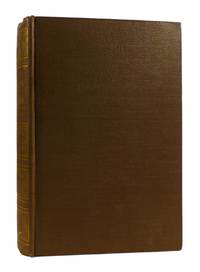
1899rif. 000994D. Appleton 1899. Hardcover. Very Good. 1899 printing of the US edition with additions corrections from the sixth and last English edition published by D. Appleton. Two volumes in one. Original cloth covers with decoration in black blind and gold a few marks to the spine some minor wear to the edges generally tidy covers securely bound. Previous owners name in ink to the free endpaper plus another in pencil pages age toned but otherwise clean and tidy complete with pull out chart. Very good condition. xxvi365vii338pp. D. Appleton hardcover
1872rif. 000904John Murray 1872. Hardcover. Good. 1872 Sixth edition thirteenth thousand published by John Murray. The sixth edition contains various additions and corrections and was the first to use the word evolution though he first used the term a year earlier in The Descent of Man. The first printing of the sixth edition is the eleventh thousand printed the same year as this. Green cloth covers with patchy fading or mottling spine ends rubbed and chipped corners rubbed secure binding endpapers bright and without any inscriptions the rear endpaper has a small tear and signs of glue to the hinge presumably a historical repair which is neat and secure. Half title spotted pages a little age toned with a few rare spots. Complete with pull out chart. Good condition. 19x13cm xxi 458 pages. John Murray hardcover
rif. ria9781108005487_inpPaperback. New. New Book; Fast Shipping from UK; Not signed; Not First Edition; This sixth edition of The Origin of Species was published in 1876. It is the last edition on which Darwin himself worked before his death in 1882 and complements the 2009 scholarly edition edited by Jim Endersby and published by Cambr paperback
2010rif. x-1616401265Cosimo Classics 2010. Hardcover. New. reprint edition edition. 558 pages. 8.58x5.67x1.81 inches. Cosimo Classics hardcover
2018rif. x-9387669343General Press 2018. Hardcover. New. 412 pages. 9.21x5.79x1.14 inches. General Press hardcover
1930rif. OP22 /16Brown grained cloth with gilt lettering on the spine. Embossed ship on front cover. On the Origin of Species or more completely On the Origin of Species by Means of Natural Selection or the Preservation of Favoured Races in the Struggle for Life published on 24 November 1859 is a work of scientific literature by Charles Darwin that is considered to be the foundation of evolutionary biology. Darwin's book introduced the scientific theory that populations evolve over the course of generations through a process of natural selection. The book presented a body of evidence that the diversity of life arose by common descent through a branching pattern of evolution. Darwin included evidence that he had collected on the Beagle expedition in the 1830s and his subsequent findings from research correspondence and experimentation. Various evolutionary ideas had already been proposed to explain new findings in biology. There was growing support for such ideas among dissident anatomists and the general public but during the first half of the 19th century the English scientific establishment was closely tied to the Church of England while science was part of natural theology. Ideas about the transmutation of species were controversial as they conflicted with the beliefs that species were unchanging parts of a designed hierarchy and that humans were unique unrelated to other animals. The political and theological implications were intensely debated but transmutation was not accepted by the scientific mainstream. The book was written for non-specialist readers and attracted widespread interest upon its publication. Darwin was already highly regarded as a scientist so his findings were taken seriously and the evidence he presented generated scientific philosophical and religious discussion. The debate over the book contributed to the campaign by T. H. Huxley and his fellow members of the X Club to secularise science by promoting scientific naturalism. Within two decades there was widespread scientific agreement that evolution with a branching pattern of common descent had occurred but scientists were slow to give natural selection the significance that Darwin thought appropriate. During "the eclipse of Darwinism" from the 1880s to the 1930s various other mechanisms of evolution were given more credit. With the development of the modern evolutionary synthesis in the 1930s and 1940s Darwin's concept of evolutionary adaptation through natural selection became central to modern evolutionary theory and it has now become the unifying concept of the life sciences. Charles Robert Darwin FRS FRGS FLS FZS 12 February 1809 – 19 April 1882 was an English naturalist geologist and biologist best known for his contributions to the science of evolution. His proposition that all species of life have descended from common ancestors is now widely accepted and considered a fundamental concept in science. In a joint publication with Alfred Russel Wallace he introduced his scientific theory that this branching pattern of evolution resulted from a process that he called natural selection in which the struggle for existence has a similar effect to the artificial selection involved in selective breeding. Darwin has been described as one of the most influential figures in human history and he was honoured by burial in Westminster Abbey. Darwin published his theory of evolution with compelling evidence in his 1859 book On the Origin of Species. By the 1870s the scientific community and a majority of the educated public had accepted evolution as a fact. However many favoured competing explanations which gave only a minor role to natural selection and it was not until the emergence of the modern evolutionary synthesis from the 1930s to the 1950s that a broad consensus developed in which natural selection was the basic mechanism of evolution. Darwin's scientific discovery is the unifying theory of the life sciences explaining the diversity of life. Darwin's early interest in nature led him to neglect his medical education at the University of Edinburgh; instead he helped to investigate marine invertebrates. Studies at the University of Cambridge Christ's College encouraged his passion for natural science. His five-year voyage on HMS Beagle established him as an eminent geologist whose observations and theories supported Charles Lyell's conception of gradual geological change and publication of his journal of the voyage made him famous as a popular author. Puzzled by the geographical distribution of wildlife and fossils he collected on the voyage Darwin began detailed investigations and in 1838 conceived his theory of natural selection. Although he discussed his ideas with several naturalists he needed time for extensive research and his geological work had priority. He was writing up his theory in 1858 when Alfred Russel Wallace sent him an essay that described the same idea prompting immediate joint publication of both of their theories. Darwin's work established evolutionary descent with modification as the dominant scientific explanation of diversification in nature. In 1871 he examined human evolution and sexual selection in The Descent of Man and Selection in Relation to Sex followed by The Expression of the Emotions in Man and Animals 1872. His research on plants was published in a series of books and in his final book The Formation of Vegetable Mould through the Actions of Worms 1881 he examined earthworms and their effect on soil Odhams Press, hardcover
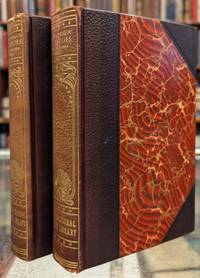
rif. 106744The Werner Co n.d. Hardcover. Very good/No jacket. Two volumes. 3/4 leather with marbled boards. From the International Science Library. No date but circa 1900-1910. Covers pines sunned. Owner's name written on first blank page. The Werner Co hardcover
rif. ria9781774378397_inpHardcover. New. New Book; Fast Shipping from UK; Not signed; Not First Edition; N/A hardcover
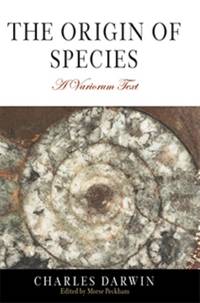
rif. ria9780812219548_inpPaperback / softback. New. New Book; Fast Shipping from UK; Not signed; Not First Edition; This volume facilitates an understanding of the evolution of Charles Darwin's theory of evolution over the six versions of The Origin of Species published during his lifetime. paperback
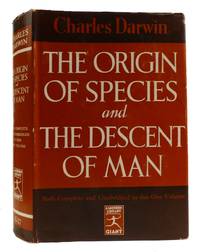
rif. 318819New York: Modern Library N.D. Modern Library Edition. Hardcover. Very Good in a Very Good dust jacket. Small open tears on panel top and bottom corners and spine crown and heel. Small closed tears on bottom front gutter top front panel top rear panel. Light scratching on rear panel. Small stain on top text block edge. Modern Library hardcover
1895rif. 2240124New York: D. Appleton and Company 1895. Hardcover. Good-. 8vo - over 7¾ - 9¾" tall. See photos for condition details. Hardcover brick red cloth boards with black design on front. Exterior shows spotting and soiling along with edge and corner bumps/wear. The rear board and a portion of the front board also show light spots near the bottom outside edge likely from moisture which is limited only to the exterior of the book. The interior binding is good at the hinge is but some of the quadrants of pages particularly around volume 1 page 235 are a bit offset and stick out from the exterior fore edge. All the pages are secure it's just that this part has some pulling. This addition advertises "two volumes in one" with additions and corrections from the sixth and last English edition. Volume 1 in this book contains 365 pages the second half of the book is volume 2 which contains 322 plus the index. The front end page and opposite pastedown both contain the original owners names and info the pastedown portion is written in pencil. No other handwriting found in the book no bookplates no library markings. There is also a small tear on the rear pastedown in the upper left corner. This may have been caused when the book was originally bound as it is all securely glued place. The rear board also has an indentation along the top edge most of which has been straightened out but there is still a small soft area. D. Appleton and Company hardcover
1884rif. feb01241884: Polish Edition of On the Origin of Species by Means of Natural Selection or the Preservation of Favoured Races in the Struggle for Life O powstawaniu gatunków drogą doboru naturalnego czyli o utrzymywaniu się doskonalszych ras w walce o byt Ikon Teralitera hardcover
rif. 183823New York: Books Inc N.D. Art-Type Edition. Hardcover. Very Good in boards. Books, Inc hardcover
rif. 1528387406.Ghardcover. Good. Access codes and supplements are not guaranteed with used items. May be an ex-library book. hardcover
rif. 1528288580.Ghardcover. Good. Access codes and supplements are not guaranteed with used items. May be an ex-library book. hardcover
rif. SB01OS-02128D. Appleton and Company. Used - Acceptable. Acceptable condition. Later edition. Volume 1. Reading copy only. Lacking most of backstrip. Heavy chipping to the crown. Slightly dampstained. In polypropylene bag. evolution science history of science nature D. Appleton and Company unknown
rif. B9783348089203Paperback / softback. New. paperback
1884rif. C214838New York: J. Fitzgerald 1884. Hardcover Hardcover. Very Good. Octavo. 2 parts from the Humbolt Library periodical bound in one. 130 131-253pp. Bound in black cloth with gilt spine titles. Slight rubbing fading and marks to covers otherwise very good. Name and blind-stamp to endpaper. J. Fitzgerald, hardcover
1930rif. 3794Brown grained cloth with gilt lettering on the spine. Embossed ship on front cover. On the Origin of Species or more completely On the Origin of Species by Means of Natural Selection or the Preservation of Favoured Races in the Struggle for Life published on 24 November 1859 is a work of scientific literature by Charles Darwin that is considered to be the foundation of evolutionary biology. Darwin's book introduced the scientific theory that populations evolve over the course of generations through a process of natural selection. The book presented a body of evidence that the diversity of life arose by common descent through a branching pattern of evolution. Darwin included evidence that he had collected on the Beagle expedition in the 1830s and his subsequent findings from research correspondence and experimentation. Various evolutionary ideas had already been proposed to explain new findings in biology. There was growing support for such ideas among dissident anatomists and the general public but during the first half of the 19th century the English scientific establishment was closely tied to the Church of England while science was part of natural theology. Ideas about the transmutation of species were controversial as they conflicted with the beliefs that species were unchanging parts of a designed hierarchy and that humans were unique unrelated to other animals. The political and theological implications were intensely debated but transmutation was not accepted by the scientific mainstream. The book was written for non-specialist readers and attracted widespread interest upon its publication. Darwin was already highly regarded as a scientist so his findings were taken seriously and the evidence he presented generated scientific philosophical and religious discussion. The debate over the book contributed to the campaign by T. H. Huxley and his fellow members of the X Club to secularise science by promoting scientific naturalism. Within two decades there was widespread scientific agreement that evolution with a branching pattern of common descent had occurred but scientists were slow to give natural selection the significance that Darwin thought appropriate. During "the eclipse of Darwinism" from the 1880s to the 1930s various other mechanisms of evolution were given more credit. With the development of the modern evolutionary synthesis in the 1930s and 1940s Darwin's concept of evolutionary adaptation through natural selection became central to modern evolutionary theory and it has now become the unifying concept of the life sciences. Charles Robert Darwin FRS FRGS FLS FZS 12 February 1809 – 19 April 1882 was an English naturalist geologist and biologist best known for his contributions to the science of evolution. His proposition that all species of life have descended from common ancestors is now widely accepted and considered a fundamental concept in science. In a joint publication with Alfred Russel Wallace he introduced his scientific theory that this branching pattern of evolution resulted from a process that he called natural selection in which the struggle for existence has a similar effect to the artificial selection involved in selective breeding. Darwin has been described as one of the most influential figures in human history and he was honoured by burial in Westminster Abbey. Darwin published his theory of evolution with compelling evidence in his 1859 book On the Origin of Species. By the 1870s the scientific community and a majority of the educated public had accepted evolution as a fact. However many favoured competing explanations which gave only a minor role to natural selection and it was not until the emergence of the modern evolutionary synthesis from the 1930s to the 1950s that a broad consensus developed in which natural selection was the basic mechanism of evolution. Darwin's scientific discovery is the unifying theory of the life sciences explaining the diversity of life. Darwin's early interest in nature led him to neglect his medical education at the University of Edinburgh; instead he helped to investigate marine invertebrates. Studies at the University of Cambridge Christ's College encouraged his passion for natural science. His five-year voyage on HMS Beagle established him as an eminent geologist whose observations and theories supported Charles Lyell's conception of gradual geological change and publication of his journal of the voyage made him famous as a popular author. Puzzled by the geographical distribution of wildlife and fossils he collected on the voyage Darwin began detailed investigations and in 1838 conceived his theory of natural selection. Although he discussed his ideas with several naturalists he needed time for extensive research and his geological work had priority. He was writing up his theory in 1858 when Alfred Russel Wallace sent him an essay that described the same idea prompting immediate joint publication of both of their theories. Darwin's work established evolutionary descent with modification as the dominant scientific explanation of diversification in nature. In 1871 he examined human evolution and sexual selection in The Descent of Man and Selection in Relation to Sex followed by The Expression of the Emotions in Man and Animals 1872. His research on plants was published in a series of books and in his final book The Formation of Vegetable Mould through the Actions of Worms 1881 he examined earthworms and their effect on soil Odhams Press, London. hardcover
1993rif. 176391Norwalk C.T. U.S.A.: The Easton Press 1993 553 pages. The book has minimal wear. Bound in red leather with gold gilt lettering red fabric endpapers gilt page edges red ribbon page edges. Books listed here are not stored at the shop. Please contact us if you want to pick up a book from Newtown. Hardcover. Very Good/No Jacket as Issued. The Easton Press unknown
1993rif. 187244New York: Modern Library 1993. Modern Library Edition; Third Printing. Hardcover. Near Fine in a Near Fine dust jacket. Modern Library hardcover
rif. A9783368316358Hardback. New. hardcover
rif. 309682New York: Modern Library N.D. Modern Library Edition. Hardcover. Very Good in a Very Good dust jacket. "2.19" inked on top front flap. Light foxing on text block edges spine and front and rear panel. Small closed tear on top rear flap spine crown and top front and rear panel. Modern Library hardcover
1910rif. 4998New York: A. L. Burt Company 1910. Measuring approximately 7.5" x 5.25" with 538 numbered pages. This book is in good plus condition. Moderate bumping to both ends of spine. Gilt lettering on spine still full and vivid. Moderate staining to both boards. Moderate scuffing to all edges of textblock. Top edge of textblock gilt. Minor paper damage to front pastedown. "Origin of Species" is considered to be the foundation of evolutionary biology. Darwin's book introduced the scientific theory that populations evolve over the course of generations through a process of natural selection. The book presented a body of evidence that the diversity of life arose by common descent through a branching pattern of evolution. Please view the many other rare titles available for purchase at our store. We are always interested in purchasing individual or collections of fine books. Inventory #N9-22. A. L. Burt Company unknown
1993rif. 8270Red leather with gilt detailing. All edges gilt. Five raised bands silk ribbon and moire endpapers. Spotting and some loses to edges. Rubbing to gilt on boards not affecting spine but otherwise remains nice in appearance see image. No previous owners' names or other markings. Easton Press hardcover