7637 risultati
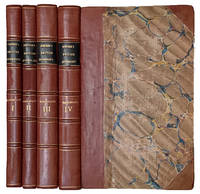
1828rif. S13985London:: Printed for the Author; published by Baldwin and Cradock 1828-31. 1828. Four volumes. 8vo. 9.5 inches tall. Vol. I: 2 iv 186 2 pp. 9 plates. Vol. II: ii 200 pp. 6 plates. Vol. III: ii 374 6 pp. 4 plates. Vol. IV: ii 413 1 pp. 4 plates. Original marbled boards with modern half-calf raised bands gilt-stamped spines black leather spine labels marbled endsheets. Small ownership labels of the Lowther Collection. Nice set. CONTAINING THE FIRST PUBLICATIONS OF CHARLES DARWIN. The full edition was issued in 12 volumes. "While at the University of Cambridge the student Charles Darwin became an enthusiastic insect collector. He sent Stephens records of the rarer insects he had captured and was delighted when Illustrations of British entomology gave him credit for capturing insects described in 33 entries quoting his words in all but two of the cases. Darwin recalled in his autobiography "No poet ever felt more delight at seeing his first poem published than I did at seeing in Stephen's Illustrations of British Insects the magic words 'captured by C. Darwin Esq.'" though the closest wording as published actually appeared slightly differently as "captured by the Rev. F. W. Hope and C. Darwin Esq. in North Wales" and "Taken in North Wales by C. Darwin Esq." – Wikip. / The exquisite plates are colored by hand after drawings by Charles M. Curtis 1795-1839 and John Obadiah Westwood 1905-1893 who was among the first entomologists with an academic position at Oxford University. Although he worked on insect classification and diversity for more than sixty years from the publication of Darwin's Origin of Species he never accepted the ideas on evolution. / James Francis Stephens was an English entomologist and naturalist. He was elected fellow of the Linnean Society on 17 February 1815 and of the Zoological Society of London in 1826. From 1815 to 1825 he took a great interest in ornithology and contributed to the work of George Shaw 1751-1813. He was granted leave from office to assist William Elford Leach in 1818 to arrange the insect collection at the British Museum and eventually described as many as 2800 British insect species. In 1833 he was founder of what became the Royal Entomological Society of London. Stephens made a large insect collection that included many specimens. After his death the insect collection was purchased by the British Museum. PROVENANCE: Bruce Lowther 1926-1999 Collection c/o J.T. Barnes 503 Royal Trust Building Victoria B.C. Lowther was a journalist broadcaster author and historian with a particular interest in British Columbia labor history. From 1954-76 he worked as a reporter and columnist for the Victoria Daily Colonist. His collection of books was donated to the Saanich Archives Saanich British Columbia. Printed for the Author; published by Baldwin and Cradock, 1828-31. hardcover books
1828rif. S13985London:: Printed for the Author; published by Baldwin and Cradock 1828-31. 1828. Four volumes. 8vo. 9.5 inches tall. Vol. I: 2 iv 186 2 pp. 9 plates. Vol. II: ii 200 pp. 6 plates. Vol. III: ii 374 6 pp. 4 plates. Vol. IV: ii 413 1 pp. 4 plates. Original marbled boards with modern half-calf raised bands gilt-stamped spines black leather spine labels marbled endsheets. Small ownership labels of the Lowther Collection. Nice set. CONTAINING THE FIRST PUBLICATIONS OF CHARLES DARWIN. The full edition was issued in 12 volumes. "While at the University of Cambridge the student Charles Darwin became an enthusiastic insect collector. He sent Stephens records of the rarer insects he had captured and was delighted when Illustrations of British entomology gave him credit for capturing insects described in 33 entries quoting his words in all but two of the cases. Darwin recalled in his autobiography "No poet ever felt more delight at seeing his first poem published than I did at seeing in Stephen's Illustrations of British Insects the magic words 'captured by C. Darwin Esq.'" though the closest wording as published actually appeared slightly differently as "captured by the Rev. F. W. Hope and C. Darwin Esq. in North Wales" and "Taken in North Wales by C. Darwin Esq." – Wikip. / The exquisite plates are colored by hand after drawings by Charles M. Curtis 1795-1839 and John Obadiah Westwood 1905-1893 who was among the first entomologists with an academic position at Oxford University. Although he worked on insect classification and diversity for more than sixty years from the publication of Darwin's Origin of Species he never accepted the ideas on evolution. / James Francis Stephens was an English entomologist and naturalist. He was elected fellow of the Linnean Society on 17 February 1815 and of the Zoological Society of London in 1826. From 1815 to 1825 he took a great interest in ornithology and contributed to the work of George Shaw 1751-1813. He was granted leave from office to assist William Elford Leach in 1818 to arrange the insect collection at the British Museum and eventually described as many as 2800 British insect species. In 1833 he was founder of what became the Royal Entomological Society of London. Stephens made a large insect collection that included many specimens. After his death the insect collection was purchased by the British Museum. PROVENANCE: Bruce Lowther 1926-1999 Collection c/o J.T. Barnes 503 Royal Trust Building Victoria B.C. Lowther was a journalist broadcaster author and historian with a particular interest in British Columbia labor history. From 1954-76 he worked as a reporter and columnist for the Victoria Daily Colonist. His collection of books was donated to the Saanich Archives Saanich British Columbia. Printed for the Author; published by Baldwin and Cradock, 1828-31. hardcover
1828rif. Stephens10of12Ten of 12 volumes: Haustellata volumes 1-4 Mandibulata 1-6 lacking volume 7 and supplement. First editions by Baldwin and Cradock London. 1828-1835. Overall good condition. Complete with all plates and pages. Bindings are mixed. Seven volumes light tan full leather goat with Yapp style bindings. Marbled endpapers and edges. Then two half leather marbled board bindings and one museum library rebind ~75 years old. The interiors are excellent except for vol. 6 Mandibulata which has water toning upper outer corner affecting last quarter of volume and final two plates. Haustellata volume 4 has museum library stamp on title page and plates are in a back pocket; has interesting old scientific marginalia. The value here is in the matching 7 volumes Haustellata 1-3; Mandibulata 1-4. First appearance of Darwin's work in print. See Freeman pages 19-20. A note on the Yapp bindings: These are clearly 19th century bindings. I find no clues to identify the binder. The leather is limp. When I got this set all edges were curled but over time I have been able to flatten all the bottom edges and some of the front edges; so I believe all edges could be flattened to their original intention with some determination. Feel free to inquire in fact you probably should. Please see scans of the volumes you will receive. Shipping will be calculated at time of purchase. Buyer will pay actual shipping cost only. Baldwin and Cradock hardcover
rif. 10626-9380235089Hardcover . New. Book Condition is in New Hardcover Original Edition. Shipped Same Day. We do not ship APO and FPO. Will be dispatched fast. Please send me an email if you have any questions. 100% Satisfaction. hardcover
rif. 25208065-nnew. unknown
rif. 25208065like new. unknown
rif. A9789380235080Hardback. New. hardcover
1913In 8 (cm 17,5 x 25), pp. 102. Danni riparati al dorso. Brossura editoriale. Sporadiche annotazioni ai margini del testo.
1990Mm 105x180 Brossura editoriale di pp. 113, collana Ritmi, 34, in stato di nuovo. SPEDIZIONE IN 24 ORE DALLA CONFERMA DELL'ORDINE.
1998ALINEA 1998 FONDO DI MAGAZZINO: LIEVI SEGNI DEL TEMPO ALLA COPERTINA, VOLUME INTONSO, MAI SFOGLIATO, PERFETTO.
1884rif. 436014Torino ; Napoli ; Roma ; Milano : Unione Tipografico-Editrice 1884. First Edition. Hardcover. First Italian edition. Near fine copy in later gilt-blocked cloth. Slightest suggestion only of dust-dulling to the spine bands and panel edges. Remains particularly well-preserved overall; tight bright clean and strong. Physical description; 406 p. : ill. ; 27 cm. Notes; Index : p. 393-406. Torino ; Napoli ; Roma ; Milano : Unione Tipografico-Editrice hardcover
1961Mm 105x180 Collana "Universale Economica" - Brossura editoriale con bandelle, 237 pagine. Testo a cura di Emanuele Padoa. In buono-ottimo stato. SPEDIZIONE IN 24 ORE DALLA CONFERMA DELL'ORDINE.
Torino, Fratelli Bocca, 1907, in-16, tela coeva, pp. VII, 360. Qualche sottolineatura in matita, ma buone condizioni.
rif. 620585869X.Gpaperback. Good. Access codes and supplements are not guaranteed with used items. May be an ex-library book. paperback
2015br. "Nessuno riuscirà a divulgare le teorie di Darwin meglio di lui stesso", avvertiva il poeta Osip Mandelstam; tuttavia, per comprenderle sarebbe stato "indispensabile studiare il suo stile letterario". Con la scrittura dei capolavori scientifici, l'umanista Darwin non aveva infatti elaborato solo un formidabile metodo argomentativo, ma permetteva ai lettori di ogni tempo di fare esperienza concreta delle leggi che governano la natura. Attraverso la composizione retorica dei testi era divenuto possibile - a lui per primo vedere le forme del mondo immerse nel movimento invisibile del tempo e delle trasformazioni; l'azione sterminatrice e modellatrice della selezione; le relazioni e le emozioni impalpabili che legano inestricabilmente tra loro le creature, noi compresi. Il libro è perciò un invito a rinnovare la lettura delle due maggiori opere di Darwin secondo una nuova prospettiva letteraria, con l'ausilio delle prime, splendide traduzioni dei naturalisti italiani dell'Ottocento. Si potrà così partecipare alla profonda esperienza di "meraviglia" che egli introdusse nella storia naturale non meno che nella storia intellettuale e letteraria dell'Occidente.
1987Mm 160x240 Collana "Biblioteca scientifica" - Volume nella sua brossura originale, 332 pagine con numerose figure in nero e a colori nel testo. Tracce d'uso esterne e volume privato delle bandelle, peraltro copia in buone condizioni generfali.
2010Un'aspra polemica è in atto tra fautori del darwinismo e seguaci dell'Intelligent Design; atei di solito i primi, credenti i secondi. Darwin da un lato, Dio dall'altro; ovvero: "Se" il darwinismo è vero... "allora"... "Dio non esiste". Viceversa: "Se" Dio esiste... "allora"... "il darwinismo è falso". Ma le cose stanno veramente così? Uno dei più famosi principi della biologia, l'esclusione competitiva, afferma che la più efficace competizione si ha tra specie simili: predatori vs predatori, erbivori vs erbivori... Perché non applicare questo principio nella contesa filosofica tra ipotesi metafisiche in gara per lo stesso ambito: il sacro? Invece di contestare il canone sacro dall'esterno, perché non proporre una alternativa agnostica, laica ma interna al tema filosofico del sacro, ai sensi di una sana competizione epistemologica? Forse non si doveva "spingere" per chiudere quella porta: forse la si doveva "tirare a sé", per aprirla, senza timori, all'indagine filosofica laica. La scienza, darwinismo in testa, può dimostrare che i ricorrenti concetti di Dio, scienza, religione sono contingenti, infondati. Come arguì Dewey, il pensiero darwiniano è molto più dirompente ed efficace di quanto si pensi. Autori: Roberto Verolini.
1983In-8 (cm. 24.50), cartonato editoriale, pp. 127, (1), con illustrazioni in bianco e nero ed a colori fuori testo. In buono stato (good copy).
1983Mm 170x245 Volume cartonato rigido,129 pagine con illustrazioni a colori e in b/n.Testi di Filippo De Filippi, Michele Lessona, Paolo Mantegazza, Giovanni Canestrini. Strenna UTET in ottimo stato. SPEDIZIONE IN 24 ORE DALLA CONFERMA DELL'ORDINE.
1913Milano, 1913, stralcio delle pag. 1137/1139 con illustrazioni. (Alfred Russell Wallace) - !! ATTENZIONE !!: Con il termine estratto (o stralcio) intendiamo riferirci ad un fascicolo contenente un articolo di rivista, sia che esso sia stato stampato a parte utilizzando la stessa composizione sia che provenga direttamente da una rivista. Le pagine sono indicate come "da/a", ad esempio: 229/231 significa che il testo è composto da tre pagine. Quando la rivista di provenienza non viene indicata é perchè ci è sconosciuta. - !! ATTENTION !!: : NOT A BOOK : “estratto” or “stralcio” means simply a few pages, original nonetheless, printed in a magazine. Pages are indicated as in "from” “to", for example: 229/231 means the text comprises three pages (229, 230 and 231). If the magazine that contained the pages is not mentioned, it is because it is unknown to us.
rif. 0879483318.Gpaperback. Good. Access codes and supplements are not guaranteed with used items. May be an ex-library book. paperback
1988rif. 8866-0276Oxford, Basil Blackwell, 1988. Oktav, Org.-Softcover, 1 Bl., 184 S., wohlerhaltenes Exemplar. - ENGLISH: Octavo, illustrated publisher's softcover, 1 f., 184 pp., a well preserved copy. ISBN 0631145346. - ENGLISH: Octavo, illustrated publisher's softcover, 1 f., 184 pp., a well preserved copy
2013brossura L'opera è strutturata in due capitoli. Il primo vuole essere una "difesa" del padre della biologia moderna, Charles Darwin, che in questi ultimi tempi è vittima di un processo sommario da parte di gente senza scrupoli. L'autore ha cercato di far parlare il biologo inglese attraverso un'analisi accurata della sua opera maggiore, L'Origine delle specie per selezione naturale. Il secondo capitolo vuole offrire una genealogia mitica della "Matonna te Noule" ("Madonna di Novoli").
1878rif. 53228Torino, Unione Tipografico-Editrice, 1878. Large8vo. In recent cardboard wrappers. Occassional light brownspotting, especially to the first and last few leaves. Otherwise fine. 127 pp.
RILEGATO IN MEZZA PERGAMENA CON TITOLI IN NERO, PIATTI MARMORIZZATI. ALCUNE ILLUSTRAZIONI AD OGNI VOLUME numero pagine: 127+239+139 formato: 26.3X18 stato conservazione: BUONO TRANNE FRONTESPIZI CON FIORITURE