507 risultati
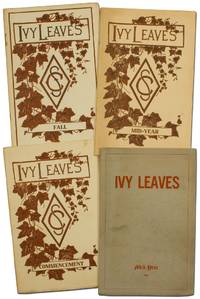
1915rif. 413958New York: Scoville School for Girls 1915. Softcover. Near Fine. Four issues as follows: Vol. XIII No. 1-2 1912-13; Commencement 1913; Mid-Year 1915. Tall octavos. Stapled wrappers. Some soiling and modest oxidation of the stapled very good or better. Poetry prose and news and events from a posh Manhattan girls' school it eventually evolved into the Robert Louis Stevenson School. Scoville School for Girls unknown books
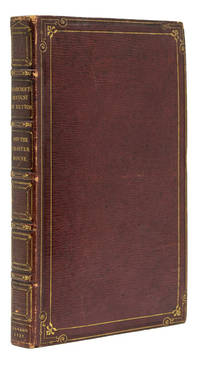
1737rif. 262745London: E. Owen 1737. First edition. Double-page engraved frontispiece of Charterhouse engraved portrait of Sutton preceding Chapter I additional engraved plate of Sutton's tomb. xvi 275 1 pp. 8vo. Early 19th-century red straight-grained morocco a.e.g. Light rubbing to joints later gift inscription on ffep. First edition. Double-page engraved frontispiece of Charterhouse engraved portrait of Sutton preceding Chapter I additional engraved plate of Sutton's tomb. xvi 275 1 pp. 8vo. A life of Thomas Sutton 1532-1611 founder of the Charterhouse School in Smithfield London. E. Owen unknown books
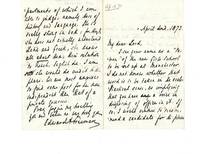
1873rif. 160861873. Freeman Edward Augustus. Autograph letter signed April 2 1873 recommends Scottish educator and historian Margaret A. R. Macarthur for appointment as headmistress of a new girls' school in Manchester explicitly arguing that her abilities warranted a position "more independent than that of a private governess." Freeman a historian who would later become Regius Professor of Modern History at Oxford had employed Macarthur as governess to his daughters for nearly five years and writes from direct experience of her teaching. His recommendation documents the professional transition available to an educated woman from domestic governess work to leadership in the expanding field of girls' secondary education and identifies history and languages as Macarthur's particular strengths. Freeman Edward Augustus. April 2 1873. Autograph letter signed to "My Dear Lord." Somerleaze Wells Somerset England. Four pages on a single folded sheet. Having seen his correspondent named as a "Patron of the new Girls School to be set up at Manchester" Freeman asks whether he has influence over appointments and recommends Macarthur for headmistress. "She is a woman of powers far above the common" he writes "and I can witness that she has practiced them well in the only two departments of which I am able to judge namely those of History and language." Freeman adds that although Macarthur did not know Latin and Greek directly "she knows all about them their relation to French English etc." As evidence of his confidence in her historical abilities he explains "I have set her to write one of my series of small histories a History of Scotland which I hope will soon be out." He concludes "I am sure she would do credit to the place. We are most anxious to find some post for her more independent than that of a private governess." Margaret A. R. Macarthur born in Scotland in 1842 subsequently published History of Scotland in Freeman's Historical Course for Schools confirming the literary project Freeman describes while it was still in preparation. The letter thus precedes publication and records Freeman using Macarthur's authorship as evidence of her qualifications for educational leadership. Although the supplied information states that Macarthur was not appointed to the Manchester position the reason given-that better-qualified candidates prevailed-cannot be established from the letter itself and is therefore omitted. Fine condition. Freeman's detailed recommendation preserves contemporary evidence of a woman educator seeking advancement beyond private governess work and of published historical scholarship being cited as a qualification for the headship of a girls' school. unknown books
1940rif. 160881940. Edith Reverend Mother. Autograph letter signed to William Nourse December 22 1940 records wartime conditions at Ascot Priory while its Anglican religious community operated St. Augustine's School for girls during the Blitz. Written three months into the German bombing campaign the letter describes bombs falling near the Priory quieter nights as Christmas approached and the financial strain affecting the institution's supporters. Ascot Priory was the mother house of the Society of the Most Holy Trinity an Anglican women's religious community whose work included nursing care of orphans and education; St. Augustine's School was among the schools operated by the sisters. Edith Reverend Mother. December 22 1940. Autograph letter signed to William Nourse on Ascot Priory letterhead Ascot Berkshire England. Writing three days before Christmas Edith acknowledges the continuing support of friends despite wartime hardship: "I appreciate the kindness of our friends more than ever this year for I know how much financially hit everyone is." Her Christmas wishes immediately turn to the war: "I do hope you will have as happy a Christmas is possible Xmas 1941 bring us peace!" She then gives a direct account of the danger experienced at Ascot: "We have had some bombs unpleasantly near but lately I am glad to say the nights have been much quieter." The letter was written during the Blitz when German aerial attacks on Britain had begun in September 1940 and would continue into May 1941. Ascot Priory had housed the Society of the Most Holy Trinity since the nineteenth century; its sisters maintained religious medical charitable and educational work including the care of girls at St. Christopher's Orphanage and instruction at St. Augustine's School. Edith's December 1940 letter records how that women-led institution continued during wartime through a concise firsthand account of nearby bombing strained finances and hopes for peace. Her remarks are especially immediate because they were written during the first winter of the Blitz rather than retrospectively after the war. No condition defects are specified in the supplied description. A contemporary account of the British home front from the woman responsible for an Anglican community and girls' school during the aerial campaign of 1940. unknown books
1916rif. 183011916. Diploma for female student from Allegan High School in Michigan. 1916. 21.5 x 16 inches. Awarded to Katherine Esther Tripp for completion of the general course prescribed by the Board of Education. Engraving of school building beneath large decorative text with school name across the top of certificate. The early 20th century saw new educational opportunities for American women who upon graduating from high school could attend integrated colleges. Educational activists like Catharine E Beecher advocated fiercely for women's right to enter any college based on the belief that gender equality was contingent on the quality of female education and institutional opportunities to support it. Creased where folded. Light toning to edges does not affect text or image. Original gold seal clipped but otherwise intact. Overall good condition. unknown books
1856rif. 83481856. NEW JERSEY. NORMAL SCHOOL STATE. First 2nd 3rd 5th-7th 9th 10th 12th 15th 16th 21st 23rd Annual Report of the Board of Trustees . Trenton etc. 1856 -1877. Chiefly wrappers two removed. Plates. Most with library stamp on front wrapper. The 13 numbers With much information on teaching methodology curriculum financial data etc. Present-day Trenton State College. unknown books
1968rif. 424844San Francisco: The More Distribution Company / T and M Graphic Arts Center 1968. Softcover. Fine. First edition. Illustrated by Matabala. Quarto. 20pp. Illustrated. Stapled illustrated orange wrappers. Staples a little oxidized else fine. A brief appreciation and biography of the soul singer by and for children. Scarce. OCLC locates three copies all on the West Coast. The More Distribution Company / T and M Graphic Arts Center unknown books
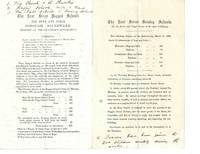
1868rif. 160851868. Newton H. Autograph letter signed on a handbill for the Lant Street Ragged Schools for Boys and Girls April 13 1868 documents free education for poor children and adults in Southwark and records substantially higher attendance among girls than boys. Newton identified as Vicar of St. Michael's Mission Schools Lant Street writes to a donor concerning the schools' work while the printed handbill describes an institution located "in the midst of the poorest population in Southwark" and reports approximately 850 attendances daily. The surviving enrollment figures give particular evidence for girls' participation: 243 girls attended the upper school room compared with 167 boys in the lower school room while afternoon attendance numbered 233 girls and 162 boys. Newton H. April 13 1868. Autograph letter signed on verso of a printed handbill for The Lant Street Ragged Schools for Boys and Girls Borough Southwark. The handbill describes the schools as "the largest with about 850 attendances daily and the most important in South London" and supplies separate attendance figures for boys and girls. It also records an evening school of approximately 65 "grown persons of both sexes" who were taught to read and write showing that the institution combined children's schooling with adult literacy instruction. Newton annotated the printed portion in his own hand including the notation "Ragged Schools male & female." His manuscript communication to a donor links the printed statistics and public appeal directly to the school's fundraising activity and administration. Ragged schools developed in nineteenth-century Britain to provide free instruction to children excluded by poverty from other forms of schooling commonly combining elementary education with religious and charitable work. The Lant Street handbill records that work before the Elementary Education Act of 1870 established a national framework for elected school boards in England and Wales. Its sex-specific figures are especially informative for the history of women's education: girls exceeded boys in both reported daytime sessions while the evening school extended literacy instruction to adult women as well as men. The handbill and Newton's signed letter preserve two aspects of the institution on the same sheet-the statistics used to describe its educational work and a clergyman's direct appeal to a supporter. No condition defects are specified in the supplied description. A contemporary record of schooling adult literacy charitable fundraising and female attendance among the poor of Victorian Southwark. unknown books
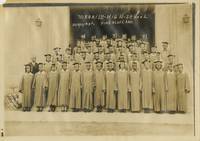
1943rif. BK0057Pine Bluff Arkansas 1943. Gelatin silver photograph 5 x 7 inches. Minor loss or wear at upper left corner otherwise very good. A class photograph of the 1943 graduating class of Merrill High School one of only a handful of schools serving Black students in Pine Bluff before integration. Approximately fifty graduates and several faculty members pose in caps and gowns before the school with the image captioned in the negative "Merrill High School / May 22 1943 / Pine Bluff Ark." Merrill was established in 1886 and graduated its first students in 1894. It became an important center of Black secondary education in Pine Bluff and was the third Black high school in Arkansas accredited by the North Central Association. The school continued as a Black high school until the integration of Pine Bluff's public schools around 1970-71. unknown books
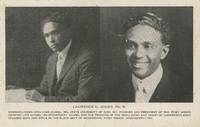
1920rif. List3814Nashville Tennessee: Ambrose 1920. Printed photographic postcard measuring approximately 3 ½ x 5 ½ inches. Recto with two portraits of Laurence C. Jones captioned "Laurence C. Jones Ph. B." and describing him as founder and president of the Piney Woods Country Life School "an opportunity school for the training of the head hand and heart of underprivileged colored boys and girls in the Black Belt of Mississippi." Divided postcard back with printed appeal headed "How to Help Piney Woods School" soliciting money clothing shoes and scholarships. Light wear and soiling; very good. A fundraising postcard for Laurence C. Jones and the Piney Woods Country Life School in Piney Woods Mississippi. Jones founded the school in 1909 to provide academic industrial and agricultural education for African American children in rural Mississippi. The front of the card summarizes the school's purpose in the language of the period describing it as an "opportunity school" for the training of "head hand and heart" in the Black Belt. The verso gives a direct appeal for support requesting "money in any amount-even one dollar is helpful" and asking for clothing and shoes for young men and women "who are working their way." It also gives the price of scholarships: $100 for an academic scholarship $50 for an industrial scholarship or $5 a month to give a boy or girl the opportunity to enter the school. Ambrose unknown books
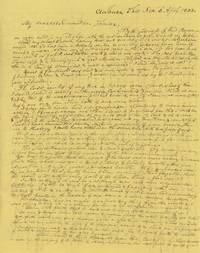
1832rif. List3436Auburn New York 1832. Single four-page letter measuring 7 ¾ x 9 ¾ inches. Folded with very small tears at folds. Excellent to Near Fine. A letter written from the Auburn Theological Seminary in 1832 from the soon-to-be Reverend Thomas Reed Rawson 1803-1877 to his soon-to-be wife Louisa W. Dawes 1810–1849. Dawes who lived in Cummington Massachusetts was the older sister of Senator Henry Laurens Dawes best known for the 1887 Dawes Act. Rawson opens by commenting on the death of one of his students and his time spent in Oswego “visiting in the most fashionable families”; he felt this taught him a great deal about “human nature” which in Oswego is “peculiar”. He seems to have been particularly perplexed by the spiritual character he encountered in upstate New York a locus of the Christian revival movement now called the Second Great Awakening: “You know I expected that the spirit of the west was a more active . spirit than what was seen in the N.E. states & hoped by breathing this pure atmosphere to enjoy great spiritual health. How erroneous was the impression! How greatly have I been deceived! . I acted as though it was so – as though man was man only in certain latitudes. I acted as though face answered to face only when seen in the waters of N.E. & consequently that the heart of a N.E. man had no analogy to what beats in the bosom of one born in a more western longitude.” Not only is Rawson nonplussed by New Yorkers’ religious qualities he is vehemently opposed to some of the new practices that arose from the religious revival there: “The state of things here I mean in all this country at the west is very peculiar. You have heard of ‘Old & New Measures’ I suppose. For myself I cannot approve of the latter. I find not a spirit in me to Fellowship them. Have been exceedingly tried by them as I have been in the midst of ‘new measures’ all winter. You can form but a faint idea of the excitement which is in this country in the religious community. In Oswego Co. the lay-men are going through the Co. holding meetings once a month in praying exhorting dispensing the duties of Clergymen &c. &c.; & it seems that the present state of things must result in a wide division in the churches. ‘A house divided against itself cannot stand.’ . As near as I can find out very sinister is the spirit that knows the new measures to that wild-pine which ran so extensively in the time of Edwards. The effects of it are seen in your town to this day.” The “New Measures” were novel practices for American Christianity that came about during the Second Great Awakening mainly due to Presbyterian minister Charles Finney. These include very lengthy meetings public naming of sinners and public confessions of sin and were controversial with those who preferred a more orthodox and restrained service. Rawson accurately predicts that the new practices would lead to a schism; starting in 1837 the Old School-New School Controversy split the Presbyterian church along these lines. He later worries that such a division in the church would allow “Catholicism to take the advantage” and that “Satan is bringing this about as rapidly as possible”. The appeal of a strong hierarchical Catholic church as opposed to a weak and divided Protestant one was a common worry among Protestants at the time. Rawson traces the “sinister spirit” of the new measures back to “the time of Edwards”: Jonathan Edwards a key figure in the First Great Awakening of the 1730s and 40s. Given his reference to “your town”—Cummington Massachusetts—Rawson is probably referring to the so-called “New England theology” that arose from the First Great Awakening. Among other things New England theology proposed new views on man’s free will and responsibility; similar views would create controversy in Rawson’s time as he explains: “I see my own heart to be depraved & wicked beyond all observation but the fruits of the spirit I think I do love & hope they are sweeter & more sweet to my taste. I say taste the New measure-men are not taste-men but believe in the ‘motive scheme’ — By taste is meant the implantation of a new principle – love to God & is affected by the Holy Spirit. The ‘motive scheme’ implies that the sinner turns himself about in by motive merely.” He is objecting to the idea that a sinner could redeem himself through an act of his own will—by his own ‘motives.’ Old School Presbyterianism holds a more orthodox Calvinist view wherein the redemption of the sinner is not up to the sinner’s will at all. Rawson makes an interesting comparison between New School views on the matter and states’ rights in the context of the then-ongoing nullification crisis: “The signs of the times declare most plainly to him who has wiped up his eyes that ‘the end has come upon the four corners of this earth’ i.e. the end of peaceful days for the present. Never was our Republic brought to a crisis like this. Nullification in the Political world is the same with Denunciation in the Religious world. This is my opinion; don’t know as have heard others say so.” The nullification crisis arose when South Carolina declared that several import tariffs were unconstitutional and thus nullified them under the states’ rights doctrine of state nullification. Rawson seems to be drawing a parallel between the revivalists’ idea of the role of one’s motives in salvation and states’ rights advocates’ idea of the relationship between the states’ wills and the federal government’s. Of course the states’ rights issue would soon reach an apotheosis. Rawson closes with some affectionate lines for Dawes and advice about her own teaching job; the crossed text updates her on the Christian conversions within his family. Overall the letter provides detailed insights into the views of a more conservative theology student on the Presbyterian controversy that was soon to come to a head. unknown books
1931rif. 166401931. Women Education Photo album of girls primary school 1931-1938. 8 3/4 x 12 in. Original blue cloth board covers. 58 vernacular Gelatin silver print black and white photos of various sizes from 2.5 x 3.5 in. to 5.5 x 4 in. Follows a class of girl students over the course of 7 years right before the start of WWII and the bombing of London. . Album kept by schoolteacher of the students at All Saints Girls' School in London. Inscription on inside front cover: "From 1931- Recording many happy hours with All Saints . Candidates Central Islington." Begins with "The Original Class" and identifying class leaders including one small child identified as "Baby". In 1935 identified as the "Jubilee Year" celebrating 25 years of King George V students had photos taken in Kensington Garden while performing a "Jockey Dance" and national dances for England Ireland Scotland and Wales. Children are dressed up in the garden as a "gypsy" jockey and "butterflies and elves." There are also pictures of girls in short dresses posing as part of the Skipping Team. In other images students wear plaid skirts ties and hats while performing a "Scotch Dance"; they also wore special costumes for different dances such as the "Mountain March" the "Shoe maker" and "Cochin-China". Includes note on what the girls were wearing for each yearly photo: "Blue and white check dresses with white collars & cuffs" and 1937 Coronation Year King George VI / Red white & blue dresses". Very good condition. unknown books
1989rif. 592604White Plains New York: Harris 1989. Hardcover. Near Fine. First edition. 284pp. Blue cloth with gilt lettering. Small abrasion on front board near fine. Laid in is a four page errata pamphlet. An alumni directory for LaGuardia High School in New York with the addresses of such notable names as: Jennifer Aniston Ving Rhames Dom DeLuise Jonathan Lethem Erica Jong Jacqueline Yvonne "Jackée" Harry Eagle-Eye Cherry Diahann Carroll Paul Stanley and more. Harris hardcover books
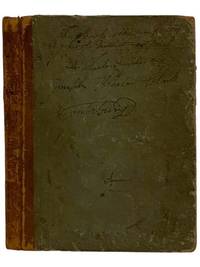
1830rif. 2324134Canterbury New Hampshire: S.N 1830. Hard Cover. Good/No Jacket. Boards rubbed and soiled ink note from district clerk on front board ink owner name on front endpaper evidence that leaves were once pressed between some blank pages. 1830 Hard Cover. Unpaginated ruled pages as one would expect to see in a ledger. Leather spine olive paper over boards. A manuscript book detailing board elections budget votes and other administrative matters related to the operation of Canterbury New Hampshire's School District No. 4 written in the hands of several different clerks. S.N hardcover books
1823rif. 15369New York: D. Fanshaw Printer No. 1 Murray-Street 1823. Broadside octavo decorated borders untrimmed. Lightly foxed and dustsoiled Good. A rare broadside hymn of New York's Reformed Dutch Church. OCLC records a single copy at the New York Historical Society as well as single copies of this title printed in three other years. OCLC 58786086 1- NYHS as of December 2016. Not in AI Sabin Eberstadt Decker NUC Library of Congress Broadside Catalog of AAS online. D. Fanshaw, Printer, No. 1 Murray-Street unknown books
1908rif. 288258Washington Barracks D. C.: The Battalion Press Press of the Engineer School Government Printing Office 1908. Hard Cover. Very Good binding. Six pamphlets from the late 19th early 20th century primarily on military engineering bound together in one volume. Brown buckram with a black leather label. Spots of discoloration to the spine. Very Good binding. The Battalion Press | Press of the Engineer School | Government Printing Office unknown books
1902rif. 562438Boston: Geo. H. Ellis Co. Printers 1902. Hardcover. Near Fine. First edition. Octavo. 159pp. Illustrated. Blue cloth gilt. Interior page with neat marks and rubbing and small spots on the boards else near fine. Compiled by six women a collection of both old standard and newly created playground games. This was co-author Elizabeth F. Gordon's copy with her Signature dated in 1902 on the front pastedown. Geo. H. Ellis Co., Printers hardcover books
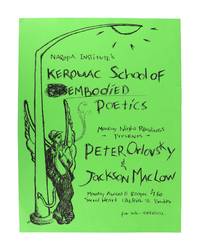
rif. 38291Boulder CO: Naropa Institute N.d. Very Good. Boulder CO: Naropa Institute ca. 1975-80. First Edition. Illustrated poster 37x28in printed offset in black on green stock. Some faint smudging and small tear at right edge. Verso likewise smudged. "Dis" has been scribbled over and "embodied" underlined with black ink by a random vandal or rogue poet. Nevertheless a Very Good copy of this scarce piece of Kerouac School ephemera. Poster promotes a weekly reading series this one featuring Peter Orlovsky Allen Ginsberg's longtime partner and Jackson Mac Low. The Naropa Institute now Naropa University was founded on Buddhist beliefs and practices. In 1974 Allen Ginsberg and Anne Waldman established the Jack Kerouac School of Disembodied Poetics on its campus. It is described by the school's website as a "radically alternative literary space rooted in contemplative practice and experimental poetics." Not separately catalogued in OCLC as of May 2026. Naropa Institute unknown books
rif. 30243PRINCETON UNIVERSITY. SCHOOL OF ARCHITECTURE. ARCHITECTURE AND THE UNIVERSITY. Princeton: School of Architecture 1954. 8vo. Cloth spine boards. vi 72 pages. First and only edition. Scarce item. "Proceedings of a conference held at Princeton University December eleventh and twelfth nineteen hundred fifty-three." A series of reports presented on the state of architecture as a profession and study by leading architects and professors in the field. Front cover partially sunned else very good. unknown books
1966rif. 19398.11966. Softcover. VG- Slight indention from a paper clip at ffep and title page; Soft bend at bottom right corners; Slight creasing at spine. Color wraps. 100 pp. Profuse bw plates. Accompanied a 1966 exhibition that featured works by Louise Bourgeois Alexander Calder Nicholas de Stael Richard Diebenkorn Jasper Johns Giorgio Morandi Andy Warhol and others; Cover is an original design by Diter Rot who has numbered and initialed this copy #301/1000; Scarce. paperback books
1916rif. List2304New York 1916. Small broadsheet measuring 9 ¾ x 6 ¼ inches mounted to backing paper. Chips to margins affecting text fair condition. A program for a benefit concert for the Manassus Industrial School at the Music School Settlement in New York featuring performances by Mabel Diggs Consuelo Pappy Jessie Janefer and Jean Kelly. The program also featured addresses by Principal Fred Norton of the Mannasus Industrial School. We find scant information on the performers other than Diggs with Pappy whose name is misspelled as Consuleo listed as a pupil of Music School Settlement. The Manassus Industrial School for Colored Youth opened in 1894 as a private residential school and was converted to a public school following the Virginia Supreme Court case of 1902 mandating the education of African-American youth. unknown books
1870rif. 29538Montgomery Alabama: John G. Stokes & Co. State Printers 1870. 7 1 blank pp. Stitched in original printed green wrappers. Light old folds wrappers lightly spotted Very Good. Contemporary inscription at head of front wrapper "Respects of G. Horton Mobile." A Bostonian who had moved to Mobile as a young man Horton was Mayor of Mobile at this time. Previously he had been an advocate of public education and had served on Mobile's school board. During the Civil War he was jailed for Unionist sympathies. During Reconstruction his advocacy of civil rights placed his life in constant danger. The Report is a chapter in Alabama's bitter Reconstruction strife. It attacks Dr. N.B. Cloud State Superintendent of Public Instruction who was regarded by unreconstructed Alabamans as a Scalawag for his support of Reconstruction and the Republican Party. The Report also attacks G.L. Putnam whom Cloud had named Mobile's superintendent of education an appointment which other Mobile educators refused to recognize. Cloud brokered a compromise-- for which he lacked authority-- by making Putnam superintendent of Emerson College known as the 'Blue School' a Negro school run by the American Missionary Association. The Report accuses Cloud and Putnam of illegally diverting public funds to the support of the Blue School. Ellison 1597. John G. Stokes & Co., State Printers unknown books
1870rif. 31292Montgomery 1870. 23 1 blank pp with original printed title wrappers. Text lightly dusted wrappers dirty stitched. This case is a chapter in Alabama's bitter Reconstruction history. Mobile School Commissioners claimed that George L. Putnam Superintendent of the Mobile schools had mishandled funds which were supposed to be used to support the free public schools. Putnam had been appointed Superintendent by N.B. Cloud State Superintendent of Public Instruction whom unreconstructed Alabamans considered a Scalawag. Putnam used public funds as authorized by Cloud for the support of a school for Negroes. The outcome of the case turned on whether the Commissioners were properly established under the laws and Reconstruction Constitution of Alabama. This brief reviews the history of the Mobile School System and the controversy. unknown books
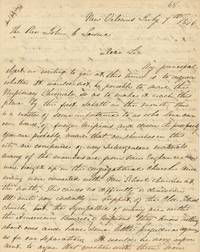
1846rif. List2863New Orleans Louisiana 1846. Single letter three 8 x 10 inch pages. Torn at folds some tears repaired with archival tape; hole at location of seal; otherwise very good to excellent. John Holt Rice 1818–1878 was the son of a Presbyterian minister and nephew of Archibald Alexander founding professor of the Princeton Theological Seminary from which Rice graduated in 1845. When he wrote this letter he was working as a city missionary to the poor in New Orleans. Rice would spend his career ministering around the southern United States before his death from yellow fever. His correspondent is John Cameron Lowrie 1808–1900 a Scottish immigrant fellow Princeton graduate and a missionary in Colonial India. When his health became too precarious to remain abroad Lowrie returned to serve with the Board of Foreign Missions. The subject of missions boards was part of the Old School-New School controversy and schism in the Presbyterian Church particularly over whether missionary work should be primary the Old School view or secondary the New School view to the Church’s work.1 Those holding the latter view were satisfied with the work of the American Board of Commissioners for Foreign Missions ABCFM which was not a specifically Presbyterian body. Those of the former view believing that the Church’s missionary board ought to be itself Presbyterian formed the Western Foreign Missionary Society. When the Church’s second schism occurred in 1837 the Western society was renamed the Board of Foreign Missions BFM and headquartered in New York City. In this letter Rev. Rice finds himself in the delicate position of being an Old School supporter of the BFM ministering to Congregationalists and New School-raised supporters of the ABCFM. He writes to Rev. Lowrie requesting that copies of the BFM’s monthly Missionary Chronicle be sent to him in a timely manner as this was “a matter of some importance to us who love our own board of foreign missions”: “You are probably aware that our churches in this city are composed of very heterogeneous materials many of the members are from New England and were brought up in the congregational church and many were connected with New School churches at the north. This causes no difficulty or division All unite very cordially in support of the Old School church but the sympathies of many are with the American Board of Missions. They know nothing about ours and have some little prejudice against us for our separation. It would be very impudent to argue that question with them now or attempt to convince them that our own board ought to be patronised by those connected with one of our churches rather than the American. But I feel certain that if they knew more of our operations they would take an interest in them.” Rice also notes that he is an editor for the New Orleans Protestant newspaper and suggests that Lowrie send “something now and then” to excite “missionary zeal”. Of interest to scholars of Presbyterian history especially the 19th-century Old School-New School schism. 1 Rev. Dr. Michael Parker “175 Years of Presbyterian World Mission” Presbyterian Historical Society archived November 1 2023 at https://web.archive.org/web/20231101183954/http://www.history.pcusa.org/history-online/topics-note/history-world-mission. unknown books
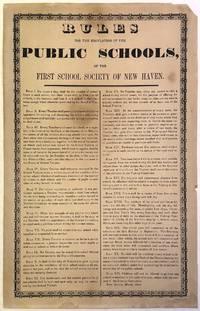
1852rif. 42361New Haven 1852. Folio broadside 9-1/2" x 15." Twenty-one rules printed in two columns divided by a border the whole surrounded by a decorative border. Lightly toned several spots minor blank corner or extremity chips. Good plus or so. Dated in type at the end "New Haven March 1852." The Rules cover school practices "Six hours a day shall be the number of school hours" recess responsibilities of teachers "Every Teacher shall faithfully and exclusively devote themselves to their duties" expulsion permitted "when reformation appears hopeless" holidays tardiness. OCLC 822577625 1- CT State Library as of August 2026. unknown books