Escola, ColeABAA

510 risultati
2024rif. 1103New York 2024. A group of 9 items from the hit play. Included are three handbill flyers 5 ½” x 8 ½” from the original off Broadway shows at Lucille Lortel Theatre two of which are signed by Escola and multiple other cast members; three signed Playbill programs 48pp. from the Broadway shows at the Lyceum Theatre one of which a Pride Month version is singed by Escola only and another from the opening night is signed by the full cast; one production still photo 8” x 10” of Escola signed by Escola; there are also two poster/window cards 14” x 22” one from the off Broadway shows signed by the 5 on-stage cast members and one from the Broadway shows signed by the full cast understudies and including a quote in Escola’s hand. A smudge on one signature some light soiling on a couple pieces else generally fine condition. The darkly silly irreverent and sardonic comedy uses a spin on Americana; telling of Mary Todd Lincoln and the days leading up to the assassination of her husband. “Oh Mary!” premiered off-Broadway at the Lucille Lortel Theatre in February 2024. The play immediately received critical acclaim and it’s close was extended multiple times before transferring to Broadway with previews beginning June 2024. unknown books
1943rif. 277008Kamnik district Slovenia: Tehnika RK VI 1943. 30pp. 8vo mimeographed text with images original tan wrappers with mimeographed cover. This rare surviving pamphlet from World War II was produced by the Yugoslav Partisans the most accomplished armed resistance movement against the Axis occupation of Europe. Starting out as a guerilla group the Partisans soon created a complete underground society based on Communist principles including schools government and medical institutions financial systems and publishing presses. This pamphlet produced by one such press likely hidden in the mountains or forests of Slovenia addresses an emergent need in such a new clandestine society: that for maps. It proceeds in logical order: geographical vocabulary instructions for making field maps and later more sophisticated and symbolic drafting techniques. Within this technical know-how it also communicates tactical military advice that the Partisan guerillas employed in their battles with Axis armies. This tactical quality of the publication is most in evidence in the pamphlets many striking diagrams which demonstrate the importance of visual knowledge in situations of survival. This pamphlet was one of many Partisan publications designed to educate protect and encourage members of the movement. It is particularly fascinating for its simple means of production since the secrecy of Partisan operations limited them to mechanical methods such as mimeographs--in witness here--as well as heliotypes linocuts and typewriting. Given its fragility the pamphlet is in excellent condition with clean text. Slight stains and some very small tears in margins. As one of the few Partisan publications on cartography this pamphlet is a rare and fascinating record of the World War II resistance. Tehnika RK VI unknown books
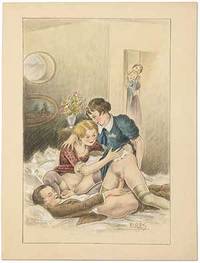
1935rif. 334200Paris: no publisher 1935. Near Fine. Hand colored lithographic print on fine wove paper. Image size approximately 7" x 11". Likely removed from a folio volume as indicated by a thin stub tipped-in along the left edge of the sheet. Near fine. Possibly one of the eight original Eres prints for the pornographic novel Aventures d'une satyre attributed to Jane de Rozat published in Paris in the mid-1930s. no publisher unknown books
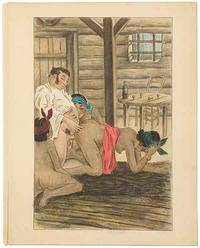
1930rif. 334203not indicated: not indicated 1930. Unbound. Near Fine. Hand colored pochoir print on fine wove paper. Image size height preceding width measures approximately 28 x 18 cm. Near fine. Signed "ERES." Could be one of the eight original prints also signed "Eres" for the pornographic novel Aventures d'une satyre attributed to Jane de Rozat published in Paris in the mid-1930s. not indicated unknown books
1877rif. 19616Montevideo: Imprenta a vapor de La Tribuna 1877. FIRST EDITION. Original printed wrappers. First printing. On May 15 1877 this first publication of the regulations of the medical school appeared in Montevideo establishing a five-year curriculum which included a course on hygiene in the second year and legal medicine and toxicology in the fourth. The professors who taught these courses were medical doctors of great renown. OCLC locates nocopies in America just a single copy at the BnF. Imprenta a vapor de La Tribuna unknown books
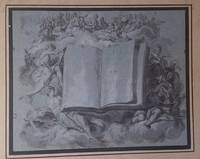
rif. 305Augsburg. Original Drawing for Book Illustration. 160 x 197 mm. 6 ¼ X 7 ¾ inches. Drawn on blue paper laid down on 19th century paper. Black double fillet ink border. Shows some light wear but otherwise in very good condition. An attractive and well executed drawing in brown and white ink which illustrates the Book of Life surrounded by figures which probably illustrate the four seasons. This motif is crowned by a chorus of angels and saints also drawn in fine detail. Originally thought to be an Italian drawing the small-scale figures and the delicate pen strokes suggest the Augsburg School of the mid-18th century. Artists like Johann Wolfgang Baumgartner Joseph Christ and Godfried Göz all painters of considerable skill and reputation who also worked closely with local publishers creating designs for prints and book illustrations. The choice of blue paper and the application of white ink to heighten the image is typical of Augsburg style of the 1750's. For further information see Thomas Kaufmann's monograph Central European Drawings 1680-1800. Princeton 1989 and an essay by Peter Stoll in OPUS "Empire of Prints. The Imperial City of Augsburg and the Printed Image in the 17th and 18th Centuries" 2016. Both works are well illustrated and show examples of the drawings and prints from Augsburg artists during the period. unknown books
1860rif. 2206161860. With Inscription and descriptive text in pencil. 1 vols. 19 x 14 inches 48.3 x 35.6 cm. Framed and glazed. Fine. With Inscription and descriptive text in pencil. 1 vols. 19 x 14 inches 48.3 x 35.6 cm. unknown books
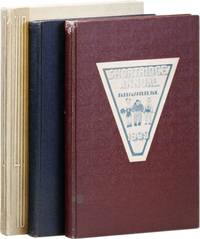
1938rif. 33807Indianapolis: Shortridge High School Press 1938-1940. First Edition. Three volumes; quarto 25.5 - 27.25cm.; original cloth the two earliest Annuals with color pictorial plates mounted to upper covers last issue pictorially blind-embossed; illus. mostly photographic throughout. Light edge wear tiny loss to cover plate of earliest volume not approaching image or text the usual student signatures throughout else a Very Good or better set. High school yearbooks dating from Vonnegut's sophomore junior and senior years. We find images of Vonnegut on the student council in 1938 and 1940 though never the Fiction Club; ths Social Committee in 1939 and 1940; and the editorial staff in 1940. He was also listed one of the ten most popular boys "Uglymen" in school his senior year. Years later Vonnegut would famously write: "Shortridge High School is my dream of an America with great public schools. [Shortridge High School Press] unknown books
rif. 798222020. Sixteen 16 linear feet shelf space. Sixteen 16 linear feet shelf space. American Criminal Law Review. Georgetown Law School. Volumes 1 to 57 1963-2020 in 75 bound volumes with 54 no.4 in 1 softbound book. Together 76 books. Title varies: Volumes 1-9 American Criminal Law Quarterly. American Bar Association; Volumes 10-57 American Criminal Law Review. Georgetown Law School. Ex-library with property stamps shelf location labels at foot of spines and small bar code labels on lower front covers else very good. Sixteen 16 linear feet shelf space. $1500. The American Criminal Law Review ACLR is one of the nation's top-ranking criminal law journals. Its issues sit on the desk of thousands of judges academics and practitioners across the country. ACLR's mission is to serve the criminal law community by providing a forum for the best scholarship in the field. unknown books
rif. 798232020. American Journal of Criminal Law. University of Texas School of Law. Volumes 1 to 46 1972-2019 in 38 bound books Volumes 47 numbers 12 and 48 no 1 2020 in 3 paper bound volumes. Together 41 books. Ex-library with shelf location labels at foot of spines and property stamps on page edges else very good. $1750. The American Journal of Criminal Law has contributed to over four decades of articles published to promote and encourage improvement in the administration of criminal justice. It has established a respected reputation as one of the nation's longest running and most prolific legal serial publications serving as vanguard to top student-edited legal journals devoted to criminal law. unknown books
1791rif. 38981791. 13 x 9 inches. Dark brown body colour on prepared paper. Inscribed "N.2.Stück" and "am 9ten Aprill 1791--nach der Natur gezeichnet von JEW" ink collector's stamp "Linel-Smlg. No." followed by pencilled number "1046" all on verso. Framed. Provenance: Linel ink collector's stamp on verso. A high quality image that clearly is drawn from life as the inscription claims. The artist's use of a dark prepared ground recalls the work of Barbara Regina Dietsch and her family. A search of Nissen's index of artists reveals one possible name: the Swiss artist Johann Emmanuel Wyss 1782-1837. However the maturity and assurance shown in the present drawing would seem to rule him out: he could have been no older than nine in April 1791. unknown books
1880rif. 630641880. 20-1/2 x 20-1/4 inches. Burl frame. 20-1/2 x 20-1/4 inches. unknown books
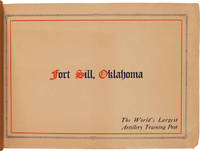
1918rif. 57357Fort Sill OK. ca. 1918. Original Photos from the Early Days of the Artillery Training School at Fort Sill A rare commercially produced photo album rendered unique by the addition of thirty original photographs of the U.S. Army Artillery Training School in Fort Sill Oklahoma at the end of World War I. The first section begins with a printed one-page "Short History of the Fort Sill Military Reservation" and consists of mounted photographs in printed frames with printed captions. This printed portion of album is divided into three parts with individual titles: "Fort Sill Oklahoma: The World's Largest Artillery Training Post"; "Medicine Park: Southwest Oklahoma's Pleasure Resort"; and "Some Views of the Comanche and Apache Indians." The second section of the album consists of blank pages for personal photographs here filled with thirty photographs with occasional manuscript captions supplied by an unnamed Army corporal. In addition to photographs of camp buildings artillery emplacements and scenery in and around Fort Sill the album features a number of photographs of the 1918 Victory Day Parade as well as a "pageant" held at the fort where members of the Comanche and Kiowa tribes participated in reenactments of the early frontier days at the fort. Fort Sill was also the birthplace of U.S. combat aviation in 1915 and a few photographs show some of the earliest military planes. The personal photos at the rear of the album include a number of individual soldiers a handful of alternate views of parades and events and the owner's actual cloth uniform stripes pasted to the final page. A rare and interesting look at the early days of a major American military base at the conclusion of World War I. OCLC records two copies of a similar souvenir album which also covers Camp Doniphan but does not locate the present version anywhere. Forty-one mounted photographs with printed captions and an additional thirty original mounted photographs some with manuscript captions most about 2½ x 4½ inches plus pasted-in corporal's stripes on final album leaf. Oblong quarto. Original printed thick wrappers with wrapper title "Souvenir from Fort Sill Oklahoma" tied with string. Spine ends chipped edge wear to wrappers. Photographs lightly faded occasional adhesive residue or paper defects particularly in latter half. Overall very good. hardcover books
1850rif. 20700Paris 1850. Pencil pen and wash drawing with numerous sub-titles in ink signed "J. Litoux" A fascinating and beautiful architectural drawing - or 'rendu' of basic elements of house construction in cluding walls floors doorways roofs and ceilings. A fine drawing from an architectural student at the Ecole des Beaux-Arts in Paris the most influential architectural school in existence during much of the 18th century the whole of the 19th century and the first part of the 20th century. 'Students were eligible for the Ecole if they were at least fifteen years old or under thirty. They began with the seconde classe in which they competed in the concours d'émulation. These alternated between an esquisse - a rough sketch for which up to twelve hours was allowed - and a rendu - the large-scale finished drawing for which one to three months were allowed. Two to four years were usually required for a student to accumulate enough credits to enter the première classe. The same system was followed again usually for two to three years after which the student should have accumulated enough credits to compete for the Grand Prix de Rome. The winner of the Grand Prix was entitled to five years study under the auspices of the French Academy in Rome. For each of his first three years he was required to submit an analytical study of an ancient monument. For his fourth year he had to submit a complete reconstruction of a major classical work. For his fifth year he was required to submit an original work designed to a program of his own invention. In the seconde classe the student was required to attend a variety of lectures in theory history and construction and learned to prepare construction drawings. Work was done at ateliers located outside the precincts of the Ecole des Beaux-Arts. These were rented and organized by the students themselves and the students had the right to invite a teacher of their own choice to serve as their maître. The teacher himself did not have to be a member of the faculty of the Ecole nor - at least in principle - did he have to be a practicing architect.' Arthur Drexler. The Architecture of the Ecole des Beaux-Arts. New York MoMA 1977 p.8-9 Arthur Drexler The Architecture of the Ecole des Beaux-Arts. New York MoMA 1977. unknown books
rif. 798252020. Thirty 30 linear feet shelf space. Thirty 30 linear feet shelf space. Fordham Law Review. Fordham Law School. Volumes 1 to 88 1914-2020 in 134 bound books. Ex-library with shelf location labels property stamps to page edges small bar code labels on lower front covers else very good. Thirty 30 linear feet of shelf space. $1995. Founded in 1914 and operating continuously since 1935 the Fordham Law Review is a scholarly journal committed to serving the legal profession and the public by discussing current legal issues. The Fordham Law Review publishes works in various formats including Articles Essays Symposia and Student Notes. The Fordham Law Review is the thirteenth most cited law review in cases ninth most cited law review in other journals and ranked eighteenth overall in Washington & Lee University's most recent annual study. unknown books
rif. 798282023. Twenty-six 26 linear feet shelf space. Twenty-six 26 linear feet shelf space. UCLA Law Review. Los Angeles School of Law University of California Los Angeles. Volumes 1 to 66 1953-2019 in 92 bound books Volumes 67 no.1 to 70 no.5 April 2020-Nov 2022 in 23 paper bound books. Together 115 books. Ex-library with Location labels at foot of spines and Property stamps on page edges very good. $1995. The Law Review is a completely student-run organization and all management editorial and publication control is vested in its members. The Law Review strives to publish articles of the highest academic quality while also appealing to the general interests of practicing attorneys legal scholars law students judges and legislators. In 2022 it was ranked No. 7 among general-topic law reviews by the Washington and Lee law journal rankings. The UCLA Law School was founded in 1949 and UCLA Law Review began in December 1953. unknown books
rif. 798292020. Twenty-six 26 linear feet shelf space. Twenty-six 26 linear feet shelf space. Notre Dame Law Review. University of Notre Dame Law School. Volumes 1 to 94 1925-2019 in 122 bound books with volume 95 2019-2020 in 5 softbound books. Together 127 books. Ex-library with shelf location labels property stamps to page edges small bar code labels to lower front covers else very good. Twenty-Six 26 linear feet of shelf space. $1995. The Notre Dame Lawyer was organized in 1925. In 1981 the staff of the Lawyer changed the publication's name from the Lawyer to the Notre Dame Law Review but all generations have remained committed to the original founders' vision of a law review "synonymous with respect for law and jealous of any unjust attacks upon it." Today the Law Review maintains its tradition of excellence and its membership includes some of the most able and distinguished judges professors and practitioners in the country. Entirely student-edited the Law Review offers its members an invaluable occasion for training in precise analysis of legal problems and in clear and cogent presentation of legal issues. In addition the Law Review affords its members the opportunity to foster scholarly discourse within the legal community. The Law Review seeks to enrich discourse in the legal community while remaining mindful of the Catholic tradition of justice a commitment prominently featured in each issue's dedication to Our Lady Mirror of Justice. unknown books
rif. 798272022. Thirty 30 linear feet shelf space. Thirty 30 linear feet shelf space. Vanderbilt Law Review. Nashville TN: Vanderbilt University School of Law. Volumes. 1 to 72 1947-2019 in 122 bound books Volumes 73 no.1 to 75 no.2 Jan 2020-March 2022 in 14 paper bound Volumes. Together 136 books. Ex-library with location labels at foot of spines and property stamps on page edges. else very good. $1995. The Vanderbilt Law Review is the flagship academic journal of Vanderbilt University Law School. The law review was founded in 1947 and is published six times per year. In 2022 it was ranked #8 among general-topic law reviews by the Washington and Lee law journal rankings. unknown books
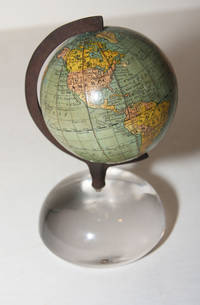
1891rif. 10008Seneca Falls NY 1891. No Binding. Near Fine. 3-inch diameter globe anchored in magnifying glass as issued; 5 ½ inches total height. Color-printed wax-engraved gores; some fading of place names a few repair in extreme southern portion but overall remarkably little wear; overall excellent condition. An unrecorded delightful cartographic curiosity: a very good quality miniature globe with a magnifying paperweight as its base. Only two other globes by the American Globe and Supply Company are known: a six-inch terrestrial recorded by Rumsey dated 1892 and an eight-inch terrestrial cited in Rittenhouse dated 1891; see below. This Seneca Falls New York company was one of several for which Rand McNally supplied gores for the globes it produced. Rand McNally did not issue its first globe until 1887. Very nice condition for an object of this kind. Cf. Rumsey 5120; Rittenhouse Vol. 2 No. 1 p. 23. unknown books
1895rif. 223921Paris: Gauthier-Villars et Fils 1895. First. hardcover. fine. Illustrated throughout with nicely printed portraits and other historical reproductions. 3 volumes. lxviii 519; 572; 646pp. Very thick short 4tos beautifully rebound by Stroobants in older 3/4 tan morocco over marbled boards; ornate gilt-stamped spines with burgundy leather labels; uncut edges t.e.g. original wrappers bound-in marbled board slipcase worn. Paris: Gauthier-Villars et Fils 1895-1897. Fore-edges foxed and also some light foxing throughout the first volume otherwise a fine copy in a lovely binding. Gauthier-Villars et Fils unknown books
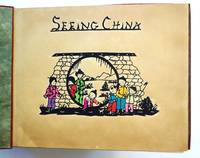
rif. 006911Chefoo China: Women's Bible School American Presbyterian Mission Book. Near Fine. Soft cover. First Edition. Oblong Folio. No Date circa 1930. Near Fine pages with light toning. Oblong folio 10" x 13 3/4". Bound in beautiful red pictorial embossed silk over limp boards string-tied 28 pp of cut-out illustrations in black and white many with colorful silk inlays with tissue guards publisher's 1 page explanatory leaf laid in also an original 6 1/2" x 10 1/2" cut-out with colorful silk inlays and string hanger readt-to-hang laid in. Cut-out chapter headings are Travel and Transportation Customs and Habits Chinese Birth-Year Cycle latest date 1935 Occupations The Eight Immortals Myths and Legends Chinese Recipes Chinese Children Chinese Junks and The Magician. Well over 100 cut-outs in all including the bonus laid in cut-out and SCARCE THUS. Women's Bible School, American Presbyterian Mission Paperback books
rif. 798302020. Thirty-Two 32 linear feet shelf space. Thirty-Two 32 linear feet shelf space. Northwestern Law Review. Volumes 1 to 113 1906-2019 in 133 bound books with volume 75 no. 6 1981 softbound supplement. Volume 114 2019-2020 no. 1-7 in 7 softbound books. Together 140 books. Title varies: Illinois Law Review. Volumes 1-46 1906-1952; Northwestern Law Review. Volumes 47-114 1952-2020. Ex-library with shelf location labels property stamps to page edges small bar code labels to lower front coversand lacking spine labels on volumes 11 13 16 19 and 22 else very good. Thirty-two 32 linear feet of shelf space. $2295. The Northwestern University Law Review is a student-operated journal that publishes six issues of high-quality general legal scholarship each year. Student editors make the editorial and organizational decisions and select articles submitted by professors judges and practitioners as well as student pieces. In 2022 it was ranked No. 14 among general-topic law reviews by the Washington and Lee law journal rankings. First published in 1906 the Law Review has been distinguished by the scholarly qualifications and variety of its participants. Prior Editors-in-Chief include: Roscoe Pound long-time dean of Harvard Law School; Judge Robert A. Sprecher of the United States Court of Appeals for the Seventh Circuit; Justice John Paul Stevens; Dean James A. Rahl; Governor Daniel Walker; and Newton N. Minow former chairman of the Federal Communications Commission. Other editorial officers have included Justice Arthur Goldberg and Adlai E. Stevenson. The equally distinguished list of contributors to the Law Review includes Dean Leon Green Sir William Holdsworth Justice Oliver Wendell Holmes Albert M. Kales Nathan William MacChesney Charles T. McCormick Sir Frederick Pollock Dean Roscoe Pound Dean John Henry Wigmore Justice Felix Frankfurter Justice Tom Clark Justice William O. Douglas Justice Abe Fortas Chief Judge Harry T. Edwards Erwin Griswold Archibald Cox Paul Freund W. Willard Wirtz Albert Ehrenzweig H.L.A. Hart Gerald Gunther Edward H. Levi Hubert H. Humphrey Brunson MacChesney Nathaniel Nathanson Dean James A. Rahl Dean now professor David Ruder Martin Redish Kenneth Culp Davis Raoul Berger Bernard Schwartz Ian Macneil John Coffee Gary Lawson Mary Becker Stephen Schulhofer Nadine Strossen Judge Jose A. Cabranes Judge Richard Posner Cass S. unknown books
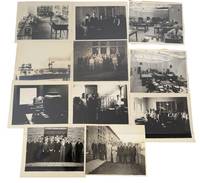
1930rif. 232561930. Stanford University Military Engineering Archive Documenting the First Army Ordnance Reserve Gauging Program ca. 1930. Stanford University photo archive documenting the emergence of interwar military-industrial technical education ordnance gauging instruction and precision engineering research on campus during the early development of Stanford's engineering and applied science programs. Rather than depicting science classrooms in a general sense these photographs specifically document the technical culture surrounding Army ordnance training instrumentation systems machine calibration and laboratory-based engineering instruction that linked universities to the expanding infrastructure of American military preparedness between World War I and World War II. Taken together the archive captures Stanford at the moment when higher education increasingly merged scientific research industrial precision manufacturing and military technical training into a unified research model that later shaped the wartime and Cold War defense university system. Photo archive of 11 large silver gelatin photographs each approximately 8" x 10" Stanford University California dating from 1930 into the 1950s; two later views mounted to decorative yellow board. Several photographs depict laboratory interiors filled with precision instrumentation gauging apparatus optical and mechanical measuring devices machine-tool equipment calibration benches microscopes drafting stations and technical worktables arranged for instruction and inspection work. One especially important close-up photograph shows a large precision gauging or rotational calibration apparatus associated with ordnance measurement and machine tolerance testing. Surrounding the device are machined cylindrical components threaded fittings gauge rings and polished metal parts likely used in dimensional inspection bore alignment concentricity testing or interchangeable manufacturing instruction. Another darkened workshop view depicts what appears to be a heavy precision lathe or gauging bench fitted with a mounted cylindrical test component equipment consistent with ordnance inspection and military engineering instruction during the interwar period. Additional photographs show groups of students and instructors posed around technical apparatus inside instrumentation laboratories while later mounted photographs document more formalized postwar engineering office and drafting environments associated with large-scale technical administration and research organization. Most important is a detailed handwritten verso inscription reading: "Equipment used Feb 1930 Ordnance School at Stanford University. This was first time a course in gauging was given in any Army Ordnance Reserve Unit permanent facilities excepted. Instructor; Lieut Merrill S. Hingo. Photo; Lieut Howard Story Taylor." The inscription firmly identifies the archive as documentation of early Army ordnance reserve technical instruction conducted at Stanford and specifically ties the machinery to military gauging education. In the 1920s-30s "gauging" referred not merely to ordinary measurement but to the specialized science of precision dimensional inspection used in artillery manufacture weapons-part standardization shell tolerances bore measurement interchangeable machining systems and industrial calibration. Such instruction formed a critical component of modern military-industrial production where even minor deviations in machining tolerances could affect artillery accuracy chamber pressure shell seating or mechanical reliability. Several outdoor group portraits further reinforce the military context. One large group stands beneath a doorway marked "Military Science and Tactics" while another includes Colonel Donald C. Cubbison a career U.S. Army officer and West Point graduate who served as professor of military science and tactics at Stanford from 1930 to 1935 before later attaining the rank of major general during World War II. His appearance situates the archive directly within Stanford's interwar military training system and links the photographs to broader national efforts to train technically educated reserve officers in engineering ordnance artillery science and industrial preparedness. The archive also reflects Stanford's broader transformation into a modern research university centered on applied science and engineering. During the interwar years Stanford's scientific departments expanded laboratory instruction instrumentation programs and research-based technical education under faculty including Robert E. Swain John P. Mitchell William H. Sloan and George S. Parks. Parks in particular became associated with analytical chemistry and geochemical laboratory science disciplines heavily dependent upon precision instrumentation and calibrated measurement systems. The engineering and laboratory culture documented here overlaps with contemporary developments in industrial metrology applied physics materials testing optical measurement and machine-tool inspection that increasingly tied university research to industrial production and military logistics. What makes the archive especially significant is the way it documents the transitional infrastructure between traditional university instruction and the emerging defense-oriented research university model. These photographs preserve not simply classrooms but the physical systems of technical education itself: calibration benches inspection machinery gauging apparatus optical instruments drafting rooms and laboratory spaces where students and reserve officers were trained in the precision engineering practices underlying twentieth-century industrial warfare and mass manufacturing. In doing so the archive visually traces the early foundations of the university-based defense engineering culture that would later expand dramatically during World War II and the Cold War throughout California research institutions and the broader military-industrial complex. Photographs are sharp and highly detailed with clear views of equipment and interiors; handwritten identifications remain legible. The two mounted 1950s photographs have several large tears without image loss with lighter handling wear elsewhere. Overall good condition. unknown books
1830rif. 6526London 1830. Aquatints coloured by hand. A fine complete series of four anonymous prints of hunting scenes possibly after the Alkens. The style and naming of these prints suggests an Alken origin for the series. Siltzer records a number of series by the Alken family in which the first plate is titled "Unkennelling." This title appears to be unique to them and supports the supposition that the present series are after the Alkens. Henry Thomas Alken was born into what became an artistic dynasty. He studied under the miniature painter J. T. Barber and exhibited his first picture a miniature portrait at the Royal Academy when he was sixteen. From about 1816 onwards he "produced an unending stream of paintings drawings and engravings of every type of field and other sporting activity. He is best remembered for his hunting prints many of which he engraved himself until the late 1830s.To many sporting art is "Alken" and to describe his work or ability is quite unnecessary." Charles Lane British Racing Prints pp. 75-76 Cf. Siltzer pp.57-76. unknown books
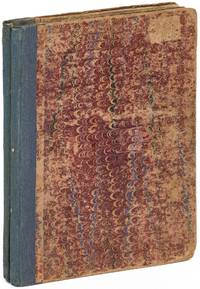
1890rif. 460264Fredonia New York 1890. Hardcover. Good. Two notebooks with printed title: Normal Rhetorical Exercise Correction Book. Fredonia N.Y.: F.C. Chatsey Publisher Copyright 1886. Small quartos. Bound in quarter cloth and marbled paper over boards. Covers are rubbed and worn one front cover has some staining good overall. Both notebooks contain several book reports and essays on special topics written by Walter Pettit when he was a teenage student at the Fredonia Normal School. Both notebooks date from the late 1890s. In addition to reports on The House of the Seven Gables Gulliver’s Travels The Merchant of Venice Oliver Twist and other books; the notebooks include both fictional essays such as “My Flying Machine” and “A Trip to the North Pole” and personal essays on special topics. Here for example is an excerpt from an essay titled: “Should Lynching be Suppressed”: “One of the greatest evils in existence is lynching. That it should be abolished is evident. Many innocent people have met their death by this means and it still is in existence in the Southern States. Perhaps some person … suspected of a crime is imprisoned. A crowd collects and is excited by somebody over the crime … the jailor gives up the suspected criminal to the mob who immediately carry the poor man to the nearest tree … This incident is kept from the newspapers and the suspected criminal dies unmourned unknown. With hanging by authorities … the criminal has a chance for his life; he may plead his case before unprejudiced men. His death is not embittered by the taunts of an unfeeling multitude of men women and children many of whom are as bad as the criminal. The wretches who are the leaders in such a mob are far worse than the victim …” Also included is a travelogue from Sitka Alaska to Dawson City then at the height of the gold rush written in the form of a letter: “Feb. 18 1898: Dawson City Canada / Dear Friend … We started from San Francisco … arrived at Sitka … the town consists of a number of Indian huts a few Russian and American residences … we accompanied an excursion party to the Yukon. This river is one of the largest in the world … upon its banks are a few Indian villages … and here and there ‘Totem poles’. These totem poles … are made of wood grotesquely carved with figures of men beasts and birds. Upon them are kept the records of the Indian’s ancestors. These Indians are a half civilized sneaking dirty race short in stature with small eyes. They act as guides around the settlements … While at Sitka we bought a large stock of groceries … We carried these with us when we went to Dawson. Our party consisted of ten Indians my partner and I. Our journey took three weeks … we reached this city in October and immediately rented the only vacant building in town … I wish you where here to wait on some of our customers. They bring in a bag of gold dust and we weigh out enough to pay for the groceries they buy. This city is in the midst of the gold fields. It is composed principally of saloons dancing halls theaters and gambling houses. The miners sleep in tents … we have rows nearly every night and thieves are as thick as mosquitos …” A graduate of the Class of 1901 Pettit had quickly shed such early external prejudices against indigenous peoples and gold miners. He taught high school in the Philippines 1901-09 attended Teacher’s College at Columbia and served as a U.S. Government Special Relief Assistant in Russia during World War I. As Director of the New York School of Social Work Pettit won international acclaim for his work on the “interdependence of peoples and the strengthening of international relations”. A compelling pair of notebooks that sheds light on Pettit’s early education in upstate New York. American Sociological Review December 1961 pp. 959-60. hardcover books