35.158 risultati
1873rif. 2111902156202536Not Available 1873. Soft Cover. Fine. Number of books: 3 Not Available paperback
rif. 94034aafZürich, Fr. Schmelhaus Limmatquai 62, 1940, quer in-4vo, 14 feste Fotoalbumseiten mit 52 eingefügten Originalfotos in S/W (bis 23x17 cm), letzte Seite bedruckt, sehr guter Zustand, Fotoalbumpappeinband d. Z. mit goldgepr. Titel auf Vorderdeckel, schönes Exemplar.
rif. 82911aafn.d. (1816), 10x16.5 cm, Original watercolour. / Aquarelle originale et lavis d’encre sur papier épais, 1 feuille avec passepartout.
2004rif. 201081021095HARCOURT SCHOOL PUBLISHERS 2004-05-01. Spiral-bound. Good. good condition pages are clean and free of written markings except for name on title page or inside cover light wear to corners and edges has dust jacket where applicable ships same or next business day HARCOURT SCHOOL PUBLISHERS unknown
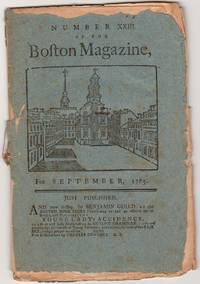
1785rif. 3784Founding of Harvard Medical School The Boston Magazine was published from October 1783 to December 1786 and was the first magazine to be published in Boston in the aftermath of the American Revolution. A major attraction of this issue is the presence of the front and rear printed wrappers although they are frayed and detached. The front wrapper features a large woodcut of the State House and surrounding buildings in Boston.The first 3 1/2 pages of the Magazine are Harvard's announcement from September 1783 of the creation of "the Medical Institution" now known as Harvard Medical School. This is followed by about two pages of an address "to the students in physic" i.e. the medical students reflecting upon the first two years of the medical school and outlining the requirements for a medical degree. About two pages are devoted to the sailing directions into and out of Plymouth Harbour. A brief news item in the "Monthly Chronology" reports a meeting to be held in October in Falmouth in the District of Maine on creating a "separate government" for the eastern counties -- a very early report on a separation that would not happen for another 35 years. Issues of The Boston Magazine in the original wrappers are extremely uncommon.References: Mott A History of American Magazines 1741-1850: Vol. I p. 28. Richardson A History of Early American Magazines 1741-1789: pp. 212-227. Lomazow American Periodicals: 15. Condition: Signatures loose. Front and back wrappers present but frayed and detached; top 1/2" or so of front wrapper lacking. Occasional spotting. Interior pages very good. ICN 2933. Printed and published by Edmund Freeman
1850rif. 8857Paris 1850. Pencil pen and wash drawing with numerous detailed measurements. A fascinating and beautiful drawing--or "rendu"--of an ancient Roman sarcophagus. A fine drawing from an architectural student at the Ecole des Beaux-Arts in Paris the most influential architectural school in existence during much of the 18th century the whole of the 19th century and the first part of the 20th century. 'Students were eligible for the Ecole if they were at least fifteen years old or under thirty. They began with the seconde classe in which they competed in the concours d'émulation. These alternated between an esquisse --a rough sketch for which up to twelve hours was allowed--and a rendu --the large-scale finished drawing for which one to three months were allowed.Two to four years were usually required for a student to accumulate enough credits to enter the première classe. The same system was followed again usually for two to three years after which the student should have accumulated enough credits to compete for the Grand Prix de Rome. The winner of the Grand Prix was entitled to five years study under the auspices of the French Academy in Rome. For each of his first three years he was required to submit an analytical study of an ancient monument. For his fourth year he had to submit a complete reconstruction of a major classical work. For his fifth year he was required to submit an original work designed to a program of his own invention. "This study of the sarcophagus of Lucius Cornelius Scipio Barbatus was part of an Ecole de Beaux Arts student's portfolio. The sarcophagus was one of many in the Scipio family tomb on the Via Appia just outside of Roma and it dates from c. 290 B.C. The obituary text reads English "Lucius Cornelius Scipio Barbatus son of Gnaeus a valiant gentleman and wise whose fine form matched his bravery very well was aedile consul and censor among you he conquered Taurasia and Cisauna in fact Samnium he overcame all the Lucanian lands and brought back hostages." Arthur Drexler The Architecture of the Ecole des Beaux-Arts. New York MoMA 1977. unknown
1850rif. 8857Paris 1850. Pencil pen and wash drawing with numerous detailed measurements. A fascinating and beautiful drawing--or "rendu"--of an ancient Roman sarcophagus. A fine drawing from an architectural student at the Ecole des Beaux-Arts in Paris the most influential architectural school in existence during much of the 18th century the whole of the 19th century and the first part of the 20th century. 'Students were eligible for the Ecole if they were at least fifteen years old or under thirty. They began with the seconde classe in which they competed in the concours d'émulation. These alternated between an esquisse --a rough sketch for which up to twelve hours was allowed--and a rendu --the large-scale finished drawing for which one to three months were allowed.Two to four years were usually required for a student to accumulate enough credits to enter the première classe. The same system was followed again usually for two to three years after which the student should have accumulated enough credits to compete for the Grand Prix de Rome. The winner of the Grand Prix was entitled to five years study under the auspices of the French Academy in Rome. For each of his first three years he was required to submit an analytical study of an ancient monument. For his fourth year he had to submit a complete reconstruction of a major classical work. For his fifth year he was required to submit an original work designed to a program of his own invention. "This study of the sarcophagus of Lucius Cornelius Scipio Barbatus was part of an Ecole de Beaux Arts student's portfolio. The sarcophagus was one of many in the Scipio family tomb on the Via Appia just outside of Roma and it dates from c. 290 B.C. The obituary text reads English "Lucius Cornelius Scipio Barbatus son of Gnaeus a valiant gentleman and wise whose fine form matched his bravery very well was aedile consul and censor among you he conquered Taurasia and Cisauna in fact Samnium he overcame all the Lucanian lands and brought back hostages." Arthur Drexler The Architecture of the Ecole des Beaux-Arts. New York MoMA 1977. unknown books
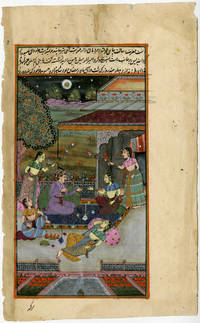
rif. 9171750. Good. Gouache and ink with heightening in gold on lightweight brown laid paper 10 x 6 1/4 inches 254 x 159 mm the full sheet. Some scattered light areas of discoloration and age related toning small edge losses and scattered handling tear along the left sheet edge well outside of the image area. Extensive hand inscriptions in black and red ink on the verso. Colors are exceptionally bright and fresh with good saturation. Mirza Nur-ud-Din Muhammad Salim 30 August 1569 - 28 October 1627 known by his imperial name Jahangir "Conqueror of the World' was the fourth Mughal Emperor who ruled from 1605 until his death in 1627. He was the third and only surviving son of Akbar and his chief empress Mariam-uz-Zamani born to them in the year 1569. He was named after the Indian Sufi saint Salim Chishti. -Singh Pashaura; Fenech Louis E. eds. 2014. The Oxford handbook of Sikh studies. Oxford University Press. p. 647. ISBN 978-0-19-969930-8. unknown
1960rif. 28178nantes 1960 Un dessin original au fusain, Format : 50 centimètres de haut par 63,5 centimètres de large, sur papier contrecollé sur carton marron clair, signé en bas à droite : P. DAUCE, sans date (1960), DESSIN ORIGINAL AU FUSAIN : "VENEZ AVEC NOUS CHEZ LA DAME ET DANS SON JOLI JARDIN" - NOTRE DAME DE L'ESCALADE (GARDERIE EN FAVEUR DES ENFANTS DU MARCHIX - COURS DE DÉCORATION E.B.A.[ECOLE DES BEAUX ARTS DE NANTES] NANTES) par PAUL DAUCE,
1751rif. 15903Paris, Hochereau, 1751 ; in-12 ; plein veau marbré, dos lisse décoré "à la grotesque", pièce de titre grenat, roulette décorative d'intérieur (reliure de l'époque) ; XXXII, 326, (2) pp. de Privilège, portrait de Rembrandt gravé par J.B.G. en frontispice.
1828rif. PHO-1950Paris, Firmin Didot, 1828, 2 tome en 1 volume in-4, VII-461pp.-435pp., sans couverture, manque les pages de titres (copie), quelques rousseurs.
rif. 101568Salamanticae (Salamanque), Apud Ioannem & Andream Renaut Fratres, 1595, 1 volume 290x210 mm environ, 6 feuillets (titre avec large vignette, Licencia, as lectorem, Censurae), 718 pages, 12 feuillets (index, , reliure plein parchemin crème, impression sur 2 colonnes. Quelques déchirures et auréoles sur la couverture, des rousseurs rares, tampons sur la page de titre et p.9, ex-libris sur le premier contreplat, des mouillures marginales et pages brunies, des erreurs de pagination sans manque, petits défauts de marge par endroits, sinon bon état.
rif. 2312111829 à vue : 8.5 x 12.5 cm - cadre : 29.5 x 35 cm , cadre moderne en bois et stuc peint Petits manques au cadre
1925Acquaforte su lastra di zinco, misure: mm 103 x 190; foglio mm 375x 505. In basso a destra timbro a secco «Centenario Gio. Fattori 1925». Lastra conservata presso il Gabinetto Disegni e Stampe degli Uffizi. Esemplare appartenente alla tiratura Benaglia, eseguita in occasione del centenario dalla nascita di Giovanni Fattori nel 1925, quando Giovanni Malesci (nominato dal Maestro suo erede universale) decise di dare alle stampe 164 lastre (per un totale di 166 fogli, perchè due incise anche sul verso) tra le 178 ritrovate nello studio di Fattori stesso. Così furono eseguite 2 tirature da 50 esemplari presso l’editore Benaglia di Firenze, a seguito delle quali le matrici furono donate al Gabinetto dei Disegni e delle Stampe degli Uffizi. Bellissima impressione stampata su carta con filigrana "Corona merlata sulla scritta UMBRIA / ITALIA" e filigrana "Ovale con lettere CPO". Ampi margini intonsi, ottima conservazione. Pittore e incisore. Viene soprattutto ricordato come uno dei principali esponenti del movimento dei Macchiaioli e come artista di spicco nel panorama ottocentesco, nonché come prolifico incisore dal segno vivace e del tutto personale. Fattori era solito stampare da sé i suoi lavori utilizzando un piccolo torchio, esegue tirature irregolari spesso contraddistinte da una ricerca per gli effetti di chiaroscuro e da un uso sapiente delle velature. Gli esemplari di una stessa lastra sono perciò spesso differenti, più carichi e attenti agli effetti di luce nelle tirature curate dall’autore, meno caldi e più nitidi quelli fatti stampare presso la Calcografia. Il ritratto, i soggetti militari, testimonianza dell’interesse verso i fatti risorgimentali, gli animali della campagna e gli scorci di vita comune sono i soggetti che più lo impegnano. Bibliografia L. Servolini, 177 Acqueforti di Giovanni Fattori, Milano 1982, n. 87; 1983. Etching on zinc plate, size mm 103 x 190; sheet mm 375x 505. Bottom right stamp "Centenario Gio. Fattori 1925". The plate is kept at the Cabinet Drawings and Prints of the Uffizi. Example belonging to the Benaglia issue, made on the occasion of the centenary of the birth of Giovanni Fattori in 1925, when Giovanni Malesci (appointed by the Master as his universal heir) decided to print 164 plates (for a total of 166 sheets, because two of them were also engraved on the reverse) from among the 178 found in Fattori's studio. Thus, two issues of 50 copies were printed by the publisher Benaglia of Florence, and afterwards the plates were donated to the Gabinetto dei Disegni e delle Stampe of the Uffizi. Beautiful impression printed on paper with watermark "Crown embattled on the writing UMBRIA / ITALY" and watermark "Oval with letters CPO", wide margins uncut, mint. Literature L. Servolini, 177 Acqueforti di Giovanni Fattori, Milano 1982, n. 87; 1983.

1806rif. 21439Lyon, Garnier, Reymann (Imprimerie de Ballanche père et fils), 1806 ; in-8, demi-veau et petits coins de parchemin, dos à nerfs décoré de filets dorés, pièce de titre rouge, tranches jaspées (reliure de l’époque) ; XVI, 341, [3] pp.
rif. wc980Saumur, S. Milon fils, libraire-éditeur Relié 2 forts volumes in-8, (19.5x28 cm), relié demi-chagrin bleu d'époque,dos à 4 nerfs titrés, XIII-593 [1]pp et 774-[1] pp, couverture illustrée conservée pour chaque volume, 52 gravures hors-texte, épidermures au tome 2, reliures frottées. Livraison a domicile (La Poste) ou en Mondial Relay sur simple demande.
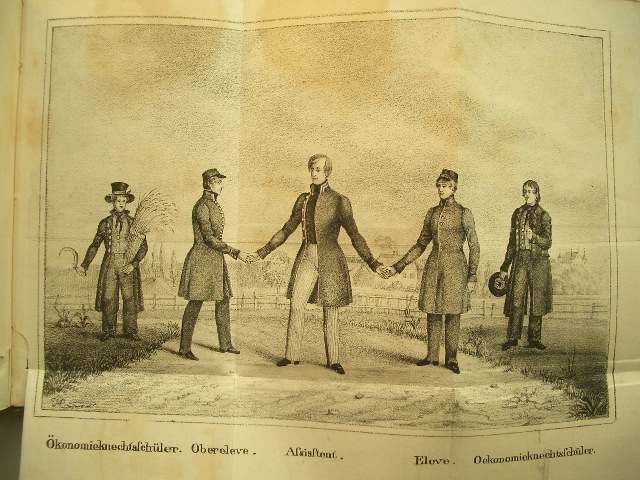
1839rif. 4350Nebst einem Bericht über das von Sr. Majestät dem Könige Ludwig von Bayern allergnädigts in der Art gegründete Institut zu Nürnberg... Zum besten der Anstalt herausgegeben. Mit 7 gefalt. lithogr. Tafeln. Nürnberg, im Verlag beim Verfasser, 1839. 8vo. (17,0 x 10,0 cm). X, 256 S. Bayrisch-blauer Pappband d. Zt. mit silbergeprägtem Rücken u. Deckeln sowie dreiseitigem Silberschnitt.
1923Telephone Talk was the glossy bimonthly publication of the British Columbia Telephone Company. It was written by employees for employees to present information of interest to those engaged in the plant, traffic, commercial, operating, accounting and other departments of the service. Each issue is replete with black and white photos and information on topics such as: company, industry and technological news, traffic levels, expansion plans, personnel announcements, publicity and social events, deaths, weddings, lists of exchanges, and more. As such, these issues serve as a vital preserve of rare and fascinating British Columbia history. This volume covers topics including: Photo of downton Nelson; Bird's-eye photo of Nelson from atop a mountain on north shore of west arm; Kootenay Feature 'The Romance of the 1890s - 8 pages of text and archival photos, including electric street cars in Nelson!; Table showing 'Exchanges in order of percent good toll calls; Cover advert. for Northern Electric Vacuum Cleaner!; Review of growth show steady expansion - 3 pages; Telephoning across Atlantic by AT&T Wireless continued for hours; When the Victoria and Esquimalt Telephone Company issued its own (one call) nickels; B.C. Industrial Review - statistics; Bar graph of # of phones operated from 1906 through 1923; the company's operator school; Issuing of monthly phone bills a work of magnitude - 4 page article with photos; photos of the halibut industry before 'the fish were scarcer in quantities and their habitats more scattered'; William Farrell- an appreciation of the former company president; 7 page article on B.C.'s deep sea fishing industry - great photos - halibut, herring, flounder; multiple photos from the Kootenays of snakes which have climbed up phone poles onto the wires!; photo of 25 year-old phone; Great full-page photo of the CIBC building at Hastings and Granville; 8 page article on the banks of vancouver with excellent photos; First interdepartmental football game; new power plant at Seymour office; A phone in B.C. for every 6 persons; Feature on Dams and the water-powers that turn the wheels of industry - photos of dams and various industries which use electricity, including the American Can factory and grain elevators; new power plant at Seymour office - illustrated; photos of productive farms and ideal homesites with super centerfold luxury Saanich home; Cover photo of U.S. President Harding in Stanley Park; Full-page photos of the U.S.S. Henderson entering the narrows and at dock with President Harding aboard; 13 page illustrated feature on the visit of President Harding - the first visit to Canada made by a President of the United States (President Harding died mere days later on August 2nd in San Francisco and this is reported as well); Photo of Crosland Bros. Farm in Duncan; 9 page illustrated feature on the seed growers of B.C.; photo of Duncan office under construction; Nice 8-page illustrated feature on Haney and area; photographing sound; Exploring Kootenay - Bill Skilling; 9 page illustrated feature on the Delta and Ladner district; Many miles of new long distance circuits; Improved inter-office trunk lines in Vancouver; and more. Half-leather binding. Average wear overall with the exception of the backstrip which is missing small chips and loose at back edge. Ink stamp of company executive E.P. LaBelle upon top edge else unmarked. Binding intact. Spine leaning moderately. Book
1901rif. ZB445353Boston Cooking School 1901-1911. volumes 6-15 bound in mid-20th century buckram with most front covers retained ex library else texts clean & bindings tight. - If you are reading this this item is actually physically in our stock and ready for shipment once ordered. We are not bookjackers. Buyer is responsible for any additional duties taxes or fees required by recipient's country. Photos available upon request. Boston Cooking School hardcover
1935162 pages plus advertisements. Includes the following four lectures: Theories of the Influence of Money on Prices; The Conditions of Equilibrium Between the Production of Consumers' Goods and the Production of Producers' Goods; The Working of the Price Mechanism in the Course of the Credit Cycle; The Case for and Against an 'Elastic' Currency. Appendix: Capital and Industrial fluctuations - a reply to criticism. No. 107 in the series of Monographs by writers connected with the London School of Economics and Political Science. Average wear. Prior owner's address and his Yale University address upon front endpaper else unmarked. Cohen 183, Cody & Ostrem B-2, Hutchinson 912. Book
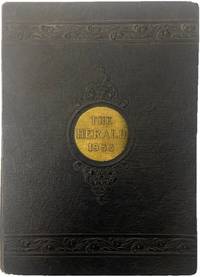
1933rif. 175261933. Archive of Walter Johnson's 1933 Atlantic City High School yearbook and related reunion materials documents African American student life within a formally integrated but socially segregated New Jersey public school during the Great Depression. Johnson a graduating senior in 1933 appears in a yearbook extensively inscribed by classmates whose messages span both commencement year and later reunions preserving contemporaneous peer networks across four decades. Created in a city where redlining confined most Black residents to Atlantic City's Northside neighborhood the volume and accompanying ephemera situate one student's educational experience within broader histories of African American urban life public schooling in the Jim Crow North Depression-era youth culture and Black alumni civic organization. Archive dates primarily from 1933 with later additions from 1978 and subsequent reunion years; ten items total. Central volume is Atlantic City High School yearbook published by Westbrook Publishing Company Philadelphia 1933 183 pages hardcover 10.5 x 7.75 inches extensively inscribed throughout by classmates in 1933 and again at the 45th reunion in 1978. The school's divisions are organized by Technical Classical and Commercial tracks with individual portrait sections and personal profile prompts listing favorite activities characteristic phrases and anticipated futures including one sardonic entry predicting a destination "In the ranks of the unemployed." Accompanying materials include a June 16 1933 telegram in original envelope from the Negro Alumni Associates of Atlantic City High School congratulating Johnson on his graduation; two reunion pamphlets from the 45th and 50th reunions; several envelopes including one bearing a lengthy handwritten note from reunion organizer Ben Ginsburg; and two printed advertisements for Atlantic Coast Amusement Enterprises promoting comedians and song-and-dance acts associated with Atlantic City's boardwalk entertainment industry. Produced in the depths of the Great Depression the yearbook captures a graduating class confronting economic uncertainty while articulating ambition humor and collective identity. Its Art Deco stylistic elements and commercial advertising reflect Atlantic City's resort economy during its interwar peak while the presence of a formal Negro Alumni organization in 1933 demonstrates structured African American institutional engagement within a multiracial public school setting. Later reunion annotations underscore continuity of alumni networks across five decades. Light general wear consistent with age; inscriptions legible and internally clean; associated ephemera well preserved with minor handling wear. Overall very good condition. Cohesive documentation of African American secondary education alumni organization and urban community formation in Depression-era New Jersey extending into the late twentieth century. unknown
1933rif. 175261933. Archive of Walter Johnson's 1933 Atlantic City High School yearbook and related reunion materials documents African American student life within a formally integrated but socially segregated New Jersey public school during the Great Depression. Johnson a graduating senior in 1933 appears in a yearbook extensively inscribed by classmates whose messages span both commencement year and later reunions preserving contemporaneous peer networks across four decades. Created in a city where redlining confined most Black residents to Atlantic City's Northside neighborhood the volume and accompanying ephemera situate one student's educational experience within broader histories of African American urban life public schooling in the Jim Crow North Depression-era youth culture and Black alumni civic organization. Archive dates primarily from 1933 with later additions from 1978 and subsequent reunion years; ten items total. Central volume is Atlantic City High School yearbook published by Westbrook Publishing Company Philadelphia 1933 183 pages hardcover 10.5 x 7.75 inches extensively inscribed throughout by classmates in 1933 and again at the 45th reunion in 1978. The school's divisions are organized by Technical Classical and Commercial tracks with individual portrait sections and personal profile prompts listing favorite activities characteristic phrases and anticipated futures including one sardonic entry predicting a destination "In the ranks of the unemployed." Accompanying materials include a June 16 1933 telegram in original envelope from the Negro Alumni Associates of Atlantic City High School congratulating Johnson on his graduation; two reunion pamphlets from the 45th and 50th reunions; several envelopes including one bearing a lengthy handwritten note from reunion organizer Ben Ginsburg; and two printed advertisements for Atlantic Coast Amusement Enterprises promoting comedians and song-and-dance acts associated with Atlantic City's boardwalk entertainment industry. Produced in the depths of the Great Depression the yearbook captures a graduating class confronting economic uncertainty while articulating ambition humor and collective identity. Its Art Deco stylistic elements and commercial advertising reflect Atlantic City's resort economy during its interwar peak while the presence of a formal Negro Alumni organization in 1933 demonstrates structured African American institutional engagement within a multiracial public school setting. Later reunion annotations underscore continuity of alumni networks across five decades. Light general wear consistent with age; inscriptions legible and internally clean; associated ephemera well preserved with minor handling wear. Overall very good condition. Cohesive documentation of African American secondary education alumni organization and urban community formation in Depression-era New Jersey extending into the late twentieth century. unknown books