35 711 résultats
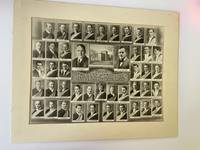
1928réf. 182801928. Randall Studio. University of Michigan Medical School student and faculty portrait 1928 documents racial and gender inclusion within a major American medical school during a period when African American and women physicians remained sharply underrepresented in medical education. The portrait supports research into professional training race gender and institutional access in interwar medicine especially because the group includes one African American man and four women among 82 students. The University of Michigan had admitted women beginning in 1870 and Sophia B. Jones became its first African American woman to earn a medical degree in 1885 giving this later class portrait added relevance within the school's longer history of medical education and inclusion. Silver gelatin photograph by Randall Studio. 1928. 22 x 18 inches. Mounted to photographer's board. The large-format image shows 82 students and faculty arranged in individual portrait format including four female students and one African American student. The scale and formal presentation identify the photograph as an institutional record of a medical cohort rather than a casual class image. The photograph captures a visibly limited but historically meaningful presence of women and an African American student in elite medical training before mid-century civil rights reforms. Small 1.5-inch tear to one corner barely affecting one of the 82 images; very small chips to side and top edges not affecting text or images; very good. Strong visual evidence of race gender and professional formation at the University of Michigan Medical School in 1928. unknown books
1932réf. 182781932. Silver gelatin portraits of faculty and graduating class from the University of Manitoba Medical School. Canada 1932. Measures 16 x 12.5 inches. 42 student subjects including a single female student. 2 faculty members with illustration of school building between them. Mounted to photographer's board. Photographer's info in bottom corner "Campbell." After fierce educational activism throughout the 19th century led to the admission of women into medical schools at the turn of the century the twentieth century saw a decline of women in the profession. By 1949 only 5.5% of students entering medical schools were women. Students are shown in graduation gowns with sashes across their chests. student's name are listed including Female medical student as "V. McDorman." In very good condition. unknown books
1916réf. 183011916. Diploma for female student from Allegan High School in Michigan. 1916. 21.5 x 16 inches. Awarded to Katherine Esther Tripp for completion of the general course prescribed by the Board of Education. Engraving of school building beneath large decorative text with school name across the top of certificate. The early 20th century saw new educational opportunities for American women who upon graduating from high school could attend integrated colleges. Educational activists like Catharine E Beecher advocated fiercely for women's right to enter any college based on the belief that gender equality was contingent on the quality of female education and institutional opportunities to support it. Creased where folded. Light toning to edges does not affect text or image. Original gold seal clipped but otherwise intact. Overall good condition. unknown books
1921réf. 543226Leonardo New Jersey: Middletown Township High School 1921. Softcover. Very Good. First edition. Octav. 52pp. Illustrated. Stapled decorated brown wrappers. Modest toning and foxing in text very good or better. Quarterly magazine of the School. Middletown Township High School unknown books
1903réf. 180101903. Association of Head Mistresses. List of Public Secondary Schools for Girls 1903 and 1905 records the geographic extent of secondary schooling available to girls in Britain during the early twentieth-century expansion of women's education. Founded in 1874 by Frances Mary Buss and other headmistresses of endowed and proprietary schools the Association developed from efforts to improve the standards and institutional position of girls' secondary education. These two successive lists arrange schools by county providing contemporary evidence of where public secondary education for girls was available and allowing comparison across localities and between the two publication years. Their dates follow three decades in which girls gained broader access to academically oriented schools and universities although educational equality remained contested; in 1897 Cambridge rejected a proposal granting women the titles of degrees followed by riotous celebrations by male undergraduates. Women were not admitted to full membership of Cambridge until 1948. Two pamphlets issued by the Association of Head Mistresses dated 1903 and 1905 each measuring 8.5 x 5.5 inches. Soft blue covers are printed "One Shilling Published by the Educational Supply Association 42 Holborn Viaduct E.C." Entries within each pamphlet are organized by county and identify public secondary schools open to girls at the time of publication. The format turns the changing institutional landscape of girls' education into a contemporary directory recording individual schools by place rather than describing educational reform retrospectively. Both front covers bear stamps reading "Board of Education Library" and "Supplied Public Service" each incorporating the royal crown; the back covers retain red "Board of Education Reference Library" stickers. These official library markings document their presence within a government educational reference collection. 1 Association of Head Mistresses. List of Public Secondary Schools for Girls. London: Educational Supply Association 1903. Arranged geographically by county the pamphlet enumerates secondary schools then available to girls and provides a contemporary reference point for the distribution of female secondary education at the beginning of the Edwardian period. Its Board of Education Library markings also preserve evidence of institutional reference use. 2 Association of Head Mistresses. List of Public Secondary Schools for Girls. London: Educational Supply Association 1905. Issued two years after the first pamphlet this updated county-by-county listing permits direct comparison of the provision of girls' secondary schools between 1903 and 1905. The directory appeared during the continuing expansion of educational opportunities that connected secondary schooling with women's increasing access to higher education; the University of London had begun awarding degrees to women on equal terms with men in 1878 while access elsewhere remained uneven. Textblocks tight bright and clean. Both pamphlets overall very good condition. The consecutive editions preserve a measurable record of girls' secondary education by county at a time when women educators and school leaders were establishing institutions capable of preparing girls for examinations professional training and higher education. unknown books
1914réf. 180951914. Certificate awarded to the Vicereine of India Lady Hardinge of Penshurst upon her visit to the Indraprastha Hindu Girls School in Delhi. 1914. Measures 10" x 16" inches. Text enclosed in ornately decorative box with the school's seal centered at the top reading "The Hindu Girls School Delhi First deserve then desire 1904." The certificate's attractive green script reads in part "To her excellency Lady Hardinge of Penshurst May it please your Excellency It is with feelings of the profoundest joy and gratitude that we to-day welcome Your Excellency to the Indraprastha Hindu Girls School Delhi.Your Excellency's loving interest in the advancement of the women of this land and motherly affection for the children your care for the suffering poor the exemplary fortitude which you have shewn in the time of danger and the heroic devotion to your husband--our ideals of womanhood--have endeared your name to every woman and child in India and we pray you to accept our reverential and warm-hearted welcome to-day." Lady Hardinge of Penshurst Winifred Selina Sturt married her first cousin Henry Sturt a racing magnate and close friend of Edward Prince of Wales. She served as a Woman of the Bedchamber to the Princess of Wales before her husband by then a Baron was named Viceroy of India. The concurrence of monarchical rule and colonialism put aristocratic families with close ties to the royal family put aristocratic Europeans in positions of power worldwide no matter their qualifications. The family moved to India where Lady Hardinge worked to advance women's education. She was instrumental in starting the Lady Hardinge Medical College in Delhi the first medical school exclusively for women in India. She died in November of 1914 just 8 months after receiving this certificate. Signed by the school's President Lady Superintendent and Secretary. Creased along lines where paper was folded. 3 small holes along left side do not affect text. 1" tears along top do not affect text. Tape attached to verso. Very good condition. unknown books
1933réf. 175261933. Archive of Walter Johnson's 1933 Atlantic City High School yearbook and related reunion materials documents African American student life within a formally integrated but socially segregated New Jersey public school during the Great Depression. Johnson a graduating senior in 1933 appears in a yearbook extensively inscribed by classmates whose messages span both commencement year and later reunions preserving contemporaneous peer networks across four decades. Created in a city where redlining confined most Black residents to Atlantic City's Northside neighborhood the volume and accompanying ephemera situate one student's educational experience within broader histories of African American urban life public schooling in the Jim Crow North Depression-era youth culture and Black alumni civic organization. Archive dates primarily from 1933 with later additions from 1978 and subsequent reunion years; ten items total. Central volume is Atlantic City High School yearbook published by Westbrook Publishing Company Philadelphia 1933 183 pages hardcover 10.5 x 7.75 inches extensively inscribed throughout by classmates in 1933 and again at the 45th reunion in 1978. The school's divisions are organized by Technical Classical and Commercial tracks with individual portrait sections and personal profile prompts listing favorite activities characteristic phrases and anticipated futures including one sardonic entry predicting a destination "In the ranks of the unemployed." Accompanying materials include a June 16 1933 telegram in original envelope from the Negro Alumni Associates of Atlantic City High School congratulating Johnson on his graduation; two reunion pamphlets from the 45th and 50th reunions; several envelopes including one bearing a lengthy handwritten note from reunion organizer Ben Ginsburg; and two printed advertisements for Atlantic Coast Amusement Enterprises promoting comedians and song-and-dance acts associated with Atlantic City's boardwalk entertainment industry. Produced in the depths of the Great Depression the yearbook captures a graduating class confronting economic uncertainty while articulating ambition humor and collective identity. Its Art Deco stylistic elements and commercial advertising reflect Atlantic City's resort economy during its interwar peak while the presence of a formal Negro Alumni organization in 1933 demonstrates structured African American institutional engagement within a multiracial public school setting. Later reunion annotations underscore continuity of alumni networks across five decades. Light general wear consistent with age; inscriptions legible and internally clean; associated ephemera well preserved with minor handling wear. Overall very good condition. Cohesive documentation of African American secondary education alumni organization and urban community formation in Depression-era New Jersey extending into the late twentieth century. unknown books
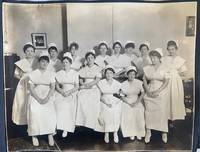
1915réf. 174731915. Nursing student photograph album circa 1915 to 1920 documenting the training social life and professional formation of fourteen young women entering nursing during the First World War and the public health crises of the period. The album records a generation of women entering a rapidly expanding medical profession while wartime mobilization increased demand for trained nurses across the United States. Its chronology overlaps both with Wold War one smallpox and the 1918 influenza pandemic which reached the United States in 1918 and produced its deadliest wave during the fall of that year. Photo album of 184 silver gelatin photographs multiple sizes ranging from approximately 1.5 x 1 inches to 11 x 8 inches most approximately 4 x 2.5 inches United States circa 1915 to 1920. Many photos have handwritten captions. The photographs are mounted on black pages and center on a class of fourteen student nurses shown in uniform in formal group portraits and in clinical settings including operating rooms. One photograph shows the nurses posed behind a sign reading "Smallpox!" directly recording the infectious disease concerns incorporated into nursing education and public health practice. Other photographs show the women together in informal settings family members and children soldiers American towns and landscapes and early aviation. Several images appear to have been taken from or around a World War I era biplane including views above the clouds suggesting a personal connection to an early aviator. Locations extend across the United States including Michigan San Antonio Texas and mountainous regions of the American West. The album belongs to the period when nursing education was becoming increasingly standardized and the First World War transformed the scale and social role of professional nursing. Following U.S. entry into the war in April 1917 the Army Nurse Corps expanded rapidly while the American Red Cross mobilized thousands of nurses for military and civilian relief. The influenza pandemic then placed extraordinary pressure on hospitals and communities in 1918 and 1919 making the album's nursing training especially relevant to the public health environment in which these women were coming of age professionally. One photo displays the nurses behind a sign that states "Smallpox!" which was a a recurrent and deadly public health issue throughout the first half of the 20th century and pushed many to enter the nursing field. In 1918 Many photos are in San Antonio and at the time Texas public health officials were simultaneously managing smallpox outbreaks and the cataclysmic arrival of the 1918 H1N1 Spanish flu pandemic. While the terrifyingly rapid spread of the flu dominated headlines smallpox was an ongoing deeply entrenched threat across Texas counties By September 1918 the Spanish flu collided with these ongoing localized smallpox containment efforts. Cities like Dallas Houston San Antonio were completely overwhelmed. The combination of clinical instruction nursing class portraits close friendships family life military imagery of Navy officers Also includes early aviation biplane photographs of the era. This nurse seems to have been dating an early fighter pilot with a few photos taken above the clouds in a WWI-era biplane. Locations span the US from Michigan to Texas to a few photos which resemble the alpine regions of the American West. Overall in very good condition. The photo album documents the women within the broader social transformations experienced by young Americans during the First World War. Minor wear consistent with use; photographs show occasional toning and fading. Album with textured black covers black interior pages photographs adhered to the leaves and tight binding. Overall in very good condition. A concentrated visual record of women entering professional nursing amid wartime mobilization infectious disease concerns and the social changes of the 1910s and early 1920s. unknown books
1954réf. 530328Rome: Apollon 1954. Softcover. Near Fine. First edition. Yellow wrappers. 77pp. Rubbing and slight edgewear else near fine. Apollon unknown books
1923réf. 168781923. Chamberlain Ola. The Girl Graduates Record Book 1923 to 1925 documents rural Texas girls' education adolescent friendship school ritual athletics domestic expectations and female self-expression at Goree High School. Kept by Ola Chamberlain of Goree Texas the album captures a young woman's final high school years through photographs teacher and classmate inscriptions certificates invitations press clippings and an original "Class Prophecy" providing direct evidence of how one Texas student recorded academic achievement peer culture humor courtship-inflected friendship extracurricular life and the movement "Out of school life into life's school." Kubinyi Victor de designer. The Girl Graduates Record Book. New York: Barse & Hopkins copyright 1920. Manuscript memory book and scrapbook kept by Ola Chamberlain Goree Texas 1923 to 1925. 190 pages. Original cloth boards with embossed floral motif 10.25 x 7 inches. Contains 85 silver gelatin photographs most approximately 4.5 x 2.75 inches more than 25 handwritten inscriptions from friends and teachers an original handwritten class prophecy and approximately 85 pieces of ephemera including ribbons party invitations commencement materials press clippings seven perfect-attendance certificates a Texas public school report card and a pressed sweet pea dated May 15 1925. Photographs and captions identify Goree High School called by Chamberlain "The Prison" classmates with nicknames including "Pie Face" "Preacher" "Shot Gun" "Lilliums" and "Hankie" class officers the Spanish Class Pep Club "Senior Girls" basketball players and eight images of students in colonial costume for "The Virginia Reel." The inscriptions preserve affectionate student memory and gendered academic praise including one classmate's statement that in mathematics Ola was "a wizard-ess" while teacher entries address her transition from school into adult life: "Life's School is open to you." The album's strongest research value lies in its unusually full record of a girl's educational world in small-town Texas during the 1920s including formal coursework in Geometry English Physics Civics Economics and Arithmetic alongside a parent-signed "Home Report" grading Cooking Care of Stock General Farm Work Providing Fuel Washing Dishes and Obedience. Chamberlain's manuscript "And How It All Came Out" imagines the futures of her graduating class through a supernatural vision prompted by the class flower placing classmates in roles from department-store worker to sheriff mayor and secretary and giving the album a rare sustained example of student-authored narrative. First two pages detached front hinge detached edges toned some pages brittle with small edge chips good. A substantial documentary record of women's education rural Texas youth culture school sociability athletics and the gendered expectations surrounding a young woman's graduation in the mid-1920s. unknown books
1916réf. 171101916. Women Education Europe Identification Card for Sophia State Girls' High School СофийÑка държавна ДъвиуеÑка Ð³Ð¸Ð¼Ð½Ð°Ð·Ð¸Ñ 1916. Sophia is the largest and Capital city of Bulgaria. 4.5 x 3.25 in. Original blue cloth folder. Identification photo of teenge girl pasted inside dated 19.III.1916. Original silver gelatin print 2.75 x 2 in. This young student wears a dark pinafore uniform and a fashionable hat and looks confidently out at the viewer. This was mere months after Bulgaria declared entered World War I in October 1915. Normal education was disrupted for most Bulgarian students during the Balkan Wars 1912-1913 and WWI 1915-1918 so this girl was likely very grateful for the opportunity to study. Original education department stamps in blue ink. In very good condition. unknown books
1967réf. 171271967. Black Power School photograph 1967 documents community education for Black children in Nashville during the city's transition from the integration campaigns of the early Civil Rights Movement toward Black Power programs emphasizing Black history political education and community self-determination. Nashville had begun gradual public-school desegregation in 1957 but integration remained incomplete a decade later. During the summer of 1967 the North Nashville Student Summer Project operated a "liberation school" whose Black teachers offered instruction in mathematics science humanities civics and Black history; after controversy over its Black Power curriculum led to its removal from St. Anselm's Episcopal Chapel and suspension of the larger summer project in August classes continued for a time on Saturdays in nearby Watkins Park. The photograph's August 16 1967 filing date and press caption recording a "Black Power School" meeting in a Nashville park place the image within this specific period of conflict over Black-controlled education in the city. Original silver gelatin press photograph 8 x 10 in. Nashville Tennessee 1967. Twelve African American children and youths sit together on a park bench while several adults stand behind them; white reporters and members of the press gather nearby recording the outdoor class as a news event. Typed press caption pasted to the verso reads: "Black Power School holds classes in a park in Nashville Tenn." An original press filing stamp on the verso is dated August 16 1967. The presence of reporters is particularly relevant to the photograph's immediate context: earlier that month testimony before the U.S. Senate Judiciary Committee alleging that Nashville's liberation school taught racial hatred had generated national press coverage while its organizers defended Black Power education as an assertion of Black self-determination rather than racial hostility. The image records children receiving instruction outside a conventional school building while journalists observe preserving both the educational activity itself and the intense press attention directed toward Black Power organizing in Nashville in 1967. That year also saw Stokely Carmichael speak at Tennessee State University in April followed the next day by a confrontation between Black students and police that resulted in injuries and more than forty arrests placing debates over Black Power policing and racial inequality at the center of Nashville public life. Original press caption filing stamp and pencil annotations on verso. Approximately 1 x 1½ in. area of surface damage and loss at lower left corner; otherwise very good condition. unknown books
1916réf. 166221916. Carpenter Rachel A. M. Photograph album of St. Mary's School Wantage 1916 to 1918 documents the daily life of girls at an English school during the final years of the First World War. Twenty-three photographs record organized sports theatrical performance swimming leisure school uniforms faculty friends and the grounds of St. Mary's with handwritten captions and dates identifying every image. The album preserves a student's record of girls' education beyond the classroom including field hockey cricket tennis swimming and dramatic performance activities that formed an increasingly visible part of female secondary education in early twentieth-century Britain. Twenty-three gelatin silver photographs dated 1916 to 1918 mounted on 14 card-stock pages in original green cloth boards titled "Photo Sketches." Album measures 6.25 × 7.5 inches; photographs range from 2 × 2.75 inches to 3.5 × 5.5 inches. Carpenter identifies friends by full names initials and nicknames including "Tufty." Several views show students in uniform at leisure while others depict the field hockey cricket and tennis teams swimming in "the Baths" faculty members and campus grounds. Three photographs record the cast of a school production of Blue Beard performed during the summer term of 1918; the album retains a program for the production. Founded in 1873 as a girls' school St. Mary's belonged to the expansion of formal secondary education for girls in late nineteenth- and early twentieth-century England. Carpenter's photographs show how that education included organized athletics theatrical performance recreation and student social life during the wartime years of 1916 to 1918. The named and captioned photographs provide unusually specific evidence of individual pupils school activities and the rhythms of campus life. Condition not stated in the supplied description. unknown books
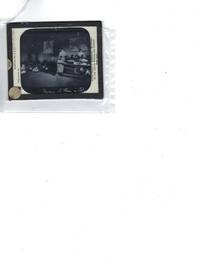
1904réf. 154021904. Gayaza School classroom lantern slide 1904 documents girls receiving classroom instruction at the pioneering Church Missionary Society school established at Gayaza in Buganda present-day Uganda. Founded in 1904 as a school for girls Gayaza developed into what is now Gayaza High School identified by the school as Uganda's oldest all-girls boarding secondary school. The image dates from the institution's founding period and records African girls engaged in reading under two female teachers providing unusually detailed visual evidence of girls' education within an early twentieth-century missionary school in Uganda. Original glass lantern slide 3¼ x 4 inches published by the Young People's Missionary Movement of the United States and Canada. Scratched into the negative beneath the image is the identification: "Gayaza A Class in School." Girls of varying school ages occupy the classroom; approximately half sit on the floor holding open books while others sit on a bench at a table with books before them. Two female teachers stand among the pupils. Classroom equipment includes a blackboard on an easel two wall maps a clock and a globe resting on a cabinet. The girls wear garments wrapped or draped around the lower body. These details record both instructional practice and the material furnishings available in the school's early classroom. The slide also documents how images of African mission schools circulated beyond Uganda. The Young People's Missionary Movement described lantern slides as its most extensively used form of pictorial material and supplied such images to mission boards for missionary education. This example therefore preserves two related historical records: the classroom at Gayaza and the presentation of girls' education in Uganda to North American Christian audiences. Gayaza subsequently developed into a secondary boarding school for girls retaining its Church foundation. unknown books
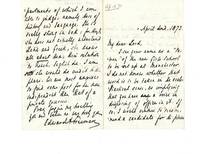
1873réf. 160861873. Freeman Edward Augustus. Autograph letter signed April 2 1873 recommends Scottish educator and historian Margaret A. R. Macarthur for appointment as headmistress of a new girls' school in Manchester explicitly arguing that her abilities warranted a position "more independent than that of a private governess." Freeman a historian who would later become Regius Professor of Modern History at Oxford had employed Macarthur as governess to his daughters for nearly five years and writes from direct experience of her teaching. His recommendation documents the professional transition available to an educated woman from domestic governess work to leadership in the expanding field of girls' secondary education and identifies history and languages as Macarthur's particular strengths. Freeman Edward Augustus. April 2 1873. Autograph letter signed to "My Dear Lord." Somerleaze Wells Somerset England. Four pages on a single folded sheet. Having seen his correspondent named as a "Patron of the new Girls School to be set up at Manchester" Freeman asks whether he has influence over appointments and recommends Macarthur for headmistress. "She is a woman of powers far above the common" he writes "and I can witness that she has practiced them well in the only two departments of which I am able to judge namely those of History and language." Freeman adds that although Macarthur did not know Latin and Greek directly "she knows all about them their relation to French English etc." As evidence of his confidence in her historical abilities he explains "I have set her to write one of my series of small histories a History of Scotland which I hope will soon be out." He concludes "I am sure she would do credit to the place. We are most anxious to find some post for her more independent than that of a private governess." Margaret A. R. Macarthur born in Scotland in 1842 subsequently published History of Scotland in Freeman's Historical Course for Schools confirming the literary project Freeman describes while it was still in preparation. The letter thus precedes publication and records Freeman using Macarthur's authorship as evidence of her qualifications for educational leadership. Although the supplied information states that Macarthur was not appointed to the Manchester position the reason given-that better-qualified candidates prevailed-cannot be established from the letter itself and is therefore omitted. Fine condition. Freeman's detailed recommendation preserves contemporary evidence of a woman educator seeking advancement beyond private governess work and of published historical scholarship being cited as a qualification for the headship of a girls' school. unknown books
1940réf. 160881940. Edith Reverend Mother. Autograph letter signed to William Nourse December 22 1940 records wartime conditions at Ascot Priory while its Anglican religious community operated St. Augustine's School for girls during the Blitz. Written three months into the German bombing campaign the letter describes bombs falling near the Priory quieter nights as Christmas approached and the financial strain affecting the institution's supporters. Ascot Priory was the mother house of the Society of the Most Holy Trinity an Anglican women's religious community whose work included nursing care of orphans and education; St. Augustine's School was among the schools operated by the sisters. Edith Reverend Mother. December 22 1940. Autograph letter signed to William Nourse on Ascot Priory letterhead Ascot Berkshire England. Writing three days before Christmas Edith acknowledges the continuing support of friends despite wartime hardship: "I appreciate the kindness of our friends more than ever this year for I know how much financially hit everyone is." Her Christmas wishes immediately turn to the war: "I do hope you will have as happy a Christmas is possible Xmas 1941 bring us peace!" She then gives a direct account of the danger experienced at Ascot: "We have had some bombs unpleasantly near but lately I am glad to say the nights have been much quieter." The letter was written during the Blitz when German aerial attacks on Britain had begun in September 1940 and would continue into May 1941. Ascot Priory had housed the Society of the Most Holy Trinity since the nineteenth century; its sisters maintained religious medical charitable and educational work including the care of girls at St. Christopher's Orphanage and instruction at St. Augustine's School. Edith's December 1940 letter records how that women-led institution continued during wartime through a concise firsthand account of nearby bombing strained finances and hopes for peace. Her remarks are especially immediate because they were written during the first winter of the Blitz rather than retrospectively after the war. No condition defects are specified in the supplied description. A contemporary account of the British home front from the woman responsible for an Anglican community and girls' school during the aerial campaign of 1940. unknown books
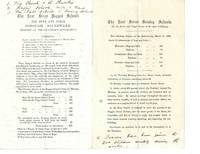
1868réf. 160851868. Newton H. Autograph letter signed on a handbill for the Lant Street Ragged Schools for Boys and Girls April 13 1868 documents free education for poor children and adults in Southwark and records substantially higher attendance among girls than boys. Newton identified as Vicar of St. Michael's Mission Schools Lant Street writes to a donor concerning the schools' work while the printed handbill describes an institution located "in the midst of the poorest population in Southwark" and reports approximately 850 attendances daily. The surviving enrollment figures give particular evidence for girls' participation: 243 girls attended the upper school room compared with 167 boys in the lower school room while afternoon attendance numbered 233 girls and 162 boys. Newton H. April 13 1868. Autograph letter signed on verso of a printed handbill for The Lant Street Ragged Schools for Boys and Girls Borough Southwark. The handbill describes the schools as "the largest with about 850 attendances daily and the most important in South London" and supplies separate attendance figures for boys and girls. It also records an evening school of approximately 65 "grown persons of both sexes" who were taught to read and write showing that the institution combined children's schooling with adult literacy instruction. Newton annotated the printed portion in his own hand including the notation "Ragged Schools male & female." His manuscript communication to a donor links the printed statistics and public appeal directly to the school's fundraising activity and administration. Ragged schools developed in nineteenth-century Britain to provide free instruction to children excluded by poverty from other forms of schooling commonly combining elementary education with religious and charitable work. The Lant Street handbill records that work before the Elementary Education Act of 1870 established a national framework for elected school boards in England and Wales. Its sex-specific figures are especially informative for the history of women's education: girls exceeded boys in both reported daytime sessions while the evening school extended literacy instruction to adult women as well as men. The handbill and Newton's signed letter preserve two aspects of the institution on the same sheet-the statistics used to describe its educational work and a clergyman's direct appeal to a supporter. No condition defects are specified in the supplied description. A contemporary record of schooling adult literacy charitable fundraising and female attendance among the poor of Victorian Southwark. unknown books
1941réf. 166461941. Photo Album Education Co-educational Primary School in Tokyo. Three-Wood Common Elementary School1941 during World War 2 right before Pearl Harbor. Photo Album of Gelatin silver print photos. Original textured paper wrapper. Album opens right to left. 6.9 x 9.75 in. Album cover is dated "March of the 15th year of the Showa Dynasty" in Japanese. 7 photographs measuring 4.5 x 6 in. Each class photo includes names of sitters printed on rice paper in Japanese. Of note in the 6 class photographs of school children and faculty are the mix of men and women as teachers and the mix of girls and boys as students. In the first image of the entire school boys and girls are lined up next to each other although they stand in rows of their own single-gender classes. Two class photos have additional small portraits of students who were absent for picture day. In Japan at this time education was not compulsory beyond primary school but childhood was regarded as an important time to foster learning growth and intellectual curiosity for both boys and girls. Very good condition. unknown books
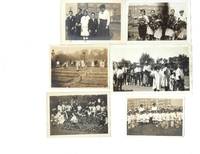
1916réf. 156401916. Collection of 43 original vintage photographs documenting the Public School Gardening Movement in Queens New York City 1916-1920 provides concentrated visual evidence of Progressive Era educational reform linking urban environmental transformation to child development and civic formation. Produced at the height of the national school gardening movement which flourished between 1900 and 1920 these photographs capture the integration of nature study playground reform tenement house activism and City Beautiful urbanism into the daily life of immigrant and working class children. The images support research in Progressive Era reform environmental education immigration history urban studies and the construction of civic identity through public schooling demonstrating how agricultural labor was reframed as moral physical and democratic training within dense metropolitan neighborhoods. Forty three original photographs primarily silver gelatin prints Queens New York City 1916-1920. Most measure approximately 2 by 4 inches with several bearing manuscript dates between 1916 and 1920 and occasional notations identifying individuals or activities. The photographs depict schoolchildren planting seeds watering beds harvesting produce carrying baskets of vegetables and working collaboratively under teacher supervision in organized garden plots. Visual evidence indicates structured rows tool distribution and adult oversight underscoring the pedagogical framework rather than informal recreation. The movement in New York was shaped by the work of reformer Frances Griscom Parsons who established the Children's School Farm in Hell's Kitchen in 1902 to provide immigrant youth living amid warehouses factories and docks with access to cultivated land. Parsons articulated gardening as instruction in "brotherhood cooperation self respect and the dignity of labor" envisioning children as "little farmers" rehearsing democratic citizenship within an idealized urban microcosm structured into "boroughs" with its own elected governance. The Queens photographs reflect the diffusion of this model into outer borough public schools during the final years of the First World War and immediate postwar period. The timing of the archive coincides with national concern over urban crowding industrialization and the assimilation of immigrant communities as well as wartime food production campaigns that reinforced agricultural instruction in schools. School gardens functioned simultaneously as environmental intervention civic laboratory and instrument of Americanization embedding Progressive reform ideals directly into children's bodily practice and daily routine. The photographs materially document how educational institutions operationalized nature study principles and urban reform agendas on the ground offering granular evidence of children's participation in structured agricultural labor within New York City's public school system. Minor edge wear and light surface handling marks to several prints; occasional light fading consistent with age; manuscript annotations legible. Overall very good condition. A cohesive visual archive illuminating the intersection of urban reform environmental education and immigrant childhood in Progressive Era New York. unknown books
1931réf. 166401931. Women Education Photo album of girls primary school 1931-1938. 8 3/4 x 12 in. Original blue cloth board covers. 58 vernacular Gelatin silver print black and white photos of various sizes from 2.5 x 3.5 in. to 5.5 x 4 in. Follows a class of girl students over the course of 7 years right before the start of WWII and the bombing of London. . Album kept by schoolteacher of the students at All Saints Girls' School in London. Inscription on inside front cover: "From 1931- Recording many happy hours with All Saints . Candidates Central Islington." Begins with "The Original Class" and identifying class leaders including one small child identified as "Baby". In 1935 identified as the "Jubilee Year" celebrating 25 years of King George V students had photos taken in Kensington Garden while performing a "Jockey Dance" and national dances for England Ireland Scotland and Wales. Children are dressed up in the garden as a "gypsy" jockey and "butterflies and elves." There are also pictures of girls in short dresses posing as part of the Skipping Team. In other images students wear plaid skirts ties and hats while performing a "Scotch Dance"; they also wore special costumes for different dances such as the "Mountain March" the "Shoe maker" and "Cochin-China". Includes note on what the girls were wearing for each yearly photo: "Blue and white check dresses with white collars & cuffs" and 1937 Coronation Year King George VI / Red white & blue dresses". Very good condition. unknown books
1968réf. 424844San Francisco: The More Distribution Company / T and M Graphic Arts Center 1968. Softcover. Fine. First edition. Illustrated by Matabala. Quarto. 20pp. Illustrated. Stapled illustrated orange wrappers. Staples a little oxidized else fine. A brief appreciation and biography of the soul singer by and for children. Scarce. OCLC locates three copies all on the West Coast. The More Distribution Company / T and M Graphic Arts Center unknown books
1939réf. 342281New York: Rand School 1939. Unbound. Very Good. Small broadside. 34 x 10 cm. The Rand School of Social Science was one of the most important schools for workers and socialists in the United States. Established in 1906 it offered a variety of courses on contemporary topics traditional subjects and socialist theory taught by intellectual leaders of the socialist movement distinguished academicians and trade union leaders. The growth of the School along with the increased strength of the socialist movement provoked the New York State Assembly to appoint a special Committee to investigate radical activities in the state. Under the chairmanship of Senator Clayton R. Lusk this committee engaged in a campaign of harassment against the Rand School and its administrative board the American Socialist Society and attempted to close the school by court ordered injunction. The School was able to successfully counteract the Lusk Committee and expanded its course offerings and special educational programs in the areas of child development trade union policies education music art juvenile delinquency race relations etc. Some of the notable instructors for the courses advertised on this broadside for the 1939 Winter Term include Theodore Reik Psychoanalysis August Claessens Public Speaking Richard Plant The Motion Picture Today Jacques Barzun Oswald Garrison Villard and Géza Róheim Race Theories and Democracy. Rand School unknown books
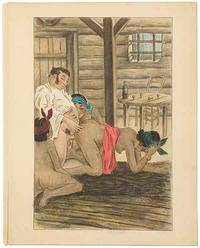
1935réf. 334200Paris: no publisher 1935. Near Fine. Hand colored lithographic print on fine wove paper. Image size approximately 7" x 11". Likely removed from a folio volume as indicated by a thin stub tipped-in along the left edge of the sheet. Near fine. Possibly one of the eight original Eres prints for the pornographic novel Aventures d'une satyre attributed to Jane de Rozat published in Paris in the mid-1930s. no publisher unknown books
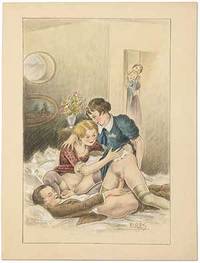
1930réf. 334203not indicated: not indicated 1930. Unbound. Near Fine. Hand colored pochoir print on fine wove paper. Image size height preceding width measures approximately 28 x 18 cm. Near fine. Signed "ERES." Could be one of the eight original prints also signed "Eres" for the pornographic novel Aventures d'une satyre attributed to Jane de Rozat published in Paris in the mid-1930s. not indicated unknown books
1960réf. 010989New York: Golden Press 1960 Pictorial boards in matching dust jacket with a few small abrasions to rear panel edge tear to front panel original price intact $1.00. An easy reader tale told in verse about a little boy who wants a whale of his very own. Charming period artwork in color throughout. . First Edition. Pictorial Boards. Fine/Very Good. Illus. by Claude Humbert. Square 8vo. Golden Press unknown books