552 resultados
ref. 240044Paris, Charavay, 1883 in-8, XXX-326 pp., portr. en front., index, broché. Rousseurs.
ref. 242012Desjonquères, 1990 20,5 x 14 x 1,2 cm., 161 pp, Broché
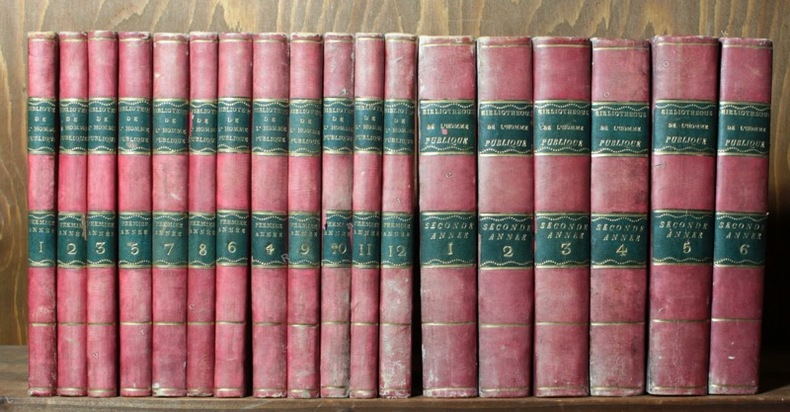
1790ref. 9307A Paris, chez Buisson, 1790-1791. 24 tomes en 18 volumes petit in-8, demi-vélin teinté rouge à coins, dos lisses ornés de roulettes et filets dorés, étiquettes de titre et tomaison vertes. Reliures un peu frottées, dos légèrement passés, minimes manques à quelques étiquettes, quelques taches au papier des plats, très rares rousseurs, quelques auréoles. A noter que les étiquettes de titre orthographient "public" avec la terminaison -que. Les 12 numéros de la première années sont reliés indépendamment, les 12 de la seconde sont reliés à raison de 2 numéros par volume, sous la même reliure toutefois.
1795ref. 20272A Paris, chez Agasse, l'an III de la République, [1795]. In-8 de [8]-385 pages, demi-basane brune, dos lisse orné de filets et fleurons dorés.
1823ref. 060320Paris: Librairie De Brissot-Thivars 1823. 3rd Edition . Hardcover. Near Fine. 466 Ii Pp. Half Green Morocco Spine Gilt Four Bands Gilt Green Marbled Boards Blue Marbled Endpapers And Edges Of Page Block. Third Edition. A Small But Very Attractively Bound Volume. Near Fine Although Small Frays At Tips. Librairie De Brissot-Thivars, hardcover
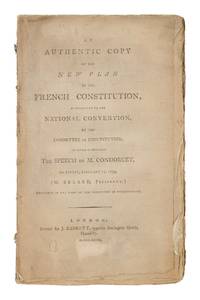
1793ref. 863891793. The Blueprint That Cost a Philosopher His Life: Condorcet's Tragic 1793 French Constitution Plan Condorcet Marquis de Jean-Antoine-Nicolas de Caritat 1743-1794. An Authentic Copy of the New Plan of the French Constitution as Presented to the National Convention by the Committee of Constitution.: To which is Prefixed the Speech of M. Condorcet on Friday February 15 1793 M. Breard President Delivered in the Name of the Committee of Constitution. London: Printed for J. Debrett Opposite Burlington House Piccadilly 1793. ii li 1 58 pp. Octavo 9" x 5-1/4"; 22.5 x 14 cm. Disbound. Uncut. Outer leaves worn and chipped at edges but text remains broad-margined and stable. Light age-toning. Internally clean and crisp. A good unsophisticated copy. $450. First English edition. This text represents the intellectual peak of the French Revolution by turning abstract Enlightenment theory into a working legal framework. Known as the "Plan Condorcet" it served as the ultimate manifesto of the moderate Girondin faction. Its rejection by the National Convention marked the precise moment the Revolution swung from rational legal reform into the radical violent Reign of Terror. Shortly after presenting this plan the Jacobins ordered Condorcet's arrest forcing him into hiding where he wrote his famous philosophical masterpiece on human progress before dying mysteriously in a prison cell days after his capture. Published by John Debrett this specific London edition highlights how closely and anxiously the British public followed the political collapse of their neighbor across the Channel. English Short-Title Catalogue T22771. unknown
2005ref. 107701alzoESPASA-CALPE 2005. DURA. Bien/Sin cubierta. Sobre los progresos futuros del espíritu humano. ESPASA-CALPE hardcover
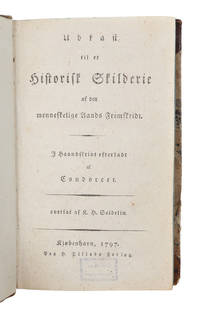
1797ref. 61971København Tikiøbs Forlag 1797. 8vo. Bound in a contemporary half calf binding with gilt spine and gilt title label. Minor cracks to spine. Insignificant wear to capitals. Edges of boards worn. Corners bumped. Bibliographical notes to front free endpaper. Small ownership stamp to verso of title page. Evenly browned. XII23681: errata pp. The extremely rare first Danish edition of Condorcet's main work "Esquisse d'un tableau historique des progrès de l'esprit humain.1795" "the most fully developed exposition of the progress of man" Printing and the Mind of Man p. 149 and a main work of the Enlightenment as well as of historical thought in general. The author was the creator of what came to found the basis for the modern French system. The great French philosopher political thinker and mathematician M.J.A. Condorcet 1743 - 1794 played a seminal role in 18th century France. He was friends with the likes of d'Alembert Voltaire Turgot etc. and he greatly contributed to the social and political debates of politically turbulent France. As one of the few he advocated a liberal economy equality in public education as well as in gender and race etc. He preached constitutionalism and his thoughts that are still influential today embody those of the Enlightenment and rationalism."A belief in the ultimate perfectibility of man lies at the root of all progressive thinking about the human condition. The "philosophes" and Godwin had familiarized the reading public with this notion; it was left to Condorcet to give it its finest and most durable expression. It was the gospel of nineteenth century that mankind is destined for indefinite future progress. Condorcet looking back and then forward saw proof of this in the growing equality between classes and nations the intellectual physical and moral improvement of man; and he prophesied that popular education on correct principles would strengthen and assure this progress." PMM 246.During the French Revolution Condorcet came to play a dominating role advocating a rationalist reconstruction of society and he championed many liberal causes. In 1791 he became secretary of the Legislation Assembly and the institution adopted his scheme for comprehensive state education which later became the basis of the modern French system. In the struggle between the two political parties the Girondists and the Montagnards Condorcet occupied an independent role but when he opposed the death penalty under the trial of King Louis XVI still supporting the actual trial and the radical Montagnards gained more power Condorcet was branded a traitor and in October 1793 a warrant was issued for his arrest. He now went into hiding for several months almost a year and it is during these months that he writes the work that was to become his most important the main work "Esquisse." "Sketch for a Historical Picture of the Progress of the Human Mind" which was published posthumously the year after his death. In 1794 Condorcet was arrested and two days later he was found dead in his cell -it is unknown whether he committed suicide or was murdered because of fear of fierce reactions that would definitely have occurred had the beloved man been officially sentenced to the death penalty."In the Esquisse" published after his death Condorcet traces the history of man through epochs the first three covering his progress from savagery to pastoral community and thence to the agricultural state. The next five span the growth of civilizations and knowledge down to Descartes and the ninth describes the revolution of Condorcet's own lifetime from Newton to Rousseau. The prophetic view of the tenth epoch shows Condorcet at his most original. He forecasts the destruction of inequality between nation and classes and the improvement intellectual moral and physical of human nature. it exercised considerable influence on Comte. But it is as the most fully developed exposition of the progress of man that Condorcet's work is now remembered and it is this which has given it its lasting appeal." PMM 246. hardcover
1802ref. 56417Kiøbenhavn: A. Soldin 1802. 8vo. Indbundet i et samtidigt hldrbd. med rygforgyldning. Titeletiket i skind med forgyldt titel. Kantslid. Øvre kapitæl slidt. Hjørner stødte. Et brændemærke på forpermermen har afgivet en brunplet på de første 6 blade. Enkelte brunpletter ellers ren og pæn. Trykt på godt papir. Ex libris Nicolai Bøgh. Titeloplag idet indholdet er identisk med førstetrykket fra 1798. unknown
1795ref. 42119Paris Agasse l'an III de la République une et indivisible 1795. 8vo. Bound in a very nice newer pastiche-binding in full mottled calf. Five raised bands and gilt title-label to spine. A very nice clean fresh and attractive copy. VIII 389 pp. The rare first edition of Condorcet's main work "the most fully developed exposition of the progress of man" Printing and the Mind of Man p. 149 and a main work of the Enlightenment as well as of historical thought in general. The author was the creator of what came to found the basis for the modern French system. The great French philosopher political thinker and mathematician M.J.A. Condorcet 1743 - 1794 played a seminal role in 18th century France. He was friends with the likes of d'Alembert Voltaire Turgot etc. and he greatly contributed to the social and political debates of politically turbulent France. As one of the few he advocated a liberal economy equality in public education as well as in gender and race etc. He preached constitutionalism and his thoughts that are still influential today embody those of the Enlightenment and rationalism."A belief in the ultimate perfectibility of man lies at the root of all progressive thinking about the human condition. The "philosophes" and Godwin had familiarized the reading public with this notion; it was left to Condorcet to give it its finest and most durable expression. It was the gospel of nineteenth century that mankind is destined for indefinite future progress. Condorcet looking back and then forward saw proof of this in the growing equality between classes and nations the intellectual physical and moral improvement of man; and he prophesied that popular education on correct principles would strengthen and assure this progress." PMM 246.During the French Revolution Condorcet came to play a dominating role advocating a rationalist reconstruction of society and he championed many liberal causes. In 1791 he became secretary of the Legislation Assembly and the institution adopted his scheme for comprehensive state education which later became the basis of the modern French system. In the struggle between the two political parties the Girondists and the Montagnards Condorcet occupied an independent role but when he opposed the death penalty under the trial of King Louis XVI still supporting the actual trial and the radical Montagnards gained more power Condorcet was branded a traitor and in October 1793 a warrant was issued for his arrest. He now went into hiding for several months almost a year and it is during these months that he writes the work that was to become his most important the main work "Esquisse." "Sketch for a Historical Picture of the Progress of the Human Mind" which was published posthumously the year after his death. In 1794 Condorcet was arrested and two days later he was found dead in his cell -it is unknown whether he committed suicide or was murdered because of fear of fierce reactions that would definitely have occurred had the beloved man been officially sentenced to the death penalty."In the Esquisse" published after his death Condorcet traces the history of man through epochs the first three covering his progress from savagery to pastoral community and thence to the agricultural state. The next five span the growth of civilizations and knowledge down to Descartes and the ninth describes the revolution of Condorcet's own lifetime from Newton to Rousseau. The prophetic view of the tenth epoch shows Condorcet at his most original. He forecasts the destruction of inequality between nation and classes and the improvement intellectual moral and physical of human nature. it exercised considerable influence on Comte. But it is as the most fully developed exposition of the progress of man that Condorcet's work is now remembered and it is this which has given it its lasting appeal." PMM 246. hardcover
ref. DADAX0521841399New unknown
ref. DADAX0548843163New unknown
ref. SONG0226035328Used: Good unknown
2019ref. 429062019. ISBN-13: 9781584776543; ISBN-10: 1584776544. Translated by Thomas Jefferson Destutt de Tracy Antoine Louis Claude Comte. Jefferson Thomas. A Commentary and Review of Montesquieu's Spirit of Laws Prepared For Press From the Original Manuscript in the Hands of the Publisher. To Which Are Annexed Observations on the Thirty-First Book by the Late M. Condorcet: And Two Letters of Helveticus on the Merits of the Same Work. Philadelphia: Duane 1811. viii 292 pp. Reprinted 2006 2019 by The Lawbook Exchange Ltd. ISBN-13: 9781584776543; ISBN-10: 1584776544. Hardcover. New. $75. Commentaire sur l'Esprit des Lois de Montesquieu 1806 is a critique of Montesquieu's pessimistic appraisal of democracy in De l'Esprit des Lois. While minister to France in the 1780s Jefferson saw this work in manuscript. It so impressed him that he arranged for its publication in France and translated it anonymously for publication in America. Looking back at this work in a letter from 1811 Jefferson commended it for correcting De l'Esprit des Lois. While other studies "nibbled only at its errors" he told his correspondent this work rebutted them "with a depth of thought precision of idea of language and of logic which will force conviction into every mind. I declare to you Sir in the spirit of truth and sincerity that I consider it the most precious gift the present age has received.": The Writings of Thomas Jefferson V:566-571. CONTENTS: Of laws in England; Of laws originating directly from the nature of the government; Of the principles of the three forms of government; The laws relating to education should be congenial with the principles of the government; Laws formed by the legislative should be consistent with the principles of the government; Consequences of the principles of different governments in relation to the simplicity of civil and criminal laws the forms of judicial proceedings and the apportionment of punishments; Consequences of the different principles of the three forms of government relative to sumptuary laws to luxury and to the condition of women; Of the corruption of the principle in each of the three forms of government -- Of laws relative to the defensive force; Of laws relative to the offensive force. unknown
ref. 74959Montreuil, Editions Bréal, 1989. 16 x 24, 192 pp., broché, quelques illustrations en N/B, broché, bon état (couverture plastifiée).
ref. 102.923Paris, Flammarion, 2009. 13 x 20, 249 pp., broché, très bon état.
ref. 70944Coll. "Petite Bibliothèque Payot" n° 281, Paris, éd. Payot, 1996, pt. in-8, cartonnage souple, couv. ill. en noir éd., 298 pp., bibliographie, table des matière, Cette petite anthologie des œuvres de Condorcet (1743 - 1794) nous offre une introduction complète à une pensée profonde et originale. Très bon état
1986ref. 29561986 éditions martinsart 1986 format in 4 reliés en mouton plein havane et marine, mis sous étuis accompagnés d un tirage a part des dessins monochromes N ° 32 complets en 10 volumes ... .... parfait état..... COMME NEUF ... PHOTOGRAPHIE SUR DEMANDE - volume 1 villon rutebeuf ouvres poetiques illustrations de gobert et geraldine allier 350 pages - volume 2 machiavel le prince ; discours sur la premiere décade de tite - live et histoires florentines illustrations de claude chanot 379 pages - volume 3 rabelais la trés mirifique histoire .... illustrations eric provoost. 375 pages - volume 4 descartes discours de la methode , méditations plus lettres illustrations lautent hours 376 pages .- volume 5 fontenelle . entretiens sur la pluralité des mondes . histoire des oracles illustrations de sylvie taugourdeau 375 pages .- volume 6 diderot . la religieuse suivi de contes entretiens illustrations de marie birais 377 pages . volume 7 montesquieu . lettres pzersanes illustrations dominique duplantier 364 pages . volume 8 voltaire . contes zadig , candide , l ingenu illustrations christophe logerot 368 pages . volume 9 rousseau . du contrat social suivi de discours sur les sciences les arts .376 pages - volume 10 condorcet . esquisse d un tableau , historique des progres de l esprit humain illustrations leopold maresc 362 pages
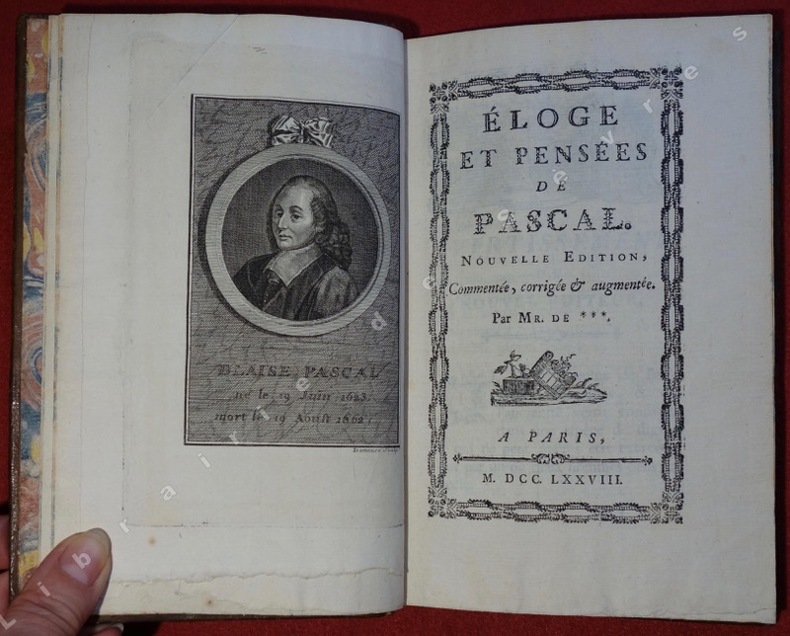
1778ref. 148111778 Paris (Genève), 1778, sans nom d'éditeur (Grasset), in 8 de XII-316 pp., titre encadré portrait de Pascal gravé par Demeuse en frontispice et portrait de Voltaire gravé par Brichet placé face à la préface, page 163 numérotée par erreur 139, jolies vignettes gravées sur bois, culs de lampes etc., rel. d'ép. plein veau fauve marbré, dos lisse orné de fers dorés, pièce de titre de maroquin rouge, tranches jaspées de couleurs, bel ex.
1798ref. 195361798 Gènes, chez Yves Gravier libraire, 1798, An I de la République Ligurienne, in-8 de 361-(1) pp., rel. postérieure fin XIXe , demipercaline bordeaux, dos lisse avec date en pied, angle supérieur de la page de faux-titre anciennement réparé, bon ex.
1786ref. 207281786 Londres (Paris), 1786, in-8 de (2) ff- 299 pp.-(1)p. (errata), reliure de l'époque de plein veau havane raciné, dos lisse orné de fers dorés, pièce de titre de maroquin rouge, charnières fendues, 1er plat détaché, reliure à restaurer, sinon bel état intérieur.
1847ref. 11057Paris, Firmin Didot frères, 1847-1849. 12 vol. grand in-8 de (6)-CLXXXVI-(2)-652 pp. ; (6)-VIII-672 pp. ; (6)-664 pp. ; (6)-644 pp. ; [6]-575 ; (6)-662 pp. ; (6)-575 pp. ; (6)-662 pp. ; (6)-547 pp. ; (6)-616 pp. ; (6)-676 p. ; (6)-690 pp., percaline grise.
1795ref. 12965A Paris, chez Agasse, 1795. In-8 de VIII-389 pp., demi-basane brune, dos frotté (reliure de l'époque).
1791ref. 39904Londres, , 1791. 2 tomes en 1 vol. in-16 de (2)-303 pp. et (2)-279 pp., demi-basane racinée, dos lisse orné (reliure de l'époque).
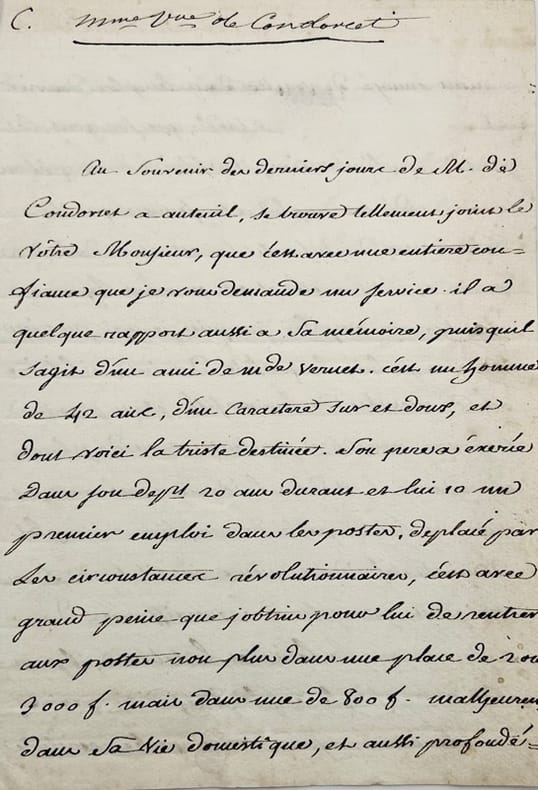
1798ref. 44332, , 1798-1811. Ensemble 4 lettres autographes signées.