555 resultados
ref. 70944Coll. "Petite Bibliothèque Payot" n° 281, Paris, éd. Payot, 1996, pt. in-8, cartonnage souple, couv. ill. en noir éd., 298 pp., bibliographie, table des matière, Cette petite anthologie des œuvres de Condorcet (1743 - 1794) nous offre une introduction complète à une pensée profonde et originale. Très bon état
1977ref. 62AyGarnier 1977 Gros In8 502 pages - broché - très bon etat
1976ref. BN155695Suhrkamp 1976. 1976. Softcover. Entwurf einer historischen Darstellung der Fortschritte des menschlichen Geistes suhrkamp taschenbuch wissenschaft stw 175 Entwurf einer historischen Darstellung der Fortschritte des menschlichen Geistes suhrkamp taschenbuch wissenschaft stw 175 Jean Antoine Nicolas de Caritat de Condorcet Suhrkamp paperback
1974ref. BN510058Editions Hermann 1974. 1974. Softcover. Mathématique et société Mathématique et société Condorcet et Roshdi Rashed Editions Hermann paperback
1994ref. BN646377Promeneur 1994. 1994. Vie de Voltaire Vie de Voltaire Condorcet Promeneur unknown
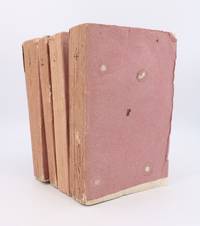
1788ref. 89325Paris Colle: Froullé 1788. Fine. Froullé Paris Colle 1788 13.5 x 21 cm 4 volumes Brochés First edition cf. Sabin 47206. Leclerc 952.Some joints cracked at head and tail minor marginal losses of no consequence to the temporary wrappers.The author Italian by birth emigrated to America before the Revolution and settled in Virginia near Monticello.His book written in collaboration with Condorcet is of particular interest with regard to the history of independence and the government of the United States cf. Fay pages 24-25: ""Compilation très exacte qui réfute les théories de Mably et de Raynal et constitue un répertoire précieux de renseignements de tous ordres sur les États-Unis.""Rare and appealing copy preserved in its original stitching and in plain pink temporary wrappers. Froullé unknown
ref. DADAX0521841399New unknown
ref. KN5794Fondation Singer-Polignac 1968.EN TRES BON ETAT. INTERIEUR IMPECCABLE.
ref. 6021672-nnew. unknown
ref. 6254623-nnew. unknown
ref. DADAX0521044642New unknown
1788ref. 89325Froullé | Paris Colle 1788 | 13.5 x 21 cm | 4 volumes Brochés
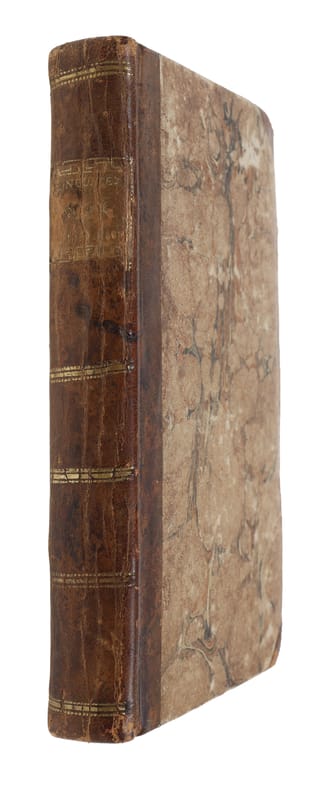
1795ref. 42119Paris, Agasse, l'an III de la République, une et indivisible (1795). 8vo. Bound in a very nice newer pastiche-binding in full mottled calf. Five raised bands and gilt title-label to spine. A very nice, clean, fresh, and attractive copy. VIII, 389 pp.
1802ref. 56417Kiøbenhavn: A. Soldin, 1802. 8vo. Indbundet i et samtidigt hldrbd. med rygforgyldning. Titeletiket i skind med forgyldt titel. Kantslid. Øvre kapitæl slidt. Hjørner stødte. Et brændemærke på forpermermen har afgivet en brunplet på de første 6 blade. Enkelte brunpletter, ellers ren og pæn. Trykt på godt papir. Ex libris Nicolai Bøgh.
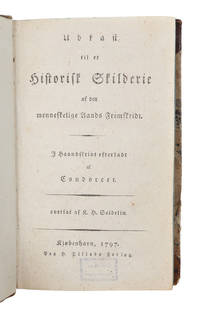
1797ref. 61971København, Tikiøbs Forlag, 1797. 8vo. Bound in a contemporary half calf binding with gilt spine and gilt title label. Minor cracks to spine. Insignificant wear to capitals. Edges of boards worn. Corners bumped. Bibliographical notes to front free endpaper. Small ownership stamp to verso of title page. Evenly browned. XII,(2),368,(1: errata) pp.
1827ref. 592428 vol. in-8 reliure de l'époque demi-maroquin brun, Chez Dalibon, Paris, 1827, XV-410 ; 495 ; 483 ; 490 ; 475 ; 544 , 464 ; 460 pp. Rappel du titre complet : Oeuvres de Montesquieu (8 Tomes - Complet) Avec Eloges, Analyses, Commentaires, Remarques, Notes, Réfutations, Imitations, par MM. Destutt de Tracy, Villemain, Membres de l'Institut, d'Alembert, Helvétius, Voltaire, Condorcet et Bertolini. Tome I : Grandeur des Romains ; Tomes II, III et IV : Esprit des Lois ; : Tome V : Défense de l'Esprit des Lois ; Tome VI : Oeuvres diverses ; Tome VII : Lettres Persanes ; Tome VIII : Commentaire sur l'Esprit des Lois
1787ref. 645356 vol. in-12 cartonnage bradel postérieur, Chez Moutard, Imprimeur-Libraire de la Reine, de Madame, de Madame Comtesse d'Artois, & de l'Académie des Sciences, A Paris, 1787, xxxiv-vi-559 pp. et 2 ff. n. ch. ; 2 ff., xii-437 pp. ; 2 ff., 523 pp. ; 2 ff., 637 pp. ; 2 ff., 668 pp. ; 2 ff., 378 pp.
1823ref. 060320Paris: Librairie De Brissot-Thivars 1823. 3rd Edition . Hardcover. Near Fine. 466 Ii Pp. Half Green Morocco Spine Gilt Four Bands Gilt Green Marbled Boards Blue Marbled Endpapers And Edges Of Page Block. Third Edition. A Small But Very Attractively Bound Volume. Near Fine Although Small Frays At Tips. Librairie De Brissot-Thivars, hardcover
1797ref. 61971København Tikiøbs Forlag 1797. 8vo. Bound in a contemporary half calf binding with gilt spine and gilt title label. Minor cracks to spine. Insignificant wear to capitals. Edges of boards worn. Corners bumped. Bibliographical notes to front free endpaper. Small ownership stamp to verso of title page. Evenly browned. XII23681: errata pp. The extremely rare first Danish edition of Condorcet's main work "Esquisse d'un tableau historique des progrès de l'esprit humain.1795" "the most fully developed exposition of the progress of man" Printing and the Mind of Man p. 149 and a main work of the Enlightenment as well as of historical thought in general. The author was the creator of what came to found the basis for the modern French system. The great French philosopher political thinker and mathematician M.J.A. Condorcet 1743 - 1794 played a seminal role in 18th century France. He was friends with the likes of d'Alembert Voltaire Turgot etc. and he greatly contributed to the social and political debates of politically turbulent France. As one of the few he advocated a liberal economy equality in public education as well as in gender and race etc. He preached constitutionalism and his thoughts that are still influential today embody those of the Enlightenment and rationalism."A belief in the ultimate perfectibility of man lies at the root of all progressive thinking about the human condition. The "philosophes" and Godwin had familiarized the reading public with this notion; it was left to Condorcet to give it its finest and most durable expression. It was the gospel of nineteenth century that mankind is destined for indefinite future progress. Condorcet looking back and then forward saw proof of this in the growing equality between classes and nations the intellectual physical and moral improvement of man; and he prophesied that popular education on correct principles would strengthen and assure this progress." PMM 246.During the French Revolution Condorcet came to play a dominating role advocating a rationalist reconstruction of society and he championed many liberal causes. In 1791 he became secretary of the Legislation Assembly and the institution adopted his scheme for comprehensive state education which later became the basis of the modern French system. In the struggle between the two political parties the Girondists and the Montagnards Condorcet occupied an independent role but when he opposed the death penalty under the trial of King Louis XVI still supporting the actual trial and the radical Montagnards gained more power Condorcet was branded a traitor and in October 1793 a warrant was issued for his arrest. He now went into hiding for several months almost a year and it is during these months that he writes the work that was to become his most important the main work "Esquisse." "Sketch for a Historical Picture of the Progress of the Human Mind" which was published posthumously the year after his death. In 1794 Condorcet was arrested and two days later he was found dead in his cell -it is unknown whether he committed suicide or was murdered because of fear of fierce reactions that would definitely have occurred had the beloved man been officially sentenced to the death penalty."In the Esquisse" published after his death Condorcet traces the history of man through epochs the first three covering his progress from savagery to pastoral community and thence to the agricultural state. The next five span the growth of civilizations and knowledge down to Descartes and the ninth describes the revolution of Condorcet's own lifetime from Newton to Rousseau. The prophetic view of the tenth epoch shows Condorcet at his most original. He forecasts the destruction of inequality between nation and classes and the improvement intellectual moral and physical of human nature. it exercised considerable influence on Comte. But it is as the most fully developed exposition of the progress of man that Condorcet's work is now remembered and it is this which has given it its lasting appeal." PMM 246. hardcover
1802ref. 56417Kiøbenhavn: A. Soldin 1802. 8vo. Indbundet i et samtidigt hldrbd. med rygforgyldning. Titeletiket i skind med forgyldt titel. Kantslid. Øvre kapitæl slidt. Hjørner stødte. Et brændemærke på forpermermen har afgivet en brunplet på de første 6 blade. Enkelte brunpletter ellers ren og pæn. Trykt på godt papir. Ex libris Nicolai Bøgh. Titeloplag idet indholdet er identisk med førstetrykket fra 1798. unknown
1795ref. 42119Paris Agasse l'an III de la République une et indivisible 1795. 8vo. Bound in a very nice newer pastiche-binding in full mottled calf. Five raised bands and gilt title-label to spine. A very nice clean fresh and attractive copy. VIII 389 pp. The rare first edition of Condorcet's main work "the most fully developed exposition of the progress of man" Printing and the Mind of Man p. 149 and a main work of the Enlightenment as well as of historical thought in general. The author was the creator of what came to found the basis for the modern French system. The great French philosopher political thinker and mathematician M.J.A. Condorcet 1743 - 1794 played a seminal role in 18th century France. He was friends with the likes of d'Alembert Voltaire Turgot etc. and he greatly contributed to the social and political debates of politically turbulent France. As one of the few he advocated a liberal economy equality in public education as well as in gender and race etc. He preached constitutionalism and his thoughts that are still influential today embody those of the Enlightenment and rationalism."A belief in the ultimate perfectibility of man lies at the root of all progressive thinking about the human condition. The "philosophes" and Godwin had familiarized the reading public with this notion; it was left to Condorcet to give it its finest and most durable expression. It was the gospel of nineteenth century that mankind is destined for indefinite future progress. Condorcet looking back and then forward saw proof of this in the growing equality between classes and nations the intellectual physical and moral improvement of man; and he prophesied that popular education on correct principles would strengthen and assure this progress." PMM 246.During the French Revolution Condorcet came to play a dominating role advocating a rationalist reconstruction of society and he championed many liberal causes. In 1791 he became secretary of the Legislation Assembly and the institution adopted his scheme for comprehensive state education which later became the basis of the modern French system. In the struggle between the two political parties the Girondists and the Montagnards Condorcet occupied an independent role but when he opposed the death penalty under the trial of King Louis XVI still supporting the actual trial and the radical Montagnards gained more power Condorcet was branded a traitor and in October 1793 a warrant was issued for his arrest. He now went into hiding for several months almost a year and it is during these months that he writes the work that was to become his most important the main work "Esquisse." "Sketch for a Historical Picture of the Progress of the Human Mind" which was published posthumously the year after his death. In 1794 Condorcet was arrested and two days later he was found dead in his cell -it is unknown whether he committed suicide or was murdered because of fear of fierce reactions that would definitely have occurred had the beloved man been officially sentenced to the death penalty."In the Esquisse" published after his death Condorcet traces the history of man through epochs the first three covering his progress from savagery to pastoral community and thence to the agricultural state. The next five span the growth of civilizations and knowledge down to Descartes and the ninth describes the revolution of Condorcet's own lifetime from Newton to Rousseau. The prophetic view of the tenth epoch shows Condorcet at his most original. He forecasts the destruction of inequality between nation and classes and the improvement intellectual moral and physical of human nature. it exercised considerable influence on Comte. But it is as the most fully developed exposition of the progress of man that Condorcet's work is now remembered and it is this which has given it its lasting appeal." PMM 246. hardcover
ref. DADAX0548843163New unknown
ref. SONG0226035328Used: Good unknown
1795ref. 59131BBParis, Chez Agasse. L'an III. (i.e. 1795). 8°. VIII S., 389 S. Halblederband der Zeit mit rotem goldgeprägtem Rückenschild und wenig Rückenvergoldung.