De Condorcet, Jean Antoine NicolasBiblio.com

545 resultados
2010ref. DADAX1165437015Kessinger Publishing 2010-09-10. paperback. New. 8.25x1.01x11.00. Buy with confidence. Excellent Customer Service & Return policy. Kessinger Publishing paperback
2010ref. DADAX116076610XKessinger Publishing 2010-03-19. paperback. New. 6.00x1.34x9.00. Buy with confidence. Excellent Customer Service & Return policy. Kessinger Publishing paperback
2010ref. DADAX1160746036Kessinger Publishing 2010-03-19. paperback. New. 6.00x0.76x9.00. Buy with confidence. Excellent Customer Service & Return policy. Kessinger Publishing paperback
1795ref. 65358Paris: Chez Agasse 1795. Can Man Become Perfect" CONDORCET Marie Jean Antoine Nicolas Caritat Marquis de. Esquisse d'un tableau historique des progrès de l'esprit humain. Ouvrage posthume de Condorcet. Paris: Chez Agasse L'an III. de la République 1795. First edition of Condorcet's philosophical masterpiece. Octavo 7 7/8 x 4 13/16 inches; 201 x 123 mm. viii 389 1 blank pp. Contemporary quarter calf over dark blue paste-paper boards spine gilt with dotted bands and ornaments gilt red morocco lettering piece. Old owner's signature on half-title. A quarter-inch marginal tear at the bottom of leaf M42 that does not affect the text. Light foxing throughout. A blue ink stain on top edge from signature Z to the end. Overall a clean and attractive copy. "It was the gospel of the nineteenth century that mankind is destined for indefinite future progress. Condorcet 1743-1794 looking back and then forward saw proof of this in the growing equality between classes and nations the intellectual physical and moral improvement of man; and he prophesied that popular education on correct principles would strengthen and assure this progress.In the Esquisse 'An Historical Outline of the Progress of the Human Mind' published after his death Condorcet traces the history of man through epochs the first three covering his progress from savagery to pastoral community and thence to the agricultural state. The next five span the growth of civilizations and knowledge down to Descartes and the ninth describes the revolution of Condorcet's own lifetime from Newton to Rousseau. The prophetic view of the tenth epoch shows Condorcet at his most original. He forecasts the destruction of inequality between nations and classes and the improvement intellectual moral and physical of human nature.it is as the most fully developed exposition of the progress of man that Condorcet's work is now remembered and it is this which has given its lasting appeal" Printing and the Mind of Man. Printing and the Mind of Man 246. HBS 65358. $2000. Chez Agasse unknown
1785ref. 66958Paris: De k'Imprimerie Royale 1785. The First Large-Scale Attempt to Apply Mathematics to Knowledge of Human Phenomena" CONDORCET Marie Jean Antoine Nicolas Caritat Marquis de. Essai sur l'application de l'analyse à la probabilité des décisions rendues à la pluralité des voix. Paris: De l'Imprimerie Royale 1785. First edition. Quarto. 2 cxci 1 blank 304 pp. Decorative woodcut head- and tail-pieces. Contemporary French mottled calf spine decorated in gilt with five raised bands. Marbled endpapers all edges red. First and last few pages browned at edges . gathering K is browned a Q and 2G is toned. Otherwise very good and very scarce. "Condorcet's most significant and fruitful endeavor was in a field entirely new at the time. The subject was one that departed from the natural sciences and mathematics but nevertheless showed the way toward a scientific comprehension of human phenomena taking the empirical approach of natural science as its inspiration and employing mathematics as its tool. Condorcet called this new science 'social mathematics.' It was apparently intended to comprise.a statistical description of society a theory of political economy inspired by the Physiocrats and a combinatorial theory of intellectual processes. The great work on the voting process published in 1785 is related to the latter. Condorcet there sought to construct a scheme for an electoral body the purpose of which would be to determine the truth about a given subject by the process of voting and in which each elector would have the same chance of voicing the truth.No doubt the results obtained in the Essai d'application de l'analyse were modest ones. 'In almost all cases' Condorcet said 'the results are in conformity with what simple reason would have dictated; but it is so easy to obscure reason by sophistry and vain subtleties that I should feel rewarded if I had only founded a single useful truth on a mathematical demonstration' Essai p. ii. One must nevertheless recognize in this work.the first large-scale attempt to apply mathematics to knowledge of human phenomena" D.S.B. Brunet VI col. 472. HBS 66958. $7500. De k'Imprimerie Royale unknown
ref. DADAX0274467038Wentworth Press 2018-08-01. hardcover. New. 6.14x1.25x9.21. Buy with confidence. Excellent Customer Service & Return policy. Wentworth Press hardcover
ref. DADAX0274483637Wentworth Press 2018-08-01. hardcover. New. 6.14x1.44x9.21. Buy with confidence. Excellent Customer Service & Return policy. Wentworth Press hardcover
ref. DADAX0274483564Wentworth Press 2018-08-01. paperback. New. 6.14x1.68x9.21. Buy with confidence. Excellent Customer Service & Return policy. Wentworth Press paperback
ref. 2406135713.Gpaperback. Good. Access codes and supplements are not guaranteed with used items. May be an ex-library book. paperback
ref. 2812405104.Gpaperback. Good. Access codes and supplements are not guaranteed with used items. May be an ex-library book. paperback
2009ref. DADAX1104076365Kessinger Publishing 2009-02-16. paperback. New. 6.00x1.12x9.00. Buy with confidence. Excellent Customer Service & Return policy. Kessinger Publishing paperback
2009ref. DADAX1104076357Kessinger Publishing 2009-02-16. paperback. New. 6.00x1.07x9.00. Buy with confidence. Excellent Customer Service & Return policy. Kessinger Publishing paperback
ref. 42721S.l.n.d. 1789. 8 pages. 195x125 Cm. Dérelié. Position politique de Condorcet sur le problème des biens ecclésiastiques. Ce sont les réflexions "d'un homme qui n'a jamais passé pour aimer le Clergé mais qui a toujours aimé la justice et la paix qui lorsqu'un Corps est détruit ne voit plus dans ceux qui le composaient que des individus. ayant les mêmes droits que les autres hommes.". Mouillure angulaire avec petits manques sans atteinte au texte. Traces de plis. S.l.n.d. (1789). unknown
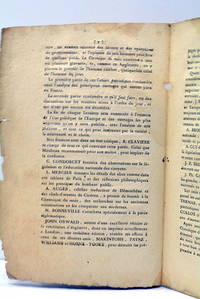
ref. 67764A la fin: Paris Imprimerie du Cercle Social 1791. 4 pages. 23x145 Cm. Broché. Rarissime prospectus de parution de ce célèbre périodique paru entre 1791 et 1793. On y trouve la philosophie de la publication la rubrique assurée par chaque auteur les conditions d'abonnement etc. Petits manques. Taches et rousseurs. (A la fin:) Paris, Imprimerie du Cercle Social (1791). unknown
ref. 6254623-nnew. unknown
ref. 54641314like new. unknown
ref. 45441330-nnew. unknown
ref. 45056690-nnew. unknown
ref. 2016183519.Gpaperback. Good. Access codes and supplements are not guaranteed with used items. May be an ex-library book. paperback
1976ref. 250510009Bobbs-Merrill Company 1976. Paperback. Clean & Unmarked. 8x5x0. A very clean and straight copy. Clean text and an uncreased spine. 304 pp. Bobbs-Merrill Company paperback
ref. 2705680837.Gpaperback. Good. Access codes and supplements are not guaranteed with used items. May be an ex-library book. paperback
2018ref. Gyan-9789353089580Facsimile Publisher 2018. Hardcover. New. 22.59 x 14.34 x 3.98 cm. English Facsimile Publisher hardcover
2016ref. Gyan-9789353202477Facsimile Publisher 2016. Hardcover. New. 22.59 x 14.34 x 2.52 cm. English Facsimile Publisher hardcover
2018ref. Gyan-9789353089580Facsimile Publisher 2018. Hardcover. New. 22.59 x 14.34 x 3.98 cm. English Facsimile Publisher hardcover
2016ref. Gyan-9789353202477Facsimile Publisher 2016. Hardcover. New. 22.59 x 14.34 x 2.52 cm. English Facsimile Publisher hardcover