22.046 resultados
1979ref. 17149JGarden City: Doubleday 1979. First Edition First Printing of his classic ballet novel. Signed and inscribed by the author Edward Stewart inscribed: “For Bob Tollett and Donn Harman with very best wishes Ned Stewart 7 March 79.” Bob Tollett was one of New York City’s leading rare autographs and manuscript dealers. Near fine in a near fine price-clipped dust Jacket with a few tiny chips. The origin of this novel involved Nora Kaye-Ross 1920-1987 who was an American prima-ballerina known for her ability to perform dramatic roles. Called the Duse of Dance after the acclaimed actress Eleonora Duse. Stewart and Nora Kaye-Ross spent extensive time together working on a potential non-fiction ballet book. The book never came to pass but their relationship allowed Stewart access to the highest and most intimate circles of ballet life in New York. Acknowledged as one of the top novels ever written dealing with the world of ballet. Doubleday unknown
1674ref. YRG-375In-12, plein cuir fauve, double filets et fleurons dorés, sur les plats, dos à nerfs pièce de titre doré sur maroquin rouge caissons rehaussés de fleurons dorés, tranches marbrées gris bleu.Intérieur frais. Nicolaum Pepingué. Paris Belle édition parisienne, du temps de l'auteur.
1950ref. 230281950 Deux dessins à l'encre de Chine recto-verso, signés en bas à droite du cachet d'atelier, (1950), 27 x 25 et 24 x 13 cm.
188125 cm, bella rilegatura dell'epoca in mezza pelle con angoli, titolo e decorazioni in oro al dorso che è diviso da 5 nervi, piatti e risguardi marmorizzati; p. XV, 955. Comprende: Supplément les ouvrages répresenés en France et a l'étranger pendant le cour de l'impression et Deuxiéme Supplément contenant les ouvrages répresentés en France et a l'étranger années 1869-1872. Senza data nel testo, ma cfr.Iccu. Tre righe manoscritte di dedica del cantante Léon Gresse al compositore Léon Delabaye, in data 28 dècembre 1890
1724ref. 41995Amsterdam, R. u. G. Wetsten, 1724. Fol. Titelbll. in Rot u. Schwarz m. gest. Vignetten. Mit einer gest. Anfangsvignette u. zahlr. Holzschn.-Vignetten bzw. -Initialen. 8 Bll., 820 S.; 2 Bll., 268 S., 1 Bl., 538 S., Ldr.-Bde. d. Zt. a. 7 Bünden m. reicher Rückenverg. u. goldgepr. Rückentiteln.
1845In-16° (17,6 x 11,2 cm), pp. 32, conservata la sola copertina editoriale anteriore, con titoli entro cornice decorata alla prima di copertina: la copertina editoriale posteriore, mancante, è stata reintegrata da recente intervento di restauro, con una in una carta simile, nella grammatura e nella colorazione, a quella originale. Qualche segno d'uso e del tempo alla prima di copertina, in particolare lievissimi aloni d'umido e, nella parte superiore del bordo sinistro della cornice decorativa a stampa, piccola macchia color marrone, di forma ellittica (0,5 x 0,4 cm), macchia che, passando la copertina, ha interessato anche, alla stessa altezza, le prime sei pagine della pubblicazione, andando attenuandosi nell'intensità e diminuendo nelle dimensioni al passare delle pagine. Sempre alla copertina anteriore, firma d'appartenenza e data della rappresentazione («Carnevale 1845») scritte da mano coeva. Aquila asburgica al frontespizio. Nel bordo interno dei fogli con le pagine 15-16 e 17-18, due piccoli strappi, che non interessano il testo, ben rimarginati con carta giapponese. Tracce d'umido alle pagine, lieve segno di piegatura longitudinale, per il resto ben conservato. Si tratta del libretto della prima rappresentazione assoluta dell'opera verdiana, andata in scena il 15 febbraio 1845 al Teatro alla Scala di Milano. Da pagina 3: «Musica del M° sig. Giuseppe Verdi. Le scene d'architettura sono inventate e dipinte dai signori Merlo Alessandro e Fontana Giovanni; quelle di paesaggio dal sig. Boccaccio Giuseppe». Personaggi e attori: Carlo VII, re di Francia: sig. Poggi Antonio; Giovanna, figlia di: sig.a Frezzolini Poggi Erm. [Erminia]; Giacomo, pastore in Dom-Remi: sig. Colini Filippo; Delil, ufficiale del re: sig. Marconi Napoleone; Talbot, supremo comandante degli Inglesi, sig. Lodetti Francesco; Ufficiali del re - Borghigiani - Popolo di Rems - Soldati francesi - Soldati inglesi - Spiriti eletti - Spiriti malvagi. Grandi del regno - Araldi - Paggi - Fanciulle - Marescialli - Deputati - Cavalieri e Dame - Magistrati - Alabardieri - Guardie d'onore. Musicisti: Maestro al cembalo: sig. Panizza Giacomo; Altro Maestro in sostituzione al sig. Panizza: sig. Bajetti Giovanni; Primo Violino, Capo e Direttore d'Orchestra: sig. Cavallini Eugenio; Altro primo Violino, in sostituzione al sig. Cavallini: signor Ferrara Bernardo; Capi dei secondi Violini a vicenda: signori Buccinelli Giacomo - Rossi Giuseppe; Primo Violino per i Balli: signor Montanari Gaetano; Altro primo Violino, in sostituzione al sig. Montanari: sig. Somaschi Rinaldo; Primo Violoncello al Cembalo: sig. Merighi Vincenzo; Altro primo Violoncello in sostituzione al sig. Merighi: sig. Tonazzi Pietro; Primo Contrabbasso al Cembalo: sig. Luigi Rossi; Altro primo Contrabbasso in sostituzione al sig. Rossi: sig. Manzoni G.; Prime Viole: signori Tassistro Pietro e Maino Carlo; Primi Clarinetti, per l'Opera: sig. Cavallini Ernesto pel Ballo, sig. Piana Giuseppe; Primi Oboe a perfetta vicenda: signori Yvon Carlo - Daelli Giovanni; Primi Flauti: per l'Opera, sig. Raboni Giuseppe, pel Ballo, sig. Marcora Filippo; Primo Fagotto: sig. Cantù Antonio; Primi Corni da caccia: sig. Martini Evergete, sig. Languiller Marco; Prima Tromba: sig. Araldi Giuseppe; Arpa: sig.a Rigamonti Virginia. Maestro Istruttore dei Cori: sig. Cattaneo Antonio; Editore della musica: sig. Giovanni Ricordi; Suggeritore: sig. Giuseppe Grolli; Vestiarista proprietario: sig. Pietro Rovaglia e Comp.; Direttore della sartoria: sig. Colombo Giacomo, socio nella ditta; Guardarobiere: sig. Antonio Felisi, socio nella ditta; Capi sarti: da uomo, sig. N. N. da donna, sig. Paolo Veronesi; Berrettonaro: signor Zamperoni Luigi; Fiorista e Piumista: signora Giuseppa Robba; Attrezzista proprietario: sig. Croce Gaetano; Inventore e direttore del Macchinismo: sig. Ronchi Giuseppe; Macchinisti: signori Pirola Giuseppe - Volpi Giovanni; Parrucchiere: signor Venegoni Eugenio; Capi illuminatori: sig. Pozzi Giuseppe Sanchioli Antonio.
1550In-32mo, cc. 188, marca tipografica al frontespizio ed in fine, iniziali dei libri incise, pergamena floscia coeva. L'ultima carta, seconda pagina di due della lettera a Matteo Giberto e con marca tipografica è riprodutta in facsimile su carta cinquecentesca.
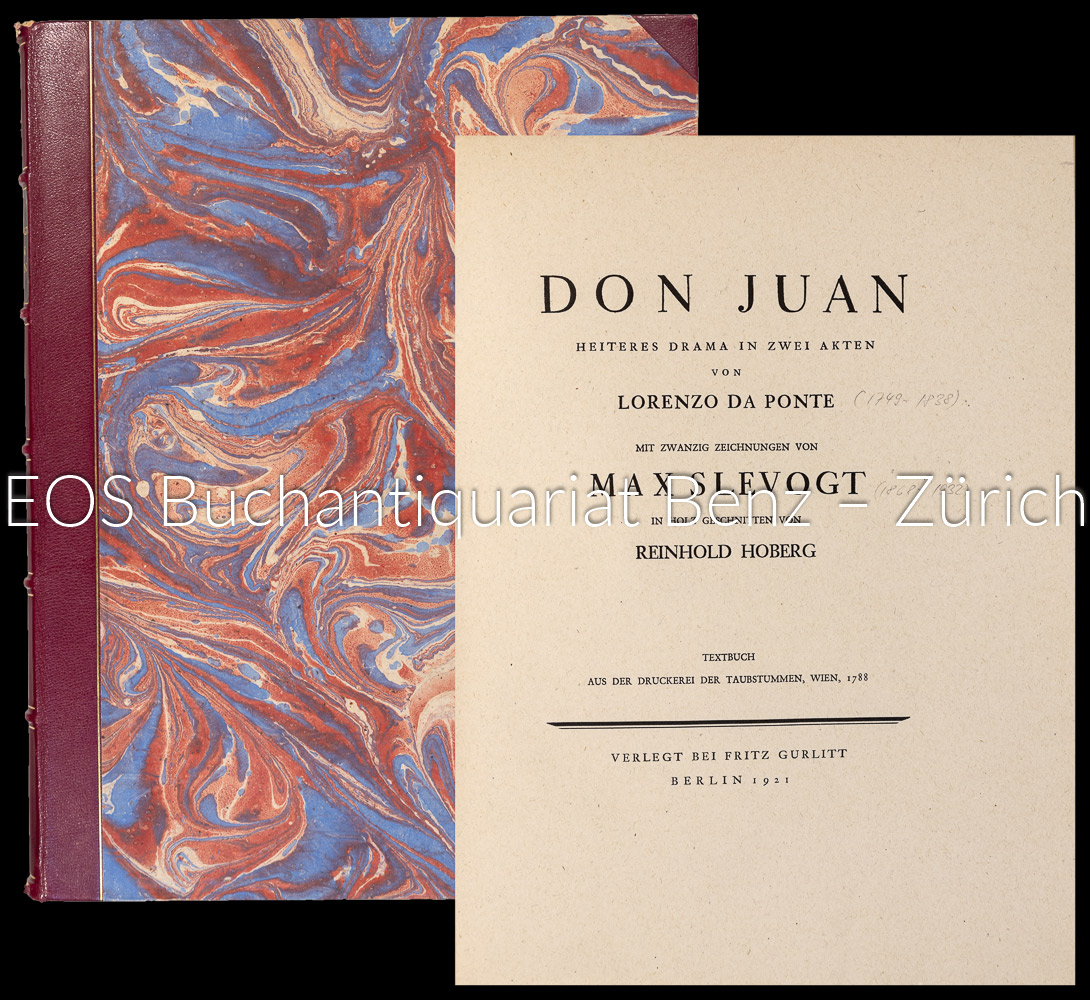
1921ref. 30ABBerlin, F. Gurlitt, 1921. Gr.-4°. 130, (3) S. Mit 20 Holzschnitten von Reinhold Hoberg nach Zeichnungen von Max Slevogt (davon 16 ganzseitige). Orig.-Halblederband mit Rückenvergoldung und Rückenschild.
ref. 11165[Lyon], Aimé Delaroche / De Laroche, aux dépens de l'Académie, 1739 à 1741. In-4 de [2]-52-[2]; VIII-12 (l'odorat)-16 (l'ouïe)-16 (la vue); [2]-16 (le goût)-14 (le toucher); [2]-55; VI-51; 59; 48; 75 pages, plein veau moucheté, dos à 5 nerfs orné du lion des armoiries de Lyon, de fleurons, d'étoiles de roulettes et du titre (Recueil d'opéra / Ballet) dorés, roulette dorée sur les coupes, tranches et gardes marbrées. Reliure frottée, coiffe supérieure manque, accroc à la coiffe inférieure, large épidermure au second plat. Tables de matières inscrite à la plume en début de volume.
1751Tomi tre in-4° cm. 37, pp. LXXVIII-442-LXXXVIII-460-CLXXXIV-350-36 più 38 nn. Legature in tutta pergamena coeva con tasselli ai dorsi. Esemplari in eccellente stato di conservazione con rare fioriture del tempo.
1817ref. AQ35026London: s.n. 1817. Single leaf broadside. Browning and staining to edges with very small loss to lower right corner small hole and tear to title slightly obscuring final letters. A scarce playbill recording an early effort by London's Lyceum Theatre renamed The English Opera House in the summer of 1817 to present an illumination of the 'audience part of the theatre' during a performance of 'Free and Easy' a comic opera. Although the use of gaslight in street-lamps had first been demonstrated a decade prior in 1807 the goal to introduce gaslighting to the commercial stage took years to evolve into the competitive landscape of 1817 where three of London's premier West End venues the Theatre Royal Covent Garden Theatre Royal Drury Lane and the Lyceum Theatre entered into a rapid race to produce the first fully-gaslit public performances in a West End venue. The Royalty an East End theatre later renamed The East London Theatre had previously installed gas piping and lighting fixtures across both the auditorium and the stage in 1816 demonstrating the viability of such a project. The English Opera House led by director Samuel Arnold proudly boasted on August 6 1817 that 'Gas Lighting will this evening be introduced over the whole stage' seemingly claiming themselves the winners of the century's most contested technical theatre contest. Despite this the lack of an illuminated auditorium meant that the theatre's audience remained in candlelight until a month later when the venue opened fully illuminated for the first time. The Theatre Royal Drury Lane despite only revealing its gaslit stage on the 6th September 1817 was able to argue that due to their introduction of gaslighting into the auditorium several weeks prior they were in fact the first of the three theatres to achieve the much vied- for feat. On the same night The Theatre Royal Covent Garden also offered a demonstration of gaslight on their stage finally concluding the rivalry and introducing a vital element of technical staging into London's leading venues for the remainder of the century. Rare; COPAC records no copies in the UK OCLC adds a single copy overseas Yale. . Dimensions 170 x 340 mm. [s.n.] unknown
ref. 2224712 March 1912 31 December 1912 and the other two without year; all on letterheads of 55 York Terrace Regent's Park N.W. Total of 7pp 12mo. All in good condition lightly aged and worn. Each folded once. All signed 'Percy Anderson'. ONE: 12 March 1912. Begins: 'Your properties are quite splendid.' He thanks Clarkson and his assistant for the trouble they have taken 'over the “M”'. Ends: 'I thought everything as good as it cd be – I refer to yr work of course'. TWO: 31 December 1912. He thanks him for his 'delightful' card and for 'yr. good wishes & for the tickets you so kindly send me for The Miracle. It was most thoughtful of you.' He ends in the hope that 1913 will be a crowning success you for sic & that you will have a very happy time'. THREE: 19 January no year. He is seeing 'Mr. Simmons' at 11 am the following day and will 'look in' on Clarkson afterwards. He thanks him 'for all the good work' on 'The Country Girl' adding: 'I want you to put all yr “guts” please into the “Ulysses” wigs'. FOUR: 10 September no year. 'It is too kind of you to send me those lovely figs. There's nothing I like better & I am most grateful.' FOUR: 31 December 1912. The recipient William Clarkson was the owner of Clarkson's Wigs Wellington Street London. James Morton in his 'Gangland Soho' 2012 alleges that Clarkson who has a blue plaque to his name at 41-43 Wardour Street was not only a repeated insurance fraudster but a notorious homosexual blackmailer after whom the public lavatory in Dansey Place was named 'Clarkson's Cottage'. RE Anderson & G & S: "The artist and costume designer Percy Anderson 1851-1928 was based in London where he exhibited watercolours at the New Water Colour Society in 1886. He designed costumes for the original productions of the last four Gilbert and Sullivan operas at the Savoy Theatre - The Yeomen of the Guard 1888 The Gondoliers 1889 Utopia Limited 1893 and The Grand Duke 1896 and for several D’Oyly Carte revivals including that for Utopia Limited considered by Rupert D’Oyly Carte in 1926 and but never realised. Given Gilbert’s exacting attitude to his productions it is an accolade to Anderson that he worked with Gilbert on so many including Gilbert and Edward German’s Fallen Fairies 1909 when Gilbert said Anderson: ‘surpassed himself’". 12 March 1912, 31 December [1912], and the other two without year; all on letterheads of 55 York Terrace, Regent's Park, N.W. unknown
1794ref. 215352London: Debrett; Longman; Debrett; Debrett 1794. All but the last title first editions. 80; 6 42; 4 61 3; 4 32 pp. 1 vols. 8vo. Three quarters blue polished calf gilt spine t.e.g. Upper cover detached. All but the last title first editions. 80; 6 42; 4 61 3; 4 32 pp. 1 vols. 8vo. Debrett; Longman; Debrett; Debrett unknown
1794ref. 215352London: Debrett; Longman; Debrett; Debrett 1794. All but the last title first editions. 80; 6 42; 4 61 3; 4 32 pp. 1 vols. 8vo. Three quarters blue polished calf gilt spine t.e.g. Upper cover detached. All but the last title first editions. 80; 6 42; 4 61 3; 4 32 pp. 1 vols. 8vo. Debrett; Longman; Debrett; Debrett unknown books
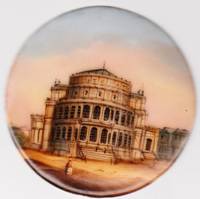
1845ref. 12060Dresden : Not published. ca 1845. Unique. Contemporary ebony frame. Very good. 68 mm diameter An early painted rendering on a bisque porcelain disk of what has come to be known as the Semperoper Dresden. The building was designed by Gottfried Semper arguably the most important German architect of the Victorian era and opened in 1841. This was his first major building - a neo Renaissance theater with subdued ornamentation and an exterior that clearly expressed its internal spaces - and the introduction of Semper's revolutionary ideas that were ' . to change the course of theater design.' The Bayreuth Festspielhaus was the last expression of these design concepts. Semper was the original architect but was dismissed by Wagner before the project was complete. The Semperoper of Dresden burned to the ground in 1861.Contemporary renderings of the building are all that remain. The disk bears a contemporary identification on the back: 'Koenig Theater / zu Dresden'. It is mounted in a contemporary wooden ebony frame and held in place with a stamped gilt bezel. The verso of the frame is marked with a letter M and the number 30 impressed in the wood. As if to emphasize the revolutionary aspects of Semper's design the painter illustrated the theater building from the stage side a unique perspective when judged by the few contemmporary illustrations of the building. Given that the Meissen works were within 25 km of Dresden one assumes the bisque porcelain disk is Meissen but it bears none of the usual marks of the great manufactory. See Mullin The Development of the Playhouse. Not published. unknown books
1991Exhibition catalog in white oversize wraps with as-issued protective jacket. Text on cover in English and Japanese, red & black print. Covers have sharp corners, no edge wear, are nearly pristine. Page block and binding are solid and straight. Text/interior is clean and free of marking of any kind. 136 pages in dual language with many b&w and color photos, large section of plates with many full and half page illustrations. Contents include: The spriti of experimentation -- an anthology by Shuzo Takiguchi: Art and experimentation, The spirit of Experimentation, People creating new art -- experimental workshop, On joie de vivre, Musical performance and the plastic arts, Ballet and the plastic arts, Words for some friends, Closed and open classics; Experimental workshop and the deterritorialization of art by Katsuhiro Yamaguchi; Innovation and expansion of music in experimental workshop by Kuniharu Akiyama; Plates by Kiyoji Otsuji, Shozo Kitadai, Tetsuro Komai, Hideko Fukushima, Katsuhiro Yamaguchi, Keijiro Sato, Hiroyoshi Suzuki, Toru Takemitsu, Kazuo Fukushima, Joji Yuasa, Kuniharu Akiyama; Comments and biographies; Experimental workshop: chronological history (1948 -- 1958, year by year) & Postcript by Kazuhiko satani
ref. SONG0061011576Used: Good unknown
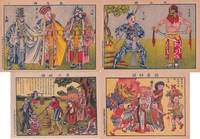
ref. 219368Tianjin.: 毓順成 芳記. Yushuncheng fangji. Early 20th Century. Four handbills showing popular images two 13.2 x 18.4 are images of characters from Peking Opera and two 12.2 x 16.5cm depict themes important in Chinese society at the time. Text in traditional Chinese characters. Light even browning tiny closed tears at margin of one sheet repaired with washi. Very good. Chinese opera characters in the style of traditional woodblock prints were popular in the late Qing dynasty and early Republican period. Handbills of characters from Beijing opera were sold as collectible items that also helped to familiarise people with the characters of different operas; their costumes make up weapons and names. In this case there are two characters from the opera 白水灘 on one handbill and three characters from the opera 落馬湖 on the other. Images with social themes also made popular handbills especially in places such as Tianjin where the influence of foreigners was pronounced. In 福壽財源 we see an immortal carrying a peach of longevity surrounded by images of fertility - a young woman and boys carry fruit and flowers as well as other items symbolic of wealth - a coin a vase gold ingots and so on probably issued for New Year. The final handbill of the four 娶大媳婦 tells the tale of a girl of eighteen married to a boy of seven. The Chinese custom of marrying a young boy to an older girl adopted into the family is thus open for discussion - everyone in the image clearly has a different opinion of the situation; from the young husband the older farmer in the background and the two men in long scholars robes to the modern young man in a western suit with leather shoes as well as the girl herself. The practice of adopting a girl to bring up as a future wife for a male child was made illegal in 1949. The text mentions some of the ways in which the girl would be expected to help in her adoptive family's home. . 毓順成 芳記. [Yushuncheng fangji] hardcover
2 tomes reliés en un volume in-8, plein veau moucheté de l'époque, dos lisse orné de cloisons fleuronnées, pièce de titre de maroquin rouge, coupes et coiffes filetées, tranches rouges, xxxij, 206 p., frontispice et une planche de musique et (4), 227 p, 3 planches gravées hors-texte. Nouvelle édition, considérablement augmentée, de cette importante relation de voyage consacrée à la Corse, à l'Italie et à la Tunisie, composée en français. La première édition (1774) est une brochure de 142 pages. L'auteur, le comte Maximilian Joseph von Lamberg (1729-1792) avait été chambellan de Frédéric le Grand. Homme des Lumières, doté d'une culture encyclopédique, philosophique comme scientifique il était en relation avec les grands esprits européens de son temps, David Hume, d'Alembert, Voltaire, Haller, Casanova, Algarotti… En 1769, il quitta son poste pour effectuer un vaste périple de trois ans en Corse, en Italie et à Tunis, qu'il relate dans cet ouvrage. Une importante partie du premier volume est consacré à la Corse: "Récit de voyage peu de temps après l'annexion de l'île. Il raconte son voyage en bateau de Livourne à Bastia puis son séjour chez le comte de Marbeuf. Il fait un rappel de l'annexion et s'attarde sur le personnage de Pascal Paoli et son frère Clément. Il établit un tableau de la Corse et de ses habitants en 1774, évoque les richesses de l'île et les traits de caractère de sa population : la sobriété, le goût de la vengeance, les superstitions..." (Universita di Corsica, CNRS en ligne). Le second volume contient des mémoires sur des sujets scientifiques et économiques, mais aussi d'ésotérisme, ainsi qu'une correspondance. (Starace, 'Bibliografia della Corsica', 4328). Traces de restaurations à la reliure. Petit accroc de papier à la dernière page. Très bon exemplaire, très frais, relié à époque, grand de marges.
ref. 341442 ouvrages reliés en un volume in-8, demi-basane vert bronze, dos lisse orné de filets et palettes dorés (rel. ca 1850).
1826In-8°; pp. 60, legatura alle armi dei Savoia Carignano, dorso usurato. Con l’elenco degli attori cantanti, dei ballerini, delle maestranze, e i balli in fine. Alle pp. 53-60: La rivalità funesta ballo tragico in tre atti di G.B. Giannini
1761ref. 003049À Londres, Chez Jean Nourse, l'An de la Vérité, 1761
1921ref. 30ABBerlin, F. Gurlitt, 1921. Gr.-4°. 130, (3) S. Mit 20 Holzschnitten von Reinhold Hoberg nach Zeichnungen von Max Slevogt (davon 16 ganzseitige). Orig.-Halblederband mit Rückenvergoldung und Rückenschild. + Wichtig: Für unsere Kunden in der EU erfolgt der Versand alle 14 Tage verzollt ab Deutschland / Postbank-Konto in Deutschland vorhanden +, A|B
1926ref. 197201926 1 Aquarelle signée et datée en bas à droite, 1926, 38,5 x 28,5 cm.
1926ref. 205241926 1 Encre de Chine signée en bas à droite, (1926), 32,5 x 23,5 cm.