436 190 résultats
2012réf. L3 box257 a1osMasterpieces of Early Chinese Painting and Calligraphy in American Collections From Chinese Five Dynasties 907-960; Song Dynasty 960-1279; Yuan Dynasty 1271-1368. Sponsored by The Metropolitan Museum of Art Museum of Fine Arts Boston The Cleveland Museum of Art The Nelson-Atkins Museum of Art Shanghai Museum. Edited by Shanghai Museum Editors-in-Chief: Chen Xiejun Chen Kelun. Published by Shanghai Fine Arts Publishing House 2012. Burgundy red buckram cloth hardcover 600 pages. This book is oversize and heavy: 17" x 12.5" x 3". This book includes: Five Forewords and Dedication by the five Museum Directors in Chinese and English; Six introductory articles in Chinese and English; Sixty pieces of painting and calligraphy collections: 52 painting 8 calligraphy with brief introduction in Chinese and English detailed introduction in Chinese. Shanghai Fine Arts Publishing House. hardcover
2021réf. 2081502111902865Tianjin People's Art Publishing House 2021. Soft Cover. Fine. The book is in fine condition. Tianjin People's Art Publishing House paperback
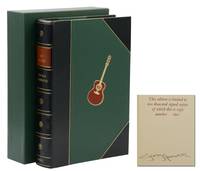
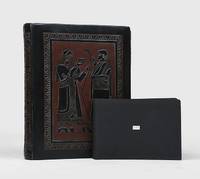
réf. 140942517Guildford Surrey: Genesis Publications Limited 1980. Signed Limited First Edition. Near Fine. Signed limited first edition. Copy number 1321 of a limited 2000 signed by George Harrison; from the collection of best-selling poet Rod McKuen with his personal emboss on two preliminary pages. In publisher's original half black leather over black cloth all edges gilt in original black cloth slipcase with paper title label to front panel. Near Fine with light wear in a Near Fine slipcase. A lovely production signed by the late Beatle. Genesis Publications Limited unknown
réf. 140942517Guildford Surrey: Genesis Publications Limited 1980. Signed Limited First Edition. Near Fine. Signed limited first edition. Copy number 1321 of a limited 2000 signed by George Harrison; from the collection of best-selling poet Rod McKuen with his personal emboss on two preliminary pages. In publisher's original half black leather over black cloth all edges gilt in original black cloth slipcase with paper title label to front panel. Near Fine with light wear in a Near Fine slipcase. A lovely production signed by the late Beatle. Genesis Publications Limited unknown books
1962réf. 148398Chicago: University of Chicago Press 1962. First edition of Friedman's magnum opus. Octavo original blue cloth. Near fine in a near fine dust jacket with light wear with a laid in signature of Milton Friedman. Housed in a custom half morocco clamshell box made by the Harcourt Bindery. An exceptional example. "Friedman a laissez-faire economist and professor at the University of Chicago is considered one of the leading modern exponents of liberalism in the 19th-century European sense. In Capitalism and Freedom he argued for a negative income tax or guaranteed income to supersede centralized bureaucratized social welfare services which in his view are inimical to the traditional values of individualism and useful work" Britannica. Selected by the Times Literary Supplement as one of the "hundred most influential books since the war". It also placed tenth on the list of the 100 best non-fiction books of the twentieth century compiled by National Review and on Time Magazine's top 100 non-fiction books written in English since 1923. University of Chicago Press hardcover
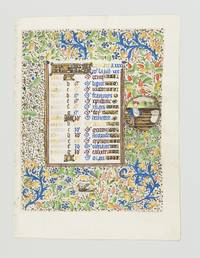
1460réf. ST12835Paris ca. 1460. 195 x 143 mm. 7 3/4 x 5 1/2". Single column 16 lines in a gothic book hand. Minor feast days in red and blue major feasts in gold numerous gold and painted line fillers the five "A" initials and the "KL" highly decorative and painted pink and blue against a gold background gold and pink bar surrounding the text on three sides BOTH SIDES OF THE LEAF WITH EXTRAVAGANTLY DECORATIVE BOTANICAL FULL BORDERS with two small birds hidden within and INCORPORATING TWO MEDALLION MINIATURES DEPICTING THE LABOR OF THE MONTH SOWING AND THE SIGN OF THE ZODIAC SCORPIO FOR OCTOBER. ◆IN VERY FINE FRESH CONDITION with gold and paint extraordinarily bright. The extraordinarily lavish and animated full borders coupled here with extensive use of brushed and burnished gold--for major feast days for decorative border elements and even for the hundreds of seeds being sown!--suggests that this calendar folio comes from a Book of Hours that was commissioned for a person or persons of high rank since it would have been very costly. The leaf comes from a manuscript that included numerous roundels depicting the lives of St. Catherine and the more obscure St. Alexius and it is possible that the Book of Hours belonged to a husband and wife for whom these saints served as patrons. The style of the delicately painted figures especially in the roundels indicates an artist who was familiar with the early output of the Coëtivy Master who according to Avril and Renaud can be identified with Colin d'Amiens who made a great name for himself in Paris not as was previously thought with Henri de Vulcop who made a great name for himself in the Loire region. The master takes his name from the Book of Hours now in the Austrian national library that he painted for Olivier de Coëtivy and his wife Marie de Valois one of some 30 works that have been identified as his. Although there is considerable Flemish influence that can be seen in his work he has links for example with Simon Marmion Colin d'Amiens was active in Paris during the third quarter of the 15th century and with Barthélmy van Eyck and Jean Fouquet was among the three great artists of this period patronized by the French court--Avril and Renaud says flatly that our master was "the most important artist practising in Paris in the third quarter of the century from about 1450 to 1485." For more on the Coëtivy Master see Avril and Reynaud pp. 58-69. unknown
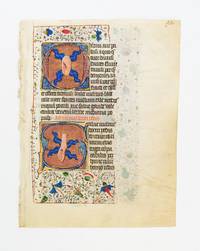
1465réf. ST17243bBruges ca. 1465. 193 x 145 mm. 7 5/8 x 5 3/4". Single column 21 lines in a gothic book hand. Rubrics in red one two-line initial in gold filled with blue on pink ground WITH THREE LARGE HISTORIATED INITIALS: ONE FEATURING AN OVAL-SHAPED PIECE OF FLESH WITH A GASH IN THE CENTER AND TWO WITH CHRIST'S DISEMBODIED FOOT SHOWING THE PUNCTURE WOUND FROM THE CRUCIFIXION each initial in pink or blue with white tracery filled with dark pink and thin gilt lines and dots four wavy blue rays radiating from behind each appendage all within a thin gilt frame both sides with a three-quarter border consisting of hairline vines gold bezants and a few colorful flowers. ◆Vellum a shade less than bright faint marginal rumpling trivial paint transfer on one initial BUT IN FINE CONDITION the initials richly painted and extremely well preserved. From a manuscript probably produced in Bruges for the English market this leaf contains arresting initials that direct the viewer's attention to the wounds endured by Christ during the Passion. According to Roger Wieck Passion Cycle images enjoyed a particular vogue in 15th century Dutch Flemish and English Books of Hours including those that were exported to England. In the present example the strikingly unusual imagery includes the wounds of the left and right foot as well as the spear injury to Christ's side depicted as an oval piece of flesh with a laceration across the center. A sister leaf to the present item features three additional initials showing a portrait of Christ wearing the Crown of Thorns his gaze fixed directly at the viewer and in separate initials his left and right hands appear disembodied and displaying the stigmata. The parent manuscript containing the present leaf sold at Christie's on 15 November 2006 lot 16 the description for which gives us additional information about the book's contents and provenance: it was made for the Use of Sarum included a calendar with the English saint Thomas Becket and Popes Gregory and Silvester with their names crossed out indicating that it was in England through at least the time of the Reformation and contained an early ownership inscription of a woman named Bridget Lowe with a Middle English inscription on the pastedown. Christie's also attributed the parent manuscript to the workshop of William Vrelant with miniatures possibly by his chief assistant the Master of the "Vraie Cronique Descoce." They note that this work is "of higher quality than many of the works that satisfied the English demand for Netherlandish illumination" and that it "demonstrates why Vrelant appealed to the great bibliophiles of the Burgundian Netherlands." Vrelant was the leading purveyor of books of private devotion in Bruges during the third quarter of the 15th century and his prominent position among Flemish illuminators of the time is indicated by the considerable number of manuscripts illustrated in his manner by other miniaturists both in Bruges and in nearby cities in Flanders. Similar examples to the present leaf can be found in intact Books of Hours at the Philadelphia Free Library MS Widener 3 and the Huntington HM 1086--both of which were produced in Flanders or the Netherlands around the same time as the present work. The present leaf surpasses both of these examples in terms of excellence of the artistic hand and attention to detail. unknown
1460réf. ST12835Paris ca. 1460. 195 x 143 mm. 7 3/4 x 5 1/2". Single column 16 lines in a gothic book hand. Minor feast days in red and blue major feasts in gold numerous gold and painted line fillers the five "A" initials and the "KL" highly decorative and painted pink and blue against a gold background gold and pink bar surrounding the text on three sides BOTH SIDES OF THE LEAF WITH EXTRAVAGANTLY DECORATIVE BOTANICAL FULL BORDERS with two small birds hidden within and INCORPORATING TWO MEDALLION MINIATURES DEPICTING THE LABOR OF THE MONTH SOWING AND THE SIGN OF THE ZODIAC SCORPIO FOR OCTOBER. ◆IN VERY FINE FRESH CONDITION with gold and paint extraordinarily bright. The extraordinarily lavish and animated full borders coupled here with extensive use of brushed and burnished gold--for major feast days for decorative border elements and even for the hundreds of seeds being sown!--suggests that this calendar folio comes from a Book of Hours that was commissioned for a person or persons of high rank since it would have been very costly. The leaf comes from a manuscript that included numerous roundels depicting the lives of St. Catherine and the more obscure St. Alexius and it is possible that the Book of Hours belonged to a husband and wife for whom these saints served as patrons. The style of the delicately painted figures especially in the roundels indicates an artist who was familiar with the early output of the Coëtivy Master who according to Avril and Renaud can be identified with Colin d'Amiens who made a great name for himself in Paris not as was previously thought with Henri de Vulcop who made a great name for himself in the Loire region. The master takes his name from the Book of Hours now in the Austrian national library that he painted for Olivier de Coëtivy and his wife Marie de Valois one of some 30 works that have been identified as his. Although there is considerable Flemish influence that can be seen in his work he has links for example with Simon Marmion Colin d'Amiens was active in Paris during the third quarter of the 15th century and with Barthélmy van Eyck and Jean Fouquet was among the three great artists of this period patronized by the French court--Avril and Renaud says flatly that our master was "the most important artist practising in Paris in the third quarter of the century from about 1450 to 1485." For more on the Coëtivy Master see Avril and Reynaud pp. 58-69. unknown books
1465réf. ST17243bBruges ca. 1465. 193 x 145 mm. 7 5/8 x 5 3/4". Single column 21 lines in a gothic book hand. Rubrics in red one two-line initial in gold filled with blue on pink ground WITH THREE LARGE HISTORIATED INITIALS: ONE FEATURING AN OVAL-SHAPED PIECE OF FLESH WITH A GASH IN THE CENTER AND TWO WITH CHRIST'S DISEMBODIED FOOT SHOWING THE PUNCTURE WOUND FROM THE CRUCIFIXION each initial in pink or blue with white tracery filled with dark pink and thin gilt lines and dots four wavy blue rays radiating from behind each appendage all within a thin gilt frame both sides with a three-quarter border consisting of hairline vines gold bezants and a few colorful flowers. ◆Vellum a shade less than bright faint marginal rumpling trivial paint transfer on one initial BUT IN FINE CONDITION the initials richly painted and extremely well preserved. From a manuscript probably produced in Bruges for the English market this leaf contains arresting initials that direct the viewer's attention to the wounds endured by Christ during the Passion. According to Roger Wieck Passion Cycle images enjoyed a particular vogue in 15th century Dutch Flemish and English Books of Hours including those that were exported to England. In the present example the strikingly unusual imagery includes the wounds of the left and right foot as well as the spear injury to Christ's side depicted as an oval piece of flesh with a laceration across the center. A sister leaf to the present item features three additional initials showing a portrait of Christ wearing the Crown of Thorns his gaze fixed directly at the viewer and in separate initials his left and right hands appear disembodied and displaying the stigmata. The parent manuscript containing the present leaf sold at Christie's on 15 November 2006 lot 16 the description for which gives us additional information about the book's contents and provenance: it was made for the Use of Sarum included a calendar with the English saint Thomas Becket and Popes Gregory and Silvester with their names crossed out indicating that it was in England through at least the time of the Reformation and contained an early ownership inscription of a woman named Bridget Lowe with a Middle English inscription on the pastedown. Christie's also attributed the parent manuscript to the workshop of William Vrelant with miniatures possibly by his chief assistant the Master of the "Vraie Cronique Descoce." They note that this work is "of higher quality than many of the works that satisfied the English demand for Netherlandish illumination" and that it "demonstrates why Vrelant appealed to the great bibliophiles of the Burgundian Netherlands." Vrelant was the leading purveyor of books of private devotion in Bruges during the third quarter of the 15th century and his prominent position among Flemish illuminators of the time is indicated by the considerable number of manuscripts illustrated in his manner by other miniaturists both in Bruges and in nearby cities in Flanders. Similar examples to the present leaf can be found in intact Books of Hours at the Philadelphia Free Library MS Widener 3 and the Huntington HM 1086--both of which were produced in Flanders or the Netherlands around the same time as the present work. The present leaf surpasses both of these examples in terms of excellence of the artistic hand and attention to detail. unknown books
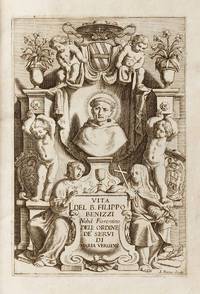
réf. 54778Bologna: Giacomo Monti 1668. Small quarto 23 × 17 cm. Contemporary elaborately decorated and richly gilt morocco binding with the armorial supralibros of Pope Clement X. on the front and back covers from the orbit of the Andreoli/Rospigliosi bindery with gilt edges; 16 148 pp. with engraved title page 14 copper-engraved plates by Lorenzo Tinti and numerous initials. Inner lid with ex-libris from the notable collection of the London bookseller W. A. Foyle Beeleigh Abbey; binding showing traces of former ties; joints headcaps edges and corners lightly rubbed the joints slightly more so; spine with a few minute almost imperceptible restorations and a few tiny wormholes; slightly toned and faintly fox-stained in places along the edges; else very good. First edition with the copperplate engravings by Lorenzo Tinti and the second edition of the text first published in Florence in 1626 under the equally fictitious authorship of Pandolfo Ricasoli Baroni see Melzi and Moreni. This Vita replaced Arcangelo Giani's "Della historia del b. Filippo Benizii nobile fiorentino" published in 1604 as the authoritative hagiography updating Giani's account in light of the Processi informativi completed in 1621 in preparation for the canonization proceedings. During this process the commissions in Florence Philip's birthplace and Todi the place of his death interviewed more than fifty witnesses and inspected the principal sites of veneration see the Preface and Sabine Hoffmann Ein heiliger und sieben Gründer . Munich 2013 p. 47. The occasion for this second edition of the Vita enriched with copperplate engravings was the renewed - and this time successful - effort undertaken in Rome by the Florentines and the Servite Order to secure the canonization of their fifth Prior General. To him they owed the survival of the Order after the Second Council of Lyon 1274 when the smaller mendicant orders faced compulsory suppression. The Servite Order subsequently received papal confirmation in 1304 and Benizi has therefore often been regarded as its founder. For four centuries the friars of the Ordo Servorum Mariae and the Florentines sought the canonization of their patron who during the conclave at Viterbo 1268-1271 was proposed for election as pope and is therefore said to have hidden in a grotto on Monte Amiata near Siena. The first major success in this long campaign came under Pope Leo X the first pope of the Florentine Medici family who in 1516 authorized the celebration of the Feast of Philip with its own Mass and Proper Office. By this time the veneration of Philip had reached its height in Florence. For this and the following see Hoffmann 2013 pp. 15-48. In the Servites' mother church Basilica della Santissima Annunziata a church central to the Florentines that housed one of the city's most important sanctuaries the miraculous image of the Annunciation Cosimo Rosselli as is well known the painter who alongside Ghirlandaio Perugino Botticelli and Signorelli executed three of the frescos in the Sistine Chapel began around 1475 a fresco cycle on the life of the city's venerated son. The cycle was continued in 1509-1510 with five frescos by Andrea del Sarto. Together with his pupils Pontormo and Rosso Fiorentino he subsequently worked also in the forecourt of the basilica the "Chiostrino dei Voti" on a second cycle whose subject was the life of the Virgin Mary. With these two cycles the pictorial biographies of the two figures of greatest importance to the order were placed before the basilica. When Vasari later wrote at length about the frescos he referred to Filippo Benizi more than a century before his canonization quite matter-of-factly as a saint "san Filippo" even though his descriptions of the paintings or more precisely his iconographic reading of the frescos suggest that he was not entirely familiar with the associated legends G. Vasari Le vite de' piu eccellenti pittori scultori e architettori Volume 1 of Part 3. Florence 1568 p. 152. Andrea del Sarto's cycle was also significant for the canonization process. At the beginning of the seventeenth century the cycle was studied by the canonization commission since it constituted an outstanding testimony to Philip's veneration. In more recent scholarship the depositions from the canonization proceedings conducted between 1619 and 1621 have been used as a source for examining the effect of the cycle on its viewers. The account of the cults in the third part of the Vita likewise makes it possible to understand the liturgical and social interconnections within which the frescoes were received at the time. On this see Alana O'Brien San Filippo Benizi 'Honour of the Servi and Florence': His Cycle and Cult at SS. Annunziata 1460-1621 Ph.D. diss. La Trobe University 2 vols. 2001. Even before Leo X approved the invocation and liturgy of Benizi the veneration of relics had already attained such significance that del Sarto depicted it in one of his frescos. On several occasions the Florentines attempted in vain to obtain the bones preserved in Todi. The Vita however lists a series of minor primary relics in Florence including a thumb and fragments of the forearm and elbow. Del Sarto by contrast depicts the veneration of the Florentine "cushion-shaped reliquary capsule" described in the Vita in which a garment of the Servite was preserved. The condition of the relic is described in detail. Furthermore additional relics in other Italian cities are listed. The accounts extensively report on the veneration as well as the miracles attributed to the relics. Thus a garment of the Servite friar preserved in Todi is said to have repeatedly brought about instantaneous healings. In this way a famous legend likewise depicted by Andrea del Sarto and here also by Lorenzo Tinti appears as it were to have been perpetuated: Philip who had once studied medicine and philosophy in Paris and Padua is said to have spontaneously healed a freezing leper by giving the beggar his garment for warmth: "No sooner was the poor man clothed than the foul-smelling scales of his disease fell to the ground his flesh was immediately cleansed and his limbs were restored as though he had never been leprous." p. 56ff. In its account of the miracle the Vita explicitly refers to del Sarto's depiction. Time and again the Vita returns to the frescoes including in its account of the "Punishment of the Blasphemers." According to the text the Florentine painter rendered the "harrowing event" "so terrifying" that "it can scarcely be viewed without dread." Both the painting and Lorenzo Tinti's engraving depict the very moment in which the blasphemers who had been warned by Philip while resting beneath an elm tree are struck dead by a bolt of lightning. p 66f. The veneration is said to have begun immediately after his death. Thus it is reported that the dying man's final words were answered by a voice audible to all proclaiming: "Faithful servant whom the Virgin has appointed to care for her household come and enter into the glory of your Lord!" Thereupon the friars are said to have set aside their grief and "contrary to the customary order begun to sing hymns and psalms." The conclusion of both the fresco cycle and the Vita is formed by the miracle that is said to have occurred during the lying in state of Philip's body: "When news of the death of the blessed Philip spread through the city of Todi people of every rank flocked to the Church of San Marco to pay their final respects to his body. Among them was the notary Paolo di Guido whose daughter Agnoletta had long suffered from a grave illness. Her hands had become completely twisted and paralyzed by the disease and her feet were so contracted that she could neither walk nor help herself. . No sooner had the girl been brought near the holy body than her condition began visibly to change. Her contracted limbs relaxed her hands opened once again her feet straightened and she fully regained her strength. Before the eyes of all those present she rose healed and unharmed." pp. 115ff. This account is followed by an extensive list spanning many pages of all the miracles said to have occurred after Philip's death. Yet despite the great efforts undertaken by the Florentines and the small mendicant order to secure his canonization the papal decision continued to be delayed even after the thorough investigation had been completed. The petitions of Grand Duke Ferdinando II de' Medici and Emperor Ferdinand III to Urban VIII and Innocent X remained unsuccessful. Only the insistence of Emperor Leopold I with Clement IX brought about the conditions under which Clement X finally canonized Philip on April 12 1671 together with Cajetan of Thiene co-founder of the Theatine Order Rose of Lima the first female saint of the Americas Louis Bertrand a Dominican missionary in Colombia and Francis Borgia who above all promoted the Jesuit mission in Central and South America. Philip was the only one among them who had died long before the sixteenth century. The present copy is distinguished above all by the binding made for Pope Clement X to be understood within the context of the centuries long campaign for the canonization of the Florentine saint. Although the Andreoli brothers were still active at this time the present lavishly decorated and highly accomplished binding is more plausibly attributable to the wider circle of the workshop known as the Rospigliosi Bindery. While the compartments framing both the octagonal armorial supralibros and the laurel wreath filled with flame motifs and terminating in volutes at the corners display clear affinities with documented bindings associated with the Rospigliosi workshop tradition including those made for Christina of Sweden and for Popes Clement IX and Clement X no correspondences could be established in a comparison of the finishing tools. Moreover the exclusive use of a single roll tool on the spine would be highly unusual. Guido Vianini Tolomei I rerri e le botteghe di legatori in: Legatura romana barocca Rome 1991 pp. 31-33; José Ruysschaert Les frères Andreoli relieurs des Chigi. Cité du Vatican 1992. Melzi Dizionario di opere anonime e pseudonime di scrittori italiani vol. III p. 231; Moreni Bibliografia storicoragionata della Toscana vol. I p. 446 cf. vol II p. 245f. As of June 2026 KVK OCLC show six copies in North America. unknown
1954réf. ZB3937511954-2001. volumes 1-48 lacks volumes 17 34 & 38 else all complete volumes partly bound library markings textually clean & tight price is for the set. - If you are reading this this item is actually physically in our stock and ready for shipment once ordered. We are not bookjackers. Buyer is responsible for any additional duties taxes or fees required by recipient's country. Photos available upon request. unknown
1717réf. 062622Oxford: John Baskett Printer to the King's most Excellent Majesty 1717. Leather Bound. Folio. Measures 52 x 34 x 14 cm. Bound in leather likely late 19th century. Binding split at rear joint. Some damage to text block especially prelims; a few loose pages some chips and tears foxing some pages darkened. Three rounds of restoration are evident the most recent carefully documented a fourth round required. Herbert 942A: "A magnificent edition printed in large type. With many plates at the beginning and end of books engraved on steel from the designs of various artists. Some of the initial letters are similarly engraved. Unfortunately the book contained many misprints and earned the nickname 'A Baskett-ful of Errors'. From the misprint The Parable of the Vinegar for vineyard in the headline above Luke xx this edition is commonly known as the 'Vinegar Bible'." "John Baskett 1665-1742 attained the title of "printer to the King's most excellent majesty" in 1709 but his publishing career turned for the worse when he issued this richly-engraved folio Bible in 1717. Quick to point out the Bible's numerous misprints Baskett's competitors branded it "a Baskett-ful of Errors." The edition's more lasting nickname has been the "Vinegar Bible" because the words "Parable of the Vinegar" appear at the top of the page containing Luke 20:9 Christ's Parable of the Vineyard." - smu.edu Special Collections. John Baskett, Printer to the King's most Excellent Majesty unknown
réf. 113069Ipswich Suffolk; Brisbane Queensland Nicholas Zurbrugg 1969-1982. . Periodical 10 issues in 7 issues 1-2/3 217 x 142 mm issue 4 229 x 152 mm. Original white wrappers printed in black wire-stitched issues 5-6 238 x 183 mm issue 7 245 x 184 mm issue 8/9/10 260 x 196 mm various paginations. Original illustrated white wrappers printed in black or black and red adhesive-bound; lightly rubbed light wear and handling covers of all issues except 2/3 and 8/9/10 toned. Issue 6 with a travel ticket mounted on upper side and a printed card laid in at Barry McCallion's contribution issue 7 numbered on inside rear cover triple issue 8/9/10 with a sleeved 7 in. vinyl single formerly taped now laid in at rear issue 5 with Bob Cobbing's name added in blue ink to his contribution. A very good set. A literary periodical with a focus on experimental and concrete poetry. Only seven physical magazines of Stereo Headphones were published over its thirteen active years. Contributors include: Samuel Beckett William Burroughs Henri Chopin Thomas A. Clark Tom Phillips Brion Gysin Kitasono Katué Bob Cobbing Ian Hamilton Finlay Ed Ruscha Joe Tilson Lawrence Weiner Robert Lax Raoul Hausmann and others. Burroughs' contribution: issue 8/9/10 'The Future of the Novel' Shoaf III.322; Schottlaender v.5 C548. Ipswich, Suffolk; Brisbane, Queensland, Nicholas Zurbrugg, 1969-1982. unknown
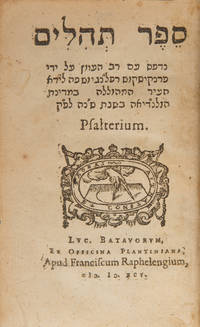
réf. 122179Leiden Plantin Press 1595. . 24mo 12.5 x 8 cm; later vellum binding some browning but otherwise clean pages; text in Hebrew 126 ll. Scarce early edition of the Book of Psalms vocalised and with cantillation. Every fifth verse indicated with a letter. Ginzei Yisrael 1850; Vinograd Leiden 15. Leiden, Plantin Press, 1595. hardcover
1897réf. 526A collection of 50 albumen prints from the British Museum Series numerous manuscript captions slight age-related toning photographs mounted to album occasional light marginal foxing not affecting image original maroon cloth with quarter morocco spine retaining studs title gilt to spine slightly rubbed folio London: W.A. Mansell c.1897 The 50 photographs of antiquities in the British Museum covering Greek Roman and Etruscan Statues and Vases including 24 of the Parthenon Frieze. Many of the images are accompanied by manuscript captions. Other photographs include: Horse of Selene Ilissos "Colossal Lion" The Piranesi Vase "Marble Vase found in the Villa of Hadrian at Tivoli" "Mercury" "Venus de Medici" "The "Townley" Venus" "Venus Entering Bath" "Apollo as a Player of the Lyre from Cyrene" "Hercules" Hercules found in Hadrian's villa at Tivoli Drum of Sculptured Column from Temple of Diana Artemision Ephesus "Casts from Balustrade of Temple of Wingless Victory - Athens -" Etruscan Sepulchral Monument in terracotta "Thalia" T. Aurelius Fulvius Antonius Pius Aurelius Antoni Satyr Apollo Demeter Ceres and Sepulchral Rites at the Tomb of a Hero. The Elgin Marbles are a collection of statues and architectural decoration acquired by the Earl of Elgin during his time as Ambassador to the Ottoman Empire. He successfully petitioned the authorities to be able to measure draw and remove figures in various ruins. The most extensive work was on the Parthenon or Temple of Athena but he also received permission to remove sculptural and architectural elements from a number of other ruins including the Acropolis and the Temple of Nike Athena. The most famous of the Elgin Marbles are the Parthenon Sculptures a collection of different types of marble architectural decoration on the Parthenon. The Parthenon Frieze 75 metres in length depicts various scenes including the battle between the Lapitas and the Centaurs at the marriage feast of Peirithoos. Elgin originally intended on using the Frieze as decoration in his private home but due to the collapse of his marriage he sold them to the British Museum. There have been debates over the legitimacy of Elgin's excavation. After an investigation from a Parliamentary Select Committee in 1816 Elgin's actions were found to be entirely legal. Since 1983 Greece has formally requested the British Museum to return all the Parthenon Sculptures in the Museum's collection the British Museum states there are no current discussions with the Greek Government on this issue. Roger Fenton is one of the most celebrated figures in the history of photography. He was a creative and highly influential photographer in the mediums "golden age" of the 1850s. In his role as the British Museum's first official photographer Fenton demonstrated his sure sense as a 'photo artist'. He was initially engaged to photograph cuneiform tablets but that soon developed into taking pictures of other antiquities. As early as 1852 Fenton received permission from the Trustees to photograph antiquities within the museum establishing a small studio inside the museum the following year. He left in 1854 to serve as a photographer in the Crimean War for which he is most widely known but he was re-appointed on his return in 1856 until the termination of his contract in July 1859. The Trustees decided that photography was not cost effective and after they failed to negotiate the South Kensington Museum now the V&A as an alternative Fenton terminated his association with the British Museum. References: The British Museum The Metropolitan Museum of Art Luminous-Lint. W.A. Mansell
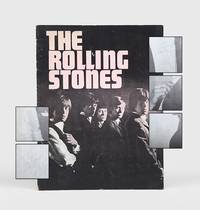
1964réf. 190422New York: Souvenir Publishing and Distributing Co. 1964. Signed by the Stones in 1964 First edition of this tour programme published to coincide with the Stones first North American Tour signed in blue ball-point pen on each of their full-page portraits by Mick Jagger Keith Richards listed as "Keith Richard" as he was originally known Brian Jones Charlie Watts and Bill Wyman. Quarto. Original photographic wrappers lettering to front and back covers in pink. Illustrated throughout with black and white photographs many full-page. Spine rubbed and covers lightly creased but overall a very good copy. unknown
1935réf. 169367Aden: 1935-36. A superb window onto Yemen in the 1930s Two albums depicting the experiences of British servicemen stationed in Yemen around the time of the Second Italo-Abyssinian War 1935-7 mixing the documentary and the personal. The images include very rare contemporary aerial photographs of towns including Aden Ta'izz and Shibam graphic pictures of war in Addis Ababa urban military and agricultural scenes and records of free time on the RAF base at Khormaksar. Nearly all carry explanatory manuscript captions. Aden was of crucial strategic importance to the British Empire having been brought under the control of the East India Company in 1839. After the opening of the Suez Canal in 1869 it became one of the world's busiest ports. The RAF maintained a base at Khormaksar now Aden International Airport which played host to numerous squadrons throughout the 1930s. Of these No. 8 Squadron was stationed at Khormaksar for the longest period of time maintaining a policing and day-bombing role. Photographs of military aircraft belonging to No. 8 Squadron can be seen in these albums alongside pictures of planes flown by Nos 203 41 and 55 Squadrons. The photographs give a vivid impression of the volume of air and maritime traffic - mostly British but also French and Dutch - which passed through Aden after Mussolini's invasion of Ethiopia. Aerial shots show Fairey MK IIIs and Vickers Vincent planes flying in formation as well as night and day bombers and flying boats. There are also detailed close-ups of ships including British aircraft carriers. It seems probable that the photographer who assembled these albums was involved in surveying: there are fine aerial shots of Aden and Crater the Sultan's palace at Lahij Shuqra Shibam Tarim Ibb al-Mukalla and Ta'izz giving an outstanding sense of how these towns looked in the early 20th century. The pictures of Ethiopia include one aerial photograph of Addis Ababa a number of ground shots of an execution the wounded and the dead and images of buildings on fire. There is only one photograph captioned as having been taken in Somaliland but this provides a further clue that the photographer was sent from Yemen to the Horn of Africa with the intention of documenting Italian military activities there. As a result of the Second Italo-Abyssinian War Ethiopia was incorporated into Italian East Africa consisting of Italian Somalia Ethiopia and Eritrea. Britain ruled British Somaliland and France controlled French Somaliland Djibouti. Many of the images may have been taken when the photographer was off duty. There are several almost touristic shots of everyday life in Crater showing children playing and Friday prayers images taken on the beach and in the salt pans around Aden pictures of Yemeni pastoralists with their cattle and photographs of Yemeni Indian and Somali women. A significant minority of the pictures show downtime at Khormaksar with a string of images depicting airmen in fancy dress playing football and drinking. There are even two photos of the squadron's dog in a cap and glasses and with a pipe in its mouth. 2 albums. Album I with 175 silver print photographs of various dimensions 100 x 65 mm - 240 x 180 mm mounted on card. Album II with 55 silver print photographs all c.100 x 150 mm or c.75 x 100 mm. Almost all photographs with period ink captions. Album I: quarto 290 x 230 mm. Original cloth covers spine and sides decorated with pictorial designs in relief marbled endpapers 36 card stock leaves. Album II: landscape octavo 130 x 187 mm. Contemporary black card wrappers "Aden" title sticker on front cover 22 card stock leaves. Album I: superficial rubbing to spine and rear cover short splits to inner hinges fore edges nicked. Album II: rear inner hinge split glue residue to gutters. Photographs all in very good condition. hardcover
réf. Brøndum, Hans JørgenIn Pristine Condition. unknown
réf. H789Rangoon Government Printing Burma 1900-1901. 4to. Mit zahlreichen Tabellen Falt- Karten Plänen fotogr. Abbildungen und teilw. handkolorierten Illustrationen auf Tafeln. Original-Leinenbände mit goldgepr. Rückentiteln. Im Original nahezu unauffindbares durch Register erschlossenes Monumentalwerk in einem guten Exemplar mit insgesamt geringen Gebrauchsspuren ein Set in gutem Zustand. unknown
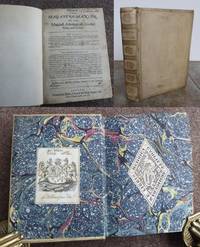
1652réf. 52876London printed for Joshua Kirton at the Kings Arms in St. Pauls Church-yard 1652. FIRST EDITION 1652. First word of title and part of running title in Greek characters. Small 4to approximately 180 x 125 mm 7 x 5 inches pages: 16 1-240 24 241-376 bound in full vellum gilt lettering and decoration to spine gilt decoration to edges of covers marbled endpapers all edges gilt 3 bookplates: Sir William Grace; Henry Cunliffe Armiger to first pastedown and first free endpaper; Fox Pointe Collection on last pastedown. Vellum slightly dusty and soiled pale age-browning and staining to title page title page slighty dusty with small ink letter and small repair on blank side to top margin trimmed copy affecting the lower margins of pages 369-374 with loss in lower margin of 4 catchwords and 2 signature numbers 16 ink pointing hands in margins plus a few ink marginalia small repair to 3 margins not affecting text occasional small ink stain or brown spot otherwise a very good copy. An attack on magical practices and beliefs with dedication to Oliver Cromwell. John Gaule 1603 1687 was an English Puritan cleric now remembered for his sceptical views on astrology witchcraft and hermetic philosophy. See: A Catalogue of Printed Books in the Wellcome Library Volume 3 page 96; William Lowndes & Henry Bohn Volume 2 page 869; Sotheby's Catalogue Tuesday 14th December 1993 The Fairfax Library and Archive No. 395; ESTC R3643. MORE IMAGES ATTACHED TO THIS LISTING ALL ZOOMABLE FURTHER IMAGES ON REQUEST. POSTAGE AT COST. London, printed for Joshua Kirton at the Kings Arms in St. Pauls Church-yard, 1652. hardcover
1979réf. 2110502151002264Masterpiece publisher 1979. Soft Cover. Fine. Number of books: 52 Masterpiece publisher paperback
1920réf. 59766Portland OR New York & Hollywood & Los Angeles CA: Earl Mossman Revue and Productions ACME Commercial Studio Allara Blixt Braun Bruno Allen J. De Lay Photo-Art Commercial Studio et al ca. 1920-1976. Three vols. Thick 4to. 179; 124; 117 leaves unnumbered. all archival mylar sleeves some 2-pocket for 5 x 7 in. material most for holding 8 x 10 in. images. With 425 photographs sized from 4 x 4 in. up to 8 x 10 in. over 90% are 8 x 10 in. most images w/ photographer’s imprints on versos many w/ pencil annotations editing notes camera-ready copy several are negative contact print sheets a few colour images many are signed some have minor tears or creasing a few show remnants of old scrapbook leaves together with several newspaper and magazine clippings printed promotions holiday leaflets. All preserved in three black cloth 3-ring clamshell binders an excellent archive. This unequaled archive of photographs chronicling the successful and colourful Vaudeville and entertainment career of Earl Mossman reveals wealth of musical and theatrical history from the Pacific Northwest during first album in this archive is largely devoted to Earl Mossman’s contributions and managing of his the first half of the 20th Century as well as impact on historic events. The chorus-line all-girl revue shows at the Frontier Village during the 100 day run of the Oregon Centennial Exposition. This re-created town from the 1870’s Old West featured the Golden Nugget dance hall & saloon as well as livery stable church post office and hotel and proved to be the most successful attraction. Mossman’s Can-Can girls put on daily shows and held dances where the daringly dressed women would dance with visitors and hired actors. The 1859-1959 Centennial Exposition lasted from June 10 to Sept. 17 on 65 acres along the Columbia River formerly Vanport wiped away in the tragic 1948 flood and also featured a Gayway Amusement Park Garden of Tomorrow & Adventureland. The photos depict not only Mossman’s Can-Can girl revue but also steam locomotives Modernist sculptures and murals by Louis Bunce and other Oregon artists as well as photos of the Mid-Century Modern Lumber Industry Pavilion and the striking Hall of Religious History in the Garden of Tomorrow which featured murals of Carl Morris. Also shown are neon sculptures the filled arena showing the opening ceremonies which featured actor Raymond Burr as master of ceremonies the Nelson Picket Dancers the Golden Nugget and Frontier Trading Post from the air and more. The second album includes as well more images from the Centennial as well as many from Earl Mossman’s “Productions” talent agency and entertainment group who supplied vaudeville dance and music acts such as Beverly Short Eleanor Malcolm Gary Marvin Ginger McClane Gwen Gibson Jerry Brown Freddie Keller’s Orchestra and Maury Meriweather’s Band to Portland OR and surrounding Pacific Northwest clubs and venues. Photos included here depict as well the Nelson Pickett Dancers The Glenns “originating new tricks in a dancing mood;” The Carsony Brothers; the Earl Mossman Girls featuring models from the Gloria LaVonne modeling agency; along with Walter Blacke Jacqueline Clark Earl Mossman’s Dolls for “Delta Dome” and more. Other notable names include Billy Daniels d. 1988 with photos of his ‘The Masculine Touch” recorded live at the Mocambo on the Sunset Strip well-known African-American singer form the mid-1930’s to 1986 who launched his career in the Harlem Renaissance; along with Jeanne Gayle who sang with Bob Crosby and starred in the Great Gildersleeve 1954 Jack Nagel and even Shirley of the Hoti PocaDot Bikini Contest.The many photos also depict Mossman meeting and greeting celebrities rolling into Portland running for mayor of Portland OR he never won: touting and promoting the “Straw hat day May 15” by not only wearing straw hats himself but inducing his all-girl revues to wear as well along with leading parades including the 1972 Merrykhana Parade where he was appointed “King of the Parade.” Many of the images show him with many different canes drawn from his large collection signing contracts for the American Legion seated in limousines and Porsches and even attending dinners. One photo includes dinner guests of Miracle Oxygen which featured the editor of The Oregonian Dick Nokes Paul Hauron stage feature writer the Todds and others. Of additional interest are the photos of Mossman showing off his scrapbook filled with images from his long career as well as images while convalescing with his bevy of beauties in the Shriner’s Hospital in Portland OR. Mossman 1894-1976 was an Oregon native and grandson of Isaac Mossman who had fought in the 1855-1856 Indian Wars rode with the Washington Territory’s Pony Express out of Walla Walla and was the first Washington Territorial librarian in 1870. Earl Mossman began running away from home as a young boy to perform in taverns and saloons in downtown Portland later worked for Pacific Power & Light Co. as an office boy and in 1913 after marrying his childhood sweetheart Catherine Groos launched his career on the Vaudeville Circuit. He initially played with the Basco Comedy Co. and later with Connie & Mack’s and the Bert Levy Circuit. Walter Winchell coined him as the “Beau Brummel of Broadway” during the 1920’s and by the 1930’s was performing with Norma Lawton in Broadway productions such as “The Dancing Producer” and performed with his partner Ray Vance at the Lotus Isle Amusement Park and the Peacock Ballroom. He would marry five different times performed at civic activities Rose Festivals and beauty pageants across the Pacific Northwest.Over half the photographs in this collection were shot by Allen J. De Lay photographer with The Oregonian from 1947 until the newspaper strike of 1960 who was not only an extraordinary photographer but also musician and competitive swimmer. He is perhaps best remembered for his photographs of the darker seamier side of Portland in the post-World War II era. Other Oregon photographers represented include Maxwell Allara Paul Blixt Kirk Braun Bill Gray Hodge Kennell-Ellis Verne Lewis Alfred Monner Dick Slater Don Thompson Donald Wilson and others. Of particular interest are noted theatrical photographers such as Bruno in Hollywood and James J. Kriegsmann 1909-1994 celebrity & theatrical photographer from 1929 to the 1980’s. We could find no similar archive of Mossman related photos in any institutional holdings except for a few images. See: Ellis Lucia Earl Mossman Oral History Recording pacific University Archives 1914-1918 Washington County Oral Histories; Walkathons - Dance Marathons Al Painter’s Lotus Isle Walkathon Organization PDX History 2022; David Kludas Centennial Exposition of 1959 Oregon Encyclopedia 2022. Earl Mossman Revue, and Productions, ACME Commercial Studio, Allara, Blixt, Braun, Bruno, Allen J. De Lay, Photo-Art Commercial hardcover
réf. 141846N.p.: N.p. 1970. Archive of 16 photographs seven double weight and ten single weight of rock performers circa the late 1960s and early 1970s. Struck by photographer Jim Marshall circa 1990s most with his stamp and manuscript identification number on the verso. Artists represented include Bob Dylan The Rolling Stones The Who Bob Dylan Joni Mitchell Sly and the Family Stone Santana Jim Morrison Tina Turner The Allman Brothers Band including standalone shots of Duane Allman and others. The Santana photos are especially notable as the band already a live sensation is performing at Woodstock just ahead of the release their first album. As a photographer for both record labels and magazines such as "Rolling Stone" Jim Marshall was one of the most prolific and influential chronicles of rock music during the 1960s and 1970s. Among his most iconic photographs are images of Jimi Hendrix setting his guitar on fire at Monterey Pop Johnny Cash performing at San Quentin and The Beatles backstage at their final live concert at Candlestick Park. In 2014 he was posthumously awarded a Lifetime Achievement Grammy the only photographer to be so honored. Photographs variously 5 x 7 inches and 8 x 10 inches. Fine overall. For details please inquire. N.p. unknown
réf. 141846N.p.: N.p. 1970. Archive of 16 photographs seven double weight and ten single weight of rock performers circa the late 1960s and early 1970s. Struck by photographer Jim Marshall circa 1990s most with his stamp and manuscript identification number on the verso. Artists represented include Bob Dylan The Rolling Stones The Who Bob Dylan Joni Mitchell Sly and the Family Stone Santana Jim Morrison Tina Turner The Allman Brothers Band including standalone shots of Duane Allman and others. The Santana photos are especially notable as the band already a live sensation is performing at Woodstock just ahead of the release their first album. As a photographer for both record labels and magazines such as "Rolling Stone" Jim Marshall was one of the most prolific and influential chronicles of rock music during the 1960s and 1970s. Among his most iconic photographs are images of Jimi Hendrix setting his guitar on fire at Monterey Pop Johnny Cash performing at San Quentin and The Beatles backstage at their final live concert at Candlestick Park. In 2014 he was posthumously awarded a Lifetime Achievement Grammy the only photographer to be so honored. Photographs variously 5 x 7 inches and 8 x 10 inches. Fine overall. For details please inquire. N.p. unknown books
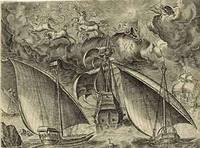
réf. 51-4349Netherlands: Late 16th-early 17th Century. Original engraving on old laid paper. 211 x 279 mm. Thread margins. Watermark of a bugle surmounted by a crown JPG Turner as 1616; not located in Briquet or Heawood Ref: The Prints of Peter Bruegel the Elder by René van Bastelaer and Susan Gilchrist San Francisco Alan Wofsy Fine Arts 1992;no. 106 state A before the text in the cartouche; De Ramaix and Lebeer 49; Lari 103. Netherlands: Late 16th-early 17th Century. unknown