TENCH, CAPTAIN WATKIN OF THE MARINESBiblio.com
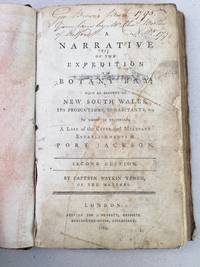
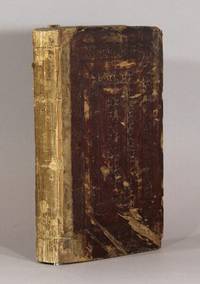
réf. 229659J. Debrett London 1789. 146 pp plus 2pp of Debretts advertisements at end - no half-title as often contemporary quarter-calf binding spine replaced- annotations on front paste-down and title- see below - overall a firm and comfortable copy of this foundation stone of Australian settlement - with contemporary patina and association. Title page inscription: Geo. Brown's Book 1795 Given him by Mr Chas. Booth of Retford Nott 1792 Front paste-down inscription: "Mr Chas. Booth inlisted for a Soldier on being refus'd his Fortune to purchase a Commission went over to Ireland and died as soon as he arrived He was a handsome youth about Twenty years Old - was the son of Mr Alister John Booth - Retford - The youngest of his numerous family. " A sad and poignant minor marker in the sequence of this tome's history. Second edition . J. Debrett, London, 1789 unknown
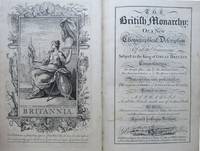
1748réf. 3799Frontispiece of Britannia enthroned engraved Title list of Subscribers Contents Title of 1743 and 190 engraved plates many illustrated with head & tail pieces: Folding map of the King's Dominions in Europe Africa and America follows plate 7; A folding Table of Several Particulars. as plate 163. Tastefully rebound in eighteenth century style full lozenge blind ruled calf; five raised bands; ruled green morocco label. A handsome supple copy.; All shipments through USPS insured Priority Mail. George Bickham hardcover
1748réf. 3799Frontispiece of Britannia enthroned engraved Title list of Subscribers Contents Title of 1743 and 190 engraved plates many illustrated with head & tail pieces: Folding map of the King's Dominions in Europe Africa and America follows plate 7; A folding Table of Several Particulars. as plate 163. Tastefully rebound in eighteenth century style full lozenge blind ruled calf; five raised bands; ruled green morocco label. A handsome supple copy.; All shipments through USPS insured Priority Mail. George Bickham hardcover books
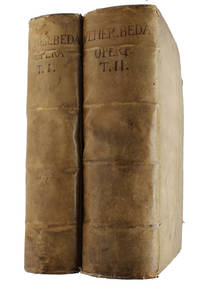
1612réf. 28124Coloniae Agrippinae (Köln), Sumptibus Anton. Hierati et Ioan. Gymnici, 1612. Folio. Bound in two contemporary, uniform full vellum bindings with remains of silk-ties on boards. Some traces of use to extremities. Some pages evenly browned, some brownspotted. First two volumes richly illustrated with woodcut diagrams, musical notes, earth- and heaven-maps etc. in the text, numerous woodcut initials throughout, engraved title-page. (10) pp, columns 1-168 (84 pp.), pp. 169 - 322, columns 323 - 452 (65 pp.) + (1) f., 238 pp. + (2) ff., columns 1 - 500 (250 pp.) + (2) ff., columns 1 - 916 (458 pp.) + (1) f., columns 1 - 816 (408 pp) + (1) f., columns 1 - 852 (426 pp.) + (2) ff., columns 1 - 485 (243 pp.) + (2) ff., columns 1 - 968 (484 pp.), 55 ff. (Index).
1612réf. 28124Coloniae Agrippinae Köln Sumptibus Anton. Hierati et Ioan. Gymnici 1612. Folio. Bound in two contemporary uniform full vellum bindings with remains of silk-ties on boards. Some traces of use to extremities. Some pages evenly browned some brownspotted. First two volumes richly illustrated with woodcut diagrams musical notes earth- and heaven-maps etc. in the text numerous woodcut initials throughout engraved title-page. 10 pp columns 1-168 84 pp. pp. 169 - 322 columns 323 - 452 65 pp. 1 f. 238 pp. 2 ff. columns 1 - 500 250 pp. 2 ff. columns 1 - 916 458 pp. 1 f. columns 1 - 816 408 pp 1 f. columns 1 - 852 426 pp. 2 ff. columns 1 - 485 243 pp. 2 ff. columns 1 - 968 484 pp. 55 ff. Index. Very rare early and apparently first complete edition of the seminal works by the "Father of English History" the venrable Bede. Bede’s most famous work his "An Ecclesiastical History of the English People" Historia Ecclesiastica Gentis Anglorum begins with the invasion of the British Isles by Roman forces and is considered one of the most important historical records documenting Roman rule Anglo-Saxon settlement and the evolution of the Church on the island. With its focus on Anglo-Saxon history the work is considered a key foundational text in the forming of a national English identity. The "Ecclesiastical History" contains stories that serve as the only source documenting the conversion to Christianity of the Anglo-Saxon tribes. It tells the story of Britons from Julius Caesar’s invasion to the time of Bede himself . He tells the story of battles conversions and miracles performed by monks and bishops and details Britain’s early history from the Roman invasion. He furthermore describes the organization and establishment of Christianity in the English church and covers the personal history of Holy Ethelwald and miracles of growth within the English church such as the development of the bishopric. "Bede’s works fall into three groups: grammatical and “scientific” scriptural commentary and historical and biographical. His earliest works included treatises on spelling hymns figures of speech verse and epigrams. His first treatise on chronology De temporibus “On Times” with a brief chronicle attached was written in 703. In 725 he completed a greatly amplified version De temporum ratione “On the Reckoning of Time” with a much longer chronicle. Both these books were mainly concerned with the reckoning of Easter. His earliest biblical commentary was probably that on the Revelation to John 703–709; in this and many similar works his aim was to transmit and explain relevant passages from the Fathers of the Church. Although his interpretations were mainly allegorical treating much of the biblical text as symbolic of deeper meanings he used some critical judgment and attempted to rationalize discrepancies. Among his most notable are his verse 705–716 and prose before 721 lives of St. Cuthbert bishop of Lindisfarne. These works are uncritical and abound with accounts of miracles; a more exclusively historical work is Historia abbatum c. 725; “Lives of the Abbots”. In 731/732 Bede completed his Historia ecclesiastica. Divided into five books it recorded events in Britain from the raids by Julius Caesar 55–54 BCE to the arrival in Kent 597 CE of St. Augustine of Canterbury. For his sources he claimed the authority of ancient letters the “traditions of our forefathers” and his own knowledge of contemporary events. Bede’s Historia ecclesiastica leaves gaps tantalizing to secular historians. Although overloaded with the miraculous it is the work of a scholar anxious to assess the accuracy of his sources and to record only what he regarded as trustworthy evidence. It remains an indispensable source for some of the facts and much of the feel of early Anglo-Saxon history." Encycl. Britt. Only three editions of Bede's Opera Omnia are known before Dr. Giles' edition from 1843 - 44. The first was printed in 1563 and the third in 1688. The 1688-edition constitutes the second edition of the present 1612-edition which is "According to Dr. Henry the only complete edition" Lowndes I:143. These three editions are also the only ones known to have been printed in folio though Lowndes mentions the 1688-edition as 4to. The 1612-edition is the rarest. Some of the works contained in this edition are said not to be Bede's own as some of the many scientific richly illustrated works on geography the heavens the universe music etc. bear small resemblance to his other works. Lowndes I:143 Brunet 1:731. hardcover
1709réf. 54195(København), 1709. Folio. In contemporary full calf Cambridge-style mirror binding with blindstamped borders. Light wear to extremities. Seven leaves with minor repairs to margins, one leaf with a 15 cm long closed tear, and one leaf with an 30 cm long closed tear, all professionally executed and with no loss of imprint. Margins slightly soiled. 19 leaves, -text and frames engraved. The broad frames that all differ from each other ornamentally depict animals and plants as well as the different trades of the country. A nice copy printed on thick, heavy paper. Housed in a cardboard box.Provenance: From the collection of Danish book collector Viggo Lohse. The present copy was exhibited at 'Dansk Bibliofil-Klubs 50 års Jubilæumsudstilling' in 1992 (The 50 year anniversary exhibition for the Danish Society of Bibliophiles), no. 94.
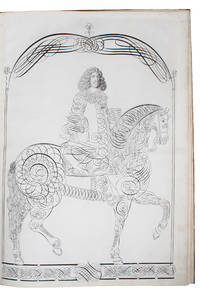
1709réf. 54195København 1709. Folio. In contemporary full calf Cambridge-style mirror binding with blindstamped borders. Light wear to extremities. Seven leaves with minor repairs to margins one leaf with a 15 cm long closed tear and one leaf with an 30 cm long closed tear all professionally executed and with no loss of imprint. Margins slightly soiled. 19 leaves -text and frames engraved. The broad frames that all differ from each other ornamentally depict animals and plants as well as the different trades of the country. A nice copy printed on thick heavy paper. Housed in a cardboard box.Provenance: From the collection of Danish book collector Viggo Lohse. The present copy was exhibited at 'Dansk Bibliofil-Klubs 50 års Jubilæumsudstilling' in 1992 The 50 year anniversary exhibition for the Danish Society of Bibliophiles no. 94. First edition of this landmark work of Danish book production and the constitution of the Danish absolute monarchy. The Royal Law established the absolute right of the Monarch to rule and it defined the line of royal succession. It was more rigorous than the other monarchal laws of Europe at the time.The text which is written by Peder Griffenfeld is engraved in copper throughout in order to prevent the possibility of re-printing pirated editions and text-counterfeiting. Frederik Rostgaard the King's state archivist who was famous for his excellent taste in books was in charge of the editing and issuing of the work. In front of the actual law text a leaf is inserted with the portrait of King Frederik III on his horse and everything except for the head of the king which was engraved after his death-mask is executed in the beloved flourishing- or scroll- manner of the time. The titles and the text are engraved throughout by Michael Røg. unknown
2000réf. 0803759China Renmin University Press 2000-01-01. paperback. Used - Good. Ship out in 2 business day And Fast shipping Free Tracking number will be provided after the shipment.Language: Chinese . The archives in this collection are stored in the First Historical Archives of China as a treasure. They systematically record the invasion of the Eight-Power Allied Forces in full detail. as well as the response of the Qing Government including the whole compensation procedure of the government after the war. It is a systematic exposure of the archives on the Boxer Movement in 1900. Most of the archives are exposed to the public for the first time which will help scholars. Satisfaction guaranteedor money back. China Renmin University Press paperback
1967réf. 2091202133103941Nihonhyoronsha 1967. Soft Cover. Fine. Number of books: 29 Nihonhyoronsha paperback
1974réf. 2083002115804196Institute of Modern Chinese History Academia Sinica 1974. Soft Cover. Fine. Number of books: 21 Institute of Modern Chinese History, Academia Sinica paperback
1989réf. 2110502151001315Agricultural policy review meeting 1989. Soft Cover. Fine. Number of books: 14 Agricultural policy review meeting paperback
réf. 2110502150901931Not Available N.A. Soft Cover. Fine. Volume: 1 Not Available paperback
1530réf. 73619Venetiis: per Stephanum de Sabio; sumptu expensis vero D. Damiani de Sancta Maria 1530. First edition folio leaf 30.6 cm; 6 192 i.e. 182 2 leaves; collating: ⶠalpha-pi⸠rhoⶠsigma-chi⸠psi¹â°; last two leaves blank; error in foliation with 175-182 numbered 185-192; text in Greek; printer's coat of arms on title page featuring shield bearing a crown with caption "Sabio" flanked by printer's names "Stephanos" and "Sabios" on left and right respectively; 3 large head-pieces in the Byzantine style: one in red at beginning of the work on leaf 1 and the other two in black on leaves 135 and 159; numerous smaller narrow rectangular head-pieces in red and black featuring a garland of acanthus leaves; large ornamental red initials; text initials marginal notes and head-pieces printed in red and black throughout; contemporary blindstamped calf over wooden boards manuscript title in ink on bottom edge; calf peeling bosses and clasps lost the spine perished and rebacked at an early date in linen the boards with some moderate worming; mild dampstain persists throughout at top margin also on the prelims in the bottom margin the occasional gathering toned; a good copy at best but venerable and beautifully printed in red and black throughout. Saint Basil "became the inseparable companion of Gregory of Nazianzus who in his famous panegyric on Basil . gives a most interesting description of their academic experiences. According to him Basil was already distinguished for brilliancy of mind and seriousness of character and associated only with the most earnest students. He was able grave industrious and well advanced in rhetoric grammar philosophy astronomy geometry and medicine . By common consent Basil ranks among the greatest figures in church history and the rather extravagant panegyric by Gregory of Nazianzus has been all but equalled by a host of other eulogists" Catholic Encyclopedia. Adams B-345; Brunet 5e éd. I 688; Ebert 1735; Graesse I 306; STC-Italian p. 75. [per Stephanum de Sabio; sumptu expensis vero D. Damiani de Sancta Maria] unknown
1530réf. 73619Venetiis: per Stephanum de Sabio; sumptu expensis vero D. Damiani de Sancta Maria 1530. First edition folio leaf 30.6 cm; 6 192 i.e. 182 2 leaves; collating: ⶠalpha-pi⸠rhoⶠsigma-chi⸠psi¹â°; last two leaves blank; error in foliation with 175-182 numbered 185-192; text in Greek; printer's coat of arms on title page featuring shield bearing a crown with caption "Sabio" flanked by printer's names "Stephanos" and "Sabios" on left and right respectively; 3 large head-pieces in the Byzantine style: one in red at beginning of the work on leaf 1 and the other two in black on leaves 135 and 159; numerous smaller narrow rectangular head-pieces in red and black featuring a garland of acanthus leaves; large ornamental red initials; text initials marginal notes and head-pieces printed in red and black throughout; contemporary blindstamped calf over wooden boards manuscript title in ink on bottom edge; calf peeling bosses and clasps lost the spine perished and rebacked at an early date in linen the boards with some moderate worming; mild dampstain persists throughout at top margin also on the prelims in the bottom margin the occasional gathering toned; a good copy at best but venerable and beautifully printed in red and black throughout. Saint Basil "became the inseparable companion of Gregory of Nazianzus who in his famous panegyric on Basil . gives a most interesting description of their academic experiences. According to him Basil was already distinguished for brilliancy of mind and seriousness of character and associated only with the most earnest students. He was able grave industrious and well advanced in rhetoric grammar philosophy astronomy geometry and medicine . By common consent Basil ranks among the greatest figures in church history and the rather extravagant panegyric by Gregory of Nazianzus has been all but equalled by a host of other eulogists" Catholic Encyclopedia. Adams B-345; Brunet 5e éd. I 688; Ebert 1735; Graesse I 306; STC-Italian p. 75. [per Stephanum de Sabio; sumptu expensis vero D. Damiani de Sancta Maria] unknown books
1991réf. AMO-4521Grafton, An Imprint of HarperCollins Publishers, 1991 (later printing 4/3/3) 3 volumes (18 x 11,2 cm), 529, 442 et 556 pages. Cartes in fine. Brochés. Couvertures illustrées par John Howe. Etui cartonné rouge et or (un côté déchiré recollé, quelues marques). Volumes très bien conservés, les dos n'ont pas de pli de lecture. Un coin légèrement plié (The Return of the King). Intérieur parfaitement frais, papier légèrement teinté. Paperback edition.
1795réf. 2111902160201111Suharaya Mohei 1795. Soft Cover. Fine. Number of pages: 74 pages 84 pages Size: 2.5 cm x 13.6 cm Number of books: 5 volumes 2 volumes Suharaya Mohei paperback
Das komplette Werkverzeichnis sämtlicher Gemälde, Aquarelle Zeichnungen und Skulpturen von Pablo Picasso. Bd. 1: 1889-1897 Youth in Spain I - Bd. 2: 1898-1900 Youth in Spain II - Bd. 3: 1900-1901 The Turn of the Century - Bd. 4: 1902-1904 The Blue Period - Bd. 5: 1905-1906 The Rose Period - Bd. 6: 1907-1909 African Period. Bd. 7: 1909-1912 Analytic Cubism - Bd. 8: 1913-1916 Synthec Cubism - Bd. 9: 1917-1919 Cubism to Neoclassicism - Bd. 10: 1920-1921 Neoclassicism I - Bd. 11: 1922-1924 Neoclassicism II - Bd. 12: 1925-1929 Toward Surrealism - Bd. 13: 1930-1936 Surrealism - Bd. 14: 1937-1939 Spanish Civil War - Bd. 15: 1939-1940 Europe at War - Bd. 16: 1940-1944 Nazi Occupation - Bd. 17: 1944-1949 Liberation and Post War Years - Bd. 18: 1950-1955 The Fifties Part I - Bd. 19: 1956-1959 The Fifties Part II - Bd. 20: 1969-1963 The Sixties Part I - Bd. 21: 1964-1967 The Sixties Part II - Bd. 22: 1968-1969 The Sixties Part III - Bd. 23: 1970-1973 The Final Years.
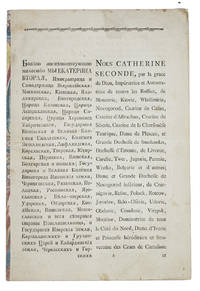
1790réf. K1VF2DNXCCLTSt. Petersburg 1790. Folio 30 x 20 and 29.5 x 20.5 cm. Imperial Printing Office Unsewn marbled paper spine ad 1; side stitched blue paper spine ad 2. With the text in Russian and French in parallel columns and with ornamental rules at the head of each page. 10; 20 pp. First and only editions of two peace treaties between Catherine the Great of Russia and Gustav III of Sweden which concluded the Russo-Swedish war of 1788-1790 each page with the Russian text in the left column and the French text in the right column. The Treaty of Värälä signed on 14 August 1790 though here dated 6 August by Catherine's representative Otto Heinrich Igelström and Gustav II's proxy Gustaf Mauritz Armfelt effectively restored the pre-war status quo and barred Russia from interferring in Swedish internal affairs which had been one of the reasons Gustav III a cousin of Catherine the Great declared war on Russia in 1788. After initial defeats Sweden was able to destroy nearly a third of the Russian fleet at sea. The second treaty signed on 19 October 1791 at Drottningholm outside of Stockholm established a close military alliance between Sweden and the Russian Empire with each power pledging active support and Catherine agreeing to pay Sweden annual subsidies. Since it was signed with a keen eye on the French Revolution the treaty can been seen as a predecessor to the war of the first coalition of 1792-1797 though neither Russia nor Sweden participated in the latter. Both are printed on Russian paper with cyrillic names and initials in the watermarks. Very good copies old horizontal crease first and last leaves lightly soiled.l KVK & WorldCat ads 1 & 2 SUB Göttingen ad 1 Ohio State ad 2 Strassbourg; not in Bitovt. unknown
1662In-4to piccolo, (36), 121, (1) pp., 10 tavole. Completo delle 56 silografie nel testo (molte delle quali a piena pagina) e delle 10 tavole incise in rame fuori testo, una delle quali (cuore) con volvelle. Vitello coevo, dorso ben restaurato.
1904Bookplate of V.M. Turnbull inside front board suggests this copy may have belonged to the owner of the famous collection now held by the Fitzwilliam Museum at Cambridge. Bookplate of Hugh John McLean upon front free endpaper. [4], 443 pages. All six plates present. The entire catalogued Franks bequest contained 35,098 plates. Above-average wear to publisher's black cloth. Innumerable small light pencil marginal tick marks beside items of interest. Narrow opening in binding at page 259. Volume II only of this renowned three volume reference. Book
1904Bookplate of V.M. Turnbull inside front board suggests this copy may have belonged to the owner of the famous collection now held by the Fitzwilliam Museum at Cambridge. Bookplate of Hugh John McLean upon front free endpaper. [6], 387 pages. All six plates present. "Includes several minor and supplementary series, viz., one of about two hundred anonymous plates which it has not been found possible to identify; Royal plates; plates of Universities, Colleges and Schools; Premium or school-prize plates; plates of Ecclesiastical, Parochial, and Public Libraries; Naval and Military and Legal and Medical plates; with those of City Companies and Public Offices, Booksellers, and Circulating Libraries. The volume also furnishes notes of a few family plates supplementary to the main series: these have for the most part been discovered in and transferred from the Foreign portion of the testator's collection. Last comes a Heraldic Index to all those plates which, although anonymous, have been identified and inserted in their proper alphabetical places in the main collection." - from Preface. The entire catalogued Franks bequest contained 35,098 plates. Above-average wear to publisher's black cloth. Binding intact. Innumerable small light pencil marginal tick marks beside items of interest. Intriguing light pencil annotation beside item 32550A, a reproduction of a James Worsley plate, on page 319 reads "a copy of the original is in my collection", possibly adding further weight to the suggested provenance of this volume. Volume III only of this renowned three volume reference. Book
1596réf. F75BBB01U79OBrescia 1596. Small 8vo 14.5 x 10 cm. Pietro Maria Marchetti Contemporary limp sheepskin parchment sewn on 3 alum-tawed thongs with manuscript title on smooth spine. With Marchetti's woodcut anchor and dolphin device imitating Aldus's on the title-page 16 numbered engraved emblematic illustrations plate size 8.5 x 6.5 cm woodcut headpieces tailpieces and decorated initials 3 series and decorations built up from cast fleurons. With the Latin text set in italic and the Italian translation in roman. 106 6 blank pp. First edition of the so-called Oracles of Leo the Wise with a bilingual Latin an Italian text and 16 lovely and rather surreal engravings: an emblematic book of prophecies traditionally attributed to Leo VI 866-911/12 Emperor of Byzantium from 866 to his death and at least here also to Antonius Severus 188-217 sole Emperor of Rome from his murder of his brother in December 211 to his death the book does not indicate which Severus is intended but the preface notes that he reigned from 212. The Latin text was circulated already attributed to Leo the Wise in the 12th century but Christians revived it in the 16th century and interpreted it as a prophecy that the Ottoman Empire would fall in 1622. These oracles remained popular in the 17th century when they were presented as having predicted the setbacks that the Ottomans suffered in Europe in that period.Owner's inscriptions on the title-page further with a bookplate. With a water stain in the first quire but otherwise in very good condition with only very minor foxing. The sewing supports have broken at the back hinge the thong ties are lost and the vellum is slightly wrinkled but the binding is still in good condition.l BMC STC Italian p. 622; Caillet 11042; Edit16/ICCU CNCE 28586; Mortimer Italian 254. hardcover
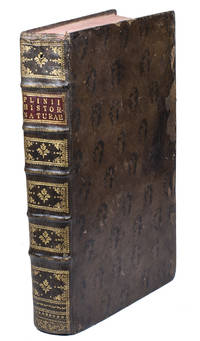
1532réf. K7GAXLMCHM25Paris 1532. Folio. Jean Parvum index: Jean Petit 18th-century cat's paw calf richly gold-tooled spine with red title-label red edges. With a woodcut printer's device on the individual title-page for the index. 36 671 188 pp. Praised 1532 edition of Pliny's Naturalis historia: "Cette édition citée avec éloge par Ernesti et par Rezzonico." Brunet. Pliny's Natural history is one of the largest single works to have survived from the Roman Empire and purports to cover the entire field of ancient knowledge based on the best authorities available at the time. It encompasses the fields of botany zoology astronomy geology and mineralogy as well as the exploitation of those resources. It remains a standard work for the Roman period and the advances in technology and understanding of natural phenomena at the time. ''We know from Pliny that there were important pearl fisheries in the Gulf Pliny identifies Tylos Bahrain as a place famous for its pearls He attests that pearls were the most highly rated valuable in Roman society and that those from the Gulf were specially praised The pearl related finds at the site of El-Dur indicate the site was integrated into the maritime trade routes linking the Roman Empire the Persian Empire India and South Arabia'' Carter.With bookplate on paste-down some ink notes on the title-page the first page and occasionally in the margins; title-page a bit soiled; some wormholes near the end of the book mostly in the margins. Binding slightly worn along the extremities. Overall in good condition.l Brunet IV col. 715; Carter ''The history and prehistory of pearling in the Persian Gulf'' in: Journal of the economic and social history of the orient 48 2005 pp.139-209; Graesse V p. 339 "Excellente édition"; for Pliny: DSB XI pp. 38-40. unknown
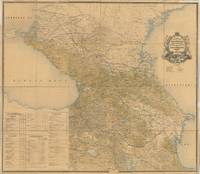
réf. 65574Tbilisi: Compiled and Lithographed at the Military Topographical Department of the Caucasus Military District 1870 with corrections to August 1896. Original large-format colour-lithographed map of the Caucasus 132 x 151 cm dissected into 24 panels and backed onto linen text in Cyrillic script folding down to 33.5 x 27 cm. With an extensive key decorative title cartouche and table showing the divisions of the Caucasus. The linen backing is in places dust-soiled and stained some tiny holes in the edges from former wall mounting that have been repaired somewhat browned overall and with a few minor brown spots a few small marginal tears not affecting map repaired with contemporary strips of paper linen edges are slightly frayed in places withal a very good example of this scarce and impressive map. A rare and large-format wall map of the Caucasus region in Russian. The map covers the modern territories of Armenia Georgia Azerbaijan Dagestan Chechnya Kalmykia etc. The map extends south to Tehran and north to Astrakhan. The eastern Black Sea is on the left and the western Caspian Sea is on the right. Beneath the title is a depiction of a railway winding through the mountains and opposite it a galloping horse with a cart crossing the mountains. Later editions were published at least until 1883 and 1903. The later edition is mentioned in 20th-century works dealing with international border disputes in the Caucasus. At the time of its creation it was almost certainly the finest map of the Caucasus produced in the Russian Empire. Tbilisi: Compiled and Lithographed at the Military Topographical Department of the Caucasus Military District, 1870 (with correc unknown
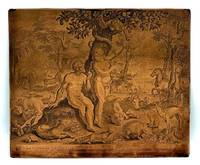
1600réf. 1745Original printing plate: Johannes Galle. c.1600-1650. Engraved copper printing plate depicting Adam and Eve in the Garden of Eden surrounded by all manner of creatures with Adam sitting at the foot of the tree of knowledge about to take a bite from an apple whilst Eve takes another from the hand of a serpentine creature coiling around the branches above. 22.7 x 19.1cm. The plate incorporating text to the foot from Genesis 3. Signed at the foot "M. de Vos invenit / Corn. Galle Sculp. / Io. Galle excudit". The plate with some old fine scratches is otherwise in very good order. WITH: A later mid nineteeth-century and somewhat weak impression of the plate on paper. This laid down to board with manuscript French labels dated 1851 to the reverse apparently gifting the item from Mademoiselle C. Thyes of Brussels to "Monsieur Delpy"; the print with two pin holes to the blank lower margin and a few spots of faint foxing. A beautifully-executed original engraved copper printing plate by the Flemish engraver Cornelis Galle the Elder 1576-1650 forming a typically busy depiction of the Garden of Eden with Adam and Eve sealing their fate amidst a varied menagerie of peaceable beasts including an elephant camel bear porcupine ostrich and rearing unicorn amongst others. Cornelis Galle was first taught engraving by his father the engraver and publisher Philip Galle 1537-1612. He subsequently resided in Rome for several years where he acquired an accuracy of design and freedom of style which marked him out as a master of his art form. Following his return to Antwerp he continued to engrave numerous plates after the works of his countrymen as well as his own designs becoming a master of the Antwerp Guild of St Luke in 1610. The present engraving was made after an original painting by the prominent Flemish artist Maerten de Vos 1532-1603. A prolific draughtsman de Vos produced numerous designs for the engravers of Antwerp the resulting prints of which circulated widely in Europe and the Spanish colonies significantly contributing to his international reputation and influence. Hollstein XLIV.61.243. [Original printing plate]: Johannes Galle. unknown