10 989 résultats
Acquaforte a 2 colori. Opera appartenente al portfolio pubblicato in occasione del 500° anniversario della nascita di Michelangelo Firma e numerazione a matita. Stampata su carta J. Green da White Ink, London. Timbro a secco dello stampatore. Esemplare 173/200. Cm 58x49 (Foglio 80x60). . . Perfetto (Mint). . Tiratura 200 + XX p.d.a.. .
Litografia a 4 colori. Opera appartenente al portfolio pubblicato in occasione del 500° anniversario della nascita di Michelangelo Firma e numerazione a matita. Stampata su carta Rives Couronne da 250 gr Da Matthieu, Zurigo. Esemplare 173/200. cm 80x60. . . Perfetto (Mint). . Tiratura 200 + XX p.d.a.. .
Acquaforte appartenente al volume ''Madre'', Ancona, Bucciarelli 1968 Firma a matita. Incisione applicata su foglio di carta bianca. Esemplare p.d.a.. Cm 27x30 (Foglio 49x34,5). pp.. . Ottimo (Fine). . . .
1914- Lucien Vogel éditeur, Paris Juin 1914, 36,5x24cm, une feuille. - Double original color print, printed on vergé paper, signed in the plate. An original print used to illustrate the Gazette du bon ton, one of the most attractive and influential 20th century fashion magazines, featuring the talents of French artists and other contributors from the burgeoning Art Deco movement. A celebrated fashion magazine established in 1912 by Lucien Vogel, La Gazette du bon ton appeared until 1925, with a hiatus from 1915 to 1920 due to the war (the editor-in-chief having been called up for service). It consisted of 69 issues printed in only 2,000 copies each and notably illustrated with 573 color plates and 148 sketches of the models of the great designers. Right from the start, this sumptuous publication "was aimed at bibliophiles and fashionable society," (Françoise Tétart-Vittu, "La Gazette du bon ton", in Dictionnaire de la mode, 2016) and was printed on fine vergé paper using a type cut specially for the magazine by Georges Peignot, known as Cochin, later used (in 1946) by Christian Dior. The prints were made using stencils, heightened in colors, some highlighted in gold or palladium. The story began in 1912, when Lucien Vogel, a man of the world involved in fashion (he had already been part of the fashion magazine Femina) decided, with his wife Cosette de Brunhoff - the sister of Jean, creator of Babar - to set up the Gazette du bon ton, subtitled at the time: "Art, fashion, frivolities." Georges Charensol noted the reasoning of the editor-in-chief: "'In 1910,' he observed, 'there was no really artistic fashion magazine, nothing representative of the spirit of the time. My dream was therefore to make a luxury magazine with truly modern artists...I was assured of success, because when it comes to fashion, no country on earth can compete with France.'" ("Un grand éditeur d'art. Lucien Vogel" in Les Nouvelles littéraires, no. 133, May 1925). The magazine was immediately successful, not only in France but also in the United States and Latin America. At first, Vogel put together a team of seven artists: André-Édouard Marty and Pierre Brissaud, followed by Georges Lepape and Dammicourt, as well as eventually his friends from school and the School of Fine Arts, like George Barbier, Bernard Boutet de Monvel and Charles Martin. Other talented people soon came flocking to join the team: Guy Arnoux, Léon Bakst, Benito, Boutet de Monvel, Umberto Brunelleschi, Chas Laborde, Jean-Gabriel Domergue, Raoul Dufy, Édouard Halouze, Alexandre Iacovleff, Jean Émile Laboureur, Charles Loupot, Chalres Martin, Maggie Salcedo. These artist, mostly unknown when Lucien Vogel sought them out, later became emblematic and sought-after artistic figures. It was also they who worked on the advertising drawings for the Gazette. The plates put the spotlight on, and celebrate, dresses by seven designers of the age: Lanvin, Doeuillet, Paquin, Poiret, Worth, Vionnet and Doucet. The designers provided exclusive models for each issue. Nonetheless, some of the illustrations are not based on real models, but simply on the illustrator's conception of the fashion of the day. The Gazette du bon ton was an important step in the history of fashion. Combining aesthetic demands with the physical whole, it brought together - for the first time - the great talents of the artistic, literary, and fashion worlds; and imposed, through this alchemy, a completely new image of women: slender, independent and daring, which was shared by the new generation of designers, including Coco Chanel, Jean Patou, Marcel Rochas, and so on... Taken over in 1920 by Condé Montrose Nast, the Gazette du bon ton was an important influence on the new layout and aesthetics of that "little dying paper" that Nast had bought a few years earlier: Vogue. [FRENCH VERSION FOLLOWS] Estampe double originale en couleur, tirée sur papier vergé, signée en bas à droite de la planche. Gravure originale réal
1914réf. 54682Lucien Vogel éditeur | Paris Juin 1914 | 36.50 x 24 cm | une feuille
1914réf. 84751Lucien Vogel éditeur | Paris Juin 1914 | 36.50 x 24 cm | une feuille
1914- Lucien Vogel éditeur, Paris 1914, 38,2x24,5cm, une feuille. - Original color print, printed on vergé paper, signed in the plate. An original print used to illustrate the Gazette du bon ton, one of the most attractive and influential 20th century fashion magazines, featuring the talents of French artists and other contributors from the burgeoning Art Deco movement. A celebrated fashion magazine established in 1912 by Lucien Vogel, La Gazette du bon ton appeared until 1925, with a hiatus from 1915 to 1920 due to the war (the editor-in-chief having been called up for service). It consisted of 69 issues printed in only 2,000 copies each and notably illustrated with 573 color plates and 148 sketches of the models of the great designers. Right from the start, this sumptuous publication "was aimed at bibliophiles and fashionable society," (Françoise Tétart-Vittu, "La Gazette du bon ton", in Dictionnaire de la mode, 2016) and was printed on fine vergé paper using a type cut specially for the magazine by Georges Peignot, known as Cochin, later used (in 1946) by Christian Dior. The prints were made using stencils, heightened in colors, some highlighted in gold or palladium. The story began in 1912, when Lucien Vogel, a man of the world involved in fashion (he had already been part of the fashion magazine Femina) decided, with his wife Cosette de Brunhoff - the sister of Jean, creator of Babar - to set up the Gazette du bon ton, subtitled at the time: "Art, fashion, frivolities." Georges Charensol noted the reasoning of the editor-in-chief: "'In 1910,' he observed, 'there was no really artistic fashion magazine, nothing representative of the spirit of the time. My dream was therefore to make a luxury magazine with truly modern artists...I was assured of success, because when it comes to fashion, no country on earth can compete with France.'" ("Un grand éditeur d'art. Lucien Vogel" in Les Nouvelles littéraires, no. 133, May 1925). The magazine was immediately successful, not only in France but also in the United States and Latin America. At first, Vogel put together a team of seven artists: André-Édouard Marty and Pierre Brissaud, followed by Georges Lepape and Dammicourt, as well as eventually his friends from school and the School of Fine Arts, like George Barbier, Bernard Boutet de Monvel and Charles Martin. Other talented people soon came flocking to join the team: Guy Arnoux, Léon Bakst, Benito, Boutet de Monvel, Umberto Brunelleschi, Chas Laborde, Jean-Gabriel Domergue, Raoul Dufy, Édouard Halouze, Alexandre Iacovleff, Jean Émile Laboureur, Charles Loupot, Chalres Martin, Maggie Salcedo. These artist, mostly unknown when Lucien Vogel sought them out, later became emblematic and sought-after artistic figures. It was also they who worked on the advertising drawings for the Gazette. The plates put the spotlight on, and celebrate, dresses by seven designers of the age: Lanvin, Doeuillet, Paquin, Poiret, Worth, Vionnet and Doucet. The designers provided exclusive models for each issue. Nonetheless, some of the illustrations are not based on real models, but simply on the illustrator's conception of the fashion of the day. The Gazette du bon ton was an important step in the history of fashion. Combining aesthetic demands with the physical whole, it brought together - for the first time - the great talents of the artistic, literary, and fashion worlds; and imposed, through this alchemy, a completely new image of women: slender, independent and daring, which was shared by the new generation of designers, including Coco Chanel, Jean Patou, Marcel Rochas, and so on... Taken over in 1920 by Condé Montrose Nast, the Gazette du bon ton was an important influence on the new layout and aesthetics of that "little dying paper" that Nast had bought a few years earlier: Vogue. [FRENCH VERSION FOLLOWS] Estampe originale en couleur tirée sur papier vergé, signée en bas à droite dans la planche. Gravure originale réalisée pour l'ill
1975réf. 17362Avon CT: The Limited Editions Club 1975. Limted Edition. Hardcover. Book condition is Near Fine bound in patterned cloth covered boards ; housed in a Very Good brown slipcase. Some rubbing and scuffing to slipcase. Slight edge wear to boards. Text is clean and unmarked illustrated throughout. ; 8vo. 10 1/2"h x 7 1/4"w. Limited to 2000 copies signed by the artist Lynd Ward of which this is copy 313. The Limited Editions Club hardcover
1834réf. 252701834 Planche HT parue dans La Caricature politique, morale, littéraire et scénique, volume 7, 27 février 1834 (Planche n°365) - LithographieDimensions - Hauteur: 27cm x Largeur: 35.5cm - Image: Hauteur: 21.7cm x Largeur: 27.9cm - Titre en bas au centre : « On dansait au Château !!... » ; indications : en ht à gche : « La Caricature (Journal) N°173. », en ht à dte : « Pl. 365. »Inscription - Dans la lettre : « Chez Aubert, galerie véro dodat. » [éditeur], « L. de Benard. » [imprimeur]Description iconographique:La composition est clairement séparée en deux parties. La partie de dte montre un cortège funéraire en pleine rue de Paris, tandis que la partie de gche laisse le spectateur entrevoir à travers la fenêtre d’un bâtiment, certainement celui des Tuileries puisque s’y trouvent Louis-Philippe jouant du violon lors d’une réception donnée dans son palais. Aux second et arrière-plans, des gens dansent. L’auteur de cette pl. a voulu créer un contraste saisissant entre la scène de réception royale, légère et insouciante, et la scène du cortège funèbre. Le corbillard progresse dans la rue, séparé et protégé de la population par une rangée de gardes. Quelques personnes suivent le carrosse, la tête basse et le chapeau ôté. La personne que les hommes pleurent est François-Charles Dulong. Député de l’opposition, il fut tué le 30 janvier 1834 en duel par un député de la monarchie, le général Bugeaud, qui s’était senti offensé sur une question militaire (à propos de l’obéissance des membres de l’armée) lors de la séance de la chambre des députés du 16 janvier 1834. Bugeaud aurait été poussé par Louis-Philippe (plus précisément, il aurait été encouragé par un proche de Louis-Philippe, Marie-Théodore Gueilly, vicomte de Rumigny) à provoquer Dulong en duel. Les journaux défenseurs de la cause républicaine y ont vu une manière commode que le roi aurait eue pour se débarrasser d’un député de l’opposition encombrant. Ainsi, la pl. crée un contraste significatif entre l’humeur joviale et insouciante du roi et de ses convives, alors que la mort de Dulong affecte profondément une grande partie de la population. Sur le même sujet, et pour plus de détails, cf. pl. 361, du numéro 171 (13 février 1834)Personne / Personnage représenté:Louis-Philippe Ier, roi des Français
1974réf. 1054791974 Paris, Collectif Edité par Les Ateliers de réalisations graphiques, 1974, un volumes 210x295mm , 232 pages en feuilles non paginées, sous couverture souple à rabat, un portfolio au même format contenant les œuvres, l’ensemble dans un coffret toilé noir, un relief en plomb de Noblet inséré sur la partie supérieure.
1924- Lucien Vogel éditeur, Paris 1924, 18x24cm, une feuille. - Original color print, printed on vergé paper, signed in the plate. An original print used to illustrate the Gazette du bon ton, one of the most attractive and influential 20th century fashion magazines, featuring the talents of French artists and other contributors from the burgeoning Art Deco movement. A celebrated fashion magazine established in 1912 by Lucien Vogel, La Gazette du bon ton appeared until 1925, with a hiatus from 1915 to 1920 due to the war (the editor-in-chief having been called up for service). It consisted of 69 issues printed in only 2,000 copies each and notably illustrated with 573 color plates and 148 sketches of the models of the great designers. Right from the start, this sumptuous publication "was aimed at bibliophiles and fashionable society," (Françoise Tétart-Vittu, "La Gazette du bon ton", in Dictionnaire de la mode, 2016) and was printed on fine vergé paper using a type cut specially for the magazine by Georges Peignot, known as Cochin, later used (in 1946) by Christian Dior. The prints were made using stencils, heightened in colors, some highlighted in gold or palladium. The story began in 1912, when Lucien Vogel, a man of the world involved in fashion (he had already been part of the fashion magazine Femina) decided, with his wife Cosette de Brunhoff - the sister of Jean, creator of Babar - to set up the Gazette du bon ton, subtitled at the time: "Art, fashion, frivolities." Georges Charensol noted the reasoning of the editor-in-chief: "'In 1910,' he observed, 'there was no really artistic fashion magazine, nothing representative of the spirit of the time. My dream was therefore to make a luxury magazine with truly modern artists...I was assured of success, because when it comes to fashion, no country on earth can compete with France.'" ("Un grand éditeur d'art. Lucien Vogel" in Les Nouvelles littéraires, no. 133, May 1925). The magazine was immediately successful, not only in France but also in the United States and Latin America. At first, Vogel put together a team of seven artists: André-Édouard Marty and Pierre Brissaud, followed by Georges Lepape and Dammicourt, as well as eventually his friends from school and the School of Fine Arts, like George Barbier, Bernard Boutet de Monvel and Charles Martin. Other talented people soon came flocking to join the team: Guy Arnoux, Léon Bakst, Benito, Boutet de Monvel, Umberto Brunelleschi, Chas Laborde, Jean-Gabriel Domergue, Raoul Dufy, Édouard Halouze, Alexandre Iacovleff, Jean Émile Laboureur, Charles Loupot, Chalres Martin, Maggie Salcedo. These artist, mostly unknown when Lucien Vogel sought them out, later became emblematic and sought-after artistic figures. It was also they who worked on the advertising drawings for the Gazette. The plates put the spotlight on, and celebrate, dresses by seven designers of the age: Lanvin, Doeuillet, Paquin, Poiret, Worth, Vionnet and Doucet. The designers provided exclusive models for each issue. Nonetheless, some of the illustrations are not based on real models, but simply on the illustrator's conception of the fashion of the day. The Gazette du bon ton was an important step in the history of fashion. Combining aesthetic demands with the physical whole, it brought together - for the first time - the great talents of the artistic, literary, and fashion worlds; and imposed, through this alchemy, a completely new image of women: slender, independent and daring, which was shared by the new generation of designers, including Coco Chanel, Jean Patou, Marcel Rochas, and so on... Taken over in 1920 by Condé Montrose Nast, the Gazette du bon ton was an important influence on the new layout and aesthetics of that "little dying paper" that Nast had bought a few years earlier: Vogue. [FRENCH VERSION FOLLOWS] Estampe originale en couleur, tirée sur papier vergé, signée en bas à droite de la planche. Gravure originale réalisée pour l'illustra
1924réf. 55095Lucien Vogel éditeur | Paris 1924 | 18 x 24 cm | une feuille
1969réf. BOOKS074342ISterling Junction MA: The Scarab Press 1969. HC. good brown paper covered boards hardcover. Besnia engravings. Limited to 250 copies - signed by Howard John Besnia in colophon. unpaginated. The Scarab Press unknown
1920- Lucien Vogel éditeur, Paris Juillet 1920, 18x24cm, une feuille. - Original color print, printed on vergé paper, signed in the plate. An original print used to illustrate the Gazette du bon ton, one of the most attractive and influential 20th century fashion magazines, featuring the talents of French artists and other contributors from the burgeoning Art Deco movement. A celebrated fashion magazine established in 1912 by Lucien Vogel, La Gazette du bon ton appeared until 1925, with a hiatus from 1915 to 1920 due to the war (the editor-in-chief having been called up for service). It consisted of 69 issues printed in only 2,000 copies each and notably illustrated with 573 color plates and 148 sketches of the models of the great designers. Right from the start, this sumptuous publication "was aimed at bibliophiles and fashionable society," (Françoise Tétart-Vittu, "La Gazette du bon ton", in Dictionnaire de la mode, 2016) and was printed on fine vergé paper using a type cut specially for the magazine by Georges Peignot, known as Cochin, later used (in 1946) by Christian Dior. The prints were made using stencils, heightened in colors, some highlighted in gold or palladium. The story began in 1912, when Lucien Vogel, a man of the world involved in fashion (he had already been part of the fashion magazine Femina) decided, with his wife Cosette de Brunhoff - the sister of Jean, creator of Babar - to set up the Gazette du bon ton, subtitled at the time: "Art, fashion, frivolities." Georges Charensol noted the reasoning of the editor-in-chief: "'In 1910,' he observed, 'there was no really artistic fashion magazine, nothing representative of the spirit of the time. My dream was therefore to make a luxury magazine with truly modern artists...I was assured of success, because when it comes to fashion, no country on earth can compete with France.'" ("Un grand éditeur d'art. Lucien Vogel" in Les Nouvelles littéraires, no. 133, May 1925). The magazine was immediately successful, not only in France but also in the United States and Latin America. At first, Vogel put together a team of seven artists: André-Édouard Marty and Pierre Brissaud, followed by Georges Lepape and Dammicourt, as well as eventually his friends from school and the School of Fine Arts, like George Barbier, Bernard Boutet de Monvel and Charles Martin. Other talented people soon came flocking to join the team: Guy Arnoux, Léon Bakst, Benito, Boutet de Monvel, Umberto Brunelleschi, Chas Laborde, Jean-Gabriel Domergue, Raoul Dufy, Édouard Halouze, Alexandre Iacovleff, Jean Émile Laboureur, Charles Loupot, Chalres Martin, Maggie Salcedo. These artist, mostly unknown when Lucien Vogel sought them out, later became emblematic and sought-after artistic figures. It was also they who worked on the advertising drawings for the Gazette. The plates put the spotlight on, and celebrate, dresses by seven designers of the age: Lanvin, Doeuillet, Paquin, Poiret, Worth, Vionnet and Doucet. The designers provided exclusive models for each issue. Nonetheless, some of the illustrations are not based on real models, but simply on the illustrator's conception of the fashion of the day. The Gazette du bon ton was an important step in the history of fashion. Combining aesthetic demands with the physical whole, it brought together - for the first time - the great talents of the artistic, literary, and fashion worlds; and imposed, through this alchemy, a completely new image of women: slender, independent and daring, which was shared by the new generation of designers, including Coco Chanel, Jean Patou, Marcel Rochas, and so on... Taken over in 1920 by Condé Montrose Nast, the Gazette du bon ton was an important influence on the new layout and aesthetics of that "little dying paper" that Nast had bought a few years earlier: Vogue. [FRENCH VERSION FOLLOWS] Estampe originale en couleur, tirée sur papier vergé, signée en bas à droite de la planche. Gravure originale réalisée pour l'illustration
1920- Lucien Vogel éditeur, Paris Juillet 1920, 18x24cm, une feuille. - Estampe originale en couleur, tirée sur papier vergé, signée en bas à droite de la planche. Gravure originale réalisée pour l'illustration de La Gazette du bon ton, l'une des plus belles et des plus influentes revues de mode du XXème siècle, célébrant le talent des créateurs et des artistes français en plein essor de l'art déco. Célèbre revue de mode fondée en 1912 par Lucien Vogel, La Gazette du bon ton a paru jusqu'en 1925 avec une interruption durant la Guerre de 1915 à 1920, pour cause de mobilisation de son rédacteur en chef. Elle se constitue de 69 livraisons tirées à seulement 2000 exemplaires et est illustrée notamment de 573 planches en couleurs et de 148 croquis représentant des modèles de grands couturiers. Dès leur parution, ces luxueuses publications « s'adressent aux bibliophiles et aux mondains esthètes » (Françoise Tétart-Vittu « La Gazette du bon ton » in Dictionnaire de la mode, 2016). Imprimées sur beau papier vergé, elles utilisent une police typographique spécialement créée pour la revue par Georges Peignot, le caractère Cochin, repris en 1946 par Christian Dior. Les estampes sont réalisées grâce à la technique du pochoir métallique, rehaussées en couleurs et pour certaines soulignées à l'or ou au palladium. L'aventure commence en 1912 lorsque Lucien Vogel, homme du monde et de la mode - il a déjà participé à la revue Femina - décide de fonder avec sa femme Cosette de Brunhoff (sur de Jean, le père de Babar) la Gazette du bon ton dont le sous-titre est alors « Art, modes et frivolités ». Georges Charensol rapporte les propos du rédacteur en chef : « En 1910, observe-t-il, il n'existait aucun journal de mode véritablement artistique et représentatif de l'esprit de son époque. Je songeais donc à faire un magazine de luxe avec des artistes véritablement modernes [...] J'étais certain du succès car pour la mode aucun pays ne peut rivaliser avec la France. » (« Un grand éditeur d'art. Lucien Vogel » in Les Nouvelles littéraires, n°133, mai 1925). Le succès de la revue est immédiat, non seulement en France, mais aussi aux Etats-Unis et en Amérique du Sud. À l'origine, Vogel réunit donc un groupe de sept artistes : André-Édouard Marty et Pierre Brissaud, suivis de Georges Lepape et Dammicourt ; et enfin ses amis de l'École des beaux-arts que sont George Barbier, Bernard Boutet de Monvel, ou Charles Martin. D'autres talents viennent rapidement rejoindre l'équipée : Guy Arnoux, Léon Bakst, Benito, Boutet de Monvel, Umberto Brunelleschi, Chas Laborde, Jean-Gabriel Domergue, Raoul Dufy, Édouard Halouze, Alexandre Iacovleff, Jean Émile Laboureur, Charles Loupot, Charles Martin, Maggie Salcedo. Ces artistes, inconnus pour la plupart lorsque Lucien Vogel fait appel à eux, deviendront par la suite des figures artistiques emblématiques et recherchées. Ce sont ces mêmes illustrateurs qui réalisent les dessins des publicités de la Gazette. Les planches mettent en lumière et subliment les robes de sept créateurs de l'époque : Lanvin, Doeuillet, Paquin, Poiret, Worth, Vionnet et Doucet. Les couturiers fournissent pour chaque numéro des modèles exclusifs. Néanmoins, certaines des illustrations ne figurent aucun modèle réel, mais seulement l'idée que l'illustrateur se fait de la mode du jour. La Gazette du bon ton est une étape décisive dans l'histoire de la mode. Alliant l'exigence esthétique et l'unité plastique, elle réunit pour la première fois les grands talents du monde des arts, des lettres et de la mode et impose, par cette alchimie, une toute nouvelle image de la femme, élancée, indépendante et audacieuse, également portée par la nouvelle génération de couturiers Coco Chanel, Jean Patou, Marcel Rochas... Reprise en 1920 par Condé Montrose Nast, la Gazette du bon ton inspirera largement la nouvelle composition et les choix esthétiques du « petit journal mourant » que Nast avait racheté quelques années auparavant : le magazine Vogue. [ENGLISH DESC
1920réf. 77353Lucien Vogel éditeur | Paris Juillet 1920 | 18 x 24 cm | une feuille
1930réf. 32214London: Faber & Faber Limited 1930. Hardcover. First Edition: Limited to 300 numbered copies signed by the author. This copy being No. 18 and signed by the author on the Limitation Page. 6 x 9.25in. xi. 331pp. Publisher's cloth boards with gilt decoration and titling. FINE/AS NEW. Flawless. As pictured. Faber & Faber Limited hardcover
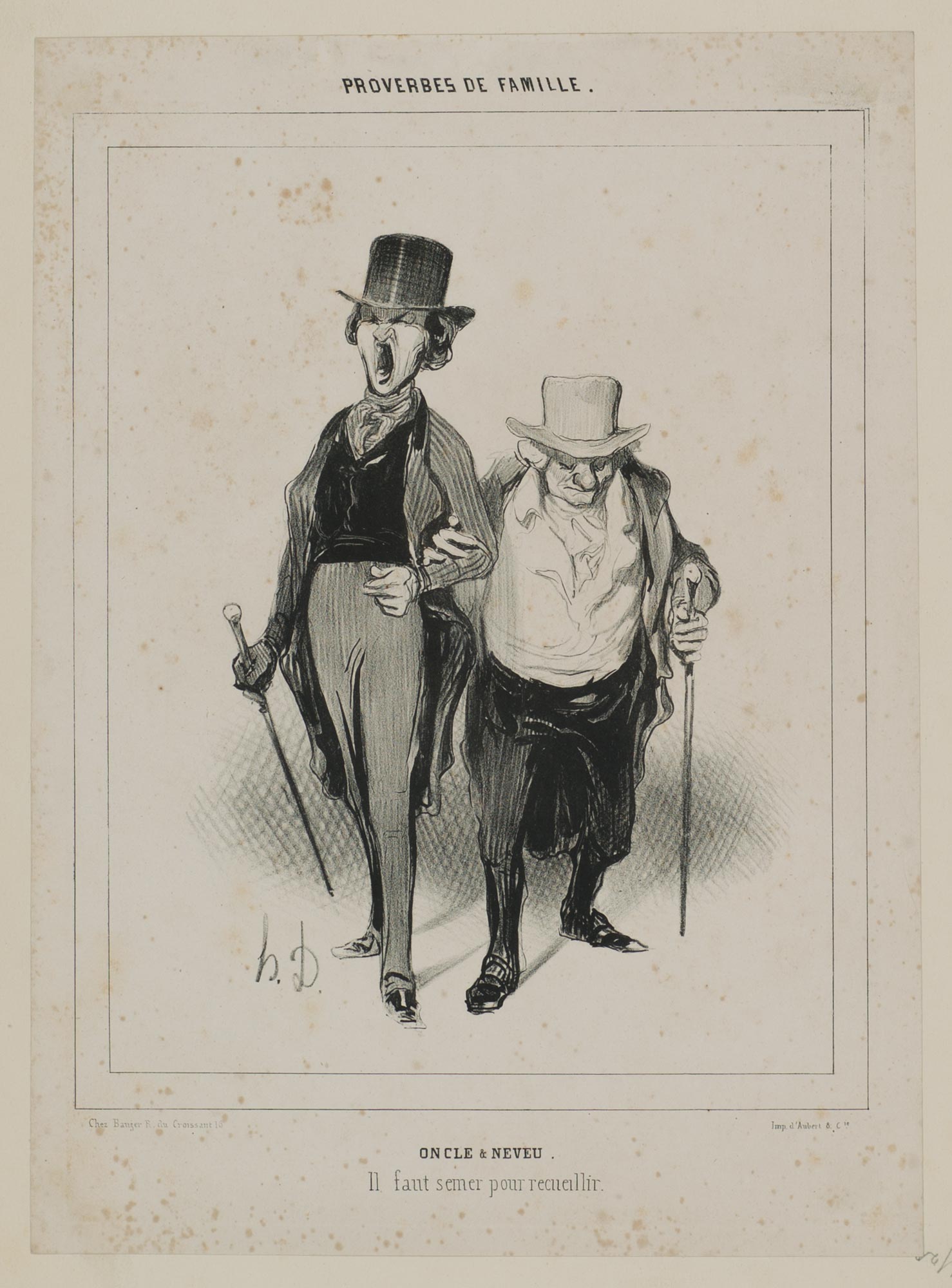
réf. HD-100o.J. ONKEL UND NEFFE. Erst muß man säen, um zu ernten. Lithographie, auf chamoisfarbenem Velin, mit den Adressen: Chez Bauger R. du Croissant 16 sowie: Imp. d?Aubert & Cie. Blattgröße 32,5:23,5 cm. ? Insgesamt stockfleckig. Literatur: Daumier-Register 797, II (von 2); Delteil 797, I (von 2), die Nummer rechts oben ausgekratzt. ? Sur blanc.
First edition, [4], iii, [1], 272pp., large paper copy, outer portion of first leaf of 'Index to the Engravings' torn-away, frontis., 100 engravings throughout, nineteenth-century cloth, hinges torn.
2007réf. 9792007 Couverture rigide Paris, George Braziller, 2007. In-folio (25x37cm), reliure d'éditeur pleine toile, jaquette à rabats illustrée en couleurs, titre en rouge au dos, quelques marques d'usage au verso de la jaquette. 256 pages. Le livre se compose de 119 gravures sur bois en couleurs, illustrant des paysages ou des scènes de genre de la ville d'Edo au milieu du XIXème siècle. Chaque planche est accompagnée d'un texte descriptif en regard, en anglais. Publié pour la première fois en 1986, l'ouvrage a connu plusieurs réimpressions. Notre exemplaire fait partie du 6ème tirage (2007). Etat intérieur excellent, bel exemplaire.
1995réf. 3885Paris 1995 in-plano en feuilles Paris, [chez l'artiste], 1995. 15 gravures sur cuivre en noir et 2 feuillets (texte de présentation intitulé "Les Ongulés, entre blanc obscur et noirs clairs" / "Los Ongulados, de entre blanco oscuro y negro claros" et justification) réunis sous 3 chemises placées dans un portefeuille de pleine toile. Portefeuille : 86 x 33,5 cm. Feuilles : 78,5 x 26 cm. Sujets : de 35 x 12,5 cm à 47,5 x 14,5 cm.
1558réf. 30348DBBasel, Hieronimus Curion, impensis Henricpetri, Mense Martio, 1558. Folio. 292 (recte 282) S. Schlichter Halblederband der Zeit. + Wichtig: Für unsere Kunden in der EU erfolgt der Versand alle 14 Tage verzollt ab Deutschland / Postbank-Konto in Deutschland vorhanden +, 30348D
1558réf. 30348DBBasel, Hieronimus Curion, impensis Henricpetri, Mense Martio 1558. Folio. 292 (recte 282) S. Schlichter Halblederband der Zeit.
1638réf. 193614to. Cont. marbled boards somewhat worn. Engraved title with text on verso. 2 engraved allegorical titles with portrait of Drexel with the years 1638 and 1645. Having 50 of 54 allegorical and symbolical engravings numbered 1-54 nos. 172932 a. 41 lacks. Interfoliert. Some traces of use. A few tears repaired. At the title: FL = Johan F. Lindencrone. hardcover
1724réf. 623917Ludgdunum Batavorum (Leiden), Apud Johannem van der Linden jun. 1724. Folio. (6) 644 (24); (2)590 (16) S. Zeitgenössischer Pergamentband (erste 30 SS. Mit Feuchtigkeitsspuren, Papier fest, Name auf Innendeckel.