9 172 résultats
réf. DADAX0367345757New unknown
1903réf. 43037ABLisboa, Imprensa Nacional, 1903. 4to. XII, 274 S. Mit zahlreichen Illustrationen im Text und auf Tafeln darunter 4 (1 große gefalt.) farblithogr. Tafeln. Schwarzer Maroquinband der Zeit mit reicher Rücken- und Deckelvergoldung, Kopfgoldschnitt (Signet von: A. Carmelita).
1911(FT) Modern Paper Wrappers. 8vo, 56 pages, 25 cm. In Hebrew. On the life and customs of the Jews of China. Following a petition to American President McKinley for a permit to tour China to research the roots and customs of the Chinese Jews, Uziel Haga accompanied the U. S. Armed Forces on an expedition in 1901. Haga present here a comprehensive description of Chinese life and customs, including a prayer for recitation during the Seven Days of Mourning. The Author maintains that the Jews of Kaifeng in Hunan Province are descendants of the exiled Ten Lost Tribes most particularly, the Tribe of Asher. The author was suspected of espionage and was imprisoned by the Boxers where he died after suffering torture. SUBJECT(S) : Lost tribes of Israel. Jews -- China. Geographic: China -- Ethnic relations. Originally published in 1900 under title: Metsiat aseret ha-shevatim. OCLC lists 12 copies worldwide. Lacks original green wrappers. Bumped corners. Yellowing of pages. Good condition. (Sef-28-6)
1561Carta tratta dalla "Geographia di Claudio Tolomeo", a cura del Ruscelli, pubblicata in Venezia in pù edizioni tra il 1561 ed il 1598. La carta è basata sulla "Geografia" di Giacomo Gastaldi, che probabilmente disegnò personalmente anche queste mappe, che vennero incise dai fratelli Sanuto. La peculiarità di queste mappe è che sono incise due per lastra e successivamente tagliate; questo il motivo per cui il segno del rame appare solo in tre lati della mappa. Il testo del Ruscelli e le sue carte sono considerate come il miglior atlante moderno fino alla prima versione del Thatrum di Ortelius, 1570. Solo la loro enorme diffusione ne impedisce una valutazione sostenuta nel mercato antiquario. L'opera infatti ebbe una prima stesura nel 1561, stampata da Vincenzo Valgrisi che ne curò anche la ristampa del 1562. Tre sono le edizioni firmate da Giordano Ziletti (due nel 1564 e una del 1574), mentre nel 1597 viene edita dai fratelli Calignani. Tutte queste edizioni contengono 64 tavole. Nel 1598 e 1599 vengono alla luce le due edizioni curate da Giuseppe Rosaccio e stampate dagli Eredi di Melchior Sessa. Queste ultime due edizioni comprendono 69 tavole; sono infatti aggiunte la carta del planisfero e dei continenti del Rosaccio. ORIGINAL COLOURING!!!!Etching with engraving, about 1561. Magnificent proof, printed on contemporary laid paper, with margins, in perfect condition. Example in wonderful contemporary coloring.Map, taken from Ruscelli edition of Ptolemy's "Geographia", printed in Venice from 1561 to 1598. Ruscelli's Atlas is an expanded edition of Gastaldi's "Geografia" of 1548, which has been called the most comprehensive atlas produced between Martin Waldseemüller's Geographiae of 1513, and the Abraham Ortelius Theatrum of 1570. Ruscelli and Gastaldi's maps were beautifully engraved on copper, marking a turning point in the history of cartography. From that point forward, the majority of cartographic works used this medium. As it was a harder material than wood it gave the engraver the ability to render more detail. Gastaldi sought the most up-to-date geographical information available, making the modern maps in Ruscelli's Geographia among the best modern maps of the period. The maps are engraved by the Sanuto borthers.Only their enormous diffusion prevents a sustained evaluation in the antique market. The work in fact had a first issue in 1561, printed by Vincenzo Valgrisi who also edited the reprint of 1562. There are three editions signed by Giordano Ziletti (two in 1564 and one in 1574), while in 1597 it was edited by the Calignani brothers. All these editions contain 64 engraved maps. In 1598 and 1599 the two editions edited by Giuseppe Rosaccio and printed by the heirs of Melchior Sessa come to light. These last two editions include 69 plates; in fact the map of the planisphere and of the continents of Rosaccio are added.
2018réf. x-3319978128Springer Verlag 2018. Hardcover. New. 2nd edition. 322 pages. 9.25x6.10x0.87 inches. Springer Verlag hardcover
(Al fin:) Lisboa, Regia Officina Typografica, 1785, 21 x 15,5 cm., tela, 2 hojas. (Pequeño roto en el margen inferior sin afectar al texto. Folleto muy raro)
1740réf. 15945Jena Sumpt. Christ. Henr. Cunonis, 1740. 984 S. 8° Oktav Kart.
réf. 52129Lisbonne - Paris Fondation Calouste Gulbenkian. Centre Culturel Portugais 1993 in 4 (27,5x19,5) 1 fort volume broché, couverture à rabats, jaquette illustrée en couleurs, 723 pages [1], ex-libris illustré, non coupé. Texte en français. Très bel exemplaire ( Photographies sur demande / We can send pictures of this book on simple request )
1808réf. 7510ABPrag, Diesbachische, 1808. 611 + 1 S. OPp. der Zeit., Abbildung
1765réf. 007287PARIS CHEZ JEAN-JACQUES HERISSANT 1765 2 volumes grand in-12 de 745 ( les pages 739 à 742 sont en début d' ouvrage ) + 704 pages , dans une reliure d' époque plein veau marbré , dos à 5 nerfs finement ornés , tranches marbrées , quelques épidermures sans gravité aux niveau des tranches , 2 trous de vers au niveau du mors du premier plat du tome II et le mors inférieur du premier plat du tome I est fendu sur 1 cm , autrement bons exemplaires avec un intérieur très frais . Bon Couverture rigide
1606Carta tratta dall'Atlas di Mercator e Hondius. Il grande Atlas del Mercator si compone di tre parti, tutte edite a Duisburg tra il 1585 ed il 1595 con il testo latino al verso. Successivamente le lastre furono acquisite da Jodocus e Hendrick Hondius e da Jan Jansson, i quali, tra il 1606 ed il 1666, diedero alla luce più edizioni dello stesso atlante con numerose aggiunte e varianti. Questo esemplare proviene da una delle edizioni a cura del Hondius, testo ltedesco. Incisione in rame, coloritura coeva con ritocchi, in ottimo stato di conservazione. Very attractive map of Castillia with Madrid and Toledo in the center of the map. Mercator's sons and grandsons, were all cartographers and made their contributions in various ways to his atlas. Rumold, in particular, was responsible for the complete edition in 1595. The map plates were bought in 1604 by Jodocus Hondius who, with his sons, Jodocus II and Henricus, published enlarged editions which dominated the map market for the following twenty to thirty years. German text on verso.
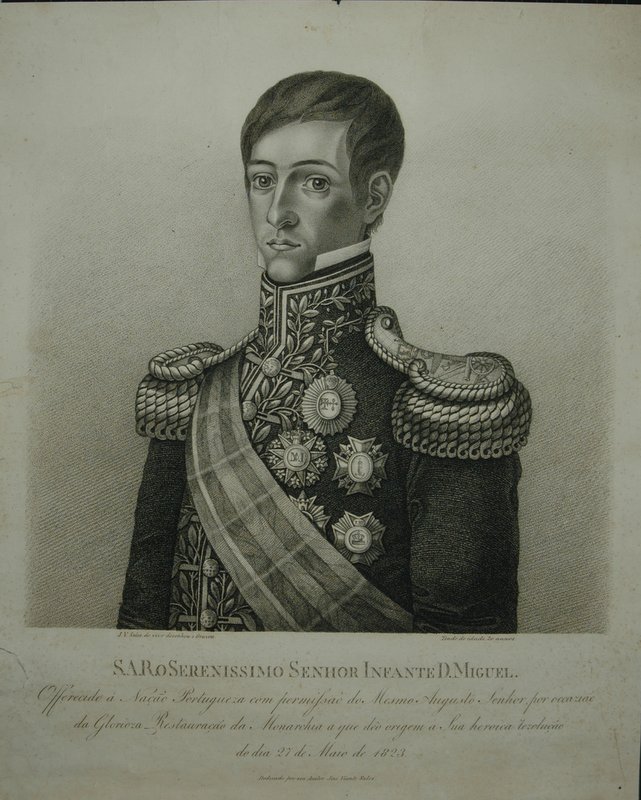
1823réf. 130677Selbstverlag von J.V. Sales, 1823. Format: 520 x 425 mm (bis auf oder über die Plattenkante beschnitten). Reines Bildformat: 365 x 380 mm).
réf. 2007Société catholique des Bons Livres, Paris, 1826.
1866réf. R33882Lisboa (Lissabon), Academia Real das Sciencias, 1866. Gr.-4°. Mit 1 mehrf. gef. lith. Karte u. zahlr. Textabbildungen. 2 Bll., 164 SS. OHldr. mit goldgepr. Rtitel (etw. beschabt u. bestoßen).
réf. 40223England. Folio 246 x 300 mm. Sewn. In two parts. i title 24 pp.; i title with addition "per Farnace" 23 pp. Notated in black ink on 10-stave rastrum-ruled paper with watermark dated 1806. For voices and unfigured bass. Cancellations and pencil corrections of two notes on p. 13 of first part; some measures numbered in contemporary manuscript. With small oval handstamp of the Glasgow Society of Musicians and "241" to first part and "86" to second to lower inner corner of titles; "10" in pencil to head of first part's title. Slightly soiled. Drawn from Portugal's opera La morte di Mitridate first performed in Lisbon at the Teatro S Carlos on 31 January 1806. The present manuscript would appear to be quite contemporary to the first performance of the opera. An edition of this aria was published in London in ca. 1807 a copy of which is held at the British Library. "Portugal was not only one of the most prolific Luso-Brazilian composers ever but also the most successful. His European fame rests above all on his comic operas especially Le confusioni della somiglianza Lo spazzacamino principe La donna di genio volubile Le donne cambiate and L'oro non compra amore and on the prima donna showpiece arias in La morte di Semiramide and Gli Orazi e i Curiazi. However he was equally famed in Portugal and Brazil as a composer of sacred music which he composed throughout his working life apart from the Italian period. His three best-known works remained in the repertory until the early 20th century: the Missa Grande c1790 the Matinas da Conceição 1802 and the Te Deum 1802. Portugal's operas were rooted in the Neapolitan style of Cimarosa. Yet as early as 1794 in Le donne cambiate he was more melodious and forward-looking using such devices as a 'stupefaction ensemble' and certain turns of phrase more readily associated with Rossini. His Lisbon operas were perhaps less adventurous musically relying more on Catalani's virtuosity. In his church music the elaborate stile concertato of his early years for the Patriarcal gradually developed into a pompous grandiloquent style fit to exhibit royal power. This is particularly so with the works for male voices and six organs at the Mafra Basilica many of which were reworked for mixed voices and orchestra for the Royal Chapel in Rio de Janeiro where the virtuosi castrati much appreciated by the King played a very influential role." António Jorge Marques and David Cranmer in Grove Music Online. unknown books
réf. 40223England. Folio 246 x 300 mm. Sewn. In two parts. i title 24 pp.; i title with addition "per Farnace" 23 pp. Notated in black ink on 10-stave rastrum-ruled paper with watermark dated 1806. For voices and unfigured bass. Cancellations and pencil corrections of two notes on p. 13 of first part; some measures numbered in contemporary manuscript. With small oval handstamp of the Glasgow Society of Musicians and "241" to first part and "86" to second to lower inner corner of titles; "10" in pencil to head of first part's title. Slightly soiled. Drawn from Portugal's opera La morte di Mitridate first performed in Lisbon at the Teatro S Carlos on 31 January 1806. The present manuscript would appear to be quite contemporary to the first performance of the opera. An edition of this aria was published in London in ca. 1807 a copy of which is held at the British Library. "Portugal was not only one of the most prolific Luso-Brazilian composers ever but also the most successful. His European fame rests above all on his comic operas especially Le confusioni della somiglianza Lo spazzacamino principe La donna di genio volubile Le donne cambiate and L'oro non compra amore and on the prima donna showpiece arias in La morte di Semiramide and Gli Orazi e i Curiazi. However he was equally famed in Portugal and Brazil as a composer of sacred music which he composed throughout his working life apart from the Italian period. His three best-known works remained in the repertory until the early 20th century: the Missa Grande c1790 the Matinas da Conceição 1802 and the Te Deum 1802. Portugal's operas were rooted in the Neapolitan style of Cimarosa. Yet as early as 1794 in Le donne cambiate he was more melodious and forward-looking using such devices as a 'stupefaction ensemble' and certain turns of phrase more readily associated with Rossini. His Lisbon operas were perhaps less adventurous musically relying more on Catalani's virtuosity. In his church music the elaborate stile concertato of his early years for the Patriarcal gradually developed into a pompous grandiloquent style fit to exhibit royal power. This is particularly so with the works for male voices and six organs at the Mafra Basilica many of which were reworked for mixed voices and orchestra for the Royal Chapel in Rio de Janeiro where the virtuosi castrati much appreciated by the King played a very influential role." António Jorge Marques and David Cranmer in Grove Music Online. unknown
réf. 6376452552Springer . Papeback. New. pp. 308 Springer unknown
réf. SONG052140908XUsed: Good unknown
Impresso en Madrid y por su original en Sevilla, por Joseph Padrino, 1762, 19,5 x 14 cm., pergamino de época, 47 págs. con texto a dos columnas, español y portugués. (Palau 248805. ?Esta edición se publicó sin permiso, alegando que la obra ya corría impresa, lo que motivó que Carlos III por Real Orden del 28 de julio de 1762 dispusiera "que los escritos que tratan de materias de estado no se divulguen ni sean reimpresos sin expresa licencia de su Majestad").
1817réf. PHO-2646Paris, F. Béchet, 1817, in-8 (20,5 x 13,5 cm), 2 ff.-166 pp., demi basane, ex-libris en page de garde, dos frotté, charnières fendues mais corps solide.
Londres, M. Calero, 1825, 13 x 9 cm., 297 + VI págs. + 1 h. (Ejemplar intonso en su mayor parte y falto de encuadernación. Rara colección de 63 cartas sobre temas muy variados, muchas de ellas sobre la política y cuestiones de Portugal, aunque también sobre otros temas como el papel moneda, condecoraciones honoríficas, La Santa Alianza en el Congreso de Verona, la educación desordomudos, etc.).
Lisboa, Jorge Rodriguez, 1637, 30 x 21 cm., pergamino con el lomo rasgado, 2 hojas + 93 folios. (Ejemplar falto de los folios 68 y 69).
réf. SONG0521830044Used: Good unknown
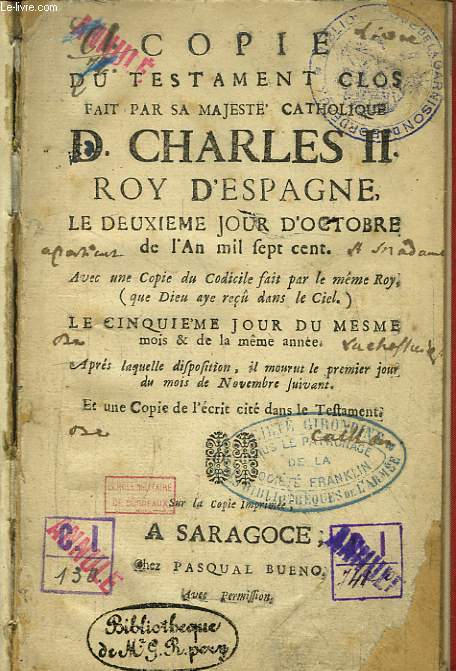
réf. RO80103391BUENO Pasqual, SARAGOCE. Non daté. In-12. Relié. Etat d'usage, Couv. légèrement passée, Dos satisfaisant, Quelques rousseurs. Ouvrage unique de 56 pages. Texte espagnol en regard du texte français, sur 2 colonnes. Etiquette de code sur la coiffe en-tête et tampons de bibliothèque sur la page de titre et dans quelques marges.. . . . Classification Dewey : 946-Espagne, Portugal
Ministère des Affaires Etrangères, Madrid. 1947-1969. In-8 Carré. Broché. Etat d'usage. Couv. convenable. Dos satisfaisant. Intérieur frais. Env. 80 numéros. Années 1952, 1957-1963 manquantes. Texte en français, et en espagnol. Quelques tampons et annotations de bibliothèque. 1er feuillet du n° 24 de déc. 1947 déchiré avec manque altérant sa lecture. Très rare. Sommaire du n° 24, déc. 1947: Le Marquis d'Auñon. Lettres et Histoire. Sociologie, Droit et Economie. Théologie et Philosophie. Etudes bibliques et ecclésiastiques. Vie artistique, etc. Sommaire du n° 279-281, avril-juin 1969: Bibliografia y temas generales. Teologia y Ciencias eclesiasticas. Filosofia. derecho. Economia. Sociologia y Politica. Letras...