AnonimoMareMagnum

9 172 résultats
1705Rara tavola, probabilmente una carta d'occasione nata per documentare l'evento bellico, dedicata al Dodicesimo assedio di Gibilterra.L'evento ebbe luogo nel corso della guerra di successione spagnola, dal settembre del 1704 al maggio del 1705, presso la Rocca di Gibilterra. Esso fece seguito alla presa dell'agosto del 1704 del villaggio fortificato di Gibilterra, all'estremità sud della Spagna, da una forza navale anglo-olandese guidata da sir George Rooke e dal principe Giorgio d'Assia-Darmstadt. I membri della Grande Alleanza, il Sacro Romano Impero, l'Inghilterra, i Paesi Bassi, la Spagna pro-Asburgo, il Portogallo ed il Ducato di Savoia, si erano alleati per prevenire l'unificazione del trono spagnolo con quello francese supportando il pretendente asburgico, l'arciduca Carlo d'Austria come Carlo III di Spagna. Il candidato rivale, il borbonico Filippo, duca d'Angiò noto come Filippo V di Spagna tra i suoi sostenitori, aveva per patrono ed alleato Luigi XIV di Francia.Il foglio viene probabilmente stampato a Madrid.Acquaforte, leggere mancanze nel testo in basso dovute a foro di tarlo, tracce di colla la verso, per il resto in buono stato di conservazione. Rare Spanish broadsheet dedicated to the Twelfth siege of Gibraltar.The Twelfth Siege of Gibraltar was fought between September 1704 and May 1705 during the War of the Spanish Succession. It followed the capture in August 1704 of the fortified town of Gibraltar, at the southern tip of Spain, by an Anglo–Dutch naval force led by Sir George Rooke and Prince George of Hesse-Darmstadt. The members of the Grand Alliance, Holy Roman Empire, England, the Netherlands, Pro-Habsburg Spain, Portugal and the Savoy, had allied to prevent the unification of the French and Spanish thrones by supporting the claim of the Habsburg pretender Archduke Charles VI of Austria as Charles III of Spain. They were opposed by the rival claimant, the Bourbon Philip, Duke of Anjou, ruling as Philip V of Spain, and his patron and ally, Louis XIV of France.The sheet is probably printed in Madrid.Etching, slight lacks in the text below due to wormhole, traces of glue on the reverse side, otherwise in good condition.
réf. 17480Dans une même reliure début 19ème en demi-cuir, 6 textes présentés en page de garde de façon manuscrite- Les Prussiens dénoncés à l'Europe par une Société de Témoins et de Victimes, de leur invasion dans la Province de Hollande. Paris 1789. 107 pages. -Relation fidèle et détaillée de la dernière campagne de Buonaparte terminée par la bataille de Mont-Saint-Jean dite de Waterloo. Paris 1815. 1 carte dépliante en couleurs. 69p. - Général de division J.H Bécaysferrand : Précis de la Défense de Valenciennes. Paris 1805. 78p -Mémoire du Duc de Rovigo sur la Mort de Pichegru du capitaine Wright, de M.Bathurst. Paris 1825. 72p. -Explications au sujet de la Commission Militaire instituée en l'An XII, pour juger le Duc D'Enghien. 15p. -Léonard Gallois : Trois mois au Portugal en 1822. Lettres. Paris 1822. 93p. Etat correct.Demi-reliure d'époque aux mors supérieurs ouverts.Coins émoussés.Ex-libris du Baron de Neuflize.
1739Rarissima carta topografica della Provincia della Castiglia Nuova, istituita nel 1588 dalla Congregazione spagnola dell'Ordine dei Carmelitani Scalzi e intitolata allo Spirito Santo la cui immagine, in forma di colomba, sormonta il cartiglio con il titolo. La mappa venne pubblicata nell'opera Provinciarum et Conventuum Fratum, ac monalium Discalceatorum Ordinis B Virginis Mariae de monte Carmelo Congregationis Hispaniae Corographica Topographica, et Chronologica Descriptio" edita a Roma nel 1739. Sulla carta i gradi delle sedi - patriarcale, arcivescovile, episcopale - sono indicati per mezzo di conventi (riconoscibili perché sormontati dalla croce) di grandezza diversa, il cui significato è chiarito sul secondo frontespizio dell'opera.Margini graduati, scala espressa in leghe spagnole - Scala Leucarum Hispaniae (40 miglia =4,5 cm); l'orografia è rappresentata con il disegno delle montagne dal profilo ombreggiato; è riportata anche l'idrografia, con l'indicazione dei nomi dei corsi d'acqua. Nel margine inferiore, due rubriche, una numerica e l'altra alfabetica, con i riferimenti rispettivamente ai Conventi dei Frati (Conventus Fratrum) e a quelli monache carmelitane (conventus Monalium).A destra, un piccolo cartiglio con una veduta di Roma, dove aveva sede il procuratore generale dell'Ordine.Incisione in rame, completa dei margini bianchi, in ottimo stato di conservazione. A very rare map of Castile, with Carmelite convents, engraved by Domenico Franceschini.The map shows the province established in 1588 by the Spanish Congregation of the Order of Discalced Carmelites and dedicated to The Holy Spitit, whose image surmounts the cartouche with the title.The map is part of the work Provinciarum et Conventuum Fratum, ac monalium Discalceatorum Ordinis B Virginis Mariae de monte Carmelo Congregationis Hispaniae Corographica Topographica, et Chronologica Descriptio" edited in Rome in 1739.Graduated borders, scale in the Spanish miles - Scala Leucarum Hispaniae (40 miles = 4.5 cm), the topography is represented with the design of the mountains from the shaded profile; It is also reported the hydrography, indicating the names of the waterways.In the lower margin, alphabetical and numerical legends respectively, with the references to the Convents of Friars (Conventus Fratrum) and those Carmelite nuns (conventus monalium).Copperplate, with margins, a small wormhole in the upper margins, otherwise perfect condition.
1739Rarissima carta topografica della Provincia di Murcia, istituita nel 1713 dalla Congregazione spagnola dell'Ordine dei Carmelitani Scalzi e intitolata a S. Anna, la cui immagine sormonta il cartiglio con il titolo. La mappa venne pubblicata nell'opera Provinciarum et Conventuum Fratum, ac monalium Discalceatorum Ordinis B Virginis Mariae de monte Carmelo Congregationis Hispaniae Corographica Topographica, et Chronologica Descriptio" edita a Roma nel 1739. Sulla carta i gradi delle sedi - patriarcale, arcivescovile, episcopale - sono indicati per mezzo di conventi (riconoscibili perché sormontati dalla croce) di grandezza diversa, il cui significato è chiarito sul secondo frontespizio dell'opera.Margini graduati, scala espressa in leghe spagnole - Scala Leucarum Hispaniae (40 miglia =4,5 cm); l'orografia è rappresentata con il disegno delle montagne dal profilo ombreggiato; è riportata anche l'idrografia, con l'indicazione dei nomi dei corsi d'acqua. Nel margine inferiore, due rubriche, una numerica e l'altra alfabetica, con i riferimenti rispettivamente ai Conventi dei Frati (Conventus Fratrum) e a quelli monache carmelitane (conventus Monalium).Incisione in rame, completa dei margini bianchi, in ottimo stato di conservazione. A very rare map of central area of Murcia, with Carmelite convents, engraved by Domenico Franceschini.The map shows the province established in 1713 by the Spanish Congregation of the Order of Discalced Carmelites and dedicated to Sant 'Anna, whose image surmounts the cartouche with the title.The map is part of the work Provinciarum et Conventuum Fratum, ac monalium Discalceatorum Ordinis B Virginis Mariae de monte Carmelo Congregationis Hispaniae Corographica Topographica, et Chronologica Descriptio" edited in Rome in 1739.Graduated borders, scale in the Spanish miles - Scala Leucarum Hispaniae (40 miles = 4.5 cm), the topography is represented with the design of the mountains from the shaded profile; It is also reported the hydrography, indicating the names of the waterways.In the lower margin, alphabetical and numerical legends respectively, with the references to the Convents of Friars (Conventus Fratrum) and those Carmelite nuns (conventus monalium).Copperplate, with margins, a small wormhole in the upper margins, otherwise perfect condition.
1739Rarissima carta topografica della Provincia di Navarra, istituita nel 1706 dalla Congregazione spagnola dell'Ordine dei Carmelitani Scalzi e intitolata a S. Giovanni, la cui immagine sormonta il cartiglio con il titolo. La mappa venne pubblicata nell'opera Provinciarum et Conventuum Fratum, ac monalium Discalceatorum Ordinis B Virginis Mariae de monte Carmelo Congregationis Hispaniae Corographica Topographica, et Chronologica Descriptio" edita a Roma nel 1739. Sulla carta i gradi delle sedi - patriarcale, arcivescovile, episcopale - sono indicati per mezzo di conventi (riconoscibili perché sormontati dalla croce) di grandezza diversa, il cui significato è chiarito sul secondo frontespizio dell'opera.Margini graduati, scala espressa in leghe spagnole - Scala Leucarum Hispaniae (40 miglia =4,5 cm); l'orografia è rappresentata con il disegno delle montagne dal profilo ombreggiato; è riportata anche l'idrografia, con l'indicazione dei nomi dei corsi d'acqua. Nel margine inferiore, due rubriche, una numerica e l'altra alfabetica, con i riferimenti rispettivamente ai Conventi dei Frati (Conventus Fratrum) e a quelli monache carmelitane (conventus Monalium).Incisione in rame, completa dei margini bianchi, in ottimo stato di conservazione. A very rare map of central area of Navarra, with Carmelite convents, engraved by Domenico Franceschini.The map shows the province established in 1706 by the Spanish Congregation of the Order of Discalced Carmelites and dedicated to St. John, whose image surmounts the cartouche with the title.The map is part of the work Provinciarum et Conventuum Fratum, ac monalium Discalceatorum Ordinis B Virginis Mariae de monte Carmelo Congregationis Hispaniae Corographica Topographica, et Chronologica Descriptio" edited in Rome in 1739.Graduated borders, scale in the Spanish miles - Scala Leucarum Hispaniae (40 miles = 4.5 cm), the topography is represented with the design of the mountains from the shaded profile; It is also reported the hydrography, indicating the names of the waterways.In the lower margin, alphabetical and numerical legends respectively, with the references to the Convents of Friars (Conventus Fratrum) and those Carmelite nuns (conventus monalium).Copperplate, with margins, a small wormhole in the upper margins, otherwise perfect condition.
réf. 67115, Galerie Lelong & Co., 2010 hardcovers, dusjackets,1716 pages, 6 vols. Illustrations col. & bw ill. Text; English, *NEW!!!! .
1857réf. 19030Paris, Jules Tardieu - Bruxelles, E. Guyot et Stapleaux Fils & Charles Tanera 1857 In-8 relié 27,5 cm. Bon état d’occasion.
1725Delineata sulla scia della più grande veduta di Jeremias Wolff, l’opera offre quaranta riferimenti topografici. Il Leopold, era un modesto incisore ed editore di Augsburg; la sua serie di vedute di città, da cui questa incisione è tratta, venne pubblicata con pochissima tiratura, rendendo quindi le opere particolarmente rare. Incisione in rame, in ottimo stato di conservazione. In the wake of Jeremias Wolff’s bigger view, this work presents many topographical references. Leopold was a modest engraver and publisher in Augsburg; the series of city views, from which this one is taken, has been published in a very limited circulation, which means these works are very rare. Copperplate, in excellent condition.
réf. 9254è quibusque probatissimis scriptoribus per Adream Eborensem luisitanum selectorum, tomus posterior. Adiecto duplici indice, uno locorum communium, altero propriorum nominum, rerùmque memoria dignarum locupletissimo. In 12 plein cuir fauve raciné, pièce de titre cuir noir, fers, nom de ville et date en pied, dorés. Roulette dorée sur coupes, filet à froid encadrant les plats. Titre XIII 667 pages, 1 page d’errata, 32 pages, Index copiosissimus omnium nomina, quorum Exempla in hoc volumine referuntur,complectens. Tranches rouges Lugduni Apud Theobaldum Paganum 1557.Petits manques aux coiffes, intérieur en très bon état, sans rousseurs, ni autres marques, ou pliures, pas de feuillets déboité. Très bon exemplaire en première édition. Fort rare.
1841réf. 10734Stuttgart und Tübingen, Cotta, 1841. 3 Bde. VI, 366; VI, 439; VI, 469 S. Kl.-8°. Lwd. der Zeit mit Rückentitel (Rücken mit kl. Bibliotheksschildchen, gering bestoßen).
1975364 pages. Extensive index. Over 5,000 entries. "...An attempt to bring under bibliographical control a wide range of published materials pertaining to the Jewish presence in Spain and Portugal from antiquity to the present day." - Introduction. Clean and bright with light wear. Binding tight. Usual library markings. A sound copy of this excellent reference. Book
réf. 71190aafLisboa, João Rodrigues Neves, 1806, in-8vo, XII + 344 (recte 346, nr. 303-4 used twice) + 2 leaves (errata), waterstaining to bottom margin in the first part of the volume (more important in the first 40 leaves, some tiny tears to bottom margin of prelim. part, some water staining (mainly marg.) to few leaves at the end, hw. former owner's name in bottom margin of title Gonçalo Pinto, small bookshop label on front pastedown, half leather binding, gold tooled spine, top ofspine chipped, top of hinges starting, partly rubbed and bumped.
réf. 71062aafLisboa, 1754, in-8vo, 353 pp + 15 pp. (alphab. index), repair to a few mainly marginal tears in (p. 33/34, p. 83/84), tiny hole in p. 223/224, some underlining with light blue pencil, browning of the paper, marbled endpaper, hw. former owner's names and stamp on title, 2 book plates on front pastedown, recent hw. former owner's name on white endpaper, 19th ,early 20 th. century marbled leather binding in contemp. style, richly gold tooled spine, simple gilt line frame on covers.
1961réf. 3471789Olisipone (Lisboa), typis academicis. 1888-1961. 1407 pp. Broschur (uncut). 44x30 cm.
réf. 198836Bruxelles, et se trouve à Paris, Volland, 1787 in-8, [7] ff. n. ch. (titre, préface, dédicace à Madame Helvétius, table des matières, errata), 257 pp., avec une carte dépliante et une planche de costume, veau fauve marbré, dos lisse orné d'un semis géométrique doré, pièce de titre cerise, encadrement de simple filet à froid sur les plats, simple filet doré sur les coupes, tranches rouges (reliure de l'époque). Charnière supérieure un peu fendue.
réf. 111832A Paris, Chez Nicolas Le Gras, 1706 (I, IV, VI, VII) - 1701 (II, III, V) -1700 (VIII), 8 volumes in-12 de 90 x 160 mm environ, 292-268-349-426-316-367-234-341 pages. Ensemble comportant 27 cartes et 5 vues contrecollées. Pleines reliures mouchetées d'époque, dos à 5 nerfs portant tomaisons dorées et titres dorés sur pièce de cuir tabac, caissons ornés, roulettes dorées sur les coupes, tranches mouchetées. Reliures solides mais avec des défauts (7 coiffes manquantes, travail de vers par endroits, coins émoussés, quelques manques de cuir), des rousseurs, des pages brunies et des traces de mouillures, il manque 1 feuillet au tome VIII (p.223-224, sans manque de texte : feuillet vierge ? faux-titre ?), ensemble néanmoins très correct.
réf. 242495Paris, Barrois l'Aîné, 1821 in-8, 360 pp., cartonnage papier fantaisie (reliure postérieure).
réf. 230037Paris, chez Paul Renouard, 1819 2 vol. in-8, 380 pp., et 384 pp., front. à chaque volume, carte dépl., demi-chagrin bleu, dos à nerfs orné, tête dorée (reliure moderne). Rousseurs.
1836réf. LBW-5981[1836]. 598 x 879 mm.
1640réf. LBW02501Amsterdam vers 1640 380 x 497 mm.
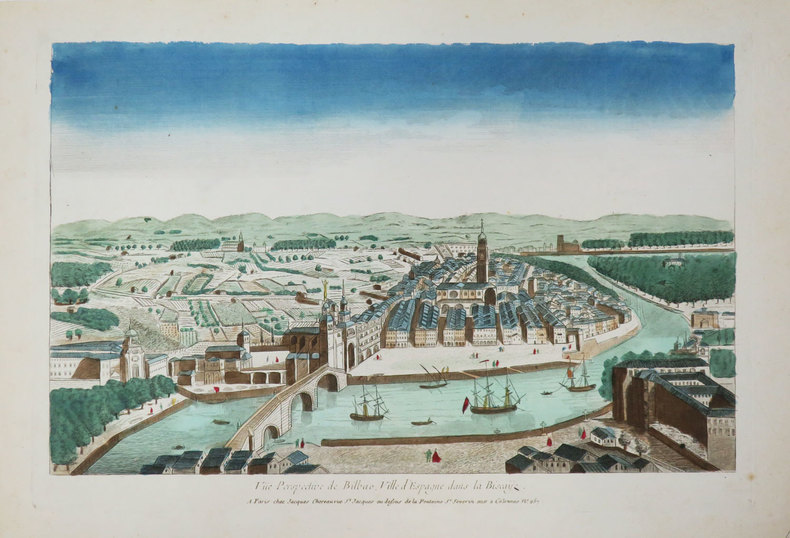
1780réf. LBW-3425Paris, Jacques Chéreau, [circa 1780]. 275 x 408 mm.
1850réf. LBW-4937Paris,chez l'auteur, [circa 1850]. 220 x 301 mm.
1822réf. QZI-21Lisboa, Na Typografia Rodrigues Galhardo, 1822. Primeira e única edição. Livro fino in-12 de 14 x 19 cm, 106 (1) pp. Encadernado em meio-couro marroquino de tom vermelho cereja com cantos. Lombada com cinco nervos, título dourado em fonte de impressão, ano no baixo da lombada. Papeis marmorizados. Encadernação recente, porém fiel ao estilo, espírito e aos materiais usados na época cujo foi livro publicado. Páginas restauradas, com partes em branco no meio das páginas, deixando adivinhar de uma a três letras em palavras ocupando essa posição. Defendendo a conservação do vínculo luso-brasileiro no contexto da crise da independência, as Reflexões foram publicadas para tentar evitar a separação, argumentando que a união traria força e estabilidade ao Reino Unido, contrariando as tendências separatistas no Brasil e as exigências das cortes em Lisboa. Uma das propostas mais interessantes que fiz era o rei viver alternativamente nas cortes de Lisboa e Rio de Janeiro, com um regente assumindo o poder a cada ausência do rei numa das capitais. Um documento escrito tentando mudar a história. Obs: um exemplar do mesmo livro em estado menos favorável foi vendido por um preço mais alto que o nosso no fim de 2025.
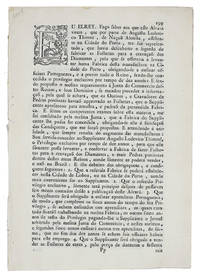
1766réf. ABC_46586Ajuda district of Lisbon 1766. Folio. Palacio de Nossa Senhora "reprinted by Miguel Rodrigues" Disbound folded. With a large decorated woodcut initial E with the coat of arms of Portugal opening the text. pp. 199-201 blank 202. Rare royal proclamation issued 22 August 1766 by King Joseph I of Portugal 1714-1750-1777 and registered and certified by his secretary Joaquim Joseph Borralho granting August Ludwig Thimne the exclusive privilege and patent for ten years to set up a factory in Porto or Lisbon to produce foil from silver and other metals for setting diamonds and other precious stones. The proclamation forbids the import of contraband foil into Portugal giving Thimne the sole rights to the production and sale of the foil. Thimne discovered how to manufacture foil to set diamonds and other gems and stones in 18th-century Portugal where the setting of diamonds and gems and the creation of spectacular jewellery became more and more important.A highly interesting proclamation on the Portuguese diamond and gemstone industry especially on underlaying with foil as an appearance modification technique used for 18th-century Portuguese jewelry not only granting Thimne a privilege but also regulating the production for the Portuguese market.The bifolium is almost completely torn into two leaves on the fold line but otherwise in very good condition.l Portuguese and Brazilian books in the John Carter Brown Library 1537 to 1839 2009 766/5; WorldCat 81024902 no copy listed; 460587852 1 copy of the whole ed. unknown