1961Very Good Arabic Original wrapper, missing back cover. Foolscap 8vo. (17 x 13 cm). In Arabic. 117, [1] p., b/w ills. and one map. Scarce illustrated Arabic book of the Afghan people living in different regions in Afghanistan, written in the period of Mohammed Daoud Khan (1909-1978), who was an Afghan politician and general who served as prime minister of Afghanistan from 1953 to 1963. It's published as the seventh book of the "Peoples of the World Series". Second Edition. Fifteen copies in OCLC 235990862, 29876584.
19398vo., First Edition, with plates and double-page map; elegantly bound in full dark red crushed morocco, sides with gilt frame border, back with raised bands, second and fourth compartments ruled and lettered in gilt, all other compartments ruled in gilt, gilt top, hand-made endpapers, a most attractive copy ideal as a gift or for presentation.
1980Best.-Nr. biblio39406Boston: Management Science for Health 1980. New SoftCover. 8.9"x6.0". be33000. Management Science for Health paperback
1939Best.-Nr. 109826Editions d'Art et d'Histoire Mémoires de la Délégation Archéologique Française en Afghanistan 1939 Paris, Editions d'Art et d'Histoire, Mémoires de la Délégation Archéologique Française en Afghanistan (tome IX), 2 volumes brochés, 1939,137 p.-LXXVIII planches, environ 380x285mm, couvertures insolées, haut et bas des dos émoussés, dos en partie décollés, des rousseurs sur les gardes, bon état pour le reste, les pages du volume de texte ne sont pas coupées (jamais lu).
1936Best.-Nr. 2111902160501196same club 1936. Soft Cover. Fine. Number of pages: B5 type printing 85p Northern Arabia map same club paperback
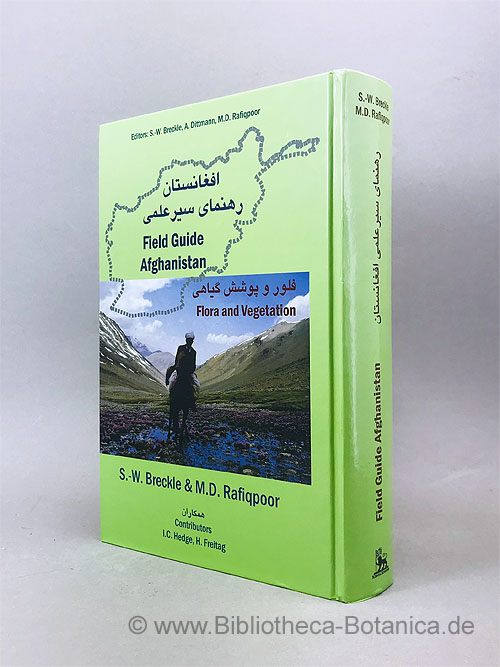
2010Best.-Nr. 10930ABBonn/Manama/New York, NY/Florianópolis, Scientia Bonnensis, 2010. 25 cm. 861 S. Mit zahlr. farb. Ill., graph. Darst., Kt. Illustrierter Pappband (Hardcover). Rücken am Fuß minimal bestoßen, sonst neuwertiges Exemplar.
Best.-Nr. BN370387Akademische Druck- und Verlag-Anst. Schmuck in Afghanistan Hardcover Schmuck in Afghanistan Hardcover Schmuck in Afghanistan Hardcover Akademische Druck- und Verlag-Anst. hardcover
1924Abundant black and white illustrations and reproductions of photos. Features: Lost in the Pacific - John Edwin Hogg attempted to take a small boat to Panama from some islands 90 miles off the coast, but encountered treacherous seas; On Niagara's Brink - Orrin E. Dunlap, the unofficial historian of Niagara Falls, describes the area's most thrilling adventure, that of a barge and two men, Lofberg and Harris, who drifted to the verge of Horseshoe Falls - article with photos; An Englishwoman in Upper Egypt - Part I - Oxford Anthropology student Winifred S. Blackman relates her experiences in three winters of living with the people of Upper Egypt - article with photos; Captain Doudera's Bet - The amazing photo-illustrated story of Captain Frank Doudera, of Brooklyn, New York, and his quest to obtain a timber wolf pelt within six weeks; The Head-Hunters of the Sepik - Part II - Beatrice Grimshaw travelled up the Sepik River of New Guinea, where she dealt with the local cannibals - article with photos; Chippin' Paint - An amusing sea story; To Afghanistan in Disguise - Part II - A British officer's remarkable journey, disguised as an Oriental, across a large part of India and finally into forbidden Afghanistan and beyond, living among the natives as one of themselves; The Treasure of Tristan Da Cunha - Photo-illustrated article about a hoard of gold and jewels said to have been hidden here by pirates in 1810; Photo of a literal river full of logs in British Columbia; The Three Angleteers - Part IV - Three bored Englishmen travel to Europe for trouble and adventure; In the British Guiana Jungle - A vividly-written photo-illustrated account of an eventful boat-journey into the interior of British Guiana with a motion picture camera, culminating with a visit to the mighty Kaietuerk Falls, the greatest cataract in the world, five times higher than Niagara; The Secret of the Wilds - photos of wild animals which resemble those of prehistoric times; "Grip" and I - Part II - A bull-terrier spared from death by its new owner Count Nils Cronstedt returns the favour by saving him multiple times during his stay in West Africa as Commander of H.M.S. Heron and Assistant Marine Superintendent in Northern Nigeria; One Night - the story of a hunt in the darkness and a panther who stood his ground; and more. 88 pages plus 24 pages of nice vintage ads. Clean and unmarked with light wear. A quality copy of this excellent vintage issue. Book
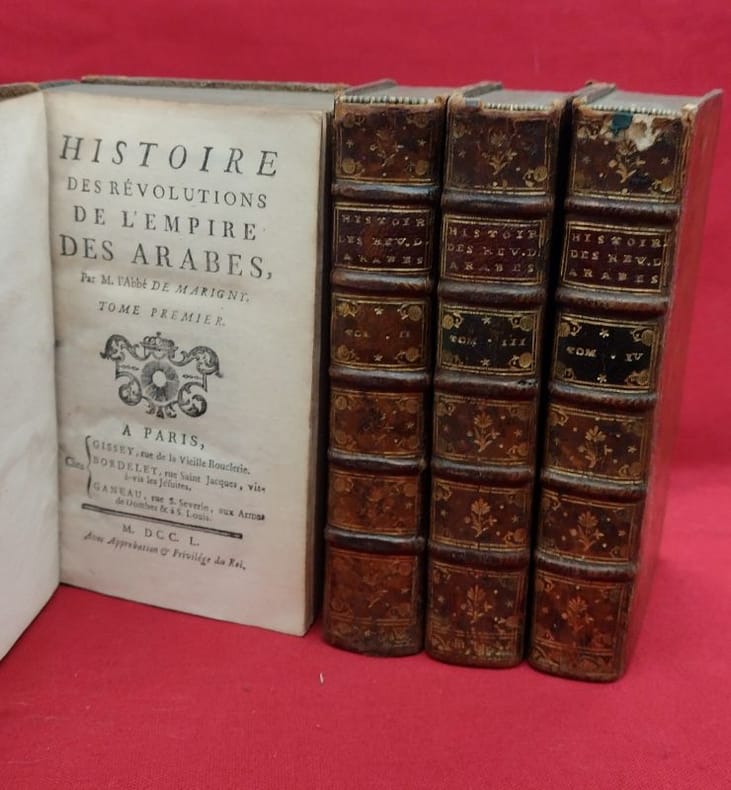
1750Best.-Nr. 118710gisset, bordelet, ganeau 1750 4 in-12 A Paris, chez Gissey, Bordelet, Ganeau, 1752, 4 volumes in-12, (2) ff., LX, 58, 498 pages, (3) ff.-(2) ff., 519 pages - (3) ff., XIV, 540 pages - (2) ff., 525 pages. Plein veau marbré, dos à cinq nerfs portant titres et tomaisons dorés sur pièces de cuir, caissons ornés, filets d'encadrements des plats à froid, filet doré sur les coupes, roulette dorée sur les chasses, tranches mouchetées de rouges, gardes de papier marbré peigné. Cinq coiffes manquantes ou endommagées, coins frottés, rares rousseurs, sinon bon état général.
1988Best.-Nr. BN502744CNRS Editions 1988. 1988. Softcover. Le fait ethnique en Iran et en Afghanistan Le fait ethnique en Iran et en Afghanistan Colloque international sur le fait ethnique en Iran et en Afghanistan 1985 : Iv Jean-Pierre Digard et Centre national de la recherche scientifique France CNRS Editions paperback
Best.-Nr. 195387Paris, Ernest Leroux, 1878 grand in-8, [6]-V-186 pp., avec des illustrations dans le texte et 27 planches hors-texte (dont un portrait-frontispice, deux lithographies, 5 cartes, 17 tableaux dont 16 de relevés anthropologiques "in fine"), demi-basane brune à coins, dos à nerfs muet, couverture conservée (reliure moderne). Dos muet.
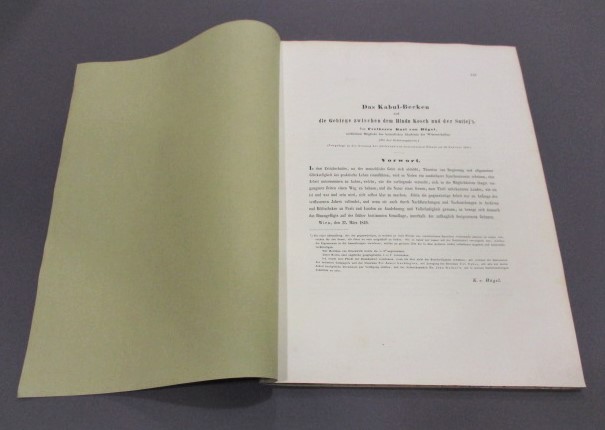
1852Best.-Nr. 21121Wien, Staatsdruckerei, 1851 - 1852. S. 119 - 190, 73 - 109. 3 (2 gefalt.) lithograph. Karten. 4°. Mod. Kart. [5 Warenabbildungen]
19378vo., First Edition, with frontispiece, 15 plates and 5 full-page maps in the text; original blue cloth, gilt back, blue top (somewhat faded), boards a little darkened at fore-edges else a very good, bright, crisp, clean copy. With 2pp of publisher's advertisements at end. First issue of the most celebrated travel book in English of the 1930s. VERY SCARCE IN THIS CONDITION.
1985Best.-Nr. 61591Graz, Akademische Druck- u. Verlagsanstalt, 1972-1985. 4°. Mit rund 400 Karten im Text, einigen gefalt. Tabellen u. einer mehrf. gefalt. farb. Karte als Beilage. Zus. ca. 3.500 S., OLwd.-Bde. m. illustr. OUmschlägen.
1909Very Good Turkish, Ottoman (1500-1928) Original illustrated wrappers. Cr. 8vo. (19 x 13 cm). In Ottoman script (Old Turkish with Arabic letters). 105 p., 8 b/w plates. First edition of this illustrated travel account of one of the exiled Young Turks to Afghanistan, who was invited to the country by the reformist Afghan Emir Habibullah Khan (1872-1919), who was the ruler of Afghanistan from 1901 to 1919. The news that the reformist Afghan Emir Hamidullah Khan was looking for well-educated Turkish youth to help the development of his country, reached the Young Turks in exile in Egypt. The author of this book, Mehmet Fazli was one of the Young Turks (A reformist group in the early 20th century that favored the replacement of the Ottoman Empire's absolute monarchy with a constitutional government), and he followed this royal invitation and set off with his friends. He reached Kabul via an adventurous journey through Austria-Hungary, Russia, Azerbaijan, Turkmenistan, and Iran. With his guide and friend who was an Afghan and his Turkish friend Hüseyin Hüsni Bey, Fazli met in Cairo and they went to Afghan lands. He described Kabul, Herat, Ghazna, Belh, and Kandahar cities during their travel, wrote about the Afghan Emîr and the dynasty. His book revolves around the many details on Afghan peoples' customs, social life, education, industry, roads, antiquity, postage system and organization, arms and army, etc. The book has a photo of the Afghan Emir beside other attractive illustrations and photographs. (Sources: Afganistan'da Bir Jöntürk: Misir Sürgününden Afgan Reformuna., Prep. by Kenan Karabulut.; History of Geographical Literature during the Ottoman Period., Edited by Ekmeleddin Ihsanoglu). Özege 16749.; OCLC 868007927.; MKAHTBK, II 948.
1899Very Good Turkish, Ottoman (1500-1928) Paperback. Foolscap 8vo. (18 x 13 cm). In Ottoman script (Turkish with Arabic letters). 80 p., [10] unnumbered b/w plts. Yenisehirlizâde Halit Eyüp was the son-in-law of Ahmet Midhat Efendi, one of the shaded names of Turkish literature. This rare book has 10 unnumbered b/w plates shows firstly Abd Al-Rahman Khan, (1845-1901), who was Emîr of Afghanistan and played a prominent role in the fierce and long-drawn struggle for power waged by his father and his uncle, A'?am Khân, against his cousin Shîr 'Alî, the successor of Dost Mo?ammad Khân. And then, Khaybar Fortress, Peshaver city in India, Tajik chief of Afghanistan: Maaz Khan (two-paged print), a view of Kabul city (two-paged print), Ghaznawid Fortress, North Gate of Kandahar, Herat Fortress (two-pages print), Cohat Fortress, a portrait of Afghan Sufi. An extremely rare and richly illustrated book of the history of Afghanistan. Hegira: 1316 = Gregorian: 1899. First and Only Edition. TBTK 12178.; Özege 19966.; Three copies located in OCLC: 944246927 (One copy in Library of Congress - Karl Süssheim Collection, No. 7.).; 163633157 (Orient-Institut Istanbul and Bayerische Staatsbibliothek).
1869Best.-Nr. 45050ABSt. Petersburg, Peatnja V. Golovina, 1869. X, 560 S. Bedruckte Orig.-Broschur.
1907Very Good Turkish, Ottoman (1500-1928) Original chromo-lithograph map on cloth. 63x98 cm. In Ottoman script (Old Turkish with Arabic letters). Chipped on extremities, some wear on folds, foxing, and stains on margins and cloth with small holes. Overall a good/fair copy. First separate edition of this rare and attractive chromo-lithographic map of the Imperial Ottoman lands in Europe, as well as the Bosphorus and Crete in separate panels, drawn by Turkish infantry major El-Hac Nasrullah b. El-Hac Nâsir from Daghestan, during the last period of the rule of Sultan Abdulhamid II, with praise to the Sultan. The map gives detailed information on the lower left telegraph and postal codes of the Imperial vilayats such as Bosnia, Bulgaria, Algeria, Egypt, and Tunisia, etc. Additionally, on the lower right, demographic statistics and data of vilayats and some cities. This rare map shows the complete Ottoman Balkans according to the Ottoman administral system. West Anatolia and West Black Sea Coats on the east, Adriatic coasts on the east, and Ottoman Greece, Bulgaria, Albania, and Bulgaria are included on the map. These countries are separated by Selanik (Thessaloniki), Roumeli, Monastery, Ioannina, Kosovo, and Shkodra vilayats.
1867Best.-Nr. 45049ABSt. Petersburg, V. Bezobrazova, 1867. XIV, 1010 S., 1 Bl. Mit 2 (1 gefalt.) lithogr. Tafeln und 1 gefalt. lithogr. Karte. Bedruckte Orig.-Broschur.
Best.-Nr. 237515London, printed for Longman, 1819 2 volumes in-8, XXIV-512 pp. et XII-495 pp., cartonnage papier gris (reliure de l'époque).
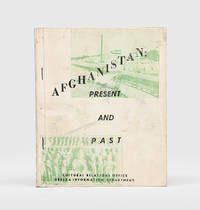
1958Best.-Nr. 180912Kabul: Bureau of Afghan Publicity Cultural Relations Office Department of Press and Information 1958. First edition of this guide to Mohammad Zahir Shah's modernizing state with chapters on politics and diplomacy industry mineral deposits and many other topics. In the year of publication Prime Minister Daoud Khan became the first Afghan to address to the US Congress and President Eisenhower made a formal visit in 1959. Octavo. With 24 photographic halftone plates. Original illustrated card wrappers wire-stitched as issued front cover lettered in black and with green halftone illustrations. Occasional contemporary green ink marks in margin. Covers marked contents evenly toned: very good. unknown
1813Best.-Nr. 137089kyoto, hishiya magobei, sd (XIXème] 1813 2 volumes, 26 x 17.5 cm. Reliure japonaise refaite, étiquetes conservées,.19 & 19 illustrations illustrations à double page en couleurs.
1860Very Good Turkish, Ottoman (1500-1928) Original fine 1/4 leather bound in Ottoman lettered gilt. Demy 8vo. (22 x 14 cm). In Ottoman script (Old Turkish with Arabic letters). 174 p. Hegira: 1277 = Gregorian: 1860. Rare early (second) edition of this eye witness and first-hand account, and one of the most important chronicles describing the history of late Safavid Iran in the 18th century, the Iranian invasion of Afghanistan and the siege and the fall of Isfahan in 1722 written by Kruzinski who was a Polish Jesuit missionary served in the Persia in the early 18th century. In 1720 he was nominated advocate general of the mission in Persia and became the secretary to the Bishop of Isfahan. Krusinski himself, however, claimed later on that he is not only the author but also the translator of this work. As a chronicle, this is a history of Iran under the Safavids from 1499 up to 1727 with a special focus on the 1722 Afghan invasion that terminated the Safavid dynasty. "His account of the conditions and events preceding and during the siege and the subsequent demise of the Safavids is unique. It also offers key insights into the workings of the late Safavid state and government as well as the functions of the royal harem." (Bloomsbury). Translated and expanded by Ibrahim Müteferrika of Kruzinski's Latin manuscript written in 1726 in Istanbul and entitled "Historia revolutionis monarchia Persica". The book was first published in Italian, French, and English translations, in Rome (1727), Paris (1728), and London (1728). The founder of the legendary first printing house in the Islamic world, Ibrahim Müteferrika (1674-1745), was the editor of this book. Ceridehâne [i.e. Journal House] Printing House is the successor of the Müteferrika Press in the early 19th century. "The book is a Turkish translation of the history of Iran written in Latin by the Jesuit missionary Judas (Jan) Tadeusz Krusinski (1675-1751). The work, whose title can be translated as 'A voyager's description on the apparition of the Afghans and on the reasons of the Safavid Empire being undermined', focuses on the Afghan invasion of 1722 which led to the fall of the Safavid dynasty, but also offers an overview on the historical processes of early 18th-century Safavid Iran. The publication of this work was made actual not only by the vicinity of Iran to the Ottoman Empire but also by the historical turn reorganizing the relations of power in the region and triggering the intervention of the Ottomans as well. This may have been the reason that among the first Turkish incunabula this was the work published in the highest number of copies. This publication also offers an early example of copyright disputes, as Krusinski considered the Turkish translation as his own work, while Müteferrika, who does not mention his name in the printed version, suggests himself to be the translator". (Source: The Mysterious Printer Ibrahim Muteferrika and the Beginnings of Turkish Book Printing: Library of Hungarian Academy of Sciences Online). Özege: 19897.
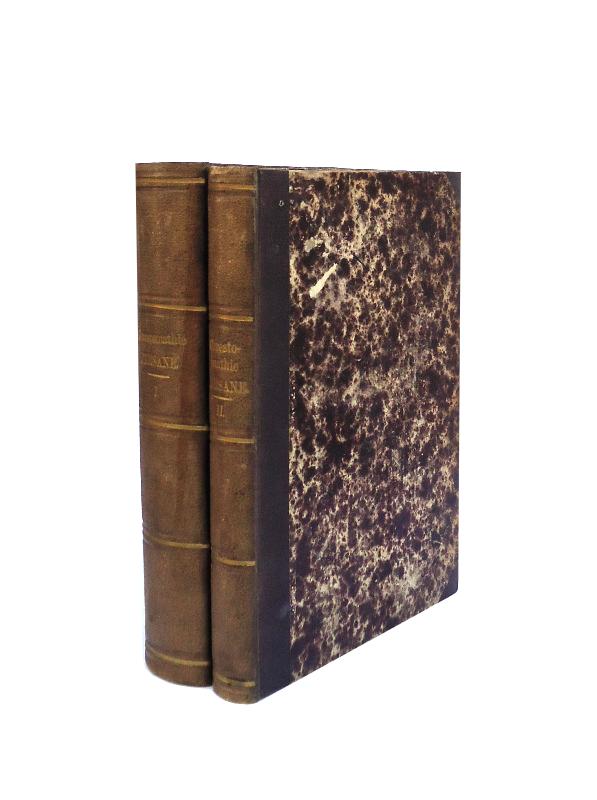
1843Best.-Nr. 19824Paris, Typographie de Firmin Didot Frères, 1843-1853. In-8°. CLV, 276; XXXVIII, 292 (2) p. (= Chrestomathies orientales), demi-reliures de toile avec titres dorés. - 1. Prolégomènes des tables astronomiques d'Oloug-Beg, publiés avec notes et variantes, et précédés d'une introduction par L.P. E. A. Sédillot. 1847. - Mirkhond: Histoire de Sassanides, à l'usage des élèves de l'école royale et spéciale des langues orientales vivantes. 1843. - 2. Prolégomènes des tables astronomiques d'Oloug-Beg. Traduction et commentaire, par L.P.E.A. Sédillot. 1853. Reliures un peu frottées. Petite manque sur le plat. Quelques cachets sur les pages de titre et sur les dernières pages de texte. Papier un peu taché par la moisissure.
Best.-Nr. PF48Fourteen loose original albumen photographs ca. 171x123 cm 6 ¾ x 4 ¾ in mounted on ornamented cardboards. All photos with period Russian captions on the verso. Photos housed in a folder. Light soiling of the cardboards photos age-toned several photographs with small stains but overall a very good collection of strong interesting photos. Historically important collection of professional albumen photographs mostly documenting Mashhad Iran in the late 19th century and before the 1912 bombardment of the city. At the time Mashhad was a major political and commercial center under the Qajar dynasty. Owing to its proximity to Afghanistan and Russian Central Asia the city became a focal point of the Great Game between Britain and Russia. Following the establishment of the Russian consulate in Mashhad 1889 Russian consular guards Cossack escorts and military advisers appeared in the city to protect Russian subjects. In 1912 amid anti-Russian protests Russian Cossack forces heavily bombarded the city heavily damaging the Imam Reza Holy shrine complex and surrounding areas. As follows from the captions the photographer was of Russian origin and was likely on assignment related to the military interests of the empire in the region. The stiff ornamental mounts suggest that the photos were produced for official or presentation purposes possibly intended for consular archives a government report or as a gift to a high-ranking official. The collection contains 14 photographs of mostly Mashhad including four well-executed early views of the pre-bombarded Imam Reza Holy Shrine. The images show a general view of the crowded shrine the arch and courtyard with horses and an archway guarded by armed soldiers. Another important photo depicts the interior of the nearby Gawhar-Shad Mosque with three Russian soldiers posing on the pulpit. Especially interesting is an image of the British Consulate entrance established in the city in 1889 The consulate was closed in 1911 following the Anglo-Russian Convention of 1907 which divided Persia into spheres of influence. Despite thorough research no other photographs of the consulate have been found online. Other identified photographs from Mashhad include the Persian artillery barracks with cannons in the yard and the entrance to the governor’s palace showing a dozen militaries and civilians posing for the photo. The collection also includes at least two photographs from Afghanistan depicting the crowded “Tehran Gate” with locals in traditional attire passing through and the “New Afghan Gate” with armed soldiers facing the camera. Among four unidentified photographs are “Igda” possibly “Eedgah” Kandahar Aghanistan “Kochan” possibly Kashan Iran the “Ergov” gates and the “Bank Gates” with Kazak soldiers guarding the entrance. Overall historically important collection of professional albumen photographs mostly documenting Mashhad Iran in the late 19th century and before the 1912 bombardment of the city. hardcover