Darwin, CharlesBiblio.com

2020rif. x-8194628644Delhi Open Books 2020. Paperback. New. unabridged edition. 606 pages. 8.00x5.00x1.35 inches. Delhi Open Books paperback
1915rif. 167211New York: Caulon Press 1915. First edition first printing of this biographical pamphlet celebrating the lives of the first women stockbrokers. Woodhull 1838-1927 and Claflin 1846-1923 were key figures in American first-wave feminism as advocates for women's education employment and free love. "Their history is really the history of women in America during the last half century" Introduction. After making a living as clairvoyants and spiritual healers in the Midwest the sisters moved to New York during the late 1860s. They opened their Wall Street brokerage firm Woodhull Claflin & Co. on 19 January 1870 to prove that "woman no less than man can qualify herself for the more onerous occupations of life" Robb p. 114. With some initial support from Claflin's lover Cornelius Vanderbilt 1794-1877 and the extensive publicity generated by a press fascinated with the "Queens of Finance" their firm was relatively profitable at first. They cornered a source of investment capital - the fortunes and business interests of women - which other brokerages had either deliberately or otherwise failed to tap. However the sisters' energies soon drifted to other causes and helped by the Panic of 1873 the brokerage house closed its doors the same year. "However brief perfunctory and ultimately unsuccessful Woodhull and Claflin's brokerage career proved to be it remains an important watershed in women's history" ibid. p. 121. Undeterred Claflin and Woodhull continued to break down barriers while advocating for women's rights and labour reforms. They were among the first women to found a newspaper in America: Woodhull & Claflin's Weekly provided extensive coverage of economic issues and prided itself on exposing fraudulent dealings and corporate corruption and it was also the first American periodical to print The Communist Manifesto. In addition both sisters ran for office Claflin running for Congress in 1871 and Woodhull becoming the first woman to run for President of the United States in 1872. There is little information available about the author M. F. Darwin. He states in the introduction that he came across Woodhull and Claflin's story "when perusing old files of American newspaper" and was "so deeply touched by the work and terrible experiences of the sisters that I at once made up my mind to write their lives". He also writes that the pamphlet was intended to precede a forthcoming larger work on Woodhull and Claflin but we have been unable to trace evidence that this ever appeared. This work is relatively uncommon institutionally. WorldCat locates 11 copies all of which are in the US: New York State Library American Antiquarian Society Library Massachusetts Historical Society Library and the university libraries of Michigan Texas Yale Cornell Kansas Hamilton College Johns Hopkins and Princeton. We can trace no copies in auction records. Small octavo. With 15 full-page illustrations. Original printed wrappers wire-stitched. Nicks to extremities slight soiling to wrappers centrally creased contents clean: a very good copy. George Robb Ladies of the Ticker: Women and Wall Street from the Gilded Age to the Great Depression 2017. unknown
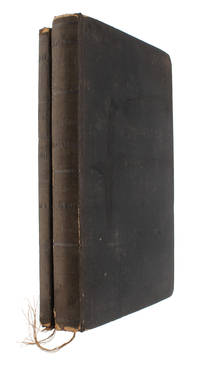
1876rif. 60588Moscow izdanie V. P. Plemânnikova 1876. 8vo. 3 parts bound in 2 uniform contemporary full cloth bindings with blind stamped titles to spines. Some soiling to extremities and part of cloth around hinges worn of. Internally with occassional brownspotting. 4 168 2 393 1 VII 2 pp. 4 folded plates. Rare first Russian translation of Darwin’s Insectivorous Plants published only one year after the English original. Freeman F1244OCLC only locates one copy in Poland Huntinton in Pasadena also holds a copy. hardcover
2016rif. G0760348634I3N00Motorbooks International 2016. Hardcover. Good. Pages can have notes/highlighting. Spine may show signs of wear. ~ ThriftBooks: Read More Spend Less.Dust jacket quality is not guaranteed. Motorbooks International hardcover
1999rif. x-0631207198Blackwell Pub 1999. Paperback. New. 558 pages. 9.75x7.00x1.25 inches. Blackwell Pub paperback
1877rif. 82941Paris: C. Reinwald & Cie 1877. Fine. C. Reinwald & Cie Paris 1877 14.50 x 23.50 cm reliure de l'éditeur First edition of the French translation established by Edmond Barbier. Biographical introduction and supplementary notes by Charles Martins. Publisher's full green percale binding smooth spine head caps lightly rubbed blind fillet frame on covers grey paper endpapers and pastedowns. Some minor foxing of no consequence. Work illustrated with 30 figures in the text. Very rare and handsome copy. C. Reinwald & Cie unknown
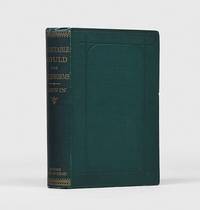
1881rif. 163369London: John Murray 1881. A fresh copy of his last book in the original cloth First edition first issue of the author's final book. Published the year before his death it was a remarkable success and sold 6000 copies within a year initially selling faster than the Origin of Species had done. The culmination of ten years of intensive research and close observation on the interaction of earthworms with their physical environment and their influence on great earth movements the work was Darwin's "leitmotif explaining vast changes by minute incremental events: mountain uplift evolving life and now worms transforming the soil" ODNB. The first impression of 2000 copies was apparently split between two equal issues the first without a "thousand" statement as here and the second with "second thousand" on the title; all issues thereafter had such a statement. Octavo. Woodcut and engraved figures in the text. Publisher's advertisement leaf at rear. Original green cloth spine lettered and decorated in gilt covers panelled in blind brown coated endpapers. Ownership inscription on first blank. Cloth with couple of bumps and tiny wear to corners but fresh overall superficial splits to sound inner hinges outer leaves foxed contents clean inconsequential paper flaw to lower corner of pp. 1/2. A very good copy indeed. Freeman 1357. hardcover
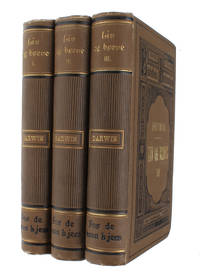
1889rif. 60362Fagerstrand pr. Høvig Bibliothek for de tusen hjem 1889. 8vo. 3 volumes all in publisher's original embossed cloth-bindings with gilt lettering to spines and front boards. Very light wear to extremities corners bumped an overall excellent set. 445 1 pp.; 456 pp.; 488 pp. 3 Frontispieces. The rare first Norwegian translation of Darwin's "The life and letters of Charles Darwin including an autobiographical chapter" - being the first translation of any of Darwin's works into Norwegian "Origin" was translated into Norwegian in 1890.A complete Danish translation of the work has never been published and the first Swedish translation did not appear until 1959. Due to the similarities between Danish Swedish and Norwegian this edition in effect introduced Darwin's letters and autobiography to Scandinavia.Martin Simon Søraas is listed as translator on all three title-pages whereas Freeman lists Peder Jacobsen Ulleland as having translated vol. 1. and Martin Simon Søraas as having translated vol. 2 and 3. Ulleland is listed in Freeman as having translated vol. 1 because he initiated a translation but only finished volume 1. Sørensen the publisher quickly discovered that Ulleland did not have the required skills as a translator and Sørensen fired him. Eventually Søraas was hired and translated all three volumes.Freeman 1528 hardcover
2017rif. 1-1936003554Blood Moon Prod Ltd 2017. Paperback. New. 528 pages. 8.75x5.75x1.50 inches. Blood Moon Prod Ltd paperback
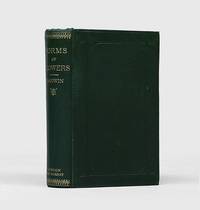
1877rif. 164452London: John Murray 1877. Presentation copy inscribed in Darwin's own hand First edition presentation copy inscribed on the title page "With the compliments of the author". The inscription is in Darwin's own hand rather than one of Murray's clerks. Different Forms of Flowers was published in a first edition of 1250 copies on 9 July 1877. There was only a single issue with the publisher's catalogue dated either January or March 1877 here the latter without priority. Darwin explained in his autobiography that "this book consists chiefly of the several papers on heterostyled flowers originally published by the Linnean Society corrected with much new matter added together with observations on some other cases in which the same plant bears two kinds of flowers. As before remarked no little discovery of mine ever gave me so much pleasure as the making out the meaning of heterostyled flowers" Life and Letters I p. 78. Freeman remarks that "had Darwin not chosen such genetically complex examples he might have approached more nearly to an understanding of the laws of particulate inheritance". Regardless it remains a seminal text on plant reproduction adaptation and evolution. It was translated into French and German during Darwin's lifetime followed by four further languages after his death. Octavo. 15 woodcut illustrations and 38 tables within text. Publisher's 32-page catalogue dated March 1877 at rear. Original green cloth spine lettered in gilt decorative bands at ends in gilt covers blocked in blind dark brown coated endpapers Simpson & Renshaw binder's ticket on rear pastedown. Housed in a dark green quarter morocco solander box by the Chelsea Bindery. Spine ends gently bumped cloth bright binding very discreetly restored and recoloured endpapers slightly faded previous ownership signature on dedication page subsequently erased a handful of neat pencil marks annotation to p. 1 translating the title into French marginal crosses and lines to a few other pp. faint semicircular damp mark running through upper margins of first c.140 pages else the contents notably clean publisher's catalogue lightly foxed towards end: a near-fine copy. Freeman 1277; Norman 602. Francis Darwin ed. The Life and Letters of Charles Darwin 1887. hardcover
2000rif. x-0631217479Blackwell Pub 2000. Paperback. New. 369 pages. 9.00x5.75x1.25 inches. Blackwell Pub paperback
1987rif. x-0521348072Cambridge Univ Pr 1987. Paperback. New. reprint edition. 704 pages. 9.00x6.25x1.50 inches. Cambridge Univ Pr paperback
1869rif. 053547New York: D. Appleton and Company 1869. Fourth American Edition First Printing . Brown Pebbled Cloth Gilt. Very Good. Folding Chart. 116 Pp 116 - 121 117-425; 426-432 Supplement; 443-440; 2 Pp Ads At Rear. "A New Edition Revised And Augmented By The Author" Containing The Entire Fourth British Edition With Additions And Corrections From The 1869 British Fifth Edition Added As Asterisked Pages And In A Supplement At End Indicating Corrections/Insertions To Be Made Throughout This Fourth Edition To Update It To The Fifth Edition But Not Including Heading "Survival Of The Fittest" Which Occurred In That Edition. Catalog At End Beginning With Page 2 No Page One But Apparently As Bound And Issued Perhaps To Remove A Now Obsolete Listing For The Fourth Edition Of This Work Continuing With P. 3. Original Pebbled Brown Cloth Covers With Slight Wear Fading To Cloth Evenly Colored And Without The Usual Fading Gilt Clear Original Yellow Endpapers With Solid Hinges Pages Clean Square And Crisp. A Very Scarce Edition Apparently Issued For A Short Time Prior To The Regular 1870 American Printing Of The Fifth British Edition; "Darwin On Line" Shows 440 Pp. But States Same As 1863-1868 Editions And Makes No Mention Of The Asterisked Pages Or The Supplement For The Fifth Edition. Folding Plate Present Facing P. 108. D. Appleton and Company hardcover
1871rif. 60108London and New York Macmillan and Co. 1871. Royal8vo. In publisher's original red embossed cloth. In "Nature. A Weekly Illustrated Journal of Science" Vol. 4 April-October 1871. Stamp to title-page and p. 1 and ex-libris pasted on to pasted down front end-paper. Binding with wear and light soiling spine partly detached with a 7 cm long tear to rear hindge. Internally fine and clean. Darwin's paper: Pp.180-181. Entire volume: XII 520 pp. First appearance of Darwin’s short notice to Henry Hoyle Howorth 1842-1923 geologist and naturalist. F1754 hardcover
1871rif. 60107London and New York Macmillan and Co. 1871. Royal8vo. In publisher's original red embossed cloth. In "Nature. A Weekly Illustrated Journal of Science" Vol. 3 November 1870 - April 1871. Stamp to title-page and ex-libris pasted on to pasted down front end-paper. Binding with considerable wear; spine partly disintegrated and front board bended vertically but bookblock firmly attached. Internally fine and clean. Darwin's paper: Pp. 502-503. Entire volume: XII 520 pp. First appearance of Darwin’s defense of his Pangenesis-theory. The Pangenesis theory was hypothetical mechanism for heredity in which he proposed that each part of the body continually emitted its own type of small organic particles called gemmules that aggregated in the gonads contributing heritable information to the gametes. He presented this 'provisional hypothesis' in his 1868 work The Variation of Animals and Plants Under Domestication intending it to fill what he perceived as a major gap in evolutionary theory at the time. Darwin's half-cousin Francis Galton spent much time conducting wide-ranging inquiries into heredity which led him to refute Charles Darwin's hypothetical theory of pangenesis. In consultation with Darwin he set out to see if gemmules were transported in the blood. Galton was troubled because he began the work in good faith intending to prove Darwin right and having praised pangenesis in Hereditary Genius in 1869. Cautiously he criticized his cousin's theory although qualifying his remarks by saying that Darwin's gemmules which he called "pangenes" might be temporary inhabitants of the blood that his experiments had failed to pick up. In the present paper Darwin challenged the validity of Galton's experiment giving his reasons in an article published in Nature where he wrote. “Now in the chapter on Pangenesis in my Variation of Animals and Plants under Domestication I have not said one word about the blood or about any fluid proper to any circulating system. It is indeed obvious that the presence of gemmules in the blood can form no necessary part of my hypothesis; for I refer in illustration of it to the lowest animals such as the Protozoa which do not possess blood or any vessels; and I refer to plants in which the fluid when present in the vessels cannot be considered as true blood." He goes on to admit: "Nevertheless when I first heard of Mr. Galton's experiments I did not sufficiently reflect on the subject and saw not the difficulty of believing in the presence of gemmules in the blood.” From the present paper The hypothesis was finally refuted in the 1900ies after Gregor Mendel's theory of the particulate nature of inheritance was accepted. The Pangenesis-theory however may be considered an eclectic mix of DNA RNA proteins and prions and can be regarded as being one of the earliest steps toward the modern mechanism for heredity namely DNA and RNA. Freeman 1751 hardcover
1866rif. 155699London: John Murray 1866. The extensively revised Origin Fourth edition of "the most important biological book ever written" Freeman one of 1500 copies. The text was significantly altered from previous editions representing the second largest increase in the Origin. The fourth edition also corrects the date of the Origin's initial publication given on the verso of the half-title from 1 October to 24 November 1859. Octavo. Folding diagram facing p. 130. With 32 pp. publisher's advertisements dated April 1867 at rear. Original green pebble-grain cloth spine lettered and decorated in gilt covers blocked in blind Freeman's variant c no priority dark green endpapers Edmond & Remnants binder's ticket on rear pastedown. Contemporary ownership signature of Samuel Oldham Lees on half-title likely the landowner 1832-1879 later bookplate on front pastedown A. Oldham Lees of Strathspey. Head of spine and inner hinges restored. Spine ends and corners bumped extremities rubbed cloth clean a few leaves creased from reading book block cracked at pp. 432-33. A very good copy. Freeman 385. hardcover
1874rif. 60116London and New York Macmillan and Co. 1873. Royal8vo. In contemporary cloth. In "Nature. A Weekly Illustrated Journal of Science" Vol. 8 July 1873 - October 1873. Extremities with wear and end papers brownspottet. Internally fine and clean. C. R. Darwin's papers: P. 244; Pp. 431-432. G. H. Darwin's paper: p. 505 . Entire volume: Pp. 237-562. First appearance of these three papes two by Charles Darwin and one by his son. Freeman 1761 1762 & 1763 hardcover
1874rif. 60115London and New York Macmillan and Co. 1874. Royal8vo. In a bit later full green cloth. In "Nature. A Weekly Illustrated Journal of Science" Vol. 10 May 1874 - October 1874. Stamp to title-page and ex-libris pasted on to pasted down front end-paper. Stamps to front free end paper. Traces from book block having been bended. Darwin's paper: Pp. 24-25. Entire volume: XI 1 534 pp. First appearance of Darwin's paper on Primrose flowers. Primrose flowers and the flowers of related members of the Primulaceae are often removed from their stalks and scattered on the ground by green finches apparently consuming the ovaries and nectaries - here first described by Darwin. Freeman 1771 hardcover
1872rif. 60122London and New York Macmillan and Co. 1872. Royal8vo. In publisher's original red embossed cloth. In "Nature. A Weekly Illustrated Journal of Science" Vol. 6 May-October 1872. Stamp to title-page and p. 1 and ex-libris pasted on to pasted down front end-paper. Binding with wear and light soiling spine loose and missing part of cloth to upper part. Internally fine and clean. Darwin's paper co-author: 211-216; P. 279. Entire volume: XII 548 pp. First publication of these two short notices by Darwin. Freeman 1937 & 1756. hardcover
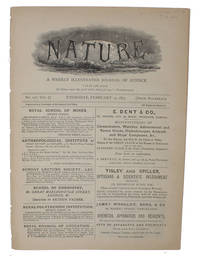
1873rif. 60132London 1873. Small folio. Extracted with traces from the sewn cords in the original printed wrappers. In "Nature" No. 172 Vol. 7 February 13. Entire issue offered. Issue split in two otherwise fine and clean. Housed in a portfolio with white paper title-label to front board. Darwin's notice: P. 281 Entire issue: Pp. 1 lx 277-296. First appearance of Darwin's comment on Dr. Huggins' letter containing an account of three generations of dogs which exhibited fright when in the vicinity of a butcher or butcher's shop an observation which Darwin considered of the utmost importance: "The following letter seems to me so valuable and the accuracy of the statements vouched for by so high an authority that I have obtained permission from Dr. Huggins to send it for publication" From the present publication. Freeman 1757 unknown
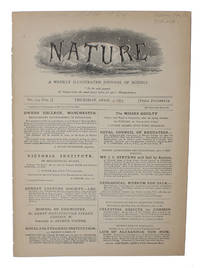
1873rif. 60133London 1873. Small folio. Extracted with traces from the sewn cords in the original printed wrappers. In "Nature" No. 179 Vol. 7 April 13. Entire issue offered. Front wrapper detached otherwise fine and clean. Housed in a portfolio with white paper title-label to front board. Darwin's notice: Pp. 417-18. Entire issue: Pp. 1 cx-cxvi 417-436. First appearance of Darwin's comment to an article in NATURE of March 20 1873 containing his view on the origin of certain instincts. "THE writer of the interesting article in NATURE of March 20 doubts whether my belief “that many of the most wonderful instincts have been acquired independently of habit through the preservation of useful variations of pre existing instincts” means more than “that in a great many instances we cannot conceive how the instincts originated.” This in one sense is perfectly true but what I wished to bring prominently forward was simply that in certain cases instincts had not been acquired through the experience of their utility with continued practice during successive generations. I had in my mind the case of neuter insects which never leave offspring to inherit the teachings of experience and which are themselves the offspring of parents which possess quite different instincts. The Hive-bee is the best known instance as neither the queen nor the drones construct cells secrete wax collect honey &c." From the present paper. Freeman 1760. unknown
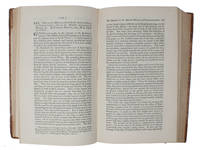
1842rif. 60134London University of London 1842. 8vo. In contemporary half calf. In "The London Edinburgh and Dublin Philosophical Magazine and Journal of Science" Vol. XXI. July - December entire volume offered. Spine with wear and lacking bits of the leather especially affecting front hinge. Leather brittle. Front hindge loose. Exlibris pasted on to pasted down front end-paper. Internally nice and clean. Darwin's paper: Pp. 180-88. Entire volume: viii 568 pp. First appearance of Darwin’s paper on the effects produced by the glaciers of Caernarvonshire. In 1831 Charles Darwin came to Cwm Idwal and failed to perceive the evidence of glaciation there. In 1842 Darwin then went on to describe the glaciation of Cwm Idwal in some detail. He recorded both his first visit with the Cambridge geologist Adam Sedgwick and his second more aware visit in his autobiography: “Next morning we started for Llangollen Conway Bangor and Capel Curig. This tour was of decided use in teaching me a little how to make out the geology of a country. Sedgwick often sent me on a line parallel to his telling me to bring back specimens of the rocks and to mark the stratification on a map. On this tour I had a striking instance of how easy it is to overlook phenomena however conspicuous before they have been observed by any one. We spent many hours in Cwm Idwal examining all the rocks with extreme care as Sedgwick was anxious to find fossils in them; but neither of us saw a trace of the wonderful glacial phenomena all around us; we did not notice the plainly scored rocks the perched boulders the lateral and terminal moraines. Yet these phenomena are so conspicuous that as I declared in a paper published many years afterwards in the ‘Philosophical Magazine’ Darwin 1842 a house burnt down by fire did not tell its story more plainly than did this valley. If it had still been filled by a glacier the phenomena would have been less distinct than they now are. Darwin 1887” “By 1842 not only had Darwin travelled widely Herbert 1991 but Agassiz 1840 had published his theory of glaciation. Darwin was also then apprised of the arguments of the geologist William Buckland. Buckland was known for his penchant for eating every variety of animal a trait which his son inherited Burgess 1967: Chapter 1; Chorley et al. 1964: 100–118; see also Lewry 2008 but he also developed highly significant ideas on glaciation and the limitations of the diluvial theory Chorley et al. 1964: 207–210. A key realization is that water-lain flood deposits are normally laid down in stratified layers with the coarser material below the fine while the glacial deposits are unstratified and mixed in size. Thus in contrast to his earlier 1831 lack of glacial observation” Trudgill Do theories tell us what to see The 19th-century observations of Darwin Ramsay and Bonney on glacial features Darwin wrote: “Guided and taught by the abstract of Dr. Buckland’s memoir ‘On Diluvio-Glacial Phænomena in Snowdonia and the adjacent parts of North Wales’ I visited several of the localities there noticed and . I have been enabled to make a few additional observations. Dr. Buckland has stated that a mile east of Lake Ogwyn there occurs a series of mounds covered with hundreds of large blocks of stone which approach nearer to the condition of an undisturbed moraine than any other mounds of detritus noticed by him in North Wales. By ascending these mounds it is indeed easy to imagine that they formed the north-western lateral moraine of a Trudgill 559 Downloaded from ppg.sagepub.com at PENNSYLVANIA STATE UNIV on September 16 2016 glacier descending in a north-east line from the Great Glyder mountain. But at the southern end of Lake Idwell the phænomena of moraines are presented though on a much smaller scale with perfect distinctness. From the present paper p. 180” Darwin then gives a detailed description of the glacial features: “On entering the wild amphitheatre in which Lake Idwell lies some small conical irregular little mounds which might easily escape attention may be seen at the further end. The best preserved mounds lie on the west side of the great black perpendicular face of rock forming the southern boundary of the lake. They have been intersected in many places by streams and they are seen to consist of earth and detritus with great blocks of rock on their summits. They at first appear quite irregularly grouped but to a person ascending any one of those furthest from the precipice they are at once seen to fall into three with traces of a fourth narrow straight linear ridges. The ridge nearest the precipice runs someway up the mountain but the outer one is longer and more perfect and forms a trough with the mountain-side from 10 to 15 feet deep. On the eastern and opposite side of the head of the lake corresponding but less developed mounds of detritus may be seen running a little way up the mountain. It is I think impossible for any one who has read the descriptions of the moraines bordering the existing glaciers in the Alps to stand on these mounds and for an instant to doubt that they are ancient moraines; nor is it possible to conceive any other cause which could have abruptly thrown up these long narrow steep mounds of unstratified detritus against the mountain-sides. From the present paper p. 180” hardcover
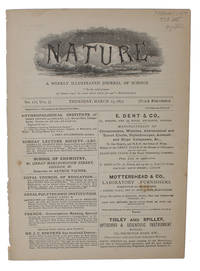
1873rif. 60131London 1873. Small folio. Extracted with traces from the sewn cords in the original printed wrappers. In "Nature" No. 176 Vol. 7 March 13. Entire issue offered. Issue split in two otherwise fine and clean. Housed in a portfolio with white paper title-label to front board. Darwin's notice: P. 360. Entire issue: Pp. 1 lxxxvi-xcii 357-376. First appearance of Darwin' comment on Aldred Wallace's suggestion that animals find their way home by recognising the odour of the places which they have passed. In the comment Darwin describes the following anecdote: "Many years ago I was on a mail-coach and as soon as we came to a public-house the coachman pulled up for the fraction of a second. He did so when we came to a second public-house and I then asked him the reason. He pointed to the off-hand wheeler and said that she had been long completely blind and she would stop at every place on the road at which she had before stopped. He had found by experience that less time was wasted by pulling up his team than by trying to drive her past the place for she was contented with a momentary stop. After this I watched her and it was evident that she knew exactly before the coachman began to pull up the other horses every public-house on the road for she had at some time stopped at all. I think there can be little doubt that this mare recognised all these houses by her sense of smell." From the present paper. Freeman 1759 unknown
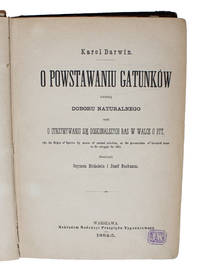
1884rif. 56005Warszawa Przegladu Tygodniowego 1884. Large8vo. In contemporary half calf. Spine with wear lacking the upper 1 cm. Small stamp to title-page. Hindges weak and back board detached from bookblock. Verso of title-page and first leaf on content. 437 1 XVI Including the plate pp. First edition of the first full Polish translation of Darwin's "Origin of Species". An attempt to publish a Polish translation was made as early as 1873. This was however never completed and only half of the work was published Freeman 739 thus making the present copy the very first full Polish translation. As seen in several other countries especially in Japan the majority of Polish intellectuals adopted a Social Darwinism perspective at a very early stage rather than appreciating the English naturalist's caution in applying his ideas to human society."Before the first translations of Darwin's appeared . many Polish intellectuals such as positivist writer Eliza Orzeszkowa 1841-1910 complained about the increasing confusion over the essence of the English naturalist's ideas which had all too often been mixed up with all sorts of ideological debates. However when Darwin's books were actually available in Polish translations the novelty of his concepts gradually wore off making room for more serious attempts to come to terms with evolutionary theory." Glick The Reception of Charles Darwin in Europe. "It appears that the struggle for or against Darwinism in partitioned Poland prefigured a pattern that is relevant for Polish thinking up to the present day: the conflict of striving for progress with the help of powerful allies abroad and of virulently rejecting all foreign advice for fear of losing one's cultural identity." Ibid.Translation was begun by Szymon Dickstein who in the processe of the translation committed suicide. It was completed by Józef Nusbaum who also translated 'The Variation of Animals and Plants under Domestication' in 1888.Freeman 740 unknown
rif. SKU0484631Wiley-Blackwell 2014-11-03. Paperback. Good. Textbook May Have Highlights Notes and/or Underlining BOOK ONLYNO ACCESS CODE NO CD Ships with Emailed Tracking Wiley-Blackwell paperback