réf. 113066Berkeley California Max Scherr 1965-1969. . Periodical 210 issues; tabloid newspaper 392 x 289 mm 15½ x 11½ in; toned occasional wear issues folded in half now flattened clipping from issue 103 very good; various paginations. A scarce substantial run of the Berkeley Barb from 1965-1969 lacking only six issues 4 9 20-21 80 & 163. The Berkeley Barb was a weekly underground newspaper founded by Max Scherr in 1965 in part to serve as an outlet for the political agenda of the Free Speech Movement at the University of California Berkeley which had emerged the previous year and to provide a voice for the civil rights anti-war and countercultural movements of the 1960s combined with opinions reviews local news and events and personal ads. Burroughs' contributions: Vol. 17 No. 14 6 April 1973; Vol. 17 No. 15 13 April 1973; Vol. 17 No. 16 20 April 1973; Vol. 17 No. 17 27 April 1973 Burroughs interview with Allen Ginsberg; 1 November 1974 Shoaf III.213. Issue 521 8 August 1975. Issue 548 13-19 February Shoaf III.229. Vol. 28 No. 2 issue 687 26 October 1978 Shoaf IV.59; Schottlaender v.4 C447; Schottlaender v.5 C459. Berkeley, California, [Max Scherr], 1965-1969. unknown
réf. 117782San Francisco Jack Spicer 1959. . Periodical 5 issues 280 x 216 mm various paginations. Corner-stapled mimeographed leaves with typographic or pictorial covers nos. 3 and 4 decorated in watercolour no. 5 with a gold paint border; light wear handling and marking oxidation to staples some occasional faint staining and finger-soiling to margins. Nos. 1 and 2 are contributor copies belonging to Joanne Kyger the first signed 'Joanne Eliz's' on the front the second 'J. Kyger'. A very good set scarce. The first five issues of Jack Spicer's poetry magazine J arguably the pinnacle of mimeo magazine design. In all there were eight issues the first five were edited by Spicer collecting submissions from a box marked "J" in The Place a North Beach bar at 1546 Grant Avenue San Francisco. Having co-founded the Six Gallery the birthplace of the Beat generation Spicer was a pivotal part of the San Francisco Renaissance. He believed poetry came from outside the poet through 'dictation' giving his work an oracular and enigmatic character and was a conduit through which poets could most organically communicate with one another. Though the circulation of the magazine was limited it is an esteemed publication nonetheless. Later issues numbers 6-7 were edited by George Stanley in San Francisco and New York and number 8 by Harold Dull in Rome. Contributors include Richard Brautigan Jess Collins Robert Duncan Fran Herndon and Jack Spicer. [San Francisco, Jack Spicer, 1959]. unknown
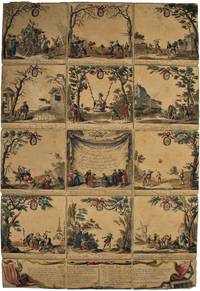
réf. 53336Paris: Crépy 1783. Original hand-coloured engraving overall 72 x 48 cm comprising 15 sections the game occupying 12 sections each 16 x 16 cm. plus 3 half-panels at the bottom for the title and rules of the Nouvelle Combinaison each 8 x 16 cm. Contemporary linen backing. Framed with museum quality glass 99% UV filter - less than 2% reflection. Easily removable from frame Joints holding although fragile wear to corners minor loss to inside margin of lower left title panel light browning a few hanging pin holes at margins. Scarce especially when coloured. Without imprint or date as normal. The 12 panels depict 12 traditional games La Main Chaude Le Balon La Crosse etc which follow the 12 months of the year. Rules for advancing around the board underneath each illustration and a second method of playing in the bottom three panels. [Paris: Crépy, 1783]. unknown
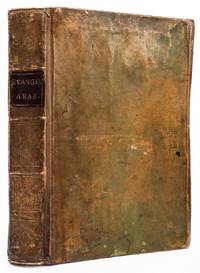
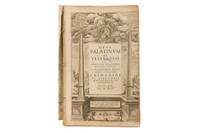
réf. 63499Romae Rome: Ex Typographia Medicea 1619. Folio 33.5x21 cm. pp. 4 9-462 2 with at recto the printer's letter repeated with the date of the 1591 original edition blank at verso. Contemporary green vellum spine with raised bands and gilt-decorated compartments red Morocco label marbled endpapers edges dyed red. Title printed in red and black with Medici's woodcut coat-of-arms printer's advice "Typographus lectori". With 149 text woodcuts by Leonardo Parassole c.1570-c.1630 after Antonio Tempesta 1555-1630 their monograms appearing on a number of the illustrations. The woodcuts are remarkable examples of Tempesta's work notable for their clarity of composition and their didactic narrative of the episodes depicted. Ex libris Luigi Bossi Milan 1758-1835 with his engraved heraldic bookplate to front pastedown along with T. Fenteman & Sons Leeds booksellers label to upper corner. Title-page lightly browned boards faded and discoloured some occasional light toning generally a very good copy printed on thick paper the woodcuts in strong impressions throughout. Rare 1619 reissue or of the original 1591 stock of the Arabic Medicean Gospels. The text lines are almost identical with those of the Arabic issue but now have an interlinear Latin version added which was prepared by Antonius Sionita. In 1584 the last year of the papacy of Gregory XIII who had constantly endeavoured to effect a union between the Church of Rome and the eastern Christians Cardinal Ferdinando de' Medici the brother and later the successor of the Grand Duke of Tuscany founded a printing press in Rome with a vast selection of oriental types cut by the French typographer Robert Granjon. Run by a versatile orientalist Giovan Battista Raimondi the press had various aims. One was to produce propaganda which would attract the eastern Christians to Roman Catholicism. Another was to corner the publishing market in an area where typography was prohibited and to make a financial profit from the sale in the east of books printed in Arabic. The third aim was to further European knowledge and to provide good editions of Arabic versions of certain standard non-religious texts. These included the writings of Avicenna al-Idrisi's geographical compendium al-Tusi's adaptation of Euclid's text on geometry and various works on Arabic grammar and syntax. The first major publication was the 1591 edition of the Gospels. This copy has an interlinear Latin translation but the work was also issued solely in Arabic. It contains 149 fine woodcut illustrations made by Leonardo Parasole mainly after designs by one of the best known Florentine artists of his day Antonio Tempesta who owed much of his fame to the frescoes he painted in the Vatican and in a number of Roman palaces. The woodcut in the Gospel of St Mark of the presentation of the head of John the Baptist to Salome Mark 6:28 by a man in Turkish dress reminds us of the common association between the great enemy of Christendom in the sixteenth century and the ancient heathens. The Arabic text is printed in Robert Granjon's famous large fount generally considered the first satisfactory Arabic printing type; as all early printed editions of the Arabic Gospels it is based on the Alexandrian Vulgate cf. Darlow/M. 1636. The Latin version is by Leonardo Sionita. The work begins with page 9 without a title-page or any preliminary matter at all: "the intended prefatory matter was apparently never published" Darlow/M. Darlow & Moule 1637 & 1643; Schnurrer Bibliotheca arabica 318; Brunet II 1122-23; Graesse II 531 Romae [Rome]: Ex Typographia Medicea, 1619. hardcover
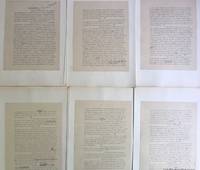
réf. 113678Oxford for the author by the Oxford Times 1922. . 2 leaves of page proofs comprising chapter 115; double column 281 x 216mm; creasing at edges with a few nicks rust mark to top leaf; with the remains of the wrap-around band with later annotations noting the place of this section within the text. Page proofs of the complete chapter 111 of the celebrated Lawrence rarity the Oxford printing of Seven Pillars of Wisdom. The text beginning 'On July the eleventh' and ending 'to improve our force'. After having lost his first manuscript of Seven Pillars of Wisdom at Reading station in 1919 and having probably burnt his second manuscript in early 1922 by the time Lawrence had completed his third manuscript version of Seven Pillars he was understandably keen to ensure that he had the text in multiple copies. He discovered that the cost of having the Oxford Times typeset the text and run off a few copies was little more than employing a typist and eight copies were duly printed. Lawrence circulated these copies amongst friends and writers including Bernard Shaw E.M. Forster Thomas Hardy and Siegfried Sassoon. Although these copies are often called proofs they were not a trial impression for a publication but a draft that formed a stage in the complex composition process of the book. Lawrence revised the text extensively before committing it to print in the 1926 Cranwell edition and the edited version of the present chapter became part of chapter 98 in the 1926 text. [Oxford, for the author by the Oxford Times, 1922]. unknown
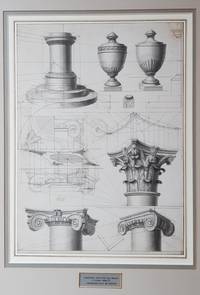
1775réf. 3622n.p. n.p. n.d. pre-1775 1775. Original drawing of classical capitals and urns with lines of perspective. Pen and brown and black ink pencil and grey wash on laid paper without visible watermark ruled border in brown ink. Sheet 302x218mm window mount 350x275mm. Very slight soiling and foxing but overall in excellent condition. A very good and rare example of a study for an important book on perspective. � In 1775 Thomas Malton the Elder 1726-1801 published A Compleat Treatise On Perspective In Theory and Practice; on the True Principles Of Dr. Brook Taylor. This drawing is a preliminary study for plate XXII from this book. Such drawings are rare; the last to appear before this one was sold at Christie's in 2011. Malton's book was important: the Royal Academy had been founded only seven years before and in its Instrument of Foundation there was a specific requirement that the art and science of perspective be taught. A Compleat Treatise was the first book to be published on the subject following the founding of the RA. Malton was perhaps making a bid for his book to be adopted as a sort of "set text" and many Royal Academicians were among the initial subscribers. It was from the outset regarded as one of the best modern books on the subject based as it was on the newest contemporary mathematical studies of perspective. The combination of science and art is captured beautifully in this drawing. Bad luck in business forced Malton to leave England to start afresh as an artist in Dublin where he died in 1801 but his influence extended well into the nineteenth century thanks to his son also called Thomas and to Turner's use of A Compleat Treatise in his own lectures at the Royal Academy where he was Professor of Perspective. Malton's book and drawings would almost certainly have been introduced to Turner by Malton's son in whose studio Turner worked as an apprentice in the 1780s and whom Turner regarded as his "my real master". Some of Turner's own drawings and sketches used in these lectures are held at the Tate and among them are two of the capitals from plate XXII of A Compleat Treatise whose origins can be traced back to this drawing by Thomas Malton the Elder. n.p. n.p. n.d. [pre-1775]
1801réf. 001380London: For the Author By J. Debrett 1801. 2 i-ii v-vi 1-134 plates 135-136 charts 137-144pp 6. Original boards later cloth reback with modern paper title label to spine later endpapers. Boards worn to edges and especially corners scrape to centre of lower board. Internally the front endpaper is creased light spotting to text but plates generally clean a few pages with marginal repairs one plate with marginal repairs with the repairs slightly offsetting on to the margin of another plate but generally quite bright and clean. With twenty coloured aquatint plates showing one hundred and thirty-seven coastal profiles and twenty-four tinted engraved charts on twelve pages by J. Stadler and J. Luffman after J.T. Serres. Housed in a calf backed slipcase with raised bands spine in six panels a leather title label to second panel with the remaining panels with repeated gilt tooling. J.ohn T.homas Serres was the elder son of the marine painter Dominic Serres and was "appointed draughtsman to the Admiralty being employed in making sketches of the harbours on the enemy's coast for which he had a vessel placed at his service and £100 a month. His two books are the outcome of work undertaken in this capacity: the 'Little Sea Torch' being a guide for coasting ships" Prideaux page 275. For Luffman see Worms and Baynton-Williams pages 417-419. NMM III:218; Goldsmiths 18296.1 and Abbey England 344. First Edition. Hardback. Good. Illus. by Stadler J. And Luffman J. After Serres J.T. Elephant Folio. For the Author By J. Debrett Hardcover
1842réf. 001525London: Longman Brown Green and Longmans 1842. 7 viii-xlviii 5 6-320pp. Later full morocco by Thomas or John Fazakerley of Liverpool with their name stamped to foot of front turn in raised bands spine in six panels title lettered directly to second panel and author to third remaining panels with double fillet border in gilt red morocco frame single fillet inner border with central heart tool and four dots upper cover with double fillet border in gilt red morocco frame with single fillet inner border hearts and dots surrounding another red morocco inner frame with central oval red morocco frame encompassing the title and author surrounded by fauna and flora in gilt lower cover with similar frames and heart and dot border single line to edges inner edges again with red morocco border and watered silk doublures and endpapers top and bottom edges gilt with gauffering fore edge gilt and gauffered with a triptych of small fore edge paintings visible of country scenes. Small repair to head of upper joint very slightly rubbed to extremities. Internally the text is lightly browned but clean. Illustrated throughout by several artists including John Bell C. W. Cope J. P. Knight Frank Stone C. Stonhouse and Thomas Webster. Book plate of Randall Moskovitz loosely laid in Weber notes that Randall Moskovitz owned other Fazakerley bindings. Thomas Fazakerley and his son John bookbinders in Liverpool were well known for their 'reliure de luxe' bindings. Weber notes that "a lot of fore-edge paintings came out of Fazakerley's bindery . Many of the Fazakerley bindings with fore-edge paintings are done on the flat or closed surface as here especially those bindings that feature a triptych . It might be added that the style of paintings does not clearly appear to differ. Carl J. Weber surmised there may have been several artists working for Fazakerley and this may be true though unproven" Weber 'Annotated Dictionary of Fore-Edge Painting Artists and Binders' page 141. First Edition. Hardback. Very Good. 8vo. Longman, Brown, Green, and Longmans hardcover
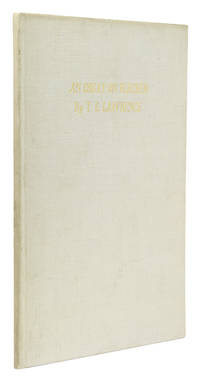
1937réf. 308243Corvinus Press 1937. No. 20 of 30 copies on J.B. Green unsized paper edition of 32. 1 vols. 4to. White linen t.e.g. others untrimmed. Fine. No. 20 of 30 copies on J.B. Green unsized paper edition of 32. 1 vols. 4to. Poet and diplomat James Elroy Flecker 1884-1915 burned bright and briefly. He joined the diplomatic service in 1908 trained for two years and was posted to Constantinople in 1910 "but in September a slight fever was diagnosed as tuberculosis and he returned to England to a sanatorium. He pronounced himself cured and . went back to Constantinople in March 1911 to be transferred in April to Beirut. Flecker was not a very efficient vice-consul" ODNB. His first formal collection of verse The Bridge of Fire was published in 1907 and The Golden Journey to Samarkand was published in 1913. He died in Switzerland aged thirty-one. Lawrence knew Flecker in Beirut before the war. "Flecker probably introduced Lawrence to contemporary poetry" wrote Wilson in his introduction to Minorities 1971. According to O'Brien An Essay on Flecker was "written in 1925 with the intention of publication in a periodical and did not appear in print until 1937". O'Brien A198; Ridler p. 58 #41 [Corvinus Press unknown
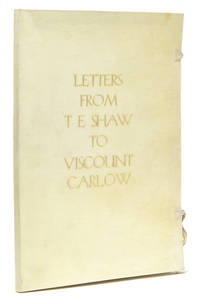
1936réf. 308242Corvinus Press 1936. No. 11 of 17 copies this copy on Milbourn hand made paper. 15 unnumbered leaves. 1 vols. 8vo. Full white vellum with yapp edges upper cover titled in gilt by Sangorski & Sutcliffe. Liddell Hart bookplate. No. 11 of 17 copies this copy on Milbourn hand made paper. 15 unnumbered leaves. 1 vols. 8vo. Inscribed to artist Eric Kennington: "EK from Carlow" Only 17 copies were printed on a variety of paper stocks for private distribution only. RARE. O'Brien A193 [Corvinus Press unknown
1682réf. 261Gibson1THE ANATOMY OF HUMANE BODIES EPITOMIZED. First Edition. Printed in 1682. Complete with all 13 plates. The Anatomy Of Humane Bodies Epitomized. Wherein All The Parts Of Man's Body With Their Actions And Uses Are Succinctly Described. Printed in 1682. This is the rare First Edition. This book is extremely difficult to find. First published anonymously in 1682 The Anatomy of Human Bodies Epitomiz'd was probably the most successful English anatomical textbook published to date – it was ultimately issued in eight editions. Illustrated with plates. ALL 13 PLATES ARE PRESENT. This book is complete. Title page imprimatur leaf containing all of the correct number of 13 engraved plates. The covers are original. The spine was rebacked in the mid 1800's. Original title page is exceptionally well preserved. Imprimatur leaf opposite the title page is still present. The first edition was printed in 1682 and is unobtainable. In very good condition. Binding with a lot of general wear. Heavy generalized abrasion wear to the original binding. Spine rebacked in the 1800's. Title page has the date handwritten. Internally exceptionally well preserved. Minor signs of use stains an underlining. In exceptional condition despite the age. Printed on quality rag paper. Paper is supple and well preserved despite the age. Printed on quality rag paper that can still be read without damaging the paper. This was one of the most important anatomical works of this era. Anatomy of Humane Bodies Printed in 1682 The Anatomy Of Humane Bodies Epitomized : Wherein All The Parts Of Man's Body With Their Actions And Uses Are Succinctly Described By Gibson Thomas London: Thomas Fletcher. Good. Full-Leather. Small 8vo First published anonymously in 1682 The Anatomy of Human Bodies Epitomiz'd was probably the most successful English anatomical textbook published to date – it was ultimately issued in eight editions. Gibson the Physician-General to the English army based his comprehensive text on Alexander Read's Manual of Anatomy. However the content was so extensively revised and supplemented Gibson claimed authorship. Gibson listed his principal sources some 33 titles by 27 authors which was an uncommon practice at the time. The Anatomy Of Humane Bodies Epitomized Original leather boards; nineteenth century re backed leather spine - Printed in 1682 by Gibson Thomas By a Fellow of the College of Physicians London Small octavo 7 3/4 by 4 3/4 inches 8 510 pages containing all of the correct number of 13 engraved plates; hardcover leather binding in original boards neatly re-backed in mid 19th century with raised bands title in gilt on spine inked name cleanly written on first fly leaf very good condition minor scuffing to base of spine minor wear to hinges hinges very strong. ESTC Nos. R 8370 & R188113 Wing 5672. Divided into six separate sections each with their own chapters: Complete in 6 books bound as one: I. "On the lowest Cavity called Abdomen" II. "Of the Breast" III. "Of the Head" IV. "Containing a description of the Veins Arteries and Nerves of the Limbs" V. "Containing a Treatise of all the Musceles of the Body" VI. "Of the Bones." This book measures 7 3/4 inches tall. This book will be well protected for shipping. Your signature will be required for delivery. 26.1 Thomas Fletcher
1968réf. 69275London: BOAC 1968. BEATLES The. O.A.C. In-Flight Menu. London: BOAC n.d.c.a 1968. An autographed in-flight menu from the British Overseas Airways Corporation BOAC. The front cover is signed in black ink by John Lennon and George Harrison. The Paul McCartney autograph is actually in John Lennon's hand and Ringo Starr's is in the hand of Neil Aspinall the Beatles' long time road manager and assistant. Octavo 11 1/4 x 7 1/2 inches; 286 x 190 mm. 8 pp. Full color wrappers. Some black ink transfer on the back cover probably from another signed copy being placed underneath it. A very good example of these autographs. The menu for the B.O.A.C. route from Hong Kong-London via Rangoon Delhi Beirut and Rome. This menu is possibly from April of 1968 when John Lennon and George Harrison left India after a two month stint studying Transcendental Meditation with Maharishi Mahesh Yogi at his ashram in Rishikesh where they stayed until 12 April. Ringo Starr and Paul McCartney left before George and John in March which would explain why their signatures are produced by other people's hands. This item was sold at Bonhams Auctions in 2022. According to Bonhams "this was a gift from a First Class B.O.A.C. stewardess." HBS 69275. $10000. BOAC unknown
1907réf. 63141Princeton NJ 1907. 4to 28 cm. 10 pages typed rectos only approximately 2850 words each leaf mounted along the left edge to a larger heavier sheet each page double-spaced with 29 separate ink corrections deletions and additions by Cleveland in his characteristic hand 44 words added 19 deleted 20 typos of poor strikes corrected; in addition there are numerous editorial marking on each page "by Grover Cleveland" is written in pencil in another hand underneath the title on the first page and "corrected by Cleveland" is written in pencil in yet another hand at the upper corner of the first page. The longest correction or addition occurs in the final paragraph where Cleveland strikes through four words replacing them with twelve. Following publication the "Youth's Companion" the essay appeared in newspapers e.g. "The Daily Republican" Monongahela Pennsylvania 25 February 1908 under the title "Our People and Our Ex-Presidents." We found one other unsigned essay by Cleveland at auction also a 10-page typescript with holograph corrections "Woman's Mission and Woman's Clubs" sold at Christie's in 2002 $8000. Very good condition throughout. 9870. An essay on the relationship between the American people and their ex-presidents by the only man who was ex-president twice. It addresses the expectations and demands the people place on their former presidents the personal financial effects these may have and the failure of the country to provide any support for them. Noting thankfully his own personally secure estate he based this one and cites specific examples of financial distress among earlier presidents. That combined with his own observations gave him concern for future ex-presidents. "If in concluding this discussion a personal word is necessary or permissible in view of the fact that I am the only man now living who could at this time profit by the ideas I have advocated I hope my sincerity will not be questioned when I say that I have dealt with the subject without the least thought of personal interest or desire for personal advantage. I am not in need of aid from the public treasury. I hope and believe that I have provided for myself and those dependent upon me a comfortable maintenance within the limits of accustomed prudence and economy and that those to whom I owe the highest earthly duty will not want when I am gone. unknown
1904réf. 86033New York: Association of Edison Illuminating Companies 1904. Presumed First Edition First printing. Hardcover. Good. 211. 5 pages. Errata slip bound in after verso. Illustrations. Fold-out. Footnotes. Table of Contents is at the back of the volume. Rare connection to Edison's inner circle. Previous owner's sticker inside the front cover. Name of former owner William H. Meadowcroft !!! in ink on fep. William Henry Meadowcroft 29 May 1853 in Manchester - 15 October 1937 in Boonton New Jersey was the secretary of Thomas Edison and author of several books including The A B C of Electricity 1888. In 1875 he immigrated to the United States where he worked as a paralegal for the law firm Carter & Eaton. He was admitted to the New York State Bar Association in 1881. His collaboration with Edison began as one of the senior partners of the Carter & Eaton firm became Vice President of the newly formed Edison Electric Light Company. In 1910 Meadowcroft left the firm to succeed Frederick Miller Harry as Edison's personal secretary a position he held until Edison's death. Among the items at the Exposition are Edison "Jumbo" Steam-Dynamo Incandescent Lamps Electrical Fixture Filaments Electric Railways Lighting Plants and Lamp Factory In 1904 St. Louis hosted a World's Fair to celebrate the centennial of the 1803 Louisiana Purchase. The actual opening was delayed until April 30 1904 to allow for full-scale participation by more states and foreign countries. Many of the inventions displayed were precursors to items which have become an integral part of today's culture. Novel applications of electricity and light waves for communication and medical use were displayed in the Palace of Electricity. In order to develop a successful incandescent lamp Edison had to design an entire electrical system which he modeled after the gas lighting systems used in large cities. Gas systems included central stations underground conductors meters and lamp fixtures. In addition to these components Edison also had to design an electrical generator and the network it powered. He also planned to sell power to balance the load at his central station during the day when fewer lights were used. In order to do this he had to design electric motors and he even experimented with an electric railway. In addition he also had to develop the screw socket to hold his lamps in the fixtures and fuses to prevent electrical overloads and fires. Edison installed his first permanent central station on Pearl Street in lower Manhattan. He designed special "jumbo" dynamos for the station. The district included Wall Street and many of the New York newspapers. Before installing the station he canvassed the district he planned to light to find out how many gas and kerosene lamps were used and how much machinery could be powered by his electric motors. "This volume . is uniform in size and binding and in general make-up similar to the series of Electrical Handbooks issued under the imprint of the American Institute of Electrical Engineers in connection with the entertainment of foreign visitors to the International Electrical Congress St. Louis September 12-17 1904 and may well be considered as completing the series. it contains a series of views and descriptions of the important features of the valuable collection of 'Edisonia' brought together by the Committee in the Exhibit of the Association at St. Louis and a series of articles containing interesting historical matter in connection therewith. Much of the material in the Exhibit is of great historical value." prefatory note. Of particular interest to collectors will be a series of illustrations of early Edison light bulbs and associated apparatus. Association of Edison Illuminating Companies hardcover
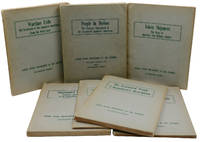
1946réf. 140941373Washington D.C.: U.S. Government Printing Office 1946. First Edition. Very Good. First edition first printings. Seven titles: Wartime Exile 167pp.; Impounded People 239pp.; The Relocation Program 105pp; Administrative Highlights of the WRA Program 82pp.; Token Shipment 104pp.; The Evacuated People 200pp.; People in Motion 270pp. Good. Wraps worn some soiled foxed chipped or stained; People in Motion has a long tear to the rear cover. Handwritten titles on spines which are also creased and chipped with loss to spine ends. Pages toned sometimes creased. Rare documents of the American government's official record of its WWII internment of people of Japanese descent one of the most controversial official programs in American history as reported by the War Relocation Authority. The WRA managed the forced confinement of people of Japanese ancestry in America during World War II as well as their return to civilian life with the commencement of the war. U.S. Government Printing Office unknown
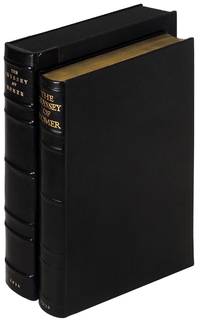
1932réf. 37494London England: Sir Emery Walker Wilfred Merton and Bruce Rogers 1932. Hardcover. Fine. Hardcover. One of 500 copies offered for sale of 530 copies of this monumental edition of Homer's Odyssey. The book was printed at the works of Emery Walker Ltd. under the supervision of Bruce Rogers. Walker and Rogers were two of the most influential figures in the world of books design and printing in the late 19th and early 20th century. Emery Walker 1851-1933 was an English engraver photographer and printer. Walker took an active role in many organizations that were at the heart of the Arts and Crafts movement including the Art Workers Guild the Society for the Protection of Ancient Buildings and the Arts and Crafts Exhibition Society. He also was a key figure in the world of design typography and printing in the teaching and dissemination of those crafts and in the cultural landscape of late nineteenth and early twentieth century Britain. Bruce Rogers 1870 - 1957 was an American typographer and type designer acclaimed by some as among the greatest book designers of the twentieth century. Rogers was known for his "allusive" typography rejecting modernism seldom using asymmetrical arrangements rarely using sans serif type faces often favoring faces such as Bell at the time known only as Brimmer Caslon his own Montaigne a Jensonian precursor to his masterpiece of type design Centaur. His books can fetch high sums at auction. Wikipedia In his book "Paragraphs on Printing" on pages 148-160 Rogers recounted the four year creation of the Odyssey from his asking Lawrence to translate the work to creating the perfect paper and making ink and the special gold and seven-step printing operation of the rondels. It was widely recognized that Rogers had created a masterpiece see Blumenthal Art of the Printed Book. Rogers had been inspired by his reading of "Seven Pillars of Wisdom" to persuade Lawrence to undertake this new translation. Lawrence began his work in 1928 and after some years produced a translation of the classic using his personal experience in the fog of war as well as faithfulness to the text as his guidelines. Bound in full black Niger morocco with gilt toes and lettering on the spine in gold. Printed on special paper made by J. Barcham Greem & Son in 16-point Monotype Centaur. There are 26 decorations of Homeric figures from Greek vase-paintings that are printed in black on roundels of gold leaf that at the head of each Book and on the title page. There is a two inch long ink line on the front free endpaper and the usual discoloration from the leather turns. Otherwise a fine copy. Accompanied by the prospectus. Not in original slipcase. Now housed in a very good fleece lined black clamshell box with a leather spine and black cloth covers. With a bit of scuffing and signs of handling. With an unusual Velcro closure. Measures 8.25 - 11.5 inches. Unpaginated 358 pages. PRI/092724. Sir Emery Walker, Wilfred Merton, and Bruce Rogers hardcover
réf. 51-6356Neustadt an der Weinstrasse: Matthaeus Harnish 1596 = Excud. M. Harnisius Neostadii in Palatinatu 1596. Folio. 22.5 x 35.5cm. Near-contemporary limp vellum bookblock loose. First edition 4 parts only of 6 engraved title-page woodcut initials and tailpieces woodcut diagrams some printing in red woodcut printer’s device below colophon Vvv5r Rheticus’s name on b5 partly covered over with a contemporary slip of paper blank leaves appearing before each part except first quire P in duplicate stubs from two pairs of ties gilt edges contemporary lettering to spine and number on upper cover lacking quire L4 title-page slightly worn at extremities cut close at foredge partial library ink stamp on title-page Otho’s name at end of preface partially effaced some toning and damp staining in places throughout Q2-3 with large brown stain upper hinge broken spine with small hole and creased Title Dedication and preface by LV Otho. - Parts - II: Rheticus GJ De fabrica canonis doctrinae triangulorum. 104 recte 109 p. 1 w. sheet - III: Ill. De triangulis globi cum angulo recto. 140 right 146 pp. 2 w. ll. including 1 after p. 102. - IV: Otho LV De triangulis globi sine angulo recto libri quinque. 1 sheet 341 recte 342 p. 1 sheet with printer's mark 1 white sheet - V: Ders. Meteoroscopium numerorum primum. 121 recte 126 pp. 1 page errata.Georg Joachim Rheticus 1514-76 fellow student of Conrad Gesner and friend of Melanchthon was an enthusiastic follower and contemporary of Copernicus. This work is of great historical importance as the first trigonometrical tables ever issued. Unfortunately the work was unfinished at his death in 1574 but the publication of Rheticus’s work was accomplished by his pupil Valentin Otho in 1596. These trigonometrical tables as corrected by Bartholomaeus Pitiscus in 1613 were still in use in the early twentieth century.The mathematician and astronomer Georg Rheticus was the only pupil of Nicolaus Copernicus whose De revolutionibus he helped publish. His major work was on the study of triangles culminating in this comprehensive set of tables to be used in angular astronomical measurements; it also includes the first use of the word "cosecant". It was completed and published after his death by Valentin Otho c.1545-1603. The tables were accurate enough to be used in astronomical computation into the early twentieth century.Rheticus’s fame rests on his connection with Copernicus and his efforts to get De revolutionibus orbium coelestium published. This is the first edition of his work on triangles a set of comprehensive set of tables using all six trigonometric functions for use in angular astronomical measurements. The work was unfinished at his death in 1574 but the publication of Rheticus’s work was accomplished by his pupil Valentin Otho c. 1545-1603 eventually seeing the light of day in 1596. These trigonometrical tables as corrected by Bartholomaeus Pitiscus in 1613 were still in use in the early twentieth century.LITERATURE & REFERENCESVD16 J 278; USTC 679854 all 6 parts; OCLC Number / Unique Identifier:457809739; Cajori A History of Mathematics p. 132–”This was indeed a gigantic work -a monument of German diligence and indefatigable perseverance ; Brunet IV 1265 ; Adams R 443 ; Honeymann 2631 ; Sotheran suppl. I 703 et suppl. II 2295 “excessively rare work”. Manque à Smith Rara Arithmetica. Burmeister vol. I 175-180 II pp.79-80 n°42-43. Tomash & Williams R81. Neustadt an der Weinstrasse: Matthaeus Harnish), 1596 = Excud. M. Harnisius, Neostadii in Palatinatu, 1596 hardcover
1922réf. 204721922. Full Limp Red Calf. Slipcase -- marbled paper pastedown on all sides other than opening. Chemise or inner folder -- thick glossy card stock all sides other than that has red calf with title label. Emily Swinton. Magnificent illuminated manuscript version of the Rubaiyat or some verses from the Rubaiyat. The illuminated borders are singular -- their design is unlike that we are familiar with and not even vaguely similar to anything we have ever seen produced by a latter-day illuminator professional or amateur. Their tracery is of blues greens reds some yellow in a few instances and not least the all important gilt. The illuminator surely was paying homage to some Islamic and Persian illumination in her palette but overall these sources are but influences; the illuminations are far from merely imitative. The design pulls you in and as one gazes longer one will discover small figurative imagery woven into the lines and swirls of the larger ornamentation. Words are beyond us to come close to capturing their complexity and character -- our photos hopefully will impart something of that. Let us just say the colors are deep and bold. Within these extraordinary borders is the calligraphic text rendered in a stunning easily legible Gothic Fraktur script. And there are four dream-like miniature watercolors as well of scenic Persian villages. N.d. circa early 1920s. 4to. 28.5 by 19 cm. Unpaginated 14 leaves with illumination -- illumination on one side. The back side of the leaf then left blank. Tissue guards for each page with illumination. The first leaf has no text -- it is a rectangular abstract design suggestive perhaps of a spectacular rug and inspired by such illuminated painting as one finds in many an antiquarian Koran. The next leaf is the title page with the words appearing to float on the page. The lettering has a distinctive verticality and the gilt letters are both clearly the letters they are supposed to be but have an abstraction that one can imagine they are Arabic script as well. The last two leaves with a more restrained formalistic illumination has evenly spaced dome-shaped pointers as one finds in Koranic decoration to highlight important passages. The binding slipcase and chemise are functional but don't really do the contents justice. Other than some crease marks on the calf and light wear overall to these protective features the binding and slipcase present no issues. unknown
1829réf. 129271Oriental Translation Fund of Great Britain and Ireland 18291836. Leather. Very Good. 3/4 leather over marbled boards 2 volume set. Gilt decorated 5 hub spine top edge gilt marbled end papers. Previous owner's book plate to front paste down and different previous owner's stamp to verso of the flyleaf. While VOL 1. title page indicates 1829 printing information on last page reads London: Printed by R. Watts Crown Court Temple Bar. 1833. VOL 2 respectively reads 1836 in both places. VOL 1. is the first 4 parts and is 421 pages VOL 2. parts 5-9 486 pages. Tight bindings. Please email for photos. Oriental Translation Fund of Great Britain and Ireland hardcover
1928réf. 026844Toronto Canada: The University of Toronto Press 1928. 2 volumes complete. This is an INSCRIBED PRESENTATION copy to the American inventor Thomas Edison from Canadian mathematician John Charles Fields. SEE PHOTOS. The inscription reads "To Dr. Thomas Alva Edision With the compliments of the Organizing Committee of the International Mathematical Congress of 1924 together with an expression of grateful appreciation and esteem for one whose discoveries and inventions have done so much to better and beautify the world in which we live signed J. C. Fields Chairman of the Organizing Committee." SEE PHOTOS. The ink stamp of "Thomas A. Edison Inc Research Engineering Department" appears in 3 places in each volume. Also laid in each volume is a printed slip confirming the source: i.e. from the library of Edison's youngest son Theodore M. Edison. SEE PHOTOS. There is no NOBEL PRIZE for mathematics. The closest analog is the FIELDS MEDAL for outstanding achievement in mathematics named for the editor of this set John Charles Fields 1863-1932 See Dictionary of Scientific Biography p. 617. The FIELDS MEDAL is presented only once every four years at the International Congress of Mathematicians. If you are like me you probably never heard of the FIELDS MEDAL until it was featured in the 1997 film GOOD WILL HUNTING nominated for 9 Oscars including Best Picture. It starred Robin Williams Best Supporting Actor Matt Damon and Ben Affleck Best Original Screenplay and Minnie Driver. In the movie fictional MIT professor Gerald Lambeau played by Stellan Skarsgård is described as having been awarded a FIELDS MEDAL for his work in combinatorial mathematics. Fields presented this 2 volume set to Thomas A. Edison the "Wizard of Menlo Park" and recipient of a record 1093 patents. Among Edison's inventions are the electric light phonograph movie camera vacuum diode carbon microphone the system for electric power distribution and the alkaline storage battery used for submarines and electric vehicles. In 1912 Edison designed the self-starter battery introduced on Henry Ford's iconic Model T automobile. These two volumes are uniformly bound in the original gilt stamped dark blue cloth. SEE PHOTOS. Oversize Hardcover. This extra large very heavy 2 volume set nearly 15 pounds before packaging will require SUBSTANTIAL postage that will be charged at our cost depending on destination. Signed by John C. Fields FIELDS MEDAL founder. First Edition. Oversize Hardcover. Near Fine condition. Illus. by NOT a library discard. 2 volumes: 935pp 1006pp. Great Packaging Fast Shipping. The University of Toronto Press Hardcover
1937réf. 308243Corvinus Press 1937. No. 20 of 30 copies on J.B. Green unsized paper edition of 32. 1 vols. 4to. White linen t.e.g. others untrimmed. Fine. No. 20 of 30 copies on J.B. Green unsized paper edition of 32. 1 vols. 4to. Poet and diplomat James Elroy Flecker 1884-1915 burned bright and briefly. He joined the diplomatic service in 1908 trained for two years and was posted to Constantinople in 1910 "but in September a slight fever was diagnosed as tuberculosis and he returned to England to a sanatorium. He pronounced himself cured and . went back to Constantinople in March 1911 to be transferred in April to Beirut. Flecker was not a very efficient vice-consul" ODNB. His first formal collection of verse The Bridge of Fire was published in 1907 and The Golden Journey to Samarkand was published in 1913. He died in Switzerland aged thirty-one. Lawrence knew Flecker in Beirut before the war. "Flecker probably introduced Lawrence to contemporary poetry" wrote Wilson in his introduction to Minorities 1971. According to O'Brien An Essay on Flecker was "written in 1925 with the intention of publication in a periodical and did not appear in print until 1937". O'Brien A198; Ridler p. 58 #41 [Corvinus Press unknown books
1936réf. 308242Corvinus Press 1936. No. 11 of 17 copies this copy on Milbourn hand made paper. 15 unnumbered leaves. 1 vols. 8vo. Full white vellum with yapp edges upper cover titled in gilt by Sangorski & Sutcliffe. Liddell Hart bookplate. No. 11 of 17 copies this copy on Milbourn hand made paper. 15 unnumbered leaves. 1 vols. 8vo. Inscribed to artist Eric Kennington: "EK from Carlow" Only 17 copies were printed on a variety of paper stocks for private distribution only. RARE. O'Brien A193 [Corvinus Press unknown books
1968réf. 69275London: BOAC 1968. BEATLES The. O.A.C. In-Flight Menu. London: BOAC n.d.c.a 1968. An autographed in-flight menu from the British Overseas Airways Corporation BOAC. The front cover is signed in black ink by John Lennon and George Harrison. The Paul McCartney autograph is actually in John Lennon's hand and Ringo Starr's is in the hand of Neil Aspinall the Beatles' long time road manager and assistant. Octavo 11 1/4 x 7 1/2 inches; 286 x 190 mm. 8 pp. Full color wrappers. Some black ink transfer on the back cover probably from another signed copy being placed underneath it. A very good example of these autographs. The menu for the B.O.A.C. route from Hong Kong-London via Rangoon Delhi Beirut and Rome. This menu is possibly from April of 1968 when John Lennon and George Harrison left India after a two month stint studying Transcendental Meditation with Maharishi Mahesh Yogi at his ashram in Rishikesh where they stayed until 12 April. Ringo Starr and Paul McCartney left before George and John in March which would explain why their signatures are produced by other people's hands. This item was sold at Bonhams Auctions in 2022. According to Bonhams "this was a gift from a First Class B.O.A.C. stewardess." HBS 69275. $10000. BOAC unknown books
1907réf. 63141Princeton NJ 1907. 4to 28 cm. 10 pages typed rectos only approximately 2850 words each leaf mounted along the left edge to a larger heavier sheet each page double-spaced with 29 separate ink corrections deletions and additions by Cleveland in his characteristic hand 44 words added 19 deleted 20 typos of poor strikes corrected; in addition there are numerous editorial marking on each page "by Grover Cleveland" is written in pencil in another hand underneath the title on the first page and "corrected by Cleveland" is written in pencil in yet another hand at the upper corner of the first page. The longest correction or addition occurs in the final paragraph where Cleveland strikes through four words replacing them with twelve. Following publication the "Youth's Companion" the essay appeared in newspapers e.g. "The Daily Republican" Monongahela Pennsylvania 25 February 1908 under the title "Our People and Our Ex-Presidents." We found one other unsigned essay by Cleveland at auction also a 10-page typescript with holograph corrections "Woman's Mission and Woman's Clubs" sold at Christie's in 2002 $8000. Very good condition throughout. 9870. An essay on the relationship between the American people and their ex-presidents by the only man who was ex-president twice. It addresses the expectations and demands the people place on their former presidents the personal financial effects these may have and the failure of the country to provide any support for them. Noting thankfully his own personally secure estate he based this one and cites specific examples of financial distress among earlier presidents. That combined with his own observations gave him concern for future ex-presidents. "If in concluding this discussion a personal word is necessary or permissible in view of the fact that I am the only man now living who could at this time profit by the ideas I have advocated I hope my sincerity will not be questioned when I say that I have dealt with the subject without the least thought of personal interest or desire for personal advantage. I am not in need of aid from the public treasury. I hope and believe that I have provided for myself and those dependent upon me a comfortable maintenance within the limits of accustomed prudence and economy and that those to whom I owe the highest earthly duty will not want when I am gone. unknown books
1946réf. 140941373Washington D.C.: U.S. Government Printing Office 1946. First Edition. Very Good. First edition first printings. Seven titles: Wartime Exile 167pp.; Impounded People 239pp.; The Relocation Program 105pp; Administrative Highlights of the WRA Program 82pp.; Token Shipment 104pp.; The Evacuated People 200pp.; People in Motion 270pp. Good. Wraps worn some soiled foxed chipped or stained; People in Motion has a long tear to the rear cover. Handwritten titles on spines which are also creased and chipped with loss to spine ends. Pages toned sometimes creased. Rare documents of the American government's official record of its WWII internment of people of Japanese descent one of the most controversial official programs in American history as reported by the War Relocation Authority. The WRA managed the forced confinement of people of Japanese ancestry in America during World War II as well as their return to civilian life with the commencement of the war. U.S. Government Printing Office unknown books