LAWRENCE, TE T EBiblio.com
389 486 résultats
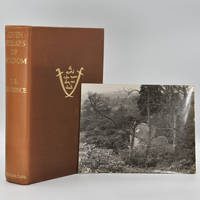
1935réf. 21205531935. London: Jonathan Cape. 1935. 4to. Original brown buckram spine lettered in gilt upper board blocked in gilt with crossed sword design top edges brown others uncut; pp. 672; frontispiece and 47 photogravure plates by John Swain & Son after Augustus John Eric Kennington Lawrence and others four folding maps printed by The Chiswick Press Ltd in red and black and bound to throw clear; minimal fading to extremities no offsetting from endpapers or frontispiece as frequently the case; a very clean and crisp copy largely unopened; with an intriguing provenance and mostly unpublished photographs of T. E. Lawrence's last home Clouds Hill as well as snapshots of his funeral.First trade edition first printing. Seven Pillars of Wisdom was first printed in 1922 in an edition of eight copies intended for Lawrence's use of which only six copies survive intact; the 'Subscribers' or 'Cranwell' edition then followed in 1926 published privately in an edition of circa 211 copies and as Lawrence wrote to Sotheran's on 24 April 1925 'this thing is being given only to my friends and their friends. No copies are for sale'; and finally after Lawrence's death in May 1935 the text was published in a trade edition by Jonathan Cape in July 1935. Such was the book's popularity that the first impression was quickly exhausted and second third and fourth impressions were printed in the following month August 1935.O'Brien A042.sold with20 original photographs of T. E. Lawrence's home since 1924 until his untimely death in 1935 a cottage in Dorset Clouds Hill all taken and printed in 1935 including two snapshots of his funeral measuring 210 by 160 mm apart from two smaller ones stamped K. N. Crowe Photographer of Reading on versos and marked in ink as Property of the Executors of T. E. Shaw the published pseudonym Lawrence took on when he joined the RAF. The photos show the exterior and interior of the cottage including the door with a stone lintel above which T. E. Lawrence had placed. Into this stone lintel Lawrence carved two Greek words which translate roughly as 'no worries'. The photos of the funeral are stamped on versos 'If used for reproduction due acknowledgement to be given to in ink: Pathe Gazette'. The photo of the bookroom downstairs was used for reproduction in T.E. Lawrence by His Friends published in 1937. The two smaller photographs measuring 98 by 143 mm show 'Clouds Hill Fine Tank or swimming bath across road from cottage' pencilled caption on verso in a hand not dissimilar to TEL's but not enough text to be conclusive and a fine Indian double door with elaborate lattice work inside the cottage. All previously contained in an envelope addressed to Jock Chambers see below which is included in this collection. T. E. Lawrence described Clouds Hill as his earthly paradise. He rented it first in 1923 while stationed with the Tank Corps at Bovington Camp. After having refurbished the property he bought it as his holiday home. In 1935 just a few weeks before his tragic death he had chosen Clouds Hill as permanent residence.Provenance: A. E. 'Jock' Chambers was an orderly to Lawrence during his time at Farnborough and they became lifelong friends and exchanged letters. Chambers visited Lawrence several times at Clouds Hill. Lawrence instructed Chambers in literature and music lent him books and paid for his membership of the London Library. The two kept in touch after Lawrence moved to Bovington and Chambers became a postal sorter in London. The Bodleian Library has a fine archive of T.E. Lawrence manuscripts including 24 letters from Lawrence to Chambers and also the original wrapping of the parcel of books posted to Chambers on 13 May 1935 only minutes before Lawrence's fatal accident. Chambers died in 1987 at the age of 91. The photographs were passed from Jock Chambers to Geoff Pawling who died in 2024. hardcover
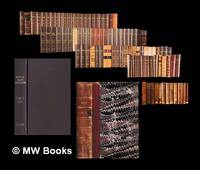
1731réf. 485211London : F. Jefferies et al 1731. First Edition. Hardcover. Mixed set of which 21 comprise contemporary bindings chiefly of calf over marble boards with the remainder in strong library bindings of gilt-blocked cloth. The contemporary bindings retain all boards with some lacking their spine covers and some boards detached; all show substantial wear. Text blocks all complete and sound showing the expected dust-dulling and foxing of age; some earlier volumes show minor contemporary annotations. On the whole a well-preserved set. Further scans images and additional bibliographical material available on request. Physical description; 92 volumes : illustrations ; 22-24 cm. Notes; Imprint varies. From 1732-35 titled: The London magazine: or Gentleman's monthly intelligencer. From 1736-1833 titled: The Gentleman's Magazine and Historical Chronicle. Contents; Seventy-eight biannual volumes incompletely cover the period 1801-52. Some earlier and later volumes also included from: 1731 vol. 1 complete in 1 1734 complete in 1 volume 1793 complete with parts 1-2; 1867 part 1 1868 part 2 1869 part 1 and 1894 part 1. Supplementary material includes 11 volumes from ""The gentleman's magazine library"" published by Elliot Stock London 1883-1894: English topography parts 3 5 7 10-12 14 and 17; Architectural antiquities part 2; Romano-British remains part 2; and Literary curiosities complete in 1 part. Also included are: A general index to the first twenty volumes of the gentleman's magazine E. Cave London 1753 with main text complete but lacking publisher's adds and rear board; and a facsimile reprint of The Gentleman's Magazine 1731-51 : the lists of books collected with annual indexes and the index to the first twenty years / Edward Kimber Gregg Press London 1966 originally published 1752. Subjects; English literature. 18th century. 19th century. Essays. Poetry. Antiquities. Great Britain. History. Periodicals. London : F. Jefferies [et al] hardcover
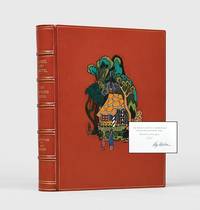
1925réf. 146530London: Hodder and Stoughton 1925. A handsomely bound copy Signed limited edition number 434 of 600 copies signed by the illustrator. An advertisement issued by the publishers appeared in the Times Literary Supplement on 3 December 1925 which stated "there is only one edition of Hansel and Gretel which is limited to 500 copies". Evidently demand increased the limitation but with no trade edition this is a scarce book. The publishers noted "the art of Kay Nielsen has never been shown to greater advantage than in these truly wonderful illustrations to Grimm's Fairy Stories. The draughtsmanship the decorative skill and the fairy imagination are unique and place Mr Kay Nielsen as one of the greatest of illustrators and decorative artists. This magnificent volume is also a fine example of the engraver's and bookmaker's art". "Nielsen is a brilliant colourist and a highly decorative illustrator his works formed into frieze-like patterns are closest to Persian or Middle-Eastern designs and therefore akin to Leon Bakst or Edmund Dulac" Houfe p. 401. Quarto 300 x 237 mm. With 12 tipped-in colour plates captioned tissues and 10 full page monochrome plates. Finely bound by the Chelsea Bindery in terracotta morocco spine lettered and decorated in gilt single rule to boards gilt pictorial onlay of the gingerbread house to the front board inner dentelles gilt dark green endpapers top edge gilt others untrimmed. Some minor light damp staining to the fore-edge of 15 pages else an excellent copy in a fine binding. Times Literary Supplement 3 December 1925 p. 823; Simon Houfe The Dictionary of British Book Illustrators and Caricaturists 1800-1914 1981. hardcover
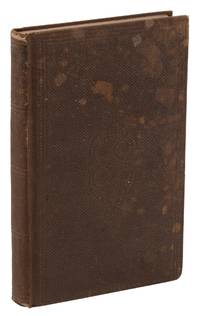
1862réf. 140949370Utica NY: M. J. Randolph 1862. First Edition. Very Good. First edition first printing. ii 268 4 pp. Bound in publisher's blindstamped brown bead-grain cloth lettered in gilt on the spine yellow coated endpapers. Very Good with moderate wear to extremities and dampstaining to front board. Gatherings printed on different paper stock and variably toned. Penciled ownership signature to title page 1892 ink gift inscription to fly-leaf. An unsophisticated copy. Paschal Beverly Randolph was a pioneering spiritualist and sex magician of partial African descent whose work influenced the Theosophical Society and Hermetic Order of the Golden Dawn. In 1850 he befriended the future Civil War general Ethan Allen Hitchcock who introduced him to the Rosicrucian Order-- the turning point in Randolph's life. He spent the rest of the decade traveling and studying scrying and other magical arts and in 1858 was inducted as Supreme Grand Master of the Fraternitas for the Western World beginning a series of lecture tours. Briefly active in the Reform Party he formed a friendship with Abraham Lincoln and in the 1860s acceded to Lincoln's request to help educate newly freed slaves in New Orleans. After the President was assassinated Randolph was a member of the procession escorting his body back to Illinois - until he was asked to leave the train due to his rumored African ancestry. Randolph began practicing medicine in the late 1860s risking the ire of authorities with his liberal attitude toward sex romance and family life. He moved to Toledo with his second wife and there died by a gunshot wound to the head at the age of 49. The circumstances are murky. The death was recorded as an accident and the Rosicrucian Dr. R. Swinburne Clymer claimed that a former friend of Randolph's had confessed on his deathbed to murdering the doctor. Uniformly snide newspaper obituaries reported that Randolph shot himself after a drinking binge tormented by a jealous possessiveness of his much younger wife. In Dealings with the Dead Randolph describes "persons who unthinkingly tear down and wreck their fellows every soul of whom might be builded up and made strong for the Right.and all by kindness open-hearted conduct and friendly cheer." Even in death he couldn't escape those who would tear him down but he earned a lasting place of respect in esoteric history. M. J. Randolph unknown
1862réf. 140949370Utica NY: M. J. Randolph 1862. First Edition. Very Good. First edition first printing. ii 268 4 pp. Bound in publisher's blindstamped brown bead-grain cloth lettered in gilt on the spine yellow coated endpapers. Very Good with moderate wear to extremities and dampstaining to front board. Gatherings printed on different paper stock and variably toned. Penciled ownership signature to title page 1892 ink gift inscription to fly-leaf. An unsophisticated copy. Paschal Beverly Randolph was a pioneering spiritualist and sex magician of partial African descent whose work influenced the Theosophical Society and Hermetic Order of the Golden Dawn. In 1850 he befriended the future Civil War general Ethan Allen Hitchcock who introduced him to the Rosicrucian Order-- the turning point in Randolph's life. He spent the rest of the decade traveling and studying scrying and other magical arts and in 1858 was inducted as Supreme Grand Master of the Fraternitas for the Western World beginning a series of lecture tours. Briefly active in the Reform Party he formed a friendship with Abraham Lincoln and in the 1860s acceded to Lincoln's request to help educate newly freed slaves in New Orleans. After the President was assassinated Randolph was a member of the procession escorting his body back to Illinois - until he was asked to leave the train due to his rumored African ancestry. Randolph began practicing medicine in the late 1860s risking the ire of authorities with his liberal attitude toward sex romance and family life. He moved to Toledo with his second wife and there died by a gunshot wound to the head at the age of 49. The circumstances are murky. The death was recorded as an accident and the Rosicrucian Dr. R. Swinburne Clymer claimed that a former friend of Randolph's had confessed on his deathbed to murdering the doctor. Uniformly snide newspaper obituaries reported that Randolph shot himself after a drinking binge tormented by a jealous possessiveness of his much younger wife. In Dealings with the Dead Randolph describes "persons who unthinkingly tear down and wreck their fellows every soul of whom might be builded up and made strong for the Right.and all by kindness open-hearted conduct and friendly cheer." Even in death he couldn't escape those who would tear him down but he earned a lasting place of respect in esoteric history. M. J. Randolph unknown books
1897réf. 24This book is over 122 years old. "The Raven" in particular—Poe investigates the loss of ideal beauty and the difficulty in regaining it. These pieces are usually narrated by a young man who laments the untimely death of his beloved. "To Helen" is a three stanza lyric that has been called one of the most beautiful love poems in the English language. The subject of the work is a woman who becomes in the eyes of the narrator a personification of the classical beauty of ancient Greece and Rome. "Lenore" presents ways in which the dead are best remembered either by mourning or celebrating life beyond earthly boundaries. In "The Raven" Poe successfully unites his philosophical and aesthetic ideals. In this psychological piece a young scholar is emotionally tormented by a raven's ominous repetition of "Nevermore" in answer to his question about the probability of an afterlife with his deceased lover. Charles Baudelaire noted in his introduction to the French edition of "The Raven": "It is indeed the poem of the sleeplessness of despair; it lacks nothing: neither the fever of ideas nor the violence of colors nor sickly reasoning nor drivelling terror nor even the bizarre gaiety of suffering which makes it more terrible." Poe also wrote poems that were intended to be read aloud. Experimenting with combinations of sound and rhythm he employed such technical devices as repetition parallelism internal rhyme alliteration and assonance to produce works that are unique in American poetry for their haunting musical quality. In "The Bells" for example the repetition of the word "bells" in various structures accentuates the unique tonality of the different types of bells described in the poem.Poe's stature as a major figure in world literature is primarily based on his ingenious and profound short stories poems and critical theories which established a highly influential rationale for the short form in both poetry and fiction. Regarded in literary histories and handbooks as the architect of the modern short story Poe was also the principal forerunner of the "art for art's sake" movement in nineteenth-century European literature. Whereas earlier critics predominantly concerned themselves with moral or ideological generalities Poe focused his criticism on the specifics of style and construction that contributed to a work's effectiveness or failure. In his own work he demonstrated a brilliant command of language and technique as well as an inspired and original imagination. Poe's poetry and short stories greatly influenced the French Symbolists of the late nineteenth century who in turn altered the direction of modern literature. It is this philosophical and artistic transaction that accounts for much of Poe's importance in literary history. This book contains the first collection of Poems Poems and Tales. See Pictures Houghton Mifflin Company hardcover
réf. 010941[Battle of the Little Bighorn, Bataille de Little Bighorn, Felice Orsini, Attentat contre Napoléon III en 1858, Charles Camillo De Rudio], Recueil de 9 autographes des 4 protagonistes dont Charles DeRudio qui devint officier lors de la fameuse bataille de Little Bighorn le 25 juin 1860, y survécut et dont le témoignage fut publié dès le 30 juin 1860. Reliés dans un volume in-8 avec une brochure du docteur Rougean, L'Attentat d'Orsini - étude de psychi-pathologie historique (Paris, Le François, 1934). L'attentat eut lieu le 14 janvier 1858. Felice Orsini (1819-1858), G Pieri (1808-1858), Charles de Rudio (1832-1910) & Antoine (Antonio) Gomez (né en 1825). Les trois premiers furent condamnés à mort le 26 février 1858 et Gomez aux travaux forcés à perpétuité. La peine de Rudio fut commuée en travaux forcés elle-aussi et il s'évada peu après alors qu'Orsini et Pieri furent exécutés le 13 mars 1858. Si on perd la trace de Gomez (probablement mort au bagne), Rudio arriva à Londres puis émigra à New-York. Il s'engagea dans l'armée et fait partie des survivants de la fameuse bataille de Little Bighorn (25 juin 1860). Son témoignage a été publié dès le 30 juin dans New York Herald. On compte ainsi : -2 autographes d'Orsini : une feuille de comptes et une L.A.S. à « M. Leveille, directeur de la conciergerie », en réalité Jean-François Lebel, datée du 2 mars 1858. -3 autographes de Pieri : une L.A.S., probablement jamais arrivée, au procureur général pour solliciter un rendez-vous, datée du 22 février 1858, et 2 reçus A.S. datés des 12 et 13 février 1858. -2 autographes de Gomez : 2 reçus A.S. datés des 9 février et 1er mars 1858. -2 autographes de Rudio : 2 reçus A.S. datés des 12 et 13 février 1858. Reliure demi-chagrin. Exceptionnel ensemble, extraordinaire même par la réunion des 4 protagonistes de l'attentat et par la présence même d'autographe d'un des protagonistes de Little Bighorn, évènement d'une importance capitale dans l'histoire des USA.
1942réf. 5627et qui paraitra sous le titre définitif "Le Charcutier de Machonville", par Marcel-E. Grancher, auteur lyonnais, journaliste, écrivain, un des principaux chefs de la Résistance à Lyon pendant l'Occupation allemande. In-4 ; demi-maroquin bordeaux, dos à nerfs, titre doré, non rogné ; (3) ff., 230 feuillets recto, à l'écriture bien lisible.Il s'agit du manuscrit brut, rempli de ratures, rajouts, modifications diverses y compris de bandes collées, du plus célèbre roman de Grancher, Grand Prix littéraire de Lyon en 1936 et Prix Courteline en 1938 ; il est daté de "Reyrieux, janvier 1942" et est émaillé d'indications typographiques. Comme il ne s'agit pas de la "mise au propre", il serait intéressant de comparer précisément ce texte avec celui finalement publié.Mention manuscrite sur la page de garde : "J'ai relié ce livre pendant la guerre de 40, le client ne m'a pas donné son nom ni adresse, je le tiens donc à sa disposition. Signé H. Jacquet, relieur 7, rue des Marronniers. Lyon".Document en très bel état.
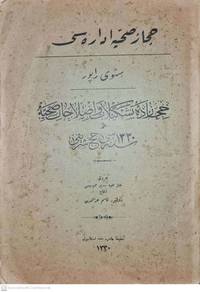
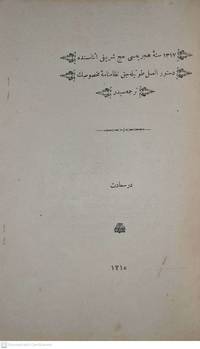
1914réf. 000179Ottoman Turkish official report about the Hijaz health rules and organizations with several illustrations of Jeddah and Mecca. Amira , government press paperback
1900réf. 00020819 p. Ottoman Turkish text. Official report of the hajj and health quarantine law in 1889-1900. Consists of 20 articles. The Anglo-ottoman Hajj policy conflict. Rare. Osmaniye press paperback
1899réf. 000432Basra – Ottoman Imperial Authority Basra Vilayet Department 1317 AH / 1899 AD First edition of the third official provincial report salname / administrative report issued by the Vilayet of Basra during a critical period of political and strategic tension in southern Iraq and the Arabian Gulf under the reign of Sultan Abdülhamid II. Printed in Basra this volume represents one of the earliest locally produced Ottoman governmental publications from the province. The work consists of 172 pages of Ottoman Turkish text and was issued in original printer's wrappers bearing the Ottoman coat of arms and the tughra of Sultan Abdülhamid II on the cover. The report provides a comprehensive and official survey of administrative military and political conditions throughout the vilayet and its dependent sanjaks and kazas including: Basra Amara Muntafiq Nasiriyya Zubayr Ahsa al-AḥsÄʾ Najd Kuwait Qatar Of particular historical importance are the named references to key regional political figures including Shaykh MubÄrak al-ṢabÄḥ Kaymakam of Kuwait and members of the Āl ThÄnī family of Qatar providing valuable contemporary documentation of Ottoman administrative recognition and authority in the Gulf. Format: 8vo 7¾–9¾ in. Pagination: 172 pp. Language: Ottoman Turkish Edition: First edition Condition: As new. Original wrappers very lightly stained; three small neat wormholes. Otherwise as issued and in excellent condition. A rare and highly significant primary source for late Ottoman governance in Basra and the Arabian Gulf documenting imperial authority regional administration and local power structures on the eve of the twentieth century. The Ottoman authority, Basra dept.
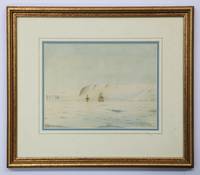
1843réf. 1450501843. Watercolour. 6 x 8.15/16in. 17.2 x 22.7cm. Titled on the original detached label: Captain John Edward Davis R.N. 1815-1877; Cape Lockyer discovered by H.M. Ships Erebus and Terror January 7th 1843 Lot Essay Davis was Second Master on Commander Crozier's Terror and a number of his drawings probably the first ever of the Antarctic continent were used by Ross to illustrate his official account of the voyage published in two volumes in London in 1847. James Clark Ross had reached the northern magnetic Pole in 1831 and was charged by the Government following the recommendation of the British Association for the Advancement of Science and the Royal Society to lead an expedition to investigate terrestrial magnetism in the southern latitudes. The expedition was the first British exploration of the southern latitudes since Cook's skirting of the Antarctic circle in 1773-4 and the sealer Weddell's furthest south of 7415'S in 1823. Bellinghausen had probably been the first to sight the Antarctic continent in January 1820 and Dumont D'Urville then discovered Adelie Land and Claire Coast. Their work towards the discovery of an Antarctic landmass was consolidated by James Clark Ross who penetrated the pack ice in January 1841 sailing into the clear water of the unknown Ross Sea and sighting snow-covered land on 11 January thereby becoming the first to discover a sea route to the continent. McCormick on the Erebus saw and named an active volcano Mt. Erebus and Ross was the first to see and chart the South Polar Barrier which he named Victoria Barrier and which was later named the Ross Ice Barrier. He made two further navigations of the Ross Sea and Wedell Sea before returning to England in 1843. 'Jan. 7. 1843.As we advanced to the southward two high rugged bluff capes at a great distance appeared bearing W.S.W. true; the nearest of them I named at the request of Captain Crozier after his friend Captain Nicholas Lockyer R.N.C.B. Capt. Sir J.C. Ross A Voyage of Discovery and Research in the southern and Antarctic Regions during the years 1839-43 London 1847 II p.346. For Davis's own account see his A Letter from the Antarctic London 1901 illustrated with own sketches. For further works by Davis on the voyage see Christie's 10 April 1997 lot 95 and 17 September 1998 lot 178. 1843 unknown
réf. 23041HARDBACK NO DUSTJACKET STATED 1ST EDITION 1957 LITE RUB WEAR & Oblong MATTED in black PAPER SIGNED BY WALT DISNEY 5 1/2 X 3 1/2 in . Creasing Tears to some Portions not Affecting Signature of Disney or other ARTWORK Signature Guaranteed Authentic Verso of Paper is White TAPE which Adheres it to MATTING on BACKside & Mends some Tears SOLD AS-IS Overall VERY NICE This is a GREAT MATTED PIECE Oblong MATTED in black PAPER SIGNED BY WALT DISNEY 5 1/2 X 3 1/2 in . WALT DISNEY SIGNS THE PAPER with Mickey artwork drawn by Disney Artist AT BOTTOMCreasing Tears to some Portions not Affecting Signature of Disney or other ARTWORK Signature Guaranteed Authentic Verso of Paper is White TAPE which Adheres it to MATTING on BACKside & Mends some Tears SOLD AS-IS Overall VERY NICE SIGNED Matted Piece of PAPER BY WALT DISNEY The Drawing of Mickey & Best Wishes Mickey Mouse are by DISNEY ARTIST. Signed by Author. First Edition. Unbound. Disney Editions NY hardcover
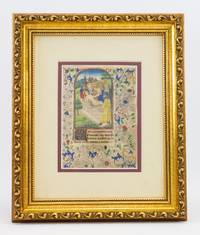
réf. ST19540bSouthern Netherlands Bruges third quarter of 15th century. Matted leaf: 150 x 150 mm. 5 7/8 x 4 3/8". Frame: 307 x 258 mm. 12 x 10 1/4". Single column with four lines below the miniature and the obverse with 17 lines in a batarde hand. Attractively matted and framed the leaf slightly shifted in the mat revealing top and side edges but in no danger of damage. Rubrics in red four one-line initials and three three-line initials all but one in burnished gold on blue and red ground with white tracery the initial beneath the miniature painted pink on a burnished gold ground and filled with painted ivy vines AN ARCH-TOPPED LARGE MINIATURE DEPICTING THE ENTOMBMENT the body of Christ surrounded by seven other people depicted in an outdoor setting with the turrets of a walled city in the background the miniature in a double frame of gold and pink surrounded by A FULL BORDER composed of hairline vines acanthus colorful flowers and gilt bezants and inhabited by a small bird. Minor soiling and a faint thumb print to borders but IN VERY FINE CONDITION THE MINIATURE BEAUTIFULLY PRESERVED. This is a beautifully rendered and deeply touching scene depicting the entombment of the crucified Christ and the pathos experienced by those at his side. Holding the sheet on which the body is lowered into the sarcophagus are on the far left the richly clothed Joseph of Arimathea and on the far right Nicodemus who dons an especially lovely yellow garment with delicate embroidery. Between the two men in the foreground but behind the body are the Virgin Mary who presses the hand of her deceased son to her lips; John the Evangelist whose body is turned toward the Virgin in a gesture of support but whose gaze is focused on the Savior; and Mary Magdalene who holds a small ointment jar. Two other women with halos stand closely behind them consoling one another. The artist has done a masterful job at creating a composition that captures the emotional gravity of the scene: Christ's body gently cradled in a white sheet is on full display with blood still trickling from the wounds on his head and side. Despite there being seven people crowded around him our attention is drawn to the action between Christ and the Virgin who gently grasps his hand with motherly affection and bids him a final farewell. Flickers of different emotions appear on the faces of his followers including pity sorrow stoicism and disbelief--echoing perhaps the viewer's own range of feelings upon viewing this image. The level of detail excellence of composition care seen in the molded bodies and faces and the convincing setting suggest that the artist was quite practiced and that the original manuscript from which the leaf comes was of very high quality. unknown
réf. ST19540bSouthern Netherlands Bruges third quarter of 15th century. Matted leaf: 150 x 150 mm. 5 7/8 x 4 3/8". Frame: 307 x 258 mm. 12 x 10 1/4". Single column with four lines below the miniature and the obverse with 17 lines in a batarde hand. Attractively matted and framed the leaf slightly shifted in the mat revealing top and side edges but in no danger of damage. Rubrics in red four one-line initials and three three-line initials all but one in burnished gold on blue and red ground with white tracery the initial beneath the miniature painted pink on a burnished gold ground and filled with painted ivy vines AN ARCH-TOPPED LARGE MINIATURE DEPICTING THE ENTOMBMENT the body of Christ surrounded by seven other people depicted in an outdoor setting with the turrets of a walled city in the background the miniature in a double frame of gold and pink surrounded by A FULL BORDER composed of hairline vines acanthus colorful flowers and gilt bezants and inhabited by a small bird. Minor soiling and a faint thumb print to borders but IN VERY FINE CONDITION THE MINIATURE BEAUTIFULLY PRESERVED. This is a beautifully rendered and deeply touching scene depicting the entombment of the crucified Christ and the pathos experienced by those at his side. Holding the sheet on which the body is lowered into the sarcophagus are on the far left the richly clothed Joseph of Arimathea and on the far right Nicodemus who dons an especially lovely yellow garment with delicate embroidery. Between the two men in the foreground but behind the body are the Virgin Mary who presses the hand of her deceased son to her lips; John the Evangelist whose body is turned toward the Virgin in a gesture of support but whose gaze is focused on the Savior; and Mary Magdalene who holds a small ointment jar. Two other women with halos stand closely behind them consoling one another. The artist has done a masterful job at creating a composition that captures the emotional gravity of the scene: Christ's body gently cradled in a white sheet is on full display with blood still trickling from the wounds on his head and side. Despite there being seven people crowded around him our attention is drawn to the action between Christ and the Virgin who gently grasps his hand with motherly affection and bids him a final farewell. Flickers of different emotions appear on the faces of his followers including pity sorrow stoicism and disbelief--echoing perhaps the viewer's own range of feelings upon viewing this image. The level of detail excellence of composition care seen in the molded bodies and faces and the convincing setting suggest that the artist was quite practiced and that the original manuscript from which the leaf comes was of very high quality. unknown books
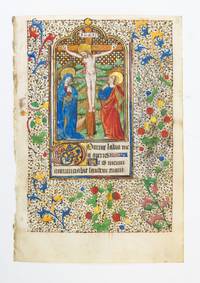
réf. ST17060ZFrance probably Besançon 3rd quarter of 15th century. 239 x 165 mm. 9 3/8 x 6 1/2". Single column 15 lines in an elegant gothic book hand. Rubrics in dark pink line-enders in dark pink and blue highlighted with a gilt bezant several one-line initials and one two-line initial in burnished gold on dark pink and blue ground with white tracery one three-line initial in pink with white tracery filled with trefoils painted red or blue all on a gold ground verso with panel border of delicate hairline vines terminating in gilt bezants and ivy and with acanthus and flowers recto with A HALF-PAGE MINIATURE OF THE CRUCIFIXION in an arch-topped gilt frame Christ in the center of the composition with the mocking inscription "I N R I" "Iesus Nazarenus Rex Iudaeorum" on a banner above him the Virgin standing on the left and St. John on the right the landscape behind them filled with hills and trees under a tessellated sky SURROUNDED BY A FULL BORDER consisting of hairline vines terminating in gold bezants and ivy colorful acanthus strawberries and flowers the text and image further framed by a "U"-shaped bar of gold pink and blue extending the full height of the miniature. ◆Virgin's robe a little mottled and chipped minor chipping elsewhere borders with slight smudging to some of the hairline vines small marginal stain but in all in excellent condition with wide margins with the colors very bright and the miniature well preserved. Opening the Hours of the Cross a shorter text that is sometimes found in addition to the Hours of the Virgin this touching miniature of the Crucifixion is richly painted and features a particularly emotional depiction of Christ his head slightly bowed with an expression of pain. Blood flows freely from his wounds partly merging with the orange in the sky and partly forming rivulets at the base of the cross. This exsanguination stands in contrast to the more typically restrained indications in other Crucifixion scenes and serves to emphasize the cruel suffering of the execution. His mother stands to the left in a blue cloak hands knitted together and with a look of weary resignation on her face; to the right stands St. John whose lips are slightly parted as he looks directly at the crucified Christ as if searching his face for signs of life. Our artist has made an unusual choice for the background with the lower two thirds devoted to a naturalistic landscape with many hills and trees and the sky entirely tessellated with squares of red blue and gold. While the Virgin and St. John are both firmly situated within the earthy realm the body of Christ occupies both spaces perhaps emphasizing his dual nature as both human and divine. Stylistically this leaf can be localized to the Franche-Comté region in eastern France and is closely related if not directly attributable to an atelier specializing in Books of Hours made for the Use of Besançon and most likely situated in that city see Avril and Reynaud p. 197. The similarities are especially apparent in the figures' faces which are slightly puffy in appearance and have distinct slit-like eyes. As noted by Avril and Reynaud the unnamed master of this atelier was deeply indebted to the Master of Morgan 293 a talented Burgundian illuminator active in the second quarter of the 15th century whose name derives from a particularly lovely Book of Hours made for the Use of Besançon. In fact there are certain consonant details between this miniature and the Crucifixion in the Morgan manuscript: Christ's position and physicality are nearly identical as is the pattern of blood as it moves down the cross and both artists create a division in the landscape with the Morgan artist using gold rather than tessellation for his sky. Whoever the artist responsible for the present miniature the work here is clearly accomplished both quietly powerful and an excellent representation of a distinct regional style. unknown
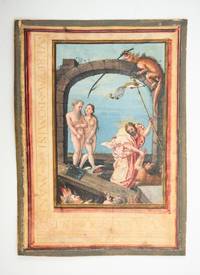
1540réf. ST20622Germany ca. 1540. 183 x 133 mm. 7 1/8 x 5 1/4". WITH A FULL-PAGE MINIATURE DEPICTING THE HARROWING OF HELL featuring a naked Adam and Eve on the left and on the right Christ bending down to rescue John the Baptist the figures framed by a stone archway supporting a hairy creature who aims the point of a spear directly at Adam and Eve the miniature in a thin brown frame with gilt lines surrounded on two sides by the words "VERBUM DOMINI MANET IN ETERNUM" in gilt all framed in gray and red washes with double rules of black and gilt. Light soiling to frame a little flaking to the gray border and a couple of small scuffs and smudges elsewhere verso with spotting but the miniature vibrant and well preserved with only very trivial imperfections. A close copy of an early 16th century engraving by Albrecht Dürer this powerful miniature depicting the Harrowing of Hell is an intriguing artifact that ties together manuscript art print culture and the Reformation. The image depicts an apocryphal tale in the Gospel of Nicodemus in which Christ following his death but before his Resurrection descends into Limbo in order to save righteous souls who had passed away before him particularly figures from the Old Testament. Christ appears here in pale pink robes carrying a long staff with a cross and banner adorning the top. Having just brought down the gates of Hell he stoops to rescue John the Baptist here dressed in furs from its depths. A naked Adam and Eve covering their loins stand at the left of the composition--Adam now a gray-bearded old man as a reflection of sin and mortality but Eve still as she was at the Expulsion in keeping with the period's inclination to retain the classically idealized youthful feminine form. Above them is a stone arch upon which a dog-like demon perches stealthily aiming a spear directly at the oblivious couple. Another demon snaps its jaws at the feet of Christ and we can see a lick of flames below the broken gate as more captive souls clamor to escape. The painting is skillfully done showing the artist's facility with anatomy proportion and foreshortening. The bodies of Adam and Eve are particularly excellent with lovely skin tones and convincing molding. The composition is clearly based on an engraving by Dürer published in 1513 as part of a major series of 16 images known as the "Engraved Passion." In translating a black & white print into a full-color painting the artist here dispensed with a few details seen in Dürer's work such as the shadowy figure behind Adam and Eve and the stigmata on Christ's hand; however the overall composition deviates little from the original suggesting that the artist may have been working from an actual engraving. Although this leaf contains just a few words in the form of a border inscription--"Verbum Domini manet eternum" "the Word of the Lord endures forever"--they are monumentally important. This line from Isaiah 40:8 and 1 Peter 1:25 became the motto of the Lutheran Reformation appearing on art clothing coins and even armor of the 16th century. The Schmalkaldic League an influential group of allied Lutheran principalities in the Holy Roman Empire at the time also adopted it as their motto. Given the dominance of print materials during the Reformation period our hand-painted miniature--possibly produced as a frontispiece--must have been a very special commission. It is also an object that is prime for further study touching on aspects of book production religious art and the transmission of images and ideas in the early modern period. unknown
1540réf. ST20622Germany ca. 1540. 183 x 133 mm. 7 1/8 x 5 1/4". WITH A FULL-PAGE MINIATURE DEPICTING THE HARROWING OF HELL featuring a naked Adam and Eve on the left and on the right Christ bending down to rescue John the Baptist the figures framed by a stone archway supporting a hairy creature who aims the point of a spear directly at Adam and Eve the miniature in a thin brown frame with gilt lines surrounded on two sides by the words "VERBUM DOMINI MANET IN ETERNUM" in gilt all framed in gray and red washes with double rules of black and gilt. Light soiling to frame a little flaking to the gray border and a couple of small scuffs and smudges elsewhere verso with spotting but the miniature vibrant and well preserved with only very trivial imperfections. A close copy of an early 16th century engraving by Albrecht Dürer this powerful miniature depicting the Harrowing of Hell is an intriguing artifact that ties together manuscript art print culture and the Reformation. The image depicts an apocryphal tale in the Gospel of Nicodemus in which Christ following his death but before his Resurrection descends into Limbo in order to save righteous souls who had passed away before him particularly figures from the Old Testament. Christ appears here in pale pink robes carrying a long staff with a cross and banner adorning the top. Having just brought down the gates of Hell he stoops to rescue John the Baptist here dressed in furs from its depths. A naked Adam and Eve covering their loins stand at the left of the composition--Adam now a gray-bearded old man as a reflection of sin and mortality but Eve still as she was at the Expulsion in keeping with the period's inclination to retain the classically idealized youthful feminine form. Above them is a stone arch upon which a dog-like demon perches stealthily aiming a spear directly at the oblivious couple. Another demon snaps its jaws at the feet of Christ and we can see a lick of flames below the broken gate as more captive souls clamor to escape. The painting is skillfully done showing the artist's facility with anatomy proportion and foreshortening. The bodies of Adam and Eve are particularly excellent with lovely skin tones and convincing molding. The composition is clearly based on an engraving by Dürer published in 1513 as part of a major series of 16 images known as the "Engraved Passion." In translating a black & white print into a full-color painting the artist here dispensed with a few details seen in Dürer's work such as the shadowy figure behind Adam and Eve and the stigmata on Christ's hand; however the overall composition deviates little from the original suggesting that the artist may have been working from an actual engraving. Although this leaf contains just a few words in the form of a border inscription--"Verbum Domini manet eternum" "the Word of the Lord endures forever"--they are monumentally important. This line from Isaiah 40:8 and 1 Peter 1:25 became the motto of the Lutheran Reformation appearing on art clothing coins and even armor of the 16th century. The Schmalkaldic League an influential group of allied Lutheran principalities in the Holy Roman Empire at the time also adopted it as their motto. Given the dominance of print materials during the Reformation period our hand-painted miniature--possibly produced as a frontispiece--must have been a very special commission. It is also an object that is prime for further study touching on aspects of book production religious art and the transmission of images and ideas in the early modern period. unknown books
réf. ST17060ZFrance probably Besançon 3rd quarter of 15th century. 239 x 165 mm. 9 3/8 x 6 1/2". Single column 15 lines in an elegant gothic book hand. Rubrics in dark pink line-enders in dark pink and blue highlighted with a gilt bezant several one-line initials and one two-line initial in burnished gold on dark pink and blue ground with white tracery one three-line initial in pink with white tracery filled with trefoils painted red or blue all on a gold ground verso with panel border of delicate hairline vines terminating in gilt bezants and ivy and with acanthus and flowers recto with A HALF-PAGE MINIATURE OF THE CRUCIFIXION in an arch-topped gilt frame Christ in the center of the composition with the mocking inscription "I N R I" "Iesus Nazarenus Rex Iudaeorum" on a banner above him the Virgin standing on the left and St. John on the right the landscape behind them filled with hills and trees under a tessellated sky SURROUNDED BY A FULL BORDER consisting of hairline vines terminating in gold bezants and ivy colorful acanthus strawberries and flowers the text and image further framed by a "U"-shaped bar of gold pink and blue extending the full height of the miniature. ◆Virgin's robe a little mottled and chipped minor chipping elsewhere borders with slight smudging to some of the hairline vines small marginal stain but in all in excellent condition with wide margins with the colors very bright and the miniature well preserved. Opening the Hours of the Cross a shorter text that is sometimes found in addition to the Hours of the Virgin this touching miniature of the Crucifixion is richly painted and features a particularly emotional depiction of Christ his head slightly bowed with an expression of pain. Blood flows freely from his wounds partly merging with the orange in the sky and partly forming rivulets at the base of the cross. This exsanguination stands in contrast to the more typically restrained indications in other Crucifixion scenes and serves to emphasize the cruel suffering of the execution. His mother stands to the left in a blue cloak hands knitted together and with a look of weary resignation on her face; to the right stands St. John whose lips are slightly parted as he looks directly at the crucified Christ as if searching his face for signs of life. Our artist has made an unusual choice for the background with the lower two thirds devoted to a naturalistic landscape with many hills and trees and the sky entirely tessellated with squares of red blue and gold. While the Virgin and St. John are both firmly situated within the earthy realm the body of Christ occupies both spaces perhaps emphasizing his dual nature as both human and divine. Stylistically this leaf can be localized to the Franche-Comté region in eastern France and is closely related if not directly attributable to an atelier specializing in Books of Hours made for the Use of Besançon and most likely situated in that city see Avril and Reynaud p. 197. The similarities are especially apparent in the figures' faces which are slightly puffy in appearance and have distinct slit-like eyes. As noted by Avril and Reynaud the unnamed master of this atelier was deeply indebted to the Master of Morgan 293 a talented Burgundian illuminator active in the second quarter of the 15th century whose name derives from a particularly lovely Book of Hours made for the Use of Besançon. In fact there are certain consonant details between this miniature and the Crucifixion in the Morgan manuscript: Christ's position and physicality are nearly identical as is the pattern of blood as it moves down the cross and both artists create a division in the landscape with the Morgan artist using gold rather than tessellation for his sky. Whoever the artist responsible for the present miniature the work here is clearly accomplished both quietly powerful and an excellent representation of a distinct regional style. unknown books
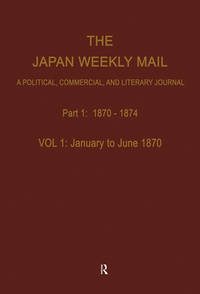
2006réf. __4861660203Routledge 2006. Hardcover. New. 1st fac edition. 5400 pages. 14.96x13.78x11.02 inches. Routledge hardcover
réf. 140947151San Francisco CA: The Arion Press 1982. Limited Edition. Near Fine. Limited edition. From an edition of 165 this is one of 15 hors de commerce copies signed by Jim Dine on the title page and Andrew Hoyem at the colophon. Bound in publisher's quarter-inch laminated oak boards stained with a lightning-bolt over white pigskin with spine lettered in blind; prospectus laid-in. Near Fine with tanning and light rubbing to spine light offsetting from plates. A striking production that marked the beginning of Dine's numerous books with this fine press publisher. The Arion Press unknown
réf. 140947151San Francisco CA: The Arion Press 1982. Limited Edition. Near Fine. Limited edition. From an edition of 165 this is one of 15 hors de commerce copies signed by Jim Dine on the title page and Andrew Hoyem at the colophon. Bound in publisher's quarter-inch laminated oak boards stained with a lightning-bolt over white pigskin with spine lettered in blind; prospectus laid-in. Near Fine with tanning and light rubbing to spine light offsetting from plates. A striking production that marked the beginning of Dine's numerous books with this fine press publisher. The Arion Press unknown books
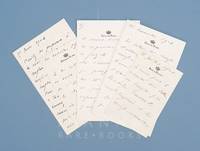
1901réf. 100107AG1901. Laeken / Brussels Château de Laeken Palace of Laeken 1901 - 1906. 16 pages of MLS Manuscript Letters signed on 10 leaves of Leopold's official stationery "Château de Laeken" and "Palais de Bruxelles". The leaves with different sizes 135 cm x 9 cm and 18 cm x 115 cm. Excellent condition. Unsigned. Tremendously rare to find original letters by Leopold II on the open market in which the Colonial Free State and the protection against inquisitive visitors is discussed in such clear and instructive fashion. Leopold's correspondence with Adolphe de Cuvelier shows how he is very much trying to still protect and influence the narrative of his Colonial Slavery Outpost even in the final years of his life. Adolphe de Cuvelier 1860-1931 Secretary General of the Ministry of Foreign Affairs of the Congo Free State President of the Syndicate for Studies and Enterprises in Congo. He was given the title of knight in 1893 and baron in 1908 each transferable at first birth. Wikipedia _______________________________ Leopold II French: Léopold Louis Philippe Marie Victor; 9 April 1835 17 December 1909 was the second King of the Belgians from 1865 to 1909 and through his own efforts the owner and absolute ruler of the Congo Free State from 1885 to 1908. Born in Brussels as the second but eldest surviving son of Leopold I and Louise of Orléans he succeeded his father to the Belgian throne in 1865 and reigned for exactly 44 years until his deaththe longest reign of any Belgian monarch. He died without surviving legitimate sons. The current Belgian king descends from his nephew and successor Albert I. Leopold was the founder and sole owner of the Congo Free State a private project undertaken on his own behalf as a personal union with Belgium. He used Henry Morton Stanley to help him lay claim to the Congo the present-day Democratic Republic of the Congo. At the Berlin Conference of 18841885 the colonial nations of Europe authorized his claim and committed the Congo Free State to him. Leopold ran the Congo using the mercenary Force Publique for his personal gain. He extracted a fortune from the territory initially by the collection of ivory and after a rise in the price of natural rubber in the 1890s by forced labour from the native population to harvest and process rubber. Leopold's administration of the Congo Free State was characterised by atrocities and systematic brutality including torture murder and the amputation of the hands of men women and children when the quota of rubber was not met. In 1890 George Washington Williams used the term "crimes against humanity" to describe the practices of Leopold II of Belgium's administration of the Congo Free State. Colonial accounts typically emphasized Leopold's modernizing changes in the Congo and not the mass death he facilitated. These and other facts were established at the time by eyewitness testimony on-site inspection by an international commission of inquiry and the 1904 Casement Report. Modern estimates range from 1 million to 15 million Congolese deaths with a consensus growing around 10 million. Some historians argue against these figures citing the lack of reliable censuses the enormous mortality caused by smallpox and African trypanosomiasis and the fact that there were only 175 administrative agents in charge of rubber exploitation. In 1908 the reports of deaths and abuse and pressure from the Congo Reform Association and other international groups induced the Belgian government to take over the administration of the Congo from Leopold as a new territory Belgian Congo. Wikipedia unknown
réf. 70298UK: Genesis Publications 1987 1992. Rock SIGNED LIMITED EDITION with RARE RECORD. 2 volumes folio 28 x 20 x 12cm. With additional text by Ringo Starr Elton John Harry Nilsson and Jeff Lynne. Quarto with colour plates and illustrations by Keith West. Photographs by Gered Mankowitz Brian Roylance Richard Young John Carter Terry O'Neill and Astrid Kirchherr. Original black half-morocco boards gilt edges with limited edition 7-inch vinyl record 'Songs' and CD recording 'Songs 2' the whole contained in custom-made clamshell boxes with a card tray. Each limited to 2500 copies being matching nos. 558 both books signed by the former Beatle and the illustrator the first title additionally signed by Beatles drummer Pete Best not called for with a Polaroid of the signing session. Also present is a Christmas card from Genesis Publications signed by founder Brian Roylance plus early flyer of forthcoming publications including an Elton John book and a Duane Eddy set which never went into production. Boxes lightly handled contents fine. The 'Songs' contained within are illustrated by talented New Zealand botanical artist Keith West who impressed Harrison with his wealth of fantastical imagery. The music included here was exclusive to this edition.A very early pop title from Genesis who have published well in excess of 80 music books; preceded only by I Me Mine 1980 Fifty Years Adrift 1984 and Twenty Years Ago Today 1987. Songs contains the more elusive record the majority were CDs; very few records were even made for Songs 2 as vinyl was virtually phased out by then. UK: Genesis Publications, 1987, 1992 unknown
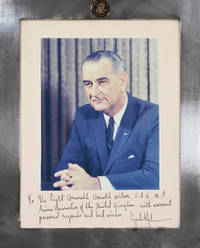
réf. 99853. Inscribed & signed by President Johnson 'To The Right Honorable Harold Wilson O.B.E. M.P. Prime Minister of the United Kingdom with warmest personal regards and best wishes Lyndon B. Johnson signed'. Presented in silver frame bearing the Seal of the President of the United States stamped 'Sterling Hand Made' 270 x 210 mm. An excellent portrait of President Lyndon B. Johnson hands clasped and looking focussed and thoughtful. A unique inscribed photograph thus affectionately presented to then Prime Minister Harold Wilson. Harold Wilson & Lyndon B. Johnson had initially enjoyed a positive relationship during Wilson's first tenure as Prime Minister but the Anglo-American 'special relationship' had been strained to quite some degree by Wilson's refusal to assist America in the Vietnam War. This was largely due to a political lack of will amongst the Labour Party and the British people but also born from the economic difficulties Britain was facing for having maintained a military presence East of Suez. unknown