AUGSBOURG, Géa.Livre Rare Book
10 990 résultats
réf. 121174Genève, Pierre Cailler 1955, 295x205mm, 73pages, broché. En feuille sous couverture à rabats. Exemplaire sur papier Marais à la forme, numéroté n° 80 / 100. Bel exemplaire.
réf. 30348Monte-Carlo André Sauret 1974 in 4 (32,5x25) 1 volume reliure toilée de l'éditeur sous jaquette illustrée en couleurs, rhodoid, 180 pages [2], avec de nombreuses reproductions en noir et blanc, et en couleurs. Répertoire de 148 notices par Fernand Mourlot et Charles Sorlier décrivant les lithographies exécutées par Chagall entre 1969 et 1973. Edition originale. Ouvrage orné 2 lithographies originales en couleurs de Chagall (dont la couverture) tirées sur les presses de Mourlot (with two original colour lithographs). Très bel exemplaire ( Photographies sur demande / We can send pictures of this book on simple request )
1924réf. 55146Lucien Vogel éditeur | Paris 1924-1925 | 18 x 24 cm | une feuille
1922réf. 84846Lucien Vogel éditeur | Paris 1922 | 19 x 24.50 cm | une feuille
réf. 15210Épreuve sur beau papier filigrané. en feuille Très bon Paris 15 x 11 cm
1865réf. 13286Charles Jacque 1813-1894. Eau-forte originale sur Chine appliqué parue chez Delâtre. Encadrée Très bon Paris Delâtre 1865 26 x 23 cm
réf. 19192Le Journal des Dames et es Modes, Costume Parisens., .an 8,Belle épreuve aux coloris très frais, coupée aux limites du cuivre 19 x 12 cm,sur papier vert, doublée et montée sur carton fort,infimes piqûres
réf. 24162Le Journal des Dames et es Modes, Costume Parisens., .an 7,Belle épreuve aux coloris très frais, coupée aux limites du cuivre 19 x 12 cm,sur papier vert, doublée et montée sur carton fort,gravure d'époque.
réf. 24164Le Journal des Dames et es Modes, Costume Parisens., .an 8,Belle épreuve aux coloris très frais, coupée aux limites du cuivre 19 x 12 cm,sur papier vert, doublée et montée sur carton fort,gravure d'époque.
1780réf. 42842[Paris], [Esnauts et Rapilly], sans date, 1780 circa. Gravure en taille-douce (16 x 11,2 cm), encadrée.
1921réf. 54923Lucien Vogel éditeur | Paris 1921 | 18 x 24 cm | une feuille
réf. 14105Pièce encadrée par un professionnel, non décadrée, dimensions à vue au passe-partout : 385 x 265 mm - Cadre moderne noir 560 x 430 mm.Très bon état.
1990réf. 126407Galerie enrico navarra 1990 Livre en anglais, japonais. In-4 broché 29 cm sur 24,8. 132 pages. Bon état d’occasion.
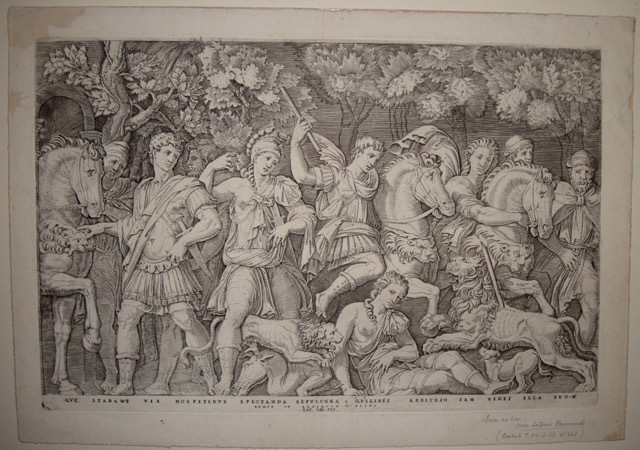
réf. 5618Grandes marges. On lit en bas au milieu : Ant. sal. exc. Bartsch XIV, p.317, 422 En feuille Très bon XVIè 26,7 x 40,9 cm
réf. 15215Épreuve sur beau papier filigrané. en feuille Très bon Paris 14 x 8,5 cm
1860réf. 226281860 imp. Lemercier à Paris imp. Lemercier à Paris (vers 1860) lithographie encadrée sous verre, image 52x 33 cm,tache bas de marge
réf. 45863Paris Librairie Séguier 1989 in 8 (21x16) 1 volume broché, couverture illustrée, 250 pages [2]. Bel exemplaire ( Photographies sur demande / We can send pictures of this book on simple request )
réf. 15198Épreuve sur beau papier filigrané. en feuille Très bon Paris 15 x 11 cm
réf. 25126La Caricature politique, morale, littéraire et scénique, volume 6, 27 décembre 1833 (Planche n°344)Titre en bas au centre : « Chacun son tour en politique. » ; indications : en ht à gche : « La Caricature (Journal) N°164. », en ht à dte : « Pl. 344. » Inscription - Dans la lettre : « Chez Aubert, galerie véro dodat. » [éditeur], « L. de Becquet, rue Furstemberg 6. » [imprimeur] ; dans l’image, en bas à dte, signature : « C. J T. » [Charles-Joseph Traviès, dessinateur]Hauteur: 27.2cm -Largeur: 35.5cmDimensions - ImageHauteur: 15cmLargeur: 29cm - pli central,plis
1990Very large format book in dark blue heavy weave cloth hardback with damage to lower 1/2" of front cover at hinge; scuffing to covers. Book is in excellent condition. Text/interior is clean and free of marking of any kind with huge full page, sometimes dual page prints throughout, at least 75 in number. Dust jacket shows general wear, damage to same lover spine area, chipping at corners.
1990Very large format book in dark blue heavy weave cloth hardback in excellent condition with a few very small, light marks to covers. Text/interior is clean and free of marking of any kind with huge full page, sometimes dual page prints throughout, at least 75 in number. Dust jacket shows light shelf wear only, no tears.
1983Contains Lithography. 32x25 cm. 191 pages. Gilt hardcover with dust jacket. In good condition. PLEASE NOTE: This item is overweight. We may ask for extra shipping costs.
2001Large format book of Yehouda Chaki's works containing 111 pages of full color prints, usually one print per page. With chronology, exhibitions and collections and select bibliography at back. Book is in excellent condition. Binding is solid and square, covers have sharp corners and are creaseless, as is spine, exterior shows light shelf wear only, text/interior is clean and free of marking of any kind.
1924- Lucien Vogel éditeur, Paris 1924-1925, 18x24cm, une feuille. - Original color print, printed on vergé paper, signed in the plate. An original print used to illustrate the Gazette du bon ton, one of the most attractive and influential 20th century fashion magazines, featuring the talents of French artists and other contributors from the burgeoning Art Deco movement. A celebrated fashion magazine established in 1912 by Lucien Vogel, La Gazette du bon ton appeared until 1925, with a hiatus from 1915 to 1920 due to the war (the editor-in-chief having been called up for service). It consisted of 69 issues printed in only 2,000 copies each and notably illustrated with 573 color plates and 148 sketches of the models of the great designers. Right from the start, this sumptuous publication "was aimed at bibliophiles and fashionable society," (Françoise Tétart-Vittu, "La Gazette du bon ton", in Dictionnaire de la mode, 2016) and was printed on fine vergé paper using a type cut specially for the magazine by Georges Peignot, known as Cochin, later used (in 1946) by Christian Dior. The prints were made using stencils, heightened in colors, some highlighted in gold or palladium. The story began in 1912, when Lucien Vogel, a man of the world involved in fashion (he had already been part of the fashion magazine Femina) decided, with his wife Cosette de Brunhoff - the sister of Jean, creator of Babar - to set up the Gazette du bon ton, subtitled at the time: "Art, fashion, frivolities." Georges Charensol noted the reasoning of the editor-in-chief: "'In 1910,' he observed, 'there was no really artistic fashion magazine, nothing representative of the spirit of the time. My dream was therefore to make a luxury magazine with truly modern artists...I was assured of success, because when it comes to fashion, no country on earth can compete with France.'" ("Un grand éditeur d'art. Lucien Vogel" in Les Nouvelles littéraires, no. 133, May 1925). The magazine was immediately successful, not only in France but also in the United States and Latin America. At first, Vogel put together a team of seven artists: André-Édouard Marty and Pierre Brissaud, followed by Georges Lepape and Dammicourt, as well as eventually his friends from school and the School of Fine Arts, like George Barbier, Bernard Boutet de Monvel and Charles Martin. Other talented people soon came flocking to join the team: Guy Arnoux, Léon Bakst, Benito, Boutet de Monvel, Umberto Brunelleschi, Chas Laborde, Jean-Gabriel Domergue, Raoul Dufy, Édouard Halouze, Alexandre Iacovleff, Jean Émile Laboureur, Charles Loupot, Chalres Martin, Maggie Salcedo. These artist, mostly unknown when Lucien Vogel sought them out, later became emblematic and sought-after artistic figures. It was also they who worked on the advertising drawings for the Gazette. The plates put the spotlight on, and celebrate, dresses by seven designers of the age: Lanvin, Doeuillet, Paquin, Poiret, Worth, Vionnet and Doucet. The designers provided exclusive models for each issue. Nonetheless, some of the illustrations are not based on real models, but simply on the illustrator's conception of the fashion of the day. The Gazette du bon ton was an important step in the history of fashion. Combining aesthetic demands with the physical whole, it brought together - for the first time - the great talents of the artistic, literary, and fashion worlds; and imposed, through this alchemy, a completely new image of women: slender, independent and daring, which was shared by the new generation of designers, including Coco Chanel, Jean Patou, Marcel Rochas, and so on... Taken over in 1920 by Condé Montrose Nast, the Gazette du bon ton was an important influence on the new layout and aesthetics of that "little dying paper" that Nast had bought a few years earlier: Vogue. [FRENCH VERSION FOLLOWS] Estampe originale en couleur, tirée sur papier vergé, signée en bas à droite de la planche. Gravure originale réalisée pour l'illu